4000K vs 5000K for Warehouse Lighting: Productivity & Safety

Table of Contents
The Science of Light: What is Color Temperature?
Deep Dive: Defining the Contenders
4000K vs 5000K: The Critical Comparison
The Full Spectrum: 3000K vs 4000K vs 5000K vs 6000K
Application Guide: Best Color Temperature by Industry
How to Choose the Right Color Temperature (Step-by-Step)
Common Myths About LED Color Temperatures
FAQ (Frequently Asked Questions)
Introduction
Choosing the right LED color temperature is one of the most critical decisions a facility manager makes—yet it is often overlooked. In industrial environments, lighting isn't just about illumination; it directly impacts worker safety, error rates in picking/packing, and overall energy levels. The debate usually comes down to two main contenders: 4000K vs 5000K.
So, which one is right for your facility?
The Direct Answer:
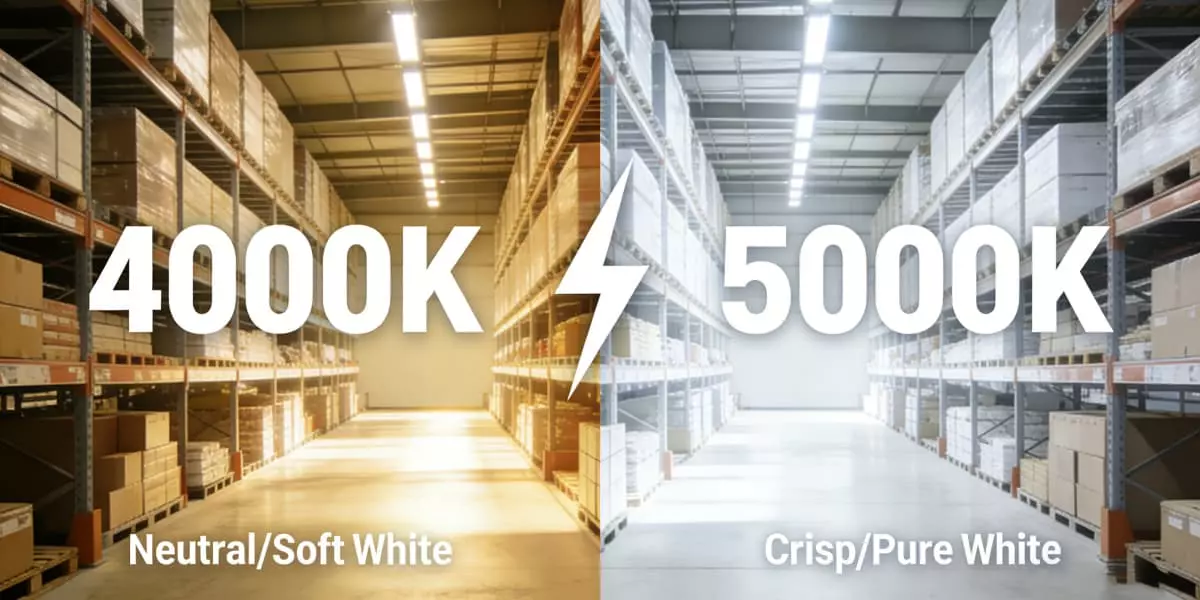
For most industrial applications, 5000K (Daylight) is the preferred standard for high bay lighting (ceilings over 20 feet) and precision manufacturing, as it maximizes contrast and alertness. 4000K (Cool White) is better suited for lower ceilings (under 15 feet), packing stations, or areas where glare reduction and eye comfort are prioritized over raw visual acuity.
However, one size does not fit all. While 4000K and 5000K are the industry workhorses, other options like 3000K (for specialized warm atmospheres) and 6000K (for clinical precision) play specific roles. Although some manufacturers offer "tunable" (CCT adjustable) lights, most enterprise facilities still prefer the reliability and consistency of fixed CCT fixtures to ensure a uniform working environment.
In this guide, we will break down the science, the biological impact on your workers, and the specific use cases for each color temperature to help you make the right investment.
The Science of Light: What is Color Temperature?
To understand which light is best for your warehouse, we first need to decode the technical jargon.
Understanding the Kelvin Scale (K)
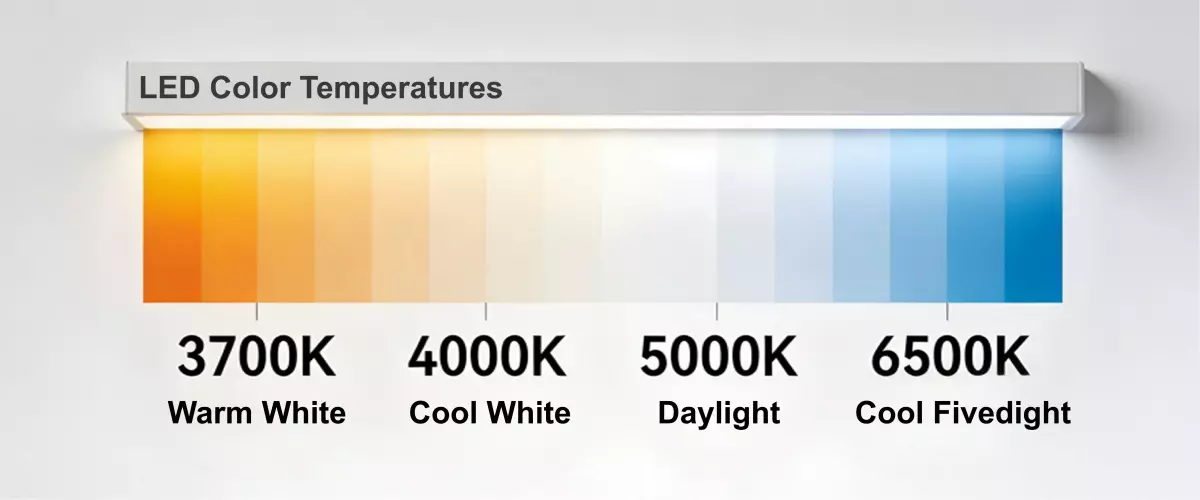
Color temperature is measured in Kelvin (K). It describes the appearance of the light emitted by a bulb.
l Lower Kelvin numbers (e.g., 3000K) produce a "warm," yellowish light, similar to sunset or traditional incandescent bulbs.
l Higher Kelvin numbers (e.g., 5000K - 6000K) produce a "cool," bluish-white light, simulating daylight or an overcast sky.

CT vs. CCT: What’s the Technical Difference?
You might see terms like CT and CCT used interchangeably, but there is a scientific distinction:
l CT (Color Temperature): This refers to heat-radiated light sources (like the filament in an old incandescent bulb). When heated, the metal glows red, then yellow, then white.
l CCT (Correlated Color Temperature): Since LEDs don't use heat to produce light, they don't have a "true" color temperature. Instead, we use CCT to describe how the LED's light color correlates to that heated metal reference.
Practical Takeaway: In the LED industry, when we say "Color Temperature," we are technically referring to CCT.
Light Color vs. Color Temperature
It is important to distinguish between the specification (Color Temperature) and the visual result (Light Color).
l Color Temperature is the number (e.g., 5000K).
l Light Color is how that number feels to the human eye (e.g., "Daylight").
Note: Two lights can have the same Color Temperature (e.g., 5000K) but look slightly different if their "tint" varies (greenish or pinkish). High-quality LEDs are strictly binned to ensure the light color is consistent across all fixtures.
Don’t Confuse CCT with CRI
This is the most common mistake buyers make.
l CCT (Color Temperature) determines the color of the light (Yellow vs. White vs. Blue).
l CRI (Color Rendering Index) determines the clarity and accuracy of colors under that light.
For example, a 5000K light with a low CRI might make orange safety vests look muddy or dull. For industrial safety, we recommend a CRI of at least 70 or 80 to ensure warning labels and wiring colors are distinct.
Deep Dive: Defining the Contenders
Before we declare a winner, it is essential to understand the distinct personality of each color temperature. While they may look similar on a spec sheet, the visual experience in a large-scale facility is vastly different.
What is 4000K? (The Neutral Standard)
Often labeled as "Cool White" or "Neutral White," 4000K is the transition point between warm and cool lighting. It emits a clean, white light that retains a hint of warmth, eliminating the clinical or sterile feel associated with higher color temperatures.
Ø Visual Experience: Think of natural sunlight in the mid-morning (around 10:00 AM).
Ø Key Characteristic: It offers excellent color balance. It is bright enough to be functional but soft enough to be comfortable for 8-hour shifts. 4000K is often described as "easy on the eyes," making it a top choice for environments where workers are stationed in one spot for long periods, such as packing benches or assembly lines.
What is 5000K? (The Precision Standard)
5000K is widely known as "Daylight." As the name suggests, it is designed to mimic the sun at its peak intensity (noon). It has a higher blue light content, which gives the light a crisp, icy-white appearance.
Ø Visual Experience: Think of bright, direct sunlight on a cloudless day at noon.
Ø Key Characteristic: It prioritizes acuity. Under 5000K lighting, details "pop" more aggressively. The light appears whiter and slightly brighter to the human eye than 4000K, even if the lumen output is identical. This makes it the go-to specification for areas requiring high concentration and meticulous detail.
4000K vs 5000K: The Critical Comparison
Now for the decision-making data. We have analyzed these color temperatures across three scientific dimensions that directly impact warehouse operations.

1. Contrast & Visual Clarity
Winner: 5000K
In B2B logistics, accuracy is currency. 5000K lighting provides superior contrast, particularly for black text on white backgrounds—the exact format of shipping labels, barcodes, and inventory checklists. The higher concentration of blue light in the 5000K spectrum stimulates the eye’s photoreceptors to perceive the environment as "sharper."
According to guidelines from the IES (Illuminating Engineering Society), higher visual tasks require higher contrast levels. If your facility involves reading small part numbers or operating high-speed forklifts, 5000K helps workers distinguish objects faster, reducing picking errors.
2. Glare & Eye Fatigue
Winner: 4000K
Brighter isn't always better. While 5000K offers clarity, its intensity can be harsh if not managed correctly. In facilities with lower ceilings (under 15-20 feet), high-intensity 5000K LED chips can cause significant glare, leading to "visual noise" and eye strain over a long shift.
OSHA standards emphasize the importance of a safe working environment free from recognized hazards—and blinding glare is a safety hazard for forklift operators looking up at racks. 4000K is naturally softer and diffuses more gently, making it the superior choice for low-bay applications or areas where reflective surfaces (like shrink wrap) might exacerbate glare.
3. Biological Impact (Melatonin & Alertness)
Winner: 5000K
Lighting does more than help us see; it tells our bodies when to be awake. This is where the blue light spectrum of 5000K provides a functional advantage. Scientific studies show that light in the 5000K-6500K range suppresses the production of melatonin (the sleep hormone).
For warehouses operating 24/7 or employing night shifts, installing 5000K fixtures is a strategic productivity move. It acts as a "biological caffeine," helping workers maintain alertness and focus during the graveyard shift, potentially reducing fatigue-related accidents. Conversely, 4000K has less of this suppressive effect, creating a more relaxed atmosphere.
The Full Spectrum: 3000K vs 4000K vs 5000K vs 6000K
While 4000K and 5000K dominate the industrial landscape, understanding the full Kelvin spectrum helps ensure you don't use the wrong light in a specialized zone. 3000K might be too sleepy for a forklift lane, while 6000K might be too harsh for a packaging desk.
Here is a quick breakdown of where each color temperature fits in an industrial context:
Kelvin | Appearance | Best Industrial Use | Pros & Cons |
3000K | Warm White | Breakrooms, Reception, Wood/Furniture Warehouses. | Pros: Inviting atmosphere. Enhances wood grain. Cons: Too relaxing; reduces contrast and alertness. |
4000K | Cool White | General Warehousing, Packing Stations, Low Ceilings (<15ft). | Pros: Excellent visual comfort; low glare. Cons: Less contrast than 5000K. |
5000K | Daylight | High Bay Warehousing (>20ft), Manufacturing, Cold Storage. | Pros: Max alertness; crisp "white" look. Cons: Can cause glare if installed too low. |
6000K | Cool Daylight | Jewelry Inspection, Precision Electronics Assembly. | Pros: "Clinical" precision. Cons: Can look blue/sterile. Prolonged exposure may cause faster eye fatigue. |
Application Guide: Best Color Temperature by Industry
One facility often requires multiple color temperatures. For example, a logistics center might need high-contrast light in the racking aisles but softer light in the shipping office.
Use this guide to match your specific facility type to the industry standard:
Facility Type | Recommended CCT | The "Why" |
General Warehouse | 4000K – 5000K | 5000K for high racks; 4000K for open floor stacking. |
Manufacturing / Machine Shops | 5000K | Critical for seeing fine details on metal parts and reading gauges. |
Cold Storage | 5000K | Crisp white light makes the facility look cleaner and more hygienic. |
Packing & QC Areas | 4000K | Reduced glare is vital here, as workers inspect goods at close range. |
Loading Docks | 4000K – 5000K | Acts as a transition zone between outdoor daylight and indoor lighting. |

How to Choose the Right Color Temperature (Step-by-Step)
Still unsure? Follow this 4-step checklist to finalize your decision.
Step 1: Check Your Ceiling Height
This is the most practical filter.
Above 20 feet (High Bay): Go with 5000K. The light disperses as it travels down, so you need the intensity and "crispness" of 5000K to ensure visibility at floor level.
低于 15 英尺(低矮棚):选择 4000K 色温。在这个高度,5000K 色温可能会感觉过曝,并产生令人不适的热点。
步骤二:分析任务
详细组装/阅读:如果工人要阅读标签上的 8 号字体或组装小型电路,请选择 5000K 对比度。
大宗搬运:如果工作涉及搬运托盘和大箱子,4000K 可提供足够的视野,同时带来更好的舒适度。
步骤三:考虑墙面颜色
深色墙壁/地板:它们会吸收光线。使用 5000K 的色温可以改善昏暗的氛围。
白色/浅色墙面:这类墙面会反射光线。4000K 的色温通常足以达到高亮度,而不会造成反射眩光。
第四步:样品测试
照明设计具有主观性。在订购 500 盏灯具之前,最好先购买每种灯具的样品。在实际项目中,我们经常会遇到不同高度的区域,这些区域需要选择不同的色温。
这就是 Ceramiclite HB01 高棚系列的原因 提供全面的定制选项(色温 3000K–6000K,显色指数 70/80)。如果您的设施有特殊要求,我们可以帮助您为每个区域配置所需的具体规格,而不是强行采用“一刀切”的解决方案。
关于LED色温的常见误区
升级到LED照明时,错误信息可能会导致代价高昂的错误。让我们来澄清业内最常见的四个误解。
误区一:开尔文值越高,光线越亮。
事实:这是错误的。亮度单位是 流明,而不是开尔文。5000K 和 4000K 的灯具,如果流明输出相同,则发出的光量也相同。然而,由于 5000K 的对比度更高,且含有更多蓝光,因此人眼通常会感觉更亮。
误区二:所有LED灯都冷冰冰的,缺乏吸引力。
事实:虽然早期的LED灯光线刺眼,但如今的技术已经非常灵活。无论是用3000K的LED灯营造温暖舒适的氛围,还是用5000K的LED灯营造明亮的日光,都能轻松实现。“冷色调”是一种选择,而非限制。
误区三:色温不能混合。
实际情况:虽然统一的色温通常是好事,但有意地混合使用不同的色温对于区域划分也十分有效。例如,为了安全起见,在繁忙的仓库区域使用 5000K 的色温,而在经理的玻璃办公室则使用 4000K 的色温,这样就能形成必要的视觉边界。
误区四:色温越高,能耗越大。
事实:能耗(瓦数)取决于LED驱动器和芯片的效率,而非颜色。同型号的5000K灯和4000K灯消耗的电量完全相同。
常见问题解答
5000K 比 4000K 更亮吗?
严格来说,并非如此。如果流明输出相同,亮度也相同。然而,5000K 提供更高的对比度(感知亮度),使人眼感觉画面更锐利、更明亮。
4000K 和 5000K:哪个对眼睛更好?
这取决于使用时间和天花板高度。一般来说,4000K 更适合长时间使用,尤其是在天花板较低的情况下,能更好地保护眼睛,减少眼部疲劳。5000K 则更适合需要快速看清细节的短时视觉任务。
5000K色温的灯更耗电吗?
不。色温并不影响功耗。一盏150瓦的高棚灯,无论色温是4000K还是5000K,功耗都是150瓦。
5000K 的色温对于仓库来说太白了吗?
对于高棚灯来说并非如此。对于超过 20 英尺(约 6 米)高的天花板,5000K 的色温非常理想,因为光线在到达地面之前就已经扩散开来。然而,对于较低的天花板(低于 15 英尺,约 4.5 米),5000K 的色温可能会显得刺眼且缺乏生气。
高棚照明的最佳色温是多少?
目前高棚照明的行业标准是 5000K。这种色温能够兼顾大型开放空间的视觉清晰度、警觉性和安全性。
结论
在4000K 与 5000K的争论中 ,没有绝对的赢家——只有适合这项工作的工具。
Ø 选择 5000K 色温,适用于高天花板、精确任务和最大限度保持警觉的情况。
Ø 对于天花板较低的场所、包装站和一般视觉舒适度,请选择 4000K。
不要让您设施的安全性和生产力取决于猜测。无论您需要为特定区域提供 3000K 的温暖色调,还是标准的 4000K/5000K 色温,亦或是 6000K 的精准度,Ceramiclite都能 提供完全定制的解决方案(可选 CRI 70/80),以满足您的具体需求。
还有疑问?请立即 联系我们。 购买前,我们提供详细的咨询服务,帮助您了解不同色温在您的空间中实际呈现的效果。