_thumb.jpg)
Quelle est la durée de vie des ampoules LED ? Usage industriel ou résidentiel ?
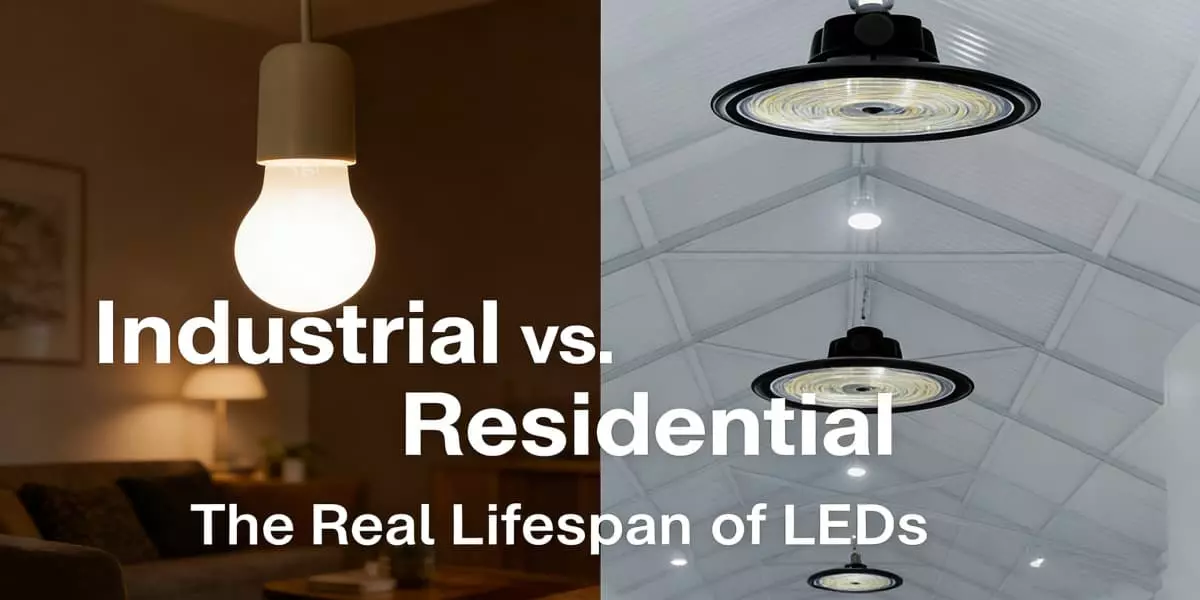
Si vous vous demandez combien de temps durent les ampoules LED , la réponse dépend entièrement de ce que vous achetez.
Voici la réponse courte :
Ø LED résidentielles (usage domestique) : Généralement de 15 000 à 25 000 heures (environ 15 ans en utilisation normale).
Ø LED industrielles/commerciales : Durée de vie typique de 51 000 à plus de 102 000 heures (environ 10 à 20 ans en utilisation intensive continue).
Pour un particulier, une ampoule grillée est un désagrément mineur. Mais pour un gestionnaire d'installations (stade, usine, élevage), la durée de vie des équipements est un enjeu financier crucial. Une panne d'éclairage ne se limite pas au coût du matériel : elle représente des milliers d'euros dépensés en location de nacelles, en main-d'œuvre et en interruption d'activité.
Cet article explore la réalité de la durée de vie des LED, en révélant les facteurs cachés qui distinguent une ampoule bon marché d'une ampoule industrielle ultra-performante.
Table des matières
Durée de vie moyenne des lampes LED (tableau comparatif)
Que signifie réellement le terme « durée de vie » ?
9 facteurs critiques qui déterminent la durée de vie des LED
Pourquoi les luminaires industriels durent-ils plus longtemps que les ampoules résidentielles ?
Comment optimiser votre investissement en éclairage ?
L'avantage Ceramiclite : une durabilité grâce à la technologie FTC
Durée de vie moyenne des lampes LED (tableau comparatif)
Les LED sont conçues différemment . Bien que cette technologie soit supérieure à l'éclairage traditionnel, l'écart entre les produits grand public et les produits industriels est considérable.
Voici comment se présentent les chiffres :
Source lumineuse | Durée de vie moyenne (Heures) | Durée de vie estimée en années (à raison de 10 heures par jour) |
ampoule incandescente | ~1 000 | < 1 an |
CFL (fluorescent) | ~8 000 | ~2 ans |
Ampoule LED résidentielle | 15 000 – 25 000 | 4 à 7 ans |
LED intégrée industrielle | 51 000 – 102 000+ | 14 à 28 ans et plus |
La variable cachée : l'utilisation quotidienne
Ne vous laissez pas tromper par la mention « années » sur un boîtier résidentiel. Les fabricants calculent souvent une durée de vie de « 20 ans » sur la base de 3 heures d’utilisation par jour .
Dans un contexte commercial, comme une usine fonctionnant 24 h/24 et 7 j/7 ou un élevage de volailles, une ampoule résidentielle « durée de vie de 20 ans » peut tomber en panne en moins de deux ans. Les luminaires industriels sont conçus pour résister aux contraintes d'une utilisation intensive pendant de longues heures sans se dégrader.
Actuellement, la spécification courante pour les luminaires disponibles sur le marché est de 51 000H (L70B50@25°C) .
La norme XH L70B50 est une mesure de durée de vie nominale largement adoptée dans l'industrie de l'éclairage LED (recommandée par l'Illuminating Engineering Society, IES). Sa définition est la suivante : la durée de vie nominale du luminaire est de X heures. À la fin de cette période de fonctionnement, le flux lumineux du luminaire est maintenu à 70 % de son niveau initial (ce qui correspond à une diminution de 30 % de la luminosité). Statistiquement, 50 % des luminaires d'un même lot de production respectent cette norme de maintien du flux lumineux.
Ici, « L » signifie maintien du flux lumineux, « 70 » fait référence à la valeur de référence du flux lumineux initial de 70 %, « B » représente le lot de production ou le groupe d'échantillons, et « 50 » indique que 50 % des luminaires peuvent satisfaire à l'exigence de décroissance lumineuse susmentionnée.
Comparée à la définition de la durée de vie des sources lumineuses traditionnelles (où celle-ci est déterminée par l'arrêt complet de l'émission de lumière), cette norme correspond mieux aux caractéristiques lumineuses des LED. Les LED ne comportent pas de composants fragiles tels que des filaments et subissent donc rarement de défaillances soudaines. Leurs performances se dégradent plutôt progressivement par une décroissance lumineuse graduelle.
C’est pourquoi la norme L70B50, axée sur le maintien du flux lumineux, permet une évaluation plus scientifique et précise de la stabilité à long terme des luminaires LED. Elle est particulièrement adaptée aux applications exigeant une continuité d’éclairage et une stabilité de la luminosité élevées, comme les installations sportives, les ateliers industriels et les élevages.
Que signifie réellement le terme « durée de vie » ?
Contrairement aux ampoules à incandescence, les LED grillent rarement instantanément (une « panne catastrophique »). Au contraire, leur luminosité diminue progressivement avec le temps. Ce processus est appelé dépréciation du flux lumineux .
Pour comprendre les fiches techniques, il faut connaître les codes de l'industrie :
1. La norme L70 (la référence)
L70 correspond au point où le flux lumineux a chuté à 70 % de sa luminosité initiale. L'œil humain perçoit à peine une baisse de 30 %, c'est pourquoi l'industrie considère ce stade comme la fin de vie de la lampe.
Exemple : Si une lampe est homologuée pour 50 000 heures (L70) , cela signifie qu'après 50 000 heures, elle produira encore 70 % de sa lumière.
2. Les normes haut de gamme : L80 et L90
Pour les environnements de précision, comme les arènes sportives professionnelles ou les élevages de volailles où l'intensité lumineuse affecte directement la production, L70 n'est pas suffisant.
L80 : La lampe conserve 80 % de sa luminosité à la fin de sa durée de vie nominale.
L90 : La lumière conserve 90 % de sa luminosité. Il s’agit de la référence en matière d’éclairage haute performance.
3. Le « piège thermique » (Lisez les petits caractères !)
C’est là que la plupart des acheteurs se font avoir. La plupart des durées de vie indiquées (par exemple, 51 000 h L70B50) sont testées en laboratoire à 25 °C (77 °F) .
Mais que se passe-t-il si vos luminaires sont installés dans une usine métallique à grande hauteur où la température du plafond atteint 45 °C (113 °F) ?
Une LED standard testée à 25 °C tombera en panne beaucoup plus rapidement dans un environnement à 45 °C.
Les véritables équipements industriels sont testés et évalués à des températures ambiantes plus élevées (35 °C à 45 °C) afin de garantir que les affirmations concernant la durée de vie se vérifient dans le monde réel.
9 facteurs critiques qui déterminent la durée de vie des LED
Pourquoi un luminaire dure-t-il une décennie alors qu'un autre tombe en panne en six mois ? Cela se résume généralement à ces neuf variables : ( 1 ) Qualité de la puce, (2) Chaleur, (3) Humidité, (4) UV, (5) Courant, (6) Pilote, (7) Matériaux, (8) Environnement, (9) Commutation.
( 1 ) Qualité de la puce LED (Le cœur)
Les puces de mauvaise qualité subissent une dégradation lumineuse rapide. Bien qu'elles puissent initialement briller, leur intensité diminue rapidement. Les puces de haute qualité conservent leur stabilité pendant des milliers d'heures.
( 2 ) Température (Le tueur)
La chaleur est le principal ennemi des composants électroniques. Une mauvaise dissipation thermique entraîne une hausse de la température interne, endommageant la jonction PN et réduisant ainsi la puissance de sortie.
( 3 ) Humidité et étanchéité
Dans les environnements humides (comme les élevages de volailles ou en extérieur), les infiltrations d'humidité peuvent provoquer des courts-circuits ou de la corrosion. Une étanchéité parfaite est donc indispensable.
( 4 ) Rayonnement UV
Pour les projecteurs de stades extérieurs, une exposition prolongée au soleil peut jaunir et fragiliser les lentilles en plastique bon marché, ruinant ainsi la qualité de la lumière et l'intégrité du boîtier.
( 5 ) Stabilité du courant
Les fluctuations du courant électrique sollicitent les composants des LED. Un courant constant et stable est nécessaire pour assurer leur longévité.
( 6 ) Qualité de l'alimentation (Le pilote)
C'est souvent le circuit de commande qui tombe en panne en premier, et non la LED elle-même. Les alimentations bon marché sont dépourvues de mécanismes de protection (surcharge/court-circuit), ce qui rend l'ensemble du dispositif inutilisable en cas de fluctuation du réseau électrique.
( 7 ) Qualité des matériaux
Le plastique retient la chaleur ; le métal la dissipe. Les luminaires en alliages d’aluminium ou en céramique technique offrent une durabilité nettement supérieure à celle des boîtiers en plastique.
( 8 ) Environnements difficiles
La poussière, les brouillards d'huile (dans les usines) ou l'ammoniac (dans les élevages) peuvent dégrader les installations standard. Des revêtements spéciaux et une protection contre les infiltrations sont nécessaires.
( 9 ) Fréquence de commutation
Bien que supérieures aux lampes fluocompactes, les LED standard subissent des cycles d'allumage et d'extinction fréquents qui peuvent tout de même solliciter excessivement leurs composants électroniques. Les modèles industriels sont conçus pour mieux résister à ces contraintes.
Pourquoi les luminaires industriels durent-ils plus longtemps que les ampoules résidentielles ?
Les LED industrielles sont conçues pour durer, et pas seulement pour éclairer. La différence réside dans le matériel, les matériaux et les normes de test rigoureuses.
Le fossé matériel : une comparaison
Fonctionnalité | LED résidentielle/standard | LED de qualité industrielle |
Conception thermique | Plastique ou aluminium fin ; refroidissement passif. | Aluminium moulé sous pression + ailettes ou caloducs ; conductivité thermique élevée. |
Qualité du conducteur | Rendement de 80 à 85 % ; conception de base. | >90 % d'efficacité ; large plage de tension (100-277 V) ; protection contre les surtensions. |
Type de puce | Puces de milieu de gamme (par exemple, 2835). | COB à haut rendement ou Flip-chip (par exemple, Lumileds, CREE). |
Protection | IP20 - IP40 (poussière uniquement). | IP65 - IP66 (Résistant à l'eau, à la poussière et à l'ammoniac). |
Température de fonctionnement | -20°C à +40°C. | -50°C à +75°C (Conçu pour les conditions extrêmes). |
Pourquoi « intégré » est meilleur que « ampoule »
Dans les habitations, on visse une ampoule dans une douille. Cela limite la surface disponible pour le refroidissement.
Dans les luminaires industriels intégrés (comme les luminaires industriels), le corps entier du luminaire sert de dissipateur thermique. Les LED sont directement collées au boîtier métallique, ce qui permet une évacuation optimale de la chaleur. Cette conception explique principalement pourquoi les luminaires commerciaux intégrés peuvent fonctionner pendant plus de 100 000 heures, alors que les ampoules peinent à atteindre 25 000 heures.
Comment optimiser votre investissement en éclairage ?
Prolonger la durée de vie de votre système d'éclairage commence par le choix et se poursuit par l'entretien.
Conseils pratiques pour les installations industrielles et commerciales
Priorisez la gestion thermique : choisissez toujours des luminaires avec dissipateurs thermiques en aluminium moulé sous pression (épaisseur > 4 mm) ou caloducs en cuivre. N’installez pas de luminaires industriels standard dans des ateliers à haute température sans avoir vérifié leurs caractéristiques.
L’ espacement est important : évitez les points chauds. Assurez-vous que l’espacement d’installation est au moins 1,5 fois la largeur du corps du luminaire et gardez les voies de ventilation dégagées.
Programme de nettoyage : La poussière agit comme une couche isolante qui emprisonne la chaleur. Dans les usines poussiéreuses, nettoyez les dissipateurs thermiques tous les mois. Dans les entrepôts plus propres, un nettoyage trimestriel est suffisant.
ü Protection contre les surtensions : Sélectionnez des drivers avec une large plage de tension d'entrée (90-305 V CA) et une protection standard contre les surtensions TVS (jusqu'à 20 kV) pour vous protéger contre les pics de tension du réseau.
ü Gradation intelligente : L’utilisation d’un système comme Philips CityTouch ou d’une gradation programmée pour réduire la consommation d’énergie de 50 % pendant les heures creuses (minuit) peut prolonger la durée de vie du luminaire jusqu’à 2,3 fois.
Conseils pratiques pour une utilisation résidentielle
ü Évitez les luminaires fermés : n’utilisez pas d’ampoules standard dans des globes en verre entièrement scellés ; la chaleur n’a nulle part où s’échapper.
Nettoyage : Utilisez une brosse douce et sèche pour enlever la poussière tous les six mois. Ne jamais laver à l'eau.
ü Clignotement ? Si une ampoule clignote ou si sa luminosité diminue de plus de 30 %, remplacez -la immédiatement pour éviter tout risque de panne du circuit.
L'avantage Ceramiclite : une durabilité grâce à la technologie FTC
Les LED industrielles standard utilisent généralement de la poudre de phosphore mélangée à du silicone. Avec le temps, la chaleur provoque la carbonisation du silicone et la dégradation du phosphore, ce qui entraîne des variations de couleur et une baisse rapide de l'intensité lumineuse.
CeramicliteNous adoptons une approche différente. Nous utilisons la technologie FTC (Fluorescent Transparent Ceramic) , une plaque de phosphore à l'état solide qui remplace le mélange de silicone traditionnel. Cette innovation offre une stabilité thermique exceptionnelle et empêche le jaunissement fréquent des LED standard.
Au-delà de la puce, notre science des matériaux est conçue pour une durabilité extrême :
Ø Refroidissement amélioré au graphène : Nos luminaires High Bay intègrent des matériaux en graphène dans le boîtier, augmentant considérablement la conductivité thermique pour une dissipation de chaleur plus rapide.
Ø Protection contre la corrosion : Grâce à des connecteurs en nylon et à des traitements anticorrosion de classe C4, nos luminaires sont conçus pour résister à l'exposition chimique qui détruit les lampes ordinaires.
Les données : Performances éprouvées dans des conditions difficiles
Alors que les concurrents effectuent leurs tests à température ambiante (25 °C), les évaluations de Ceramiclite reflètent la réalité.
² Éclairage sportif (stades et terrains) :
51 000 heures (L90B30 à 45 °C)
102 000 heures (L80B10 à 45 °C)
Pourquoi c'est important : Conçu spécifiquement pour les environnements à haute température. Bénéficie d'indices de protection IP/IK élevés et d'une résistance à la corrosion C4 pour résister aux intempéries.
² Éclairage pour volailles et bétail :
102 000 heures (L80B10 à 35 °C)
Pourquoi c'est important : Conçu avec des indices de protection IP67/IP69K et IK06 pour résister au gaz ammoniac, aux lavages à haute pression et aux environnements agricoles corrosifs.
² Ampoules LED pour volailles :
70 000 heures (L90B20 à 35 °C)
² Éclairage LED industriel :
102 000 heures (L80B10 à 35 °C)
Pourquoi c'est important : Boîtier renforcé au graphène pour un refroidissement supérieur, et protection IP67/IP69K et IK08 contre la poussière industrielle et les chocs.
Résultat : Une véritable solution « Installez et oubliez » pour les environnements à haut risque où la maintenance est coûteuse et difficile.
Conclusion
Lorsqu'on se demande combien de temps durent les ampoules LED , la réponse se résume finalement au retour sur investissement.
Vous pouvez acheter un luminaire standard d'une durée de vie de 3 ans, ou investir dans une solution conçue pour fonctionner pendant plus de 15 ans. Pour les gestionnaires d'installations, l'éclairage « moins cher » s'avère souvent l'option la plus coûteuse une fois pris en compte la main-d'œuvre pour son remplacement, la location de la nacelle et les temps d'arrêt.
Ne laissez pas la maintenance de votre éclairage grever votre budget. Optez pour une durabilité prouvée par des données.
Prêt à moderniser vos installations ?
Découvrez dès aujourd'hui la gamme de solutions d'éclairage Ceramiclite alimentées par la technologie FTC et assurez une fiabilité à long terme à votre entreprise.