ETL Certification vs. UL: Complete Safety Guide for Lighting

etl-certification-for-lighting-safety-guide


Table of Contents

Introduction

What is ETL Certification? (Meaning & Authority)

ETL vs. UL Certification: What’s the Real Difference?

Key Testing Requirements for ETL Certified LED Fixtures

Is ETL Certification Accepted in the US and Canada?

Why ETL Matters Specifically for Specialized Lighting?

How to Verify an ETL Certificate?

Conclusion

Frequently Asked Questions (FAQ)


Introduction

Navigating the world of safety certifications can be confusing. When sourcing lighting for industrial facilities, livestock farms, or sports arenas, you will often encounter two dominant marks: UL and ETL.


A common question we hear from our clients is: "Is ETL certification as good as UL? Will my project pass inspection with ETL-listed fixtures?"


The short answer is: Yes.


As a professional lighting manufacturer that holds both UL and ETL certifications across our various product lines, Ceramiclite is in a unique position to give you the unbiased truth. We don't prefer one over the other based on myths; we choose the right certification pathway to bring high-quality, compliant products to market efficiently.


In this guide, we will strip away the jargon and explain what ETL certification actually means, the rigorous testing behind the mark, and why it is legally and technically equivalent to UL for your next project.


What is ETL Certification? (Meaning & Authority)

Before we compare it to others, let's define what the mark on your light fixture actually stands for.


The Definition

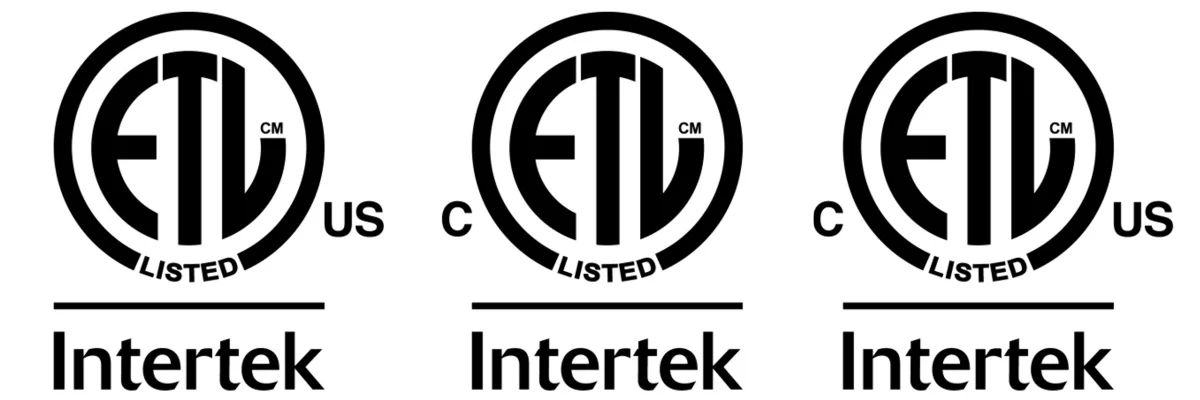
ETL stands for Electrical Testing Laboratories. The mark is proof that a product has been tested by Intertek, a global leader in Total Quality Assurance, and meets all applicable North American safety standards.


The "Edison" Connection

Contrary to the belief that ETL is a "new" or "lesser" player, it has a history that rivals any organization. ETL was founded in 1896 by Thomas Edison to ensure the performance and safety of his invention—the light bulb. When you trust the ETL mark, you are trusting a legacy of safety that spans over a century.


The Most Important Concept: NRTL

To understand why ETL is accepted by inspectors across the US and Canada, you need to understand one acronym: NRTL (Nationally Recognized Testing Laboratory).


The Occupational Safety and Health Administration (OSHA) recognizes private organizations to test products for workplace safety. These organizations are called NRTLs.


Ø Is UL an NRTL? Yes.

Ø Is Intertek (ETL) an NRTL? Yes.


What This Means for You:
Under US Federal Law (29 CFR 1910.7), certifications from any OSHA-recognized NRTL carry the exact same legal authority. Whether the sticker says UL or ETL, it signifies that the fixture has passed the 
same safety tests (such as UL 1598 for luminaires) and is safe for installation.


ETL vs. UL Certification: Whats the Real Difference?

If you search online, you might find forums debating whether one is "better" than the other. Let’s separate the myths from the manufacturing reality.


The Common Myth

Many people assume that UL (Underwriters Laboratories) is the "Gold Standard" and ETL is a "Silver Standard" or a generic knock-off. This is a misconception rooted in brand awareness, not technical fact. UL has simply been around longer in the consumer consciousness.


The Technical Truth

Here is the reality that every lighting engineer knows: The standards are identical.


When Intertek (ETL) tests a Ceramiclite LED High Bay, they do not use an "ETL standard." They use the 
exact same ANSI/UL standards that UL uses.


Ø For general luminaires, both use UL 1598.

Ø For LED equipment, both use UL 8750.

Ø For hazardous locations, both use UL 844.


The only difference is the laboratory conducting the test, not the difficulty of the test itself.


Comparison Table: ETL vs. UL

To give you a clear picture, we have compared the two NRTLs side-by-side:

Feature

UL

(Underwriters Laboratories)

ETL (Intertek)

Testing Standards

Uses UL Standards (e.g., UL 1598)

Uses UL Standards (e.g., UL 1598)

NRTL Status

OSHA Recognized

OSHA Recognized

Accepted in North America

Yes (US & Canada)

Yes (US & Canada)

Legal Validity

100%

100%

Certification Speed

Generally Slower (Can take months)

Faster (Optimized for speed)

Cost to Manufacturer

Higher (Premium brand fees)

More Cost-Effective


Why Do Manufacturers Choose ETL? (And Why It Benefits You)

You might wonder, "If Ceramiclite has both certifications, why use ETL for certain product lines?"


Transparency is key here. The testing process with Intertek (ETL) is often significantly faster and more cost-effective than UL.


Ø Speed: We can get new, innovative lighting technologies certified and into your hands weeks or months sooner.


Ø Cost: The savings on certification fees are passed directly to you. This allows us to offer premium industrial fixtures at a more competitive price point, without compromising a single percentage point of safety.


Key Testing Requirements for ETL Certified LED Fixtures

Seeing the ETL stamp is one thing; understanding what the fixture went through to earn it is another.


At Ceramiclite, we view the certification process not just as paperwork, but as a "torture test" for our engineering. For a fixture to carry the ETL mark, it must survive a rigorous gauntlet based on UL 1598 standards. Here is what happens behind the laboratory doors:


1. The "Torture" Tests: Physical & Mechanical Strength

Industrial lights hang above heavy machinery, and livestock lights are suspended over valuable animals. They cannot fail structurally.


l Strain Relief Test: The power cord is pulled with significant force to ensure it doesn’t rip out of the fixture.


l Impact Test: The housing is subjected to impacts (mimicking a stray ball in a gym or equipment collision in a factory) to ensure the casing doesn't crack and expose live electrical parts.


2. Electrical Safety: The Dielectric Voltage-Withstand Test

Commonly known as the Hi-Pot Test (High Potential), this is the gatekeeper of electrical safety.


Intertek applies a massive voltage spike—typically 
1000V plus twice the rated voltage—to the fixture for one minute.


The Goal: To guarantee that the insulation is impenetrable. If even a micro-amp of current leaks to the casing, the fixture fails. This ensures that a worker touching the light fixture will never be shocked.


3. Thermal Management: The Temperature Rise Test

Overheating is the enemy of LED longevity and a fire risk in dusty barns.


The Test: The fixture is run at full power in a chamber simulating its maximum rated ambient temperature. Engineers place thermocouples on critical components—the LED driver, the LED chips, and internal wiring.


Ceramiclite’s Edge: Thanks to our advanced aluminum heat sink designs, our fixtures maintain internal temperatures well below the safety limits during these tests. This not only secures the ETL mark but ensures the 50,000+ hour lifespan we promise.


4. Environmental Durability: Rain & Moisture Testing

For our Livestock and Outdoor Sports lighting lines, electrical safety isn't enough; they must be weather-proof.


l Rain/Sprinkler Test: Fixtures are blasted with water to simulate heavy storms or high-pressure washdowns.


l Humidity Conditioning: The unit sits in a high-humidity chamber for 48 hours before undergoing another electrical test. This ensures that moisture doesn't compromise the insulation over time.


5. Abnormal Operation Tests

What happens if a component fails?


In this test, engineers deliberately break things—short-circuiting a capacitor or jamming a cooling fan.


The Pass Criteria: The fixture might stop working, but it must not catch fire, explode, or drip molten metal. This is the ultimate "fail-safe" guarantee for your facility.


Is ETL Certification Accepted in the US and Canada?

This is the final hurdle for many of our customers. You know it's safe, but will the inspector sign off on it?


The Official Answer

Yes. ETL Listed products are accepted in all 50 U.S. states and throughout Canada.


The AHJ Perspective (Authorities Having Jurisdiction)

"AHJ" is the industry term for the person who has the final say—your Fire Marshal, Electrical Inspector, or Building Code Official.


Because Intertek is a recognized NRTL, AHJs act according to the National Electrical Code (NEC). The NEC requires listed equipment, but it 
does not specify that it must be UL. It simply mandates certification by an approved NRTL.


Pro Tip: If an inspector ever questions an ETL mark (which is rare today), simply pointing out the "ETL Listed" identifier and its NRTL status resolves the issue immediately.


The Insurance Perspective

For business owners, liability is a major concern. Commercial insurance policies require that electrical equipment be certified by a recognized laboratory.


Using ETL-certified Ceramiclite fixtures fulfills this requirement completely.


In the event of an electrical fire or accident, having ETL-listed equipment ensures your insurance claim cannot be denied on the grounds of using "uncertified" equipment.


Why ETL Matters Specifically for Specialized Lighting?

Generic office lighting is one thing; lighting for specialized, high-risk environments is another.


At Ceramiclite, we don't just "pass" standards—we engineer our fixtures to thrive in the toughest conditions on earth. Here is why the ETL mark is critical for your specific industry application.


1. Livestock Lighting: Surviving Ammonia & Washdowns

In poultry houses and swine barns, the environment is hostile. High levels of corrosive ammonia gas and frequent high-pressure washdowns can destroy standard fixtures in weeks.


The Risk: If a fixture’s seal fails due to corrosion, water enters the electrical compartment, causing short circuits that can electrocute livestock or start a fire.


The Ceramiclite ETL Advantage:
Our ETL-listed agricultural lights are tested alongside rigorous 
IP69K (Waterproof) and material corrosion tests. The ETL mark on a Ceramiclite poultry light signifies that the specialized anti-corrosion materials and hermetic seals have been verified to maintain electrical safety even when exposed to harsh chemicals and 1500 PSI water jets.


2. Industrial & Hazardous Locations: Preventing Explosions

For facility managers in flour mills, chemical plants, or wood processing centers, "safety" means preventing an explosion.


The Risk: Combustible dust or flammable gases can be ignited by a single spark from a faulty light fixture.


The Ceramiclite ETL Advantage:
Did you know ETL certifies for 
Hazardous Locations (HazLoc) just like UL?


Our industrial fixtures are certified to 
ANSI/UL 844 standards through Intertek. When you see the ETL mark on our explosion-proof lights, it verifies compliance with Class I, Division 2 requirements. It proves the fixture’s surface temperature will never exceed the ignition point of the gas or dust in your facility.


3. Sports Lighting: Managing Extreme Heat & Height

Lighting a stadium or an indoor arena requires immense power—often 1000W+ per fixture.


The Risk: High wattage generates intense heat. If the thermal management fails, the driver can overheat, leading to failure or fire hazards high above the spectators.


The Ceramiclite ETL Advantage:
Our sports lighting solutions undergo rigorous thermal testing under the ETL scheme. Intertek engineers verify that our proprietary heat dissipation design keeps critical components cool, ensuring stable performance and safety, even during a 4-hour overtime game.


How to Verify an ETL Certificate?

Trust is good, but verification is better. As a transparent manufacturer, Ceramiclite encourages all our clients to verify our certifications independently. Here is how you can check if an ETL mark is genuine and valid.


Step 1: Locate the Mark and Control Number

Every ETL-listed product must have a legible label (sticker) on the product housing.


Look for the "ETL Listed" logo. Directly underneath or next to it, you will find a unique 
Control Number (usually 6 to 7 digits).


Note: This number identifies the manufacturing factory, not just the brand.


Step 2: Use the Official Intertek Directory

You don't need to call us to confirm. You can check the global database yourself:


1. Go to the Intertek Directory of Listed Products.

2. Select "Search by Control Number".

3. Enter the number found on the fixture’s label.

4. Click Search.

https://www.intertek.com/directories/etl-listed-mark/ 

https://ramuk.intertekconnect.com/webclients/its/dlp/products.nsf/$$search?openform 

Step 3: What You Should See

If the product is genuine, the system will return the company name (e.g., Ceramiclite or our parent manufacturing entity) and the specific standards the product adheres to (e.g., UL 1598).


Conclusion

ETL Certification is a Safe, Legal, and Smart Choice.


For decades, a myth has persisted that UL is the only path to safety. But as we have explored, the industry reality is different. Whether it is an ETL mark or a UL mark, what matters is the rigorous testing standard behind it.


For facility managers, engineers, and farm owners, the choice shouldn't be about the logo on the sticker. It should be about the engineering inside the fixture.


Ready to Upgrade Your Facility?


Don't let certification myths delay your project or inflate your budget. At Ceramiclite, we hold ourselves to the highest safety standards in the world. Our dual-certified (ETL/UL) product lines are running safely in thousands of harsh industrial and agricultural environments across North America.

Explore our certified solutions today:


[Check our ETL Certified Poultry Lights] (Link to Poultry Lighting Solution Page)


[Explore Industrial High Bays] (Link to Industrial Lighting Solution Page)


Frequently Asked Questions (FAQ)

Q: Is ETL as good as UL?
A: Yes. In terms of safety and legal compliance, they are identical. Both ETL (Intertek) and UL are Nationally Recognized Testing Laboratories (NRTLs) approved by OSHA. They test to the exact same safety standards (such as UL 1598). Having an ETL-listed fixture is legally equivalent to having a UL-listed one for inspection and insurance purposes.


Q: Is ETL equivalent to NSF certification?
A: No, they serve different purposes. This is critical for our food processing and agricultural clients.


l ETL certifies Electrical Safety (prevention of shock and fire).


l NSF (National Sanitation Foundation) certifies Sanitation & Hygiene (ensuring the fixture is easy to clean and won't harbor bacteria).
For a food processing plant, you often need both. Ceramiclite offers fixtures that hold both ETL (for safety) and NSF (for hygiene) certifications.


Q: Does ETL certification guarantee high quality?
A: It guarantees Safety, but not necessarily performance.


ETL proves the light won't catch fire or shock you. However, it doesn't measure energy efficiency or light quality. That is where 
DLC (DesignLights Consortium) comes in.


l ETL = Safety.


l DLC = Performance & Efficiency.
At Ceramiclite, most of our industrial and sports lighting fixtures are 
both ETL Listed and DLC Premium qualified, ensuring you get the safest product with the highest energy rebate potential.


Get a precise quote.