_thumb.jpg)
How Tall Are Softball Field Lights? Standard Pole Heights
Table of Contents
Typical Softball Field Light Pole Heights (Quick Reference)
Recommended Pole Heights by Level of Play
Lighting Standards and Regulatory Context
Technical Factors That Influence Pole Height
Cost, Installation, and Maintenance Considerations
Real-World Constraints Designers Must Balance
How Engineers Calculate and Validate Pole Height?
Conclusion: A Practical 3-Step Approach
Introduction
How tall are softball field lights?
In softball field lighting design, light pole height is not an arbitrary number. It directly affects visibility, glare control, light spill, installation cost, and whether a project can pass local approval.
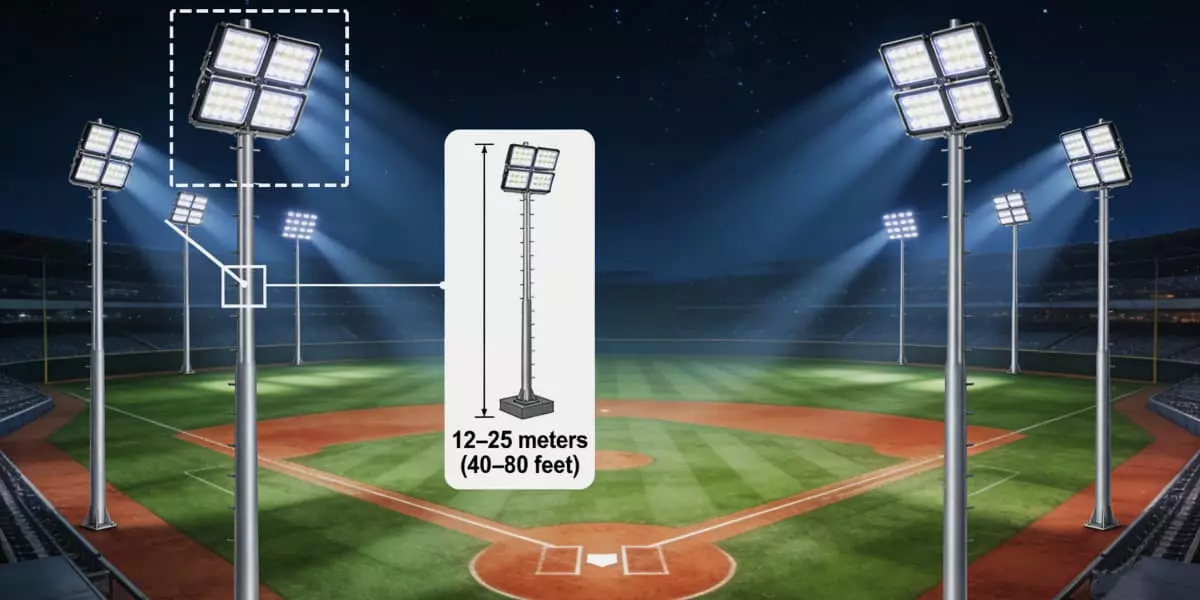
In practice, softball field light poles are typically 12–25 meters (40–80 feet) tall. The correct height depends on the level of play, field size, lighting standards, and local zoning rules.
This guide explains standard pole heights, how they are calculated, and the real-world constraints that influence final decisions.
Typical Softball Field Light Pole Heights (Quick Reference)
Before diving into detailed recommendations, it helps to see how pole heights are commonly classified by field type.
In sports lighting practice, light pole height refers to the total installed height, measured from the finished ground level to the highest point of the luminaire, including the pole, mounting base above grade, brackets, and the light fixture itself.
Field Type | Typical Pole Height | Typical Number of Poles | Common Lighting Level |
Recreational / Community | 12–15 m (40–50 ft) | 4–6 poles | ~200 lux |
Competitive / Collegiate | 15–20 m (50–65 ft) | 6–8 poles | ~300 lux |
Professional / Stadium | 20–25 m (65–80 ft) | 6–8+ poles | 500 lux or higher |
Note: In North America, pole height is usually specified in feet, and final approval often depends on zoning and spill-light limits rather than lighting performance alone.
Pole height is measured from the finished ground surface to the top of the installed luminaire.
Recommended Pole Heights by Level of Play
While the table above provides a general overview, recommended pole heights vary by playing level and design priorities. The sections below explain why each range is used.
(1) Recreational and Community Softball Fields
For recreational softball fields, both pole height and pole quantity are selected to balance basic visibility, glare control, and neighborhood impact.
Typical configuration:
Ø Pole height: 12–15 m (40–50 ft), measured to the top of the luminaire
Ø Number of poles: 4–6 perimeter poles
This configuration typically achieves around 200 lux for casual play while limiting light spill into surrounding residential areas. Shorter poles also reduce structural cost and simplify maintenance access.
(2) Competitive and Collegiate Softball Fields
As the level of play increases, higher mounting heights and additional poles are required to improve vertical illuminance and lighting uniformity.
Typical configuration:
Ø Pole height: 15–20 m (50–65 ft), including luminaires
Ø Number of poles: 6–8 poles
These heights support common competitive targets of 300 lux or more, while providing better ball visibility and smoother infield-to-outfield transitions.
Higher mounting positions also allow more flexible optical aiming, reducing sharp brightness differences between the infield and outfield.
(3) Professional and Stadium Softball Fields
Professional and stadium softball fields rely on taller poles and optimized pole layouts to support broadcast-quality lighting and strict glare control.
Typical configuration:
Ø Pole height: 20–25 m (65–80 ft), total installed height
Ø Number of poles: 6–8 poles or more, depending on stadium geometry
Higher mounting positions allow advanced optical control, help keep upward light ratio below 1%, and meet environmental and broadcasting requirements.
Lighting Standards and Regulatory Context
Understanding recommended pole heights also requires knowing which standards and regulations apply. Lighting performance alone is rarely the only deciding factor.
Common Lighting Standards for Softball Fields
Most softball lighting designs reference guidance from organizations such as:
IES (Illuminating Engineering Society) – RP-6 Sports Lighting Practices
NFHS – U.S. high school competition guidelines
NCAA – Collegiate-level lighting benchmarks
These standards typically recommend 200–500 lux depending on the level of play, with limits on uniformity and glare.
Local Zoning Laws and Light Spill Restrictions
Beyond lighting standards, local zoning laws often impose limits on:
Ø Maximum pole height
Ø Light trespass at property lines
Ø Operating hours
In residential areas, a project may be rejected even if it meets IES or NFHS recommendations. Early coordination with local planning departments is often more important than optimizing theoretical lighting performance.
Technical Factors That Influence Pole Height
Once standards and regulations are understood, designers evaluate technical factors that determine whether a proposed pole height will actually work on site.
Pole height is not determined in isolation. The number of light poles also plays a role in lighting design. Increasing pole quantity can reduce the required mounting height by shortening beam throw distances and improving coverage angles.
However, pole quantity cannot fully replace mounting height, especially when vertical illuminance and glare control are critical.
Beam Angles and LED Optics
Modern LED softball field lights use precision optics, typically ranging from 60° to 120° beam angles.
Narrow beams concentrate light in the infield
Wider beams support even outfield coverage
For example, with 15 m (50 ft) poles, a 90° beam angle often provides a good balance between uniformity and spill control.
Glare Control and Player Visibility
Pole height plays a major role in glare. Higher mounting heights, combined with 25°–30° downward aiming, reduce direct glare in players’ lines of sight.
For most outdoor ball sports, keeping glare below UGR 22 is considered acceptable and improves visual comfort during night games.
Cost, Installation, and Maintenance Considerations
Pole height decisions also have direct cost and operational implications, which often influence final project choices.
How Pole Height Affects Project Cost?
As pole height increases, so do:
ü Pole and foundation costs
ü Installation equipment requirements
ü Structural engineering fees
In many projects, increasing pole height from 15 m to 20 m can significantly raise total cost without proportionally increasing usable lighting performance.
Structural and Maintenance Impacts
Poles taller than 15 m (50 ft) often require:
ü Structural engineer sign-off
ü Larger concrete foundations
ü Higher wind-load ratings
Maintenance access also becomes more complex, sometimes requiring specialized lift equipment instead of standard service vehicles.
Real-World Constraints Designers Must Balance
In real projects, the “ideal” pole height is often adjusted due to:
Ø Budget limits
Ø Existing electrical infrastructure
Ø Property setbacks and boundaries
Ø Community concerns about glare and light pollution
As a result, lighting design is usually a compromise between standards, performance, and feasibility.
In many real projects, designers adjust pole height and pole quantity together. When zoning or structural limits restrict pole height, additional poles are sometimes used to achieve target lighting levels—within practical and budgetary limits.
How Engineers Calculate and Validate Pole Height
To finalize pole height, professional designers typically use photometric simulation software such as Dialux. These simulations model horizontal and vertical illuminance, uniformity, and glare.
After installation, on-site lux measurements are used to confirm real-world performance. Without proper aiming and calibration, results can deviate by 10–15% from simulation values.
Conclusion: A Practical 3-Step Approach
Choosing the right softball field light pole height can be simplified into three steps:
l Define the level of play and applicable standards
l Use photometric simulations to test height and layout options
l Consult lighting and structural professionals, then validate on site
As LED technology and controls continue to evolve, revisiting designs with updated tools ensures long-term performance, compliance, and community acceptance.
Ceramiclite provides FREE photometric plan for you, Contact Us for your project!

Frequently Asked Questions
Q: What is the standard height of a light pole?
A: There is no single standard height for all applications. For softball fields, light poles typically range from 12 to 25 meters (40–80 feet) depending on the level of play and site conditions.
Q: What height should my lights be?
A: Your lights should be tall enough to meet required illuminance levels while controlling glare and spill light. Recreational fields usually need 12–15 m, while competitive fields often require 15–20 m or more.
Q: How to calculate pole height?
A: Pole height is calculated based on field dimensions, required lighting levels, beam angles, and glare limits. Designers typically verify height through photometric simulations before installation.
Q: How tall are the lights in a stadium?
A: Stadium softball lights are commonly 20–25 meters (65–80 feet) tall to support uniform coverage, broadcast-quality lighting, and strict glare control.
Q: Does adding more light poles reduce the required pole height?
A: In some cases, yes. Adding more poles can reduce the required height by improving coverage and reducing beam throw distances. However, pole quantity cannot fully replace pole height. Minimum mounting heights are still needed to control glare and provide adequate vertical illuminance for ball tracking.