_thumb.jpg)
LED-Binning erklärt: Präzision und Farbkonsistenz
In der professionellen Beleuchtungsindustrie beginnt die Erzielung präziser Lichtqualität auf der mikroskopischen Ebene der Halbleiter. Da keine zwei LED-Chips jemals vollkommen identisch hergestellt werden können, ist die gesamte Branche auf einen kritischen Test- und Sortierprozess angewiesen. Das Verständnis von LED-Binning , den internationalen Normen zur Bewertung und warum ein strenger Binning-Code allein keine Garantie für die endgültige Leistung bietet, ist die Grundlage für die Entwicklung hochwertiger Leuchten.
Dieser Artikel richtet sich an Lichtingenieure , Produktmanager und Spezifizierer , die über die idealisierten Angaben in Datenblättern hinausgehen und die physikalischen Realitäten der Erzielung zuverlässiger Farbkonsistenz und elektrischer Stabilität in realen Projekten verstehen müssen.
Inhaltsverzeichnis
Warum ist die LED-Sortierung für Beleuchtungssysteme so wichtig?
ANSI-LED-Binning-Standards vs. MacAdam-Ellipsen
Methoden zur Erzielung präziser Farbkonsistenz
Faktoren, die jenseits der Farbsortierung zu Farbverschiebungen führen
Was ist LED-Binning?
Im Kern ist die LED-Sortierung der systematische Prozess des Testens, Messens und Sortierens einzelner Leuchtdioden (LEDs) in spezifische Kategorien – oder „Bins“ – basierend auf ihren exakten optischen und elektrischen Eigenschaften. Diese Kategorisierung erfolgt üblicherweise unmittelbar nach der Chipherstellung unter standardisierten Bedingungen (typischerweise bei einer Sperrschichttemperatur von 25 °C mit einem kurzen elektrischen Impuls).
Der LED-Herstellungsprozess: Warum die Sortierung unvermeidlich ist
Um zu verstehen, warum eine Sortierung notwendig ist, müssen wir uns das MOCVD-Verfahren (Metallorganische chemische Gasphasenabscheidung) ansehen, das zur Züchtung von LED-Kristallen verwendet wird.
Bei der Herstellung von Epitaxie-Wafern sind mikroskopische Schwankungen im Gasfluss, der Materialzusammensetzung und vor allem der Temperatur unvermeidbar. So ist beispielsweise selbst innerhalb eines einzelnen Silizium- oder Saphir-Wafers der Temperaturgradient zwischen der Mitte und den Rändern geringfügig unterschiedlich . Diese mikroskopische Temperaturabweichung verändert die Bandlücke des Halbleiters, wodurch Chips, die aus der Mitte des Wafers geschnitten werden, naturgemäß eine etwas andere Wellenlänge (Farbe) und Helligkeit aufweisen als solche, die vom Rand geschnitten werden.
Der LED-Sortierprozess: Wie werden Chips getestet und sortiert?
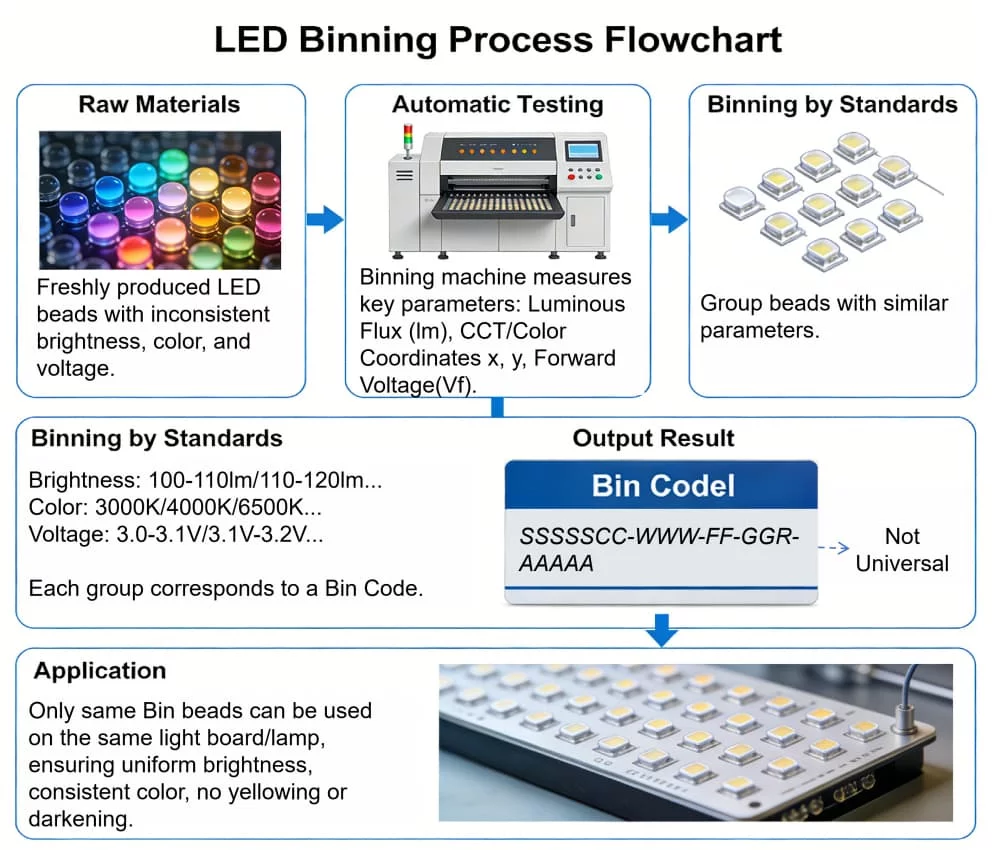 Sobald die Roh-LEDs verpackt sind, durchlaufen sie eine hochautomatisierte Test- und Sortierphase. Das Verständnis dieses Prozesses deckt einen entscheidenden blinden Fleck in vielen Beleuchtungskonzepten auf.
Das Verfahren basiert auf Hochgeschwindigkeitsspektrometrie und Ulbricht-Kugeln. Während die LEDs die Produktionslinie durchlaufen, wird jeder Chip mit einem präzise gesteuerten elektrischen Strom versorgt. Ein Sensor erfasst sofort die spezifischen Farbkoordinaten (x, y), den Lichtstrom (Lumen) und die Durchlassspannung (Vf).
Das entscheidende Merkmal dieses industriellen Prozesses ist jedoch seine Geschwindigkeit . Um einen hohen Produktionsdurchsatz zu gewährleisten, beleuchtet die Prüfmaschine die LED nur für einen Bruchteil einer Sekunde – typischerweise einen 20-Millisekunden-Impuls . Darüber hinaus wird dieser Test bei einer Standard-Raumtemperatur von 25 °C durchgeführt (oft als „Kalttest“ bezeichnet).
Sobald der kurzzeitige Lichtblitz gemessen wurde, sortiert eine robotergestützte Pick-and-Place-Maschine die LED physisch in ein bestimmtes Behälterfach und schließlich auf eine mit einem eindeutigen alphanumerischen Behältercode gekennzeichnete Bandspule .
(Anmerkung: Wie wir später noch sehen werden, liegt der Grund dafür, dass LEDs nur 20 Millisekunden lang bei kalten 25 °C sortiert werden, genau darin, warum Sortiercodes die Leistung in der Praxis bei 85 °C oft nicht korrekt vorhersagen können.)
Gibt es einen universellen Standard für LED-Bin-Codes ?
Wenn Lichtplaner oder Einkäufer ein LED-Datenblatt öffnen, stoßen sie oft auf lange, komplexe alphanumerische Zeichenfolgen – wie beispielsweise SSSSSCC-WWW-FF-GGR-AAAAA (Cree Lighting Bin Code) . Eine häufige Frage ist, ob es sich dabei um einen universellen Industriestandard handelt.
Die kurze Antwort lautet: Nein . Es gibt keine allgemein gültige oder universelle Namenskonvention für LED-Codes. Jeder Hersteller (z. B. Cree, Lumileds, Osram, Nichia, Ceramiclite) verwendet eine eigene Bezeichnung. ) verwendet eine eigene proprietäre Logik zur Strukturierung seiner Teilenummern und Behälteretiketten.
Obwohl die spezifischen Buchstaben und Zahlen je nach Marke variieren, integrieren nahezu alle Premium-LED-Hersteller dieselben Kategorien wichtiger Informationen in ihre Bestellcodes und Etiketten. Im Abschnitt „Nomenklatur“ oder „Bestellinformationen“ eines typischen Datenblatts wird ein LED-Code in der Regel aus folgenden Parametern zusammengesetzt:
l Produktserie / Produktfamilie : Kennzeichnet die physikalische Architektur und Größe der LED (z. B. eine 18-mm-COB oder einen 3030-SMD-Chip).
l CRI-Spezifikation (Farbwiedergabeindex) : Definiert die minimale Lichtqualität. Hersteller verwenden häufig spezielle Buchstaben zur Kennzeichnung der Stufen. (Zum Beispiel: B = 70 CRI min, H = 80 CRI min, U = 90 CRI min, Z = 95 CRI min).
l Farbkategorie : Gibt die spezifische Farbtemperatur (CCT) und das genaue Mikro-Quadrangle oder die MacAdam-Ellipse (SDCM) an, in die der Chip auf der CIE 1931-Karte fällt.
l Lichtstromklasse : Ein Code, der den gemessenen Lichtstrombereich (Lichtstrom) darstellt. (Hinweis: Während für präzise Beleuchtung eine enge Lichtstromklassifizierung erforderlich ist, kann bei einigen industriellen Großbestellungen ein Code verwendet werden, der angibt, dass die Charge „nicht in Lichtstromklassen eingeteilt“ ist, um die Kosten zu senken.)
l Vorwärtsspannungsklasse (Vf) : Definiert die elektrischen Anforderungen für den ordnungsgemäßen Betrieb der LED (z. B. eine Kennung für eine COB der Klasse 36-V).
l Interne / Leistungscodes : Zusätzliche firmeneigene Ziffern, die die spezifische Generation des Chips, die Leistungsstufe oder interne Kit-Codes des Herstellers bezeichnen.
Gehen Sie niemals davon aus, dass ein Lagerplatzcode von Lieferant A dasselbe bedeutet wie bei Lieferant B. Um wirklich zu verstehen, was Sie kaufen, müssen Sie immer die alphanumerische Zeichenfolge auf Ihrer Spule mit der Entschlüsselungstabelle „Lagerung und Etikettierung“ vergleichen , die sich ganz am Ende des Datenblatts des jeweiligen Herstellers befindet.
Die drei Haupttypen von LED-Bunkern
Sobald die LEDs vom Wafer abgetrennt und verpackt sind, testen Hochgeschwindigkeitssortiermaschinen jede einzelne Einheit und kategorisieren sie in drei Hauptbehälter:
l Farb-/Chromatizitätsklassifizierung : Diese definiert die exakte Farbe des emittierten Lichts, dargestellt als x- und y-Koordinaten im CIE-1931-Farbdiagramm . Sie stellt sicher, dass LEDs, die als „3000K Warmweiß“ vorgesehen sind, keinen sichtbaren Grünstich oder Rosastich aufweisen.
l Lichtstrom- (Helligkeits-) Klassifizierung : Hierbei werden LEDs anhand ihres Lichtstroms (Lumen) bei einem bestimmten Betriebsstrom kategorisiert. Dies gewährleistet, dass eine Reihe von LEDs Licht mit gleichmäßiger Intensität abgibt.
l Vorwärtsspannungs- (Vf) Binning : Oftmals von Einsteiger-Spezifizierern übersehen, ist das elektrische Binning entscheidend für die Auslegung von Stromversorgungen und das Wärmemanagement.
Die technischen Folgen der Vf-Binning-Methode:
Stellen Sie sich eine Hochleistungsleuchte vor, in der mehrere LEDs parallel geschaltet sind . Werden zwei LEDs mit einem signifikanten Unterschied in der Durchlassspannung (Vf) in dieselbe Parallelschaltung geschaltet, zieht die LED mit der niedrigeren Vf deutlich mehr Strom – ein Phänomen, das als „ Stromverschlucken “ bekannt ist. Diese LED leuchtet merklich heller, erzeugt übermäßige Wärme und altert schneller. Dadurch entsteht eine positive Rückkopplungsschleife (thermisches Durchgehen), die letztendlich zum vorzeitigen Ausfall der LED und damit zum Ausfall der gesamten Leuchte führt.
Warum die LED-Sortierung für Beleuchtungssysteme entscheidend ist
Für Lichtplaner und Leuchtenhersteller ist die LED-Sortierung nicht nur ein Qualitätskontrollkriterium im Datenblatt, sondern die absolute Grundlage für die Vorhersagbarkeit des Systems .
Beim Bau von professionellen Leuchten – insbesondere von Multi-Chip-Arrays, die in industriellen Hallenbeleuchtungen eingesetzt werden., SportstadienBei linearen architektonischen Wandflutern führt die Missachtung strikter Sortierprotokolle zu kaskadierenden Systemausfällen. Die Sortierung ist entscheidend, weil sie Folgendes verhindert:
l Sichtbare optische Defekte : Bei Anwendungen mit enger Optik (wie Streiflicht oder Wandflutung) führt das Mischen verschiedener Farbbereiche zu dem gefürchteten "Zebrastreifeneffekt" auf beleuchteten Oberflächen, was eine sofortige Ablehnung durch den Kunden zur Folge hat.
Systemweite Leistungsdefizite : Schwankungen des Lichtstroms gleichen sich nicht einfach aus, sondern verstärken sich gegenseitig. Wenn eine Leuchte mit einem breiten Lichtstrombereich mit einer Abweichung von über 10 % konstruiert ist, können die ungleichmäßige Wärmeverteilung und die optischen Ineffizienzen dazu führen, dass die Gesamtleistung der Leuchte im Vergleich zum Nennwert um mehr als 15 % sinkt .
l Vorzeitiger Treiber- und Chipausfall : Wie bereits beim Vf-Binning deutlich wurde, führen elektrische Inkonsistenzen auf einer Leiterplatte zu lokalen Hotspots, die sowohl das Wärmemanagementsystem der LED als auch den LED-Treiber belasten.
Strenge LED-Sortierung ist die einzige Möglichkeit für Produktmanager, zu garantieren, dass die tausendste Leuchte, die vom Band läuft, identisch zum Entwicklungsprototyp funktioniert. Wie wir im Folgenden sehen werden, ist die Definition einer „strengen Sortierung“ in der Branche jedoch höchst umstritten .
ANSI-LED-Binning-Standards vs. MacAdam-Ellipsen
Bei der Durchsicht von Leuchtenspezifikationen stößt man häufig auf Angaben wie „ANSI-konform“ oder „3-stufiges MacAdam-Verfahren“. Diese beiden Begriffe synonym zu verwenden, ist jedoch ein schwerwiegender Konstruktionsfehler. Sie bezeichnen völlig unterschiedliche Ansätze zur Bewertung der Farbkonsistenz.
Ursprünge und Grenzen von ANSI C78.377
Der ANSI-Standard C78.377 definiert eine Reihe von Farbvierecken (vierseitige Polygone), die entlang der Schwarzkörper-Ortslinie (BBL) angeordnet sind .
Dieser Standard wurde ursprünglich für Leuchtstofflampen entwickelt und später für die LED-Industrie angepasst. Da die Ausbeute in der frühen LED-Herstellung relativ gering war, wurde der ANSI-Standard so konzipiert, dass er sehr tolerant ist. Ein Standard-ANSI-Farbraumquadrat entspricht in etwa einer großen Farbskala von sieben Stufen .
Diese grobe Kategorisierung maximiert zwar die Produktionsausbeute und hält die Chipkosten niedrig, stellt aber eine gravierende Einschränkung für moderne LED-Anwendungen dar: Die innerhalb eines einzigen ANSI-Vierecks zulässigen spektralen Variationen sind für hochwertige Beleuchtungsdesigns einfach zu groß.
MacAdam-Ellipsen verstehen (SDCM)
Zur genauen Quantifizierung visueller Farbunterschiede verwendet die Branche die SDCM (Standardabweichung der Farbanpassung) , die geometrisch durch MacAdam-Ellipsen dargestellt wird .
Im Gegensatz zu breiten Vierecken stellen MacAdam-Ellipsen die menschliche visuelle Wahrnehmung auf der Grundlage statistischer Konfidenzintervalle dar:
l 1-Stufen-Ellipse (68% Konfidenz) : Stellt einen Farbunterschied dar, der für das menschliche Auge völlig unmerklich ist.
l 3-Stufen-Ellipse (99,7 % Konfidenzintervall) : Der Basisstandard für hochwertige Gewerbe- und Architekturbeleuchtung. Abweichungen sind kaum wahrnehmbar, es sei denn, die Leuchten sind direkt nebeneinander an einer weißen Wand angebracht.
l 5-stufige Ellipse und darüber : Farbunterschiede (z. B. wirkt eine Lichtquelle rosa, die andere grünlich) sind für den ungeübten Betrachter sofort erkennbar.
Die „Viereckfalle“ im Beschaffungswesen:
Stellen Sie sich ein großes ANSI-Viereck mit 7 Farbstufen vor. Sie könnten zwei LED-Chips kaufen, die beide exakt in diese eine ANSI-Kategorie fallen. Befindet sich Chip A jedoch in der oberen linken Ecke des Vierecks und Chip B in der unteren rechten, gehören sie zwar jeweils zu einer eigenen, eng begrenzten Ellipse mit 3 Farbstufen, der relative Farbunterschied zwischen Chip A und Chip B kann aber mehr als 6 Farbstufen betragen .
Zwei LEDs können zwar perfekt „ANSI-konform“ sein, aber dennoch einen gravierenden Farbunterschied aufweisen. Professionelle Planer müssen daher spezifische SDCM-Werte fordern, nicht nur ANSI-Binärcodes.
Methoden zur Erzielung präziser Farbkonsistenz
Wenn die ANSI-Normen nicht ausreichen, wie können Leuchtenhersteller dann eine 3-stufige oder 2-stufige SDCM-Leistung gewährleisten? Ingenieure wenden im Allgemeinen eine von zwei Strategien an, die jeweils erhebliche Auswirkungen auf die Lieferkette haben.
1. Enge Sortierung (Mikrosortierung)
Am einfachsten ist es, vorsortierte, extrem eng beieinander liegende Behälter zu kaufen (z. B. nur Chips, die innerhalb einer zweistufigen MacAdam-Ellipse liegen).
Der Vorteil : Hervorragende Farbkonsistenz direkt nach dem Auspacken bei minimalem Entwicklungsaufwand auf Leuchtenseite.
Die wirtschaftliche Realität : Da die Halbleiterausbeute für ein bestimmtes 2-Schritt-Verfahren extrem gering ist, verlangen Verpackungsunternehmen einen enormen Aufpreis. Die Beschaffung von 2-Schritt-Chips kann leicht 1,5- bis 2-mal so teuer sein wie die von Standard-5-Schritt-Chips. Darüber hinaus birgt die Abhängigkeit von einem einzigen Mikro-Verfahren erhebliche Risiken für die Lieferkette und verlängert die Lieferzeiten oft um 4 bis 6 Wochen, wenn die Ausbeute des Lieferanten sinkt.
2. Algorithmisches Mix-Binning
Um Kosten und Leistung in Einklang zu bringen, nutzen moderne Leuchtenhersteller das Mix-Binning-Verfahren. Dabei werden benachbarte, breitere Farbbehälter (die günstiger und leichter verfügbar sind) gekauft und mithilfe optischer Technik eine exakte Zielfarbe erzielt.
Das Prinzip : Durch die Kombination eines Chips aus einem leicht „grünen“ Farbbereich mit einem Chip aus einem leicht „rosa“ Farbbereich in bestimmten algorithmischen Verhältnissen wird die Lichtausgabe räumlich gemischt. Durch mehrfache interne Reflexionen in einer Diffusorplatte trifft das endgültige kombinierte Licht genau auf den Zielfarbpunkt (z. B. ein 3-stufiges SDCM).
Die Einschränkung : Die Farbmischung erfordert einen ausreichenden optischen Abstand, um das Licht zu mischen. Sie ist bei Flächenleuchten oder diffusen Einbauleuchten sehr effektiv, versagt jedoch bei flachen Leuchten, linearen LED-Streifen ohne Abdeckung oder Leuchten mit schmalem, klarem Lichtstrahl (wie z. B. Wandstreifenleuchten) , da die einzelnen LED-Farben sichtbar getrennt bleiben würden.
Faktoren, die jenseits der Farbsortierung zu Farbverschiebungen führen
Hier ist die wohl revolutionärste Wahrheit in der Beleuchtungsindustrie: Ein LED-Datenblatt ist eine Momentaufnahme eines Chips, der 20 Millisekunden lang bei 25°C getestet wurde.
Der Kauf eines einwandfreien 2-Stufen-LED-Chips garantiert noch keine 2-Stufen-Leuchte. Sobald der Chip auf eine Leiterplatte gelötet, in ein Gehäuse eingesetzt, mit einer Linse abgedeckt und an einer 10 Meter hohen Decke befestigt ist, verändern sich die Betriebsbedingungen drastisch. Verschiedene physikalische Faktoren beeinflussen dann unmittelbar die Farbtemperatur der LED.
Thermische Verschiebung bei Sperrschichttemperatur (Tj)
LEDs reagieren sehr empfindlich auf Wärme. Sobald die Leuchte eingeschaltet wird und die Sperrschichttemperatur (Tj) von den im Labor getesteten 25 °C auf eine realistische Betriebstemperatur von 85 °C (oder höher in industriellen Umgebungen) ansteigt, sinkt die Vorwärtsspannung und die Phosphor-Umwandlungseffizienz nimmt ab.
Diese thermische Belastung führt zu einer Verschiebung des Farbpunktes, typischerweise in Richtung Blau oder Grün. Ein Chip, der im kalten Zustand einen SDCM-Wert von 3 Stufen aufweist, kann nach vollständiger Erwärmung leicht eine thermische Verschiebung von 2 bis 4 SDCM- Stufen erfahren.
Daher wird empfohlen, dass Planer von den Herstellern Daten zur Heißklassifizierung (getestet bei 85°C) anfordern und die Konstruktion des Kühlkörpers der Leuchte sorgfältig prüfen.
Ansteuerstrom und Dimm-Effekte
Der elektrische Ansteuerstrom beeinflusst die Farbwiedergabe direkt. Dies ist besonders problematisch bei Systemen mit analoger Dimmung mittels CCR (Konstantstromreduktion) . Wird der Ansteuerstrom zum Dimmen des Lichts verringert, verschiebt sich der Farbpunkt der LED (oft in Richtung Grün). Systeme mit PWM-Dimmung (Pulsweitenmodulation) hingegen halten Stromstärke und Farbpunkt konstant, erfordern jedoch eine sorgfältige Konstruktion, um hochfrequentes Flimmern zu vermeiden.
Optische Interferenz durch Linsen und Diffusoren
Das Licht einer ungeschützten LED muss sekundäre optische Elemente (Polycarbonatlinsen, Glasabdeckungen oder Reflektoren) durchlaufen, die eine Winkelverschiebung der Farbe (räumliche Farbhomogenität) verursachen . Unterschiedliche Wellenlängen des Lichts werden beim Durchgang durch diese Materialien in unterschiedlichen Winkeln gebrochen.
l TIR-Linsen (Total Internal Reflection) : Führen oft zu einer Farbtrennung, was zu einem Strahl mit einem kühleren (bläulicheren) Mittelfleck und einem wärmeren (gelblicheren) Halo-Rand führt .
l Metallische Reflektoren : Sie erzeugen typischerweise den genau gegenteiligen Effekt, indem sie bestimmte Wellenlängen absorbieren und ein wärmeres Zentrum reflektieren.
Phosphorlöschung vs. Siliziumabbau im Laufe der Zeit
Die langfristige Farbbeständigkeit hängt davon ab, dass das Material Tausende von Stunden thermischer und photonischer Belastung standhält. Es gibt zwei unterschiedliche Alterungsmechanismen, die überwacht werden müssen:
1. Thermische Löschung des Leuchtstoffs : Längere Einwirkung extremer Hitze beeinträchtigt die Fähigkeit der Leuchtstoffschicht, blaues Licht umzuwandeln. Mit abnehmender Leuchtstoffleistung entweichen mehr blaue Photonen, wodurch das Licht der Leuchte sichtbar einen grellen Blaustich annimmt .
2. Silikon-/PC-Degradation : Das die LED schützende Silikon oder die PC-Optik selbst können unter kontinuierlicher UV-/Blaulichtbestrahlung und Hitzeeinwirkung vergilben. Dies führt nicht nur zu einer deutlichen Verringerung des Lichtstroms, sondern auch zu einer Verschiebung des Lichts hin zu einer trüben, wärmeren Farbe .
Beide Mechanismen hängen vollständig vom Wärmemanagement der Leuchte ab. Eine schlecht gekühlte 2-Stufen-LED sieht nach einem Jahr schlechter aus als eine gut gekühlte 5-Stufen-LED.
Fazit & Checkliste
Die LED-Sortierung ist zwar der grundlegende Rohstoff eines Beleuchtungssystems, aber nicht das Endprodukt. Echte optische Konsistenz ist ein komplexes technisches Zusammenspiel, das strenge Halbleiterbeschaffung, robustes Wärmemanagement und präzises optisches Design erfordert.
Um Beleuchtungsexperten dabei zu helfen, sich im Marketing-Dschungel zurechtzufinden und zuverlässige Produkte für anspruchsvolle Projekte zu sichern, verwenden Sie diese 5-Punkte-Checkliste für Planer bei der Auswahl Ihres nächsten Leuchtenlieferanten:
1. Verlangen Sie SDCM, nicht nur ANSI : Fragen Sie konkret nach dem MacAdam-Ellipsenschrittwert (z. B. ≤3-stufiges SDCM), nicht nur nach einer ANSI-Konformitätsbehauptung.
2. Überprüfen Sie die Testtemperatur : Stellen Sie sicher, dass die gemeldete Farbkonsistenz auf Hot-Binning-Daten (typischerweise 85 °C) basiert , die reale Betriebsbedingungen repräsentieren, und nicht auf einem 25 °C-Laborimpuls.
3. Wärmemanagement bewerten : Um sicherzustellen, dass die Sperrschichttemperatur niedrig genug bleibt, um thermische Verschiebungen und Phosphorabbau zu verhindern, sollten Berichte über thermische Simulationen oder Spezifikationen für physikalische Kühlkörper angefordert werden.
4. Dimmstrategie bestätigen : Fragen Sie, ob der Treiber PWM- oder CCR-Dimmung verwendet, und fordern Sie Daten darüber an, wie sich der Farbpunkt bei einer Dimmung auf 10 % der Ausgangsleistung verschiebt.
5. Sekundäroptik auf Winkelverschiebung prüfen : Lassen Sie sich ein visuelles Modell oder photometrische Testberichte zeigen, um zu bestätigen, dass keine sichtbare Farbtrennung (blaue Zentren/gelbe Halos) durch die Linsen oder Reflektoren verursacht wird.
Indem sie über einfache Binärcodes hinausgehen und die physikalischen Gegebenheiten der LED-Technologie verstehen, können Planer sicherstellen, dass ihre Projekte vom Tag der Installation bis zum jahrelangen Betrieb eine perfekte Beleuchtung gewährleisten.