Lighting Power Density (LPD): What It Is & How to Reduce It

Table of Contents
What Is Lighting Power Density (LPD)?
Why LPD is a Critical Metric for ROI & Compliance
Typical LPD Standards by Application
The Hidden Risk: Low LPD vs. Proper Illumination
How to Reduce LPD Without Losing Brightness?
Step-by-Step: How to Calculate LPD for Your Facility
Common LPD Design Mistakes to Avoid
Introduction
As energy codes become stricter and electricity costs continue to rise, energy efficiency has moved from a "nice-to-have" to a critical requirement for facility managers and lighting designers. In any modern lighting project—whether for new construction or a retrofit—one metric dictates the balance between compliance and performance: Lighting Power Density (LPD).
What Is Lighting Power Density?
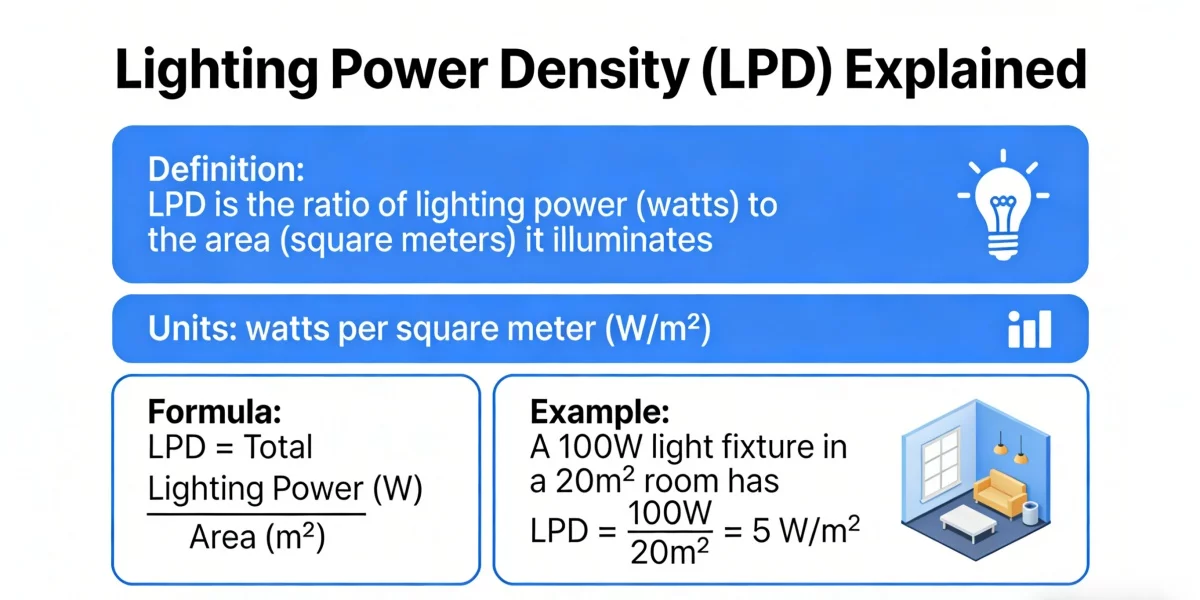
Lighting Power Density (LPD) is a measure of the lighting energy efficiency of a space. It is defined as the total lighting power load (in watts) divided by the total gross floor area of that space. The unit is typically expressed as watts per square foot (W/ft²) or watts per square meter (W/m²). LPD is the primary metric used by energy standards, such as ASHRAE 90.1, IECC, and Title 24, to set maximum allowable energy limits for different building types.
However, simply meeting the LPD limit is not the ultimate goal. The real challenge lies in reducing power consumption without sacrificing the illuminance levels (foot-candles) required for safety and productivity. A low LPD that results in a dim, unsafe environment is a failed design.
This guide will explain exactly how to calculate lighting power density, interpret the latest code requirements, and, most importantly, how to optimize your lighting system to achieve lower LPDs while maintaining high-quality illumination.
What Is Lighting Power Density (LPD)?
At its core, Lighting Power Density (LPD) represents the electrical load of lighting equipment per unit of illuminated area. It serves as the primary gauge for determining whether a lighting design is energy-efficient enough to meet building codes.
LPD focuses strictly on the power drawn by the lighting system—it does not account for the amount of light (lux or foot-candles) actually reaching the surface. This is an important distinction: LPD measures input energy, not output performance.
The LPD Calculation Formula
Calculating LPD is straightforward. It is the quotient of the total lighting power divided by the total floor area.
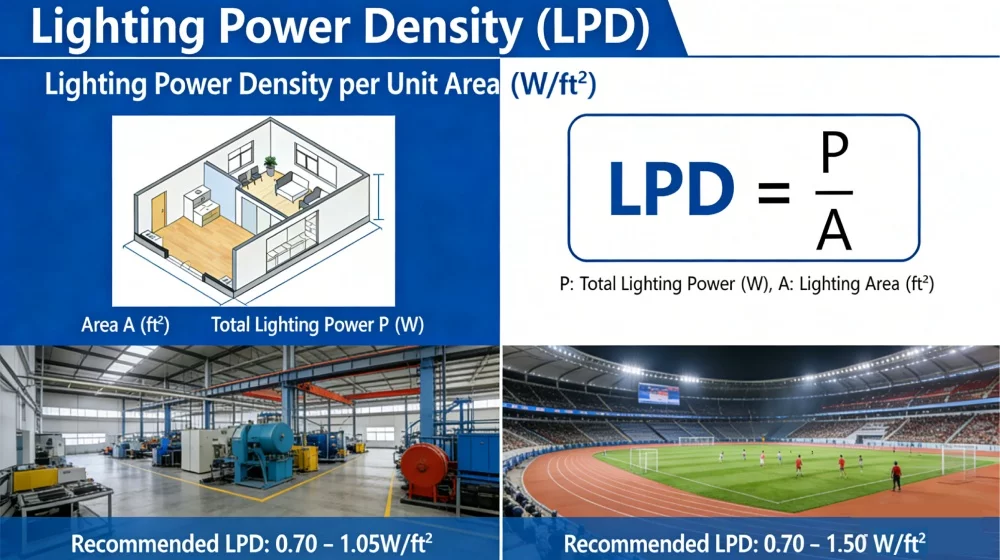
LPD = Total Lighting Power (Watts) ÷ Total Floor Area (ft² or m²)
l Total Lighting Power: This must include the wattage of all lighting fixtures, including ballasts, drivers, and transformers (not just the nominal lamp wattage).
l Total Floor Area: The gross lighted area of the building or specific space.
For example, if a 10,000-square-foot facility uses 6,000 watts of lighting, the LPD is:
6,000 W ÷ 10,000 ft² = 0.60 W/ft²
Two Methods for Compliance
When submitting lighting plans for regulatory approval, designers typically use one of two methods to determine the allowable LPD limit:
1. Building Area Method:
This is the simplified approach. It assigns a single LPD cap for the entire building based on its primary classification (e.g., "Manufacturing Facility" or "Warehouse"). It is faster to calculate but offers less flexibility.
2. Space-by-Space Method:
This approach assigns specific LPD limits to each individual room or area type (e.g., an office area within a factory vs. the main production floor). This method is often preferred for complex industrial or mixed-use projects because it allows for "trade-offs"—saving power in a hallway to allow for higher lighting density in a precision inspection zone.
Why LPD is a Critical Metric for ROI & Compliance
While LPD is a mandatory figure on engineering drawings, for facility owners and investors, it translates directly to financial and operational health. Understanding LPD is essential for three key reasons:
1. Regulatory Compliance (ASHRAE, IECC, & Title 24)
Energy codes are legally binding. In the United States, standards such as ASHRAE 90.1, the International Energy Conservation Code (IECC), and California’s rigorous Title 24 set strict maximum LPD values.
These codes are updated roughly every three years, with LPD allowances generally trending downward (becoming stricter). Failure to meet these limits can result in:
l Rejection of building permits.
l Failed final inspections.
l Costly redesigns and project delays.
2. OPEX Reduction (The Financial Impact)
LPD is the most accurate predictor of a facility's fixed lighting costs. In large-scale operations like logistics centers, heavy industry, or sports complexes, a small reduction in LPD yields significant savings in Operating Expenses (OPEX).
Consider this ROI example:
Imagine a 50,000 sq. ft. warehouse operating 24/7.
l Scenario A (Standard LPD): 0.60 W/ft²
l Scenario B (Optimized LPD): 0.45 W/ft² (Achieved via high-efficacy LEDs)
The difference is 0.15 W/ft², which equals 7,500 Watts of saved load.
Over a year (8,760 hours), this saves 65,700 kWh.
At an average commercial rate of $0.12/kWh, optimizing LPD saves roughly $7,884 annually—purely from electricity reduction, excluding maintenance savings.
3. Sustainability & ESG Goals
For modern enterprises, LPD is a key performance indicator (KPI) for environmental stewardship. Lowering LPD directly reduces a facility's Scope 2 carbon emissions (indirect emissions from purchased electricity).
Additionally, low-LPD designs are a prerequisite for achieving green building certifications, such as LEED (Leadership in Energy and Environmental Design), which can increase property value and corporate reputation.
Typical LPD Standards by Application
Understanding that "one size fits all" does not apply to lighting, energy codes differentiate heavily based on the function of the space. A sterile operating room, a high-speed assembly line, and a poultry farm all have vastly different visual requirements, and thus, different allowable power densities.
The following table outlines typical LPD allowances based on recent standards (such as ASHRAE 90.1-2019 and IECC 2021). Note how requirements shift from general commercial spaces to specialized industrial environments.
Building / Space Type | Typical LPD Range (W/ft²) | Key Design Factors |
Warehouse (Storage) | 0.40 – 0.60 | Often requires motion sensors to reduce effective LPD in aisles. |
Manufacturing (General) | 0.60 – 0.90 | Higher allowances are given for detailed work (fine assembly/inspection). |
Manufacturing (High Bay) | 0.70 – 1.05 | Allowances increase for ceiling heights >25ft to ensure light reaches the floor. |
Sports Arena (Class III/IV) | 0.70 – 1.50+ | Highly Variable. LPD often exceeds 1.0 due to high vertical illuminance needs for cameras & fast-moving objects. |
Livestock (Poultry/Swine) | 0.50 – 0.70 | Driven by biological needs (photoperiod) rather than just human visibility. |
Office (Open Plan) | 0.60 – 0.75 | Heavily regulated; relies on task tuning and daylight harvesting. |
Retail (Sales Area) | 0.90 – 1.20 | Higher allowance to highlight merchandise and create contrast. |
Parking Garage | 0.15 – 0.25 | Extremely low limits; safety and security are the priority. |
Insight: The "Moving Target" of Compliance
It is crucial to note that these numbers are not static. Energy codes are typically updated on a three-year cycle, with LPD allowances tightening by approximately 5-10% per cycle. A lighting design that barely passes code today may be non-compliant in a retrofit three years from now.
Forward-thinking facility managers should aim for 15-20% below current code limits to "future-proof" their infrastructure.
The Hidden Risk: Low LPD vs. Proper Illumination
In the race to cut energy costs and meet strict codes, many facility managers fall into the "Wattage Trap."
The Wattage Trap is the mistaken belief that the lowest possible LPD is always the best design choice. While reducing wattage lowers your electricity bill, LPD is purely an input metric (energy consumed). It tells you nothing about the output quality (light delivered).
If you reduce LPD by simply lowering wattage—without upgrading to higher efficacy fixtures or better optics—you risk creating an environment that is technically "energy efficient" but operationally dysfunctional.
Low LPD should never come at the expense of Lighting Quality. Here is how this imbalance threatens specific industries:
1. Industrial & Manufacturing: The Safety Compromise
In high-bay manufacturing plants or logistics centers, pushing LPD too low often results in insufficient foot-candles (fc) on the floor or poor vertical illumination on racking.
The Risk: Shadows mask tripping hazards or forklift pathways.
The Cost: A single safety accident or a Quality Control (QC) error due to poor visibility can cost more than five years of energy savings.
2. Sports Facilities: The "Zebra Effect"
Sports lighting requires high horizontal and vertical uniformity so players can track the ball and spectators can follow the game.
The Risk: Using low-power fixtures with poor beam spread to "cheat" the LPD calculation often creates hot spots and dark patches (the "Zebra Effect").
The Cost: The venue becomes unusable for sanctioned play or broadcast, and player safety is compromised by poor visual tracking.
3. Agricultural & Livestock: Biological Impact
Unlike a warehouse where light is just for vision, in poultry or swine farming, light is a biological trigger.
The Risk: Over-dimming to save power can disrupt the animal’s photoperiod (day/night cycle) and feed intake behavior.
The Cost: Lower production yields (meat/eggs) and slower growth rates. In this sector, Spectrum and Intensity > Raw Energy Savings.
Key Takeaway: The goal of a professional lighting upgrade is not just to lower the denominator (Watts), but to maintain or improve the numerator (Lumens). True efficiency is achieving the required foot-candles with the least amount of power—not just cutting power and accepting the dark.
How to Reduce LPD Without Losing Brightness?
The challenge of modern lighting design is simple to state but hard to execute: How do you lower the watts (LPD) while keeping the lumens (brightness) high?
Achieving this balance doesn't require magic; it requires engineering. To reduce your Lighting Power Density effectively, focus on these three technical pillars:
1. Maximize Luminous Efficacy (lm/W)
The most direct way to lower LPD is to improve the efficiency of the light source itself. Luminous efficacy measures how many lumens a fixture produces for every watt of electricity consumed.
l Legacy Tech: A 400W Metal Halide lamp might only deliver ~60-70 lm/W (system efficiency).
l Standard LED: Generic LEDs often hover around 120-130 lm/W.
l High-Performance LED: To aggressively cut LPD, you need fixtures rated at 160 lm/W or higher.
The Math: By switching from a 130 lm/W fixture to a 170 lm/W fixture, you can reduce total wattage by nearly 25% while delivering the exact same amount of light. This is why solutions like Ceramiclite’s high-efficacy LED luminaires are often specified for projects with strict energy caps—they allow designers to meet code without dimming the facility.
2. Precision Optics (Light Distribution)
Wasted light is wasted energy. In a warehouse with tall racking, a standard "flood" beam spreads light everywhere—illuminating the tops of racks and the upper walls, where it serves no purpose.
l The Solution: Use application-specific optics. For example, Rectangular or Aisle Optics direct the beam strictly down the vertical face of the rack and onto the floor.
l The Result: Because more light hits the target area (the working plane), you can use lower-wattage fixtures to achieve the required foot-candle levels, effectively lowering your LPD.
3. Intelligent Control Systems
While LPD is calculated based on maximum potential power, modern energy codes are beginning to recognize the value of controls.
l Occupancy Sensors: Automatically dim or switch off lights in empty warehouse aisles.
l Daylight Harvesting: In agricultural barns or hangars with skylights, sensors dim the electric lights when natural sunlight is sufficient.
l Task Tuning: "Trimming" the high-end output (e.g., setting max brightness to 80%) prevents over-lighting and extends fixture life.
Step-by-Step: How to Calculate LPD for Your Facility
Calculating Lighting Power Density is a critical step in the audit or design phase. Whether you are retrofitting a factory or planning a new sports complex, follow this three-step process to determine your current or projected LPD.
Step 1: Audit Total System Wattage
The most common mistake in LPD calculation is summing up the wattage of the lamps rather than the fixtures.
² Rule: You must use the Input Wattage (System Watts).
² Example: A fixture might have "200W" LED chips, but the driver draws an additional 10W, making the total input 210W.
² Action: List every fixture type, multiply by the quantity, and sum the total watts.
Step 2: Measure the Illuminated Floor Area
Determine the gross lighted floor area of the space.
² Include: All areas within the exterior walls that are illuminated.
² Exclude: Unlit structural voids or areas specifically exempted by local codes (though most codes use Gross Floor Area).
² Note: Ensure your measurements are in square feet (ft²) or square meters (m²) to match your target metric.
Step 3: Apply the Formula
Divide your total system wattage (Step 1) by the total floor area (Step 2).
Calculation:
Total System Watts ÷ Total Area = LPD
Pro Tip: Don't Forget "Control Credits"
Many energy codes (like IECC and ASHRAE 90.1) offer "Power Adjustment Factors" (PAFs) or control credits.
This means if you install advanced controls (like institutional tuning or occupancy sensing in open offices), the code allows you to mathematically reduce your calculated LPD wattage.
Real-World Benefit: This allows you to install slightly higher-wattage (brighter) fixtures if necessary, provided they are controlled intelligently, making it easier to pass strict compliance checks.
Common LPD Design Mistakes to Avoid
Calculating LPD is just math, but designing for LPD is an art. Even seasoned facility managers can fall into traps that pass the energy inspection but fail in daily operations. Here are the three most common errors to watch for:
Mistake 1: Ignoring Ceiling Height & Beam Angles
A Lighting Power Density of 0.60 W/ft² behaves very differently in a 12-foot office versus a 40-foot warehouse.
² The Trap: Treating all "square footage" the same.
² The Reality: In high-bay applications (Industrial/Sports), light has to travel much farther to reach the working plane. If you use wide-beam fixtures at high mounting heights to keep LPD low, most of the light will scatter onto the walls or rack tops, leaving the floor dark.
² The Fix: For high ceilings, you don't necessarily need more watts; you need narrower optics to punch the light down to the floor without increasing power consumption.
Mistake 2: Confusing "Nominal" vs. "System" Wattage
² The Trap: Designing based on the wattage printed on the LED chip or the marketing brochure (e.g., "100W Lamp").
² The Reality: Energy codes measure the total circuit load. A "100W" fixture actually draws power for the LED chips plus the driver efficiency loss and cooling fans. The real draw might be 110W or 115W.
² The Fix: Always use the Input Wattage listed on the technical spec sheet. Ignoring this 10-15% variance can cause your entire project to fail a Title 24 or ASHRAE audit.
Mistake 3: Sacrificing Uniformity (The "Zebra Effect")
² The Trap: Spacing fixtures too far apart to reduce the fixture count and lower the total LPD.
² The Reality: This creates pools of bright light and dark shadows—known as the "Zebra Effect." In warehouses, this causes eye fatigue for forklift drivers moving between light and dark zones. In sports, this makes the ball "strobe" or disappear in shadow zones.
² The Fix: It is better to use more fixtures at lower wattages (or dimmed levels) than fewer fixtures at full power. Uniformity is key to safety.
Conclusion
Lighting Power Density is more than just a regulatory hurdle; it is the critical balance point between operational efficiency and environmental responsibility.
However, a low LPD number on a piece of paper is worthless if your facility is too dim to work in safely. The goal of modern lighting design is not to simply "cut the watts," but to maximize the lumens per watt through superior LED technology, precision optics, and intelligent controls.
Whether you are retrofitting a manufacturing plant, lighting up a competition field, or optimizing animal growth in a barn, the right strategy turns compliance into a competitive advantage.
Ready to Optimize Your LPD?
Don't compromise on safety or productivity just to meet energy codes.