_thumb.jpg)
Volleyball Court Lighting: Standards, Layouts, and Costs
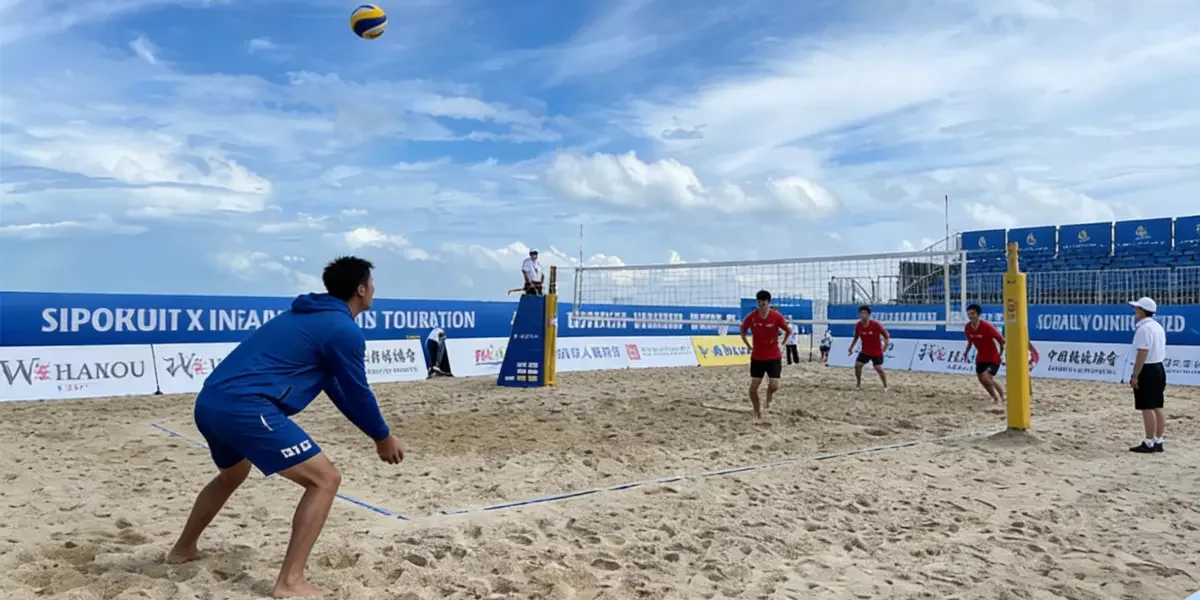
Table of Contents
Why Choose LED Lights for Volleyball Courts?
Volleyball Court Classifications and Lighting Standards
How to Choose the Best LED Lights for Your Volleyball Court?
Volleyball Court Lighting Design & Layouts
How Much Does Volleyball Court Lighting Cost?
Project Timeline: How Long Does Installation Take?
Frequently Asked Questions (FAQs)
Kick Off Your LED Sports Lighting Project
Why Choose LED Lights for Volleyball Courts?
When upgrading an existing facility or building a new one, selecting the right illumination technology is the most critical first step. For decades, traditional Metal Halide (HID) fixtures were the norm. Today, they are entirely obsolete.
Whether designing an indoor arena or a beachfront sand court, installing high-quality LED lights for volleyball courts is now the only logical and cost-effective choice. Here is why modern sports facilities have completely transitioned to LED:
1) Unmatched Energy Savings & Extended Lifespan
Traditional HID lamps are notorious power-hogs that lose brightness rapidly over time. Upgrading to a modern volleyball LED light system can reduce your facility's energy consumption by up to 70%. Furthermore, premium LED fixtures feature advanced heat-resistant structures and proprietary heat sinks. By effectively dissipating heat to protect the internal chips, these luminaires guarantee an ultra-long lifespan of 50,000+ hours without significant lumen depreciation.
2) Glare-Free & Eye Protection (UGR < 19)
Volleyball is a highly vertical sport. Players are constantly looking up to spike, block, or dive. Harsh lighting can cause temporary visual impairment, ruining the gameplay and leading to injuries. High-end LED lighting utilizes proprietary optical lenses and anti-glare visors to achieve a Unified Glare Rating (UGR) of less than 19, ensuring maximum visibility with zero eye strain.
3) Zero Flicker for Televised Games
For collegiate or professional arenas, broadcasting is a major consideration. Older lighting technologies produce a subtle flicker that ruins slow-motion replays. Advanced LED lighting is completely flicker-free, supporting ultra-high-speed shooting (up to 6000 Hz). This guarantees pristine, broadcast-ready footage for fast-paced rallies.
4) Perfect Uniformity & High CRI (Color Rendering Index)
Uniform lighting is critical for players and spectators to track the ball clearly. LED lights distribute light evenly across the entire playing surface, eliminating dark spots. Combined with a High CRI that mimics natural sunlight, colors are showcased as realistically as possible, improving the overall viewing experience.
5) Extreme Weatherability (Waterproof & Anti-Corrosion)
Outdoor environments demand rugged fixtures. Standard outdoor lighting must meet at least an IP66 waterproof rating to withstand harsh weather. However, for highly corrosive environments like coastal beaches or harbor-side courts, standard fixtures will rust quickly.
This is where specialized engineering comes in: Ceramiclite’s outdoor luminaires are rigorously Salt Spray Tested and rated for C4 and C5 marine-grade anti-corrosion environments, ensuring they will not degrade even under constant exposure to sun, kick-up sand, and highly saline ocean air.
Volleyball Court Classifications and Lighting Standards
A one-size-fits-all approach does not work in sports court lighting. The optimal layout heavily depends on two defining factors: the level of competition and the specific court environment.
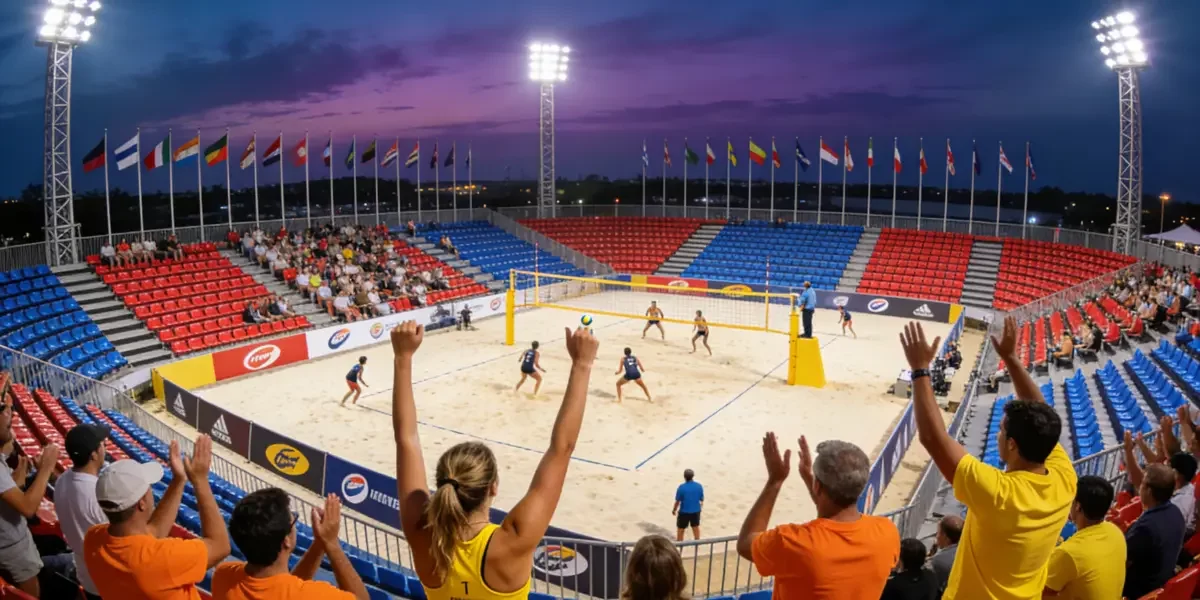
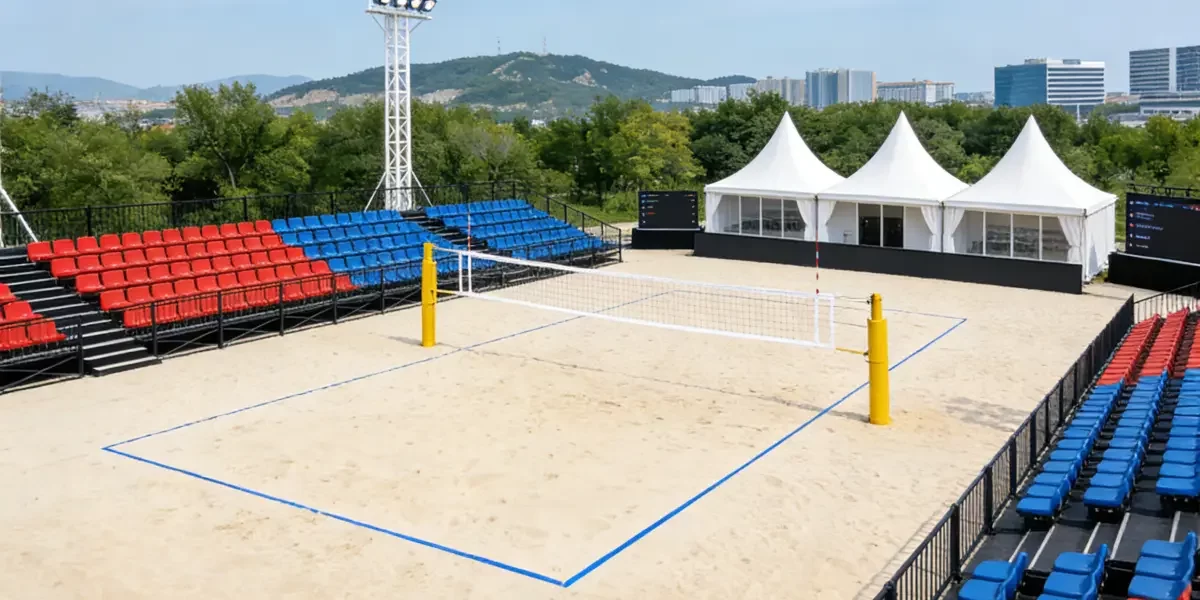
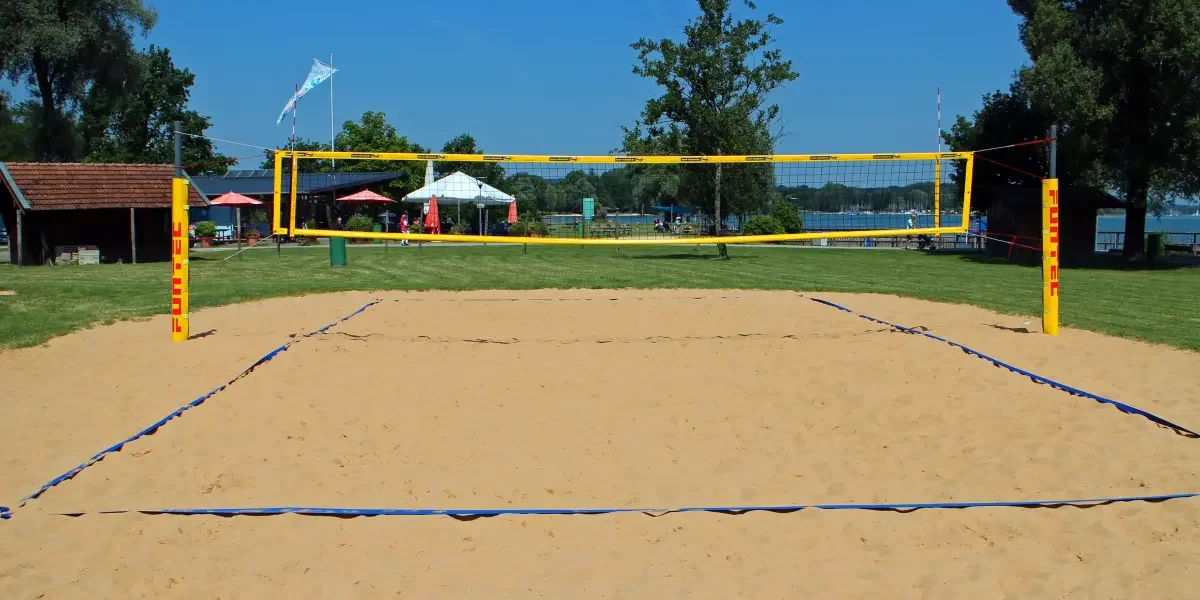
A. Lighting Standards by Competition Level
Governing bodies like the FIVB (Fédération Internationale de Volleyball) and the NCAA dictate strict volleyball court lighting standards. The higher the level of play, the brighter and more uniform the lighting must be.
Competition Level | Facility Type | Recommended Illuminance (Lux) | Illuminance (Footcandles - fc) |
Class I | Professional / Televised / International | 500 - 1000+ Lux | 50 - 100+ fc |
Class II | College (NCAA) / High School / Club | 300 - 500 Lux | 30 - 50 fc |
Class III | Recreational / Parks / Backyard | 100 - 200 Lux | 10 - 20 fc |
B. Lighting Requirements by Court Environment
Beyond brightness, the physical location of the court presents unique engineering challenges. Understanding these distinctions is crucial for a successful lighting design.
a. Indoor Volleyball Courts:
The Challenge: Limited ceiling heights and the high risk of ball strikes.
The Solution: Indoor facilities require uniform, downward-facing illumination, typically mounted via a ceiling layout or truss system. Fixtures must feature impact-resistant polycarbonate lenses or wire guards to withstand powerful spikes without shattering.
b. Outdoor Hard Courts:
The Challenge: Wind loads on lighting poles and light pollution affecting surrounding areas.
The Solution: Poles and fixtures must be engineered to withstand local EPA (Effective Projected Area) wind load requirements. Additionally, precise asymmetrical optics and spill-light shields are mandatory to prevent "light trespass," ensuring the court is brightly lit without blinding nearby residents or traffic.
c. Sand/Beach Volleyball Courts:
The Challenge: Extreme glare from highly reflective sand and corrosive humidity.
The Solution: This is arguably the most demanding lighting environment. White sand acts as a mirror, making exceptional anti-glare technology essential for player safety. Furthermore, as these courts are often located near water, the use of marine-grade, C4/C5 rated fixtures is non-negotiable to prevent premature rust and failure.
A Note on Power Solutions:
When configuring your system, you must also consider the power source. For the vast majority of professional and recreational facilities, grid-powered LED lights remain the absolute standard, delivering the consistent, high-lumen output required for safe gameplay.
However, for remote beaches, pop-up events, or community parks lacking electrical infrastructure, solar-powered LED lights serve as a viable, eco-friendly alternative. Regardless of the power source, traditional HID technology has been entirely phased out in favor of LED.
How to Choose the Best LED Lights for Your Volleyball Court?
Once you have decided to upgrade to LED and calculated your required lumens, you will face hundreds of options on the market.
To protect your investment and avoid costly mistakes, use this technical buyer's checklist to evaluate your options:
Weight & EPA (Effective Projected Area) Ratings:
This is especially critical for outdoor retrofit projects. If you are mounting new LED fixtures on existing poles, you must ensure the new lights do not exceed the pole's structural weight limits or wind load capacity (EPA). Choose fixtures with a streamlined, aerodynamic die-cast aluminum profile to minimize wind resistance.
Surge Protection Devices (SPD):
Outdoor volleyball lighting poles are basically giant lightning rods. A single lightning strike or grid power surge can instantly destroy an unprotected LED array. Only purchase outdoor fixtures that feature built-in 10kV or 20kV surge protection.
Smart Controls & Dimming Capabilities:
A modern facility shouldn't operate on a simple "on/off" switch. Look for LED fixtures compatible with 0-10V, DALI, or wireless smart control systems. This allows facility managers to lower the brightness (and save electricity) during routine practices, and instantly ramp up to 100% output for official tournament play.
Certifications & Warranty (For Rebates):
For projects in the U.S., always verify if the fixtures are UL Listed and DLC Premium certified. High-quality fixtures with these certifications not only guarantee electrical safety but also qualify your facility for significant utility rebates, accelerating your ROI. Additionally, a reputable manufacturer should stand behind their engineering with at least a 5 to 10-year comprehensive warranty.
Demand a Photometric Report:
Never purchase sports lighting based purely on a spec sheet. A trustworthy supplier will always provide a customized 3D DIALux lighting simulation before you buy, proving their specific fixture optics will deliver uniform, glare-free coverage across your exact court dimensions.
Volleyball Court Lighting Design & Layouts
When executing a professional volleyball court lighting design, simply buying bright lights is not enough. You must consider where the fixtures will be placed, how many are required, and what type of rigging or poles are needed to achieve optimal uniformity.
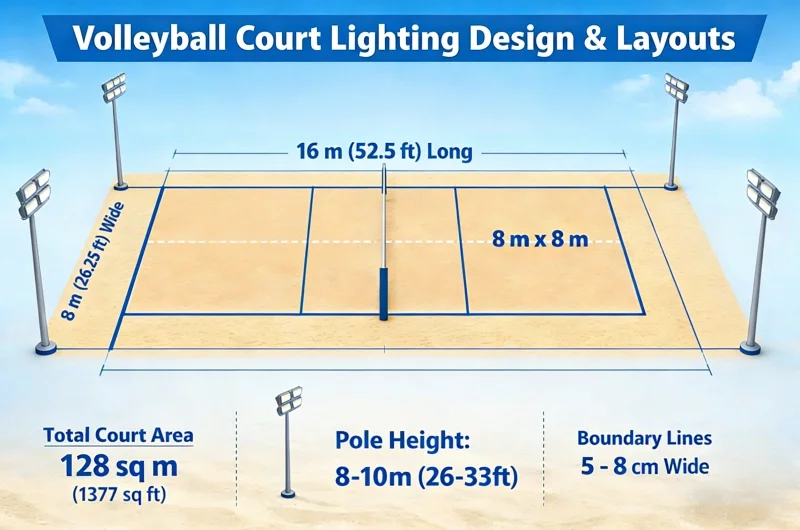
A. Indoor & Outdoor Layout Options
The physical structure of your facility dictates your volleyball lighting layout:
l Indoor Layout Options:
Ceiling Layout: This is the most common approach for gymnasiums with high, unobstructed ceilings. Fixtures are mounted directly to the ceiling structure, projecting light downward for even distribution.
Truss System: If your facility features low or uneven ceilings, a truss system is the best solution. Trusses can be mounted on walls or existing steel structures, allowing for precise angling of the fixtures without relying on the ceiling height.
l Outdoor Layout Options:
Standard 4-Pole Setup: For full-court outdoor recreational and standard club play, a 4-pole layout is the industry standard. Poles are strategically placed outside the four corners of the free zone. This cross-illumination strategy minimizes shadows and reduces direct glare when players look up at the net.
B. How Many Lumens to Light a Volleyball Court? (The Calculation)
To calculate the exact number of LED fixtures required, you must know the total area (including the safety free zone) and the target competition level.
Here is a practical calculation for a standard-sized volleyball court:
Ø Dimensions (including free zone): 94′ x 50′
Ø Total Area: Approx. 4,000 square feet
Ø Assumed LED Efficiency: 130 Lumens per Watt (LPW)
Scenario 1: Recreational Gym / Backyard Setup
² Target: 10 to 20 footcandles
² Lumen Output Needed: Approx. 80,000 lumens
² Total Wattage Needed: 80,000 lumens ÷ 130 LPW ≈ 600W
² The Solution: You will need at least 4 x 150W LED sports lighters.
Scenario 2: Professional / Collegiate Gym
² Target: 50+ footcandles (for high-speed play and broadcasting)
² Lumen Output Needed: Approx. 400,000 lumens
² Total Wattage Needed: 400,000 lumens ÷ 130 LPW ≈ 3,000W
² The Solution: You will need at least 15 x 200W LED sports lighters to achieve the dense, uniform coverage required for elite competition.
How Much Does Volleyball Court Lighting Cost?
Budgeting is often the biggest hurdle for facility managers. Based on 2025 U.S. project data, installing LED lighting for a volleyball court typically costs between $25,000 and $215,000.
This wide range accounts for a complete turnkey installation, encompassing the LED fixtures, poles, specialized rigging, electrical wiring, and regional labor rates.
Several critical factors influence your total project cost:
l New System vs. Retrofit: This is the biggest price differentiator. If you are retrofitting an existing court with LEDs, you can often reuse existing poles, trusses, and underground wiring. This reduces the project to essentially the cost of the fixtures and minimal labor. A brand-new installation requires expensive trenching, concrete pouring for pole bases, and full electrical setup.
l Level of Competition: As demonstrated in the calculation above, a recreational court requires a fraction of the lumens—and therefore a fraction of the fixtures—compared to a professional arena. More fixtures equal higher material and installation costs.
l Environment & Certifications: The physical location dictates the grade of the equipment. Outdoor courts require heavy-duty galvanized steel poles, while indoor courts require specialized wall-mounted trusses. Furthermore, if you are lighting a sand volleyball court near the ocean or a harbor, you must invest in premium, marine-grade fixtures that are strictly salt spray tested (C4/C5 rated) and carry UL/DLC certifications. These high-spec fixtures have a higher upfront unit price but are essential to prevent catastrophic premature failure.
Project Timeline: How Long Does Installation Take?
Setting realistic expectations with your stakeholders or general contractors is vital. The timeline for a lighting project varies drastically based on the scope of work and the environment:
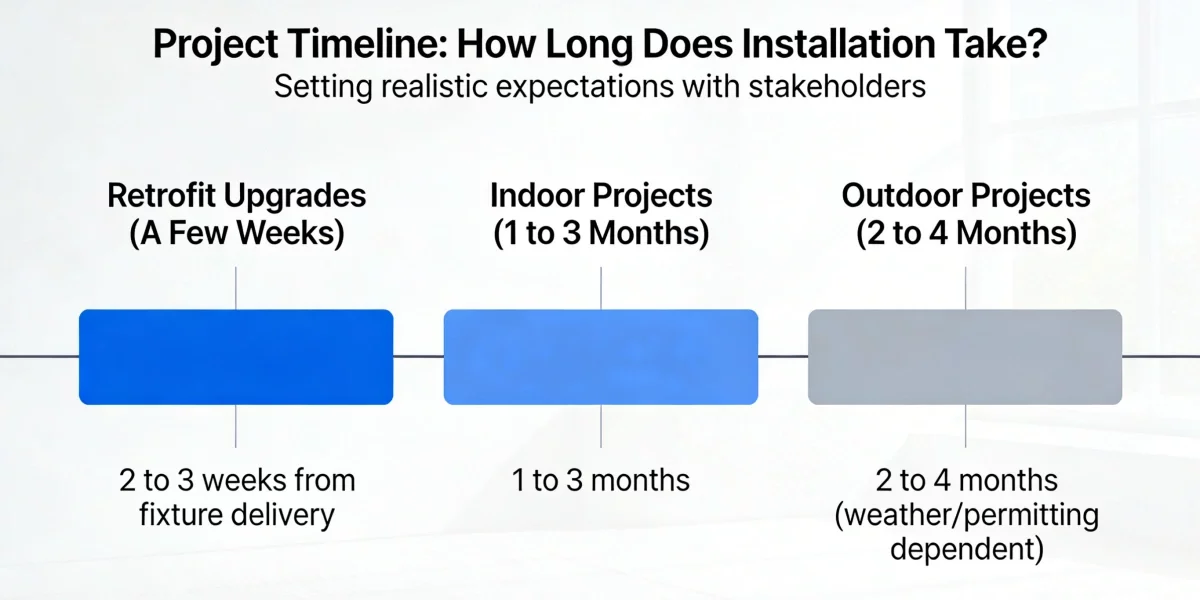
l Retrofit Upgrades (A Few Weeks):
If your facility’s infrastructure (poles, wiring, electrical panels) is structurally sound and up to code, replacing outdated HID lamps with modern LED sports lighters is incredibly fast. Most retrofit projects can be completed in just 2 to 3 weeks from fixture delivery.
l Indoor Projects (1 to 3 Months):
New indoor installations move relatively quickly. Because the work is enclosed, teams avoid weather delays. Additionally, indoor permitting and electrical approvals are generally more straightforward than outdoor structural zoning.
l Outdoor Projects (2 to 4 Months):
Building an outdoor system from scratch is a heavy civil engineering project. It involves site preparation, trenching for underground conduit, pouring concrete bases, and erecting tall light poles. This timeline heavily depends on the speed of local government permitting approvals and is highly susceptible to weather delays.
Frequently Asked Questions (FAQs)
What is the best LED light for an outdoor volleyball court?
The best LED light for an outdoor volleyball court is a high-mast fixture featuring asymmetrical optics and precision glare-control visors. This ensures the light is pushed down onto the court rather than spilling into the players' eyes or the surrounding neighborhood. Additionally, the ideal fixture must be fully weatherproof (IP66+) and built with advanced heat sinks to maintain a long lifespan.
How high should volleyball court lighting poles be?
For optimal illumination and minimal glare, outdoor volleyball court lighting poles should generally be between 20 to 30 feet (6 to 9 meters) tall.
² If poles are too low (under 20 ft): The light source enters the players' direct line of sight too easily, causing severe glare during serves and spikes.
² If poles are too high (over 30 ft): You will experience significant light loss (lumens failing to reach the ground), requiring you to purchase much higher-wattage fixtures to maintain the required footcandles.
Kick Off Your LED Sports Lighting Project
Whether you are retrofitting a community gymnasium, designing a professional indoor arena, or building a beachfront sand court from scratch, proper lighting transforms the entire playing experience. It ensures player safety, meets strict broadcasting standards, and significantly reduces your facility's operational costs.
Taking the first step doesn't have to be complicated. At Ceramiclite, our team of sports lighting engineers is dedicated to helping facility managers, contractors, and project planners bring their courts to life with industry-leading, rigorously tested LED solutions.
Ready to upgrade your court? We offer a complete suite of professional tools to get your project started:
Get a Free Photometric Design: Send us your court dimensions, and our engineers will create a custom 3D DIALux simulation to guarantee perfect uniformity and zero dark spots.
Receive a Tailored Cost Estimate: Get a transparent, no-obligation quote based on your specific competition level, environmental requirements (indoor, outdoor, or marine-grade), and layout.
Don't let outdated lighting keep your players in the dark.