2025年匹克球场照明成本完全指南


匹克球场地照明成本完整指南


目录

匹克球场照明成本由哪些因素决定?

匹克球场照明成本:平均价格明细

特殊照明成本方案(改造、升级和转换)

六种常见照明布局及其成本差异

LED照明与传统照明——哪种更具成本效益?

如何降低匹克球场照明成本(实用技巧)

关于匹克球场照明成本的常见问题

结论


无论您是计划在自家后院安装照明设备、升级社区球场,还是建造商业设施,了解匹克球场照明成本 都至关重要。


本指南详细分析了 2025 年的实际价格——包括成本范围、影响预算的关键因素、常见照明布局和常见问题——以便您可以自信地进行规划并避免不必要的开支。


匹克球场照明成本由哪些因素决定?

影响匹克球场照明总成本的关键因素有很多。了解每个因素有助于您估算出合理的预算,避免意外支出。


1)照明类型:LED灯 vs 金卤灯

LED灯具虽然前期投入较高,但耗电量远低于LED灯具,而且几乎不需要维护。 

金属卤化物(MH) 虽然初始价格较低,但能耗较高,升温较慢,使用寿命较短。

大多数新建法院选择LED照明,因为它能降低长期运营成本。


2)灯具数量和功率

一个典型的法庭使用300瓦至600瓦的LED灯具

功率越大,亮度越高。

灯具越多,光线均匀性越好,阴影越少。

功率和数量都会直接增加设备成本。


3)灯杆(高度、材质、数量)

更高的电线杆(20-26 英尺)可以改善覆盖范围,但成本更高。

钢杆是标准配置;更重型的杆子价格更高。

基本配置可能需要4 根杆子,而更大或更专业的配置可能需要6-8 根杆子


4)球场布局:单球场与多球场

单个球场 需要的灯具和灯杆更少。

并排球场 需要更均匀的照明,以避免出现暗区。

多球场综合体的总成本自然最高。


5) 照明要求(勒克斯值)

欧洲标准EN 12193:2017 将运动照明性能分为三个官方等级。匹克球与其他小型球类户外运动属于同一类别,因此适用相同的框架:


• Class I – International & National Competition (≥500 lux)
This level supports high-speed play, professional matches, and potential broadcast use.
Players get excellent visibility with very high uniformity and strict glare control.
Achieving this class usually requires more poles, higher-lumen fixtures, and precise aiming.


• Class II – Regional / Club Competition (300–500 lux)
Suitable for club leagues, training centers, and regular competitive play.
Players can track fast shots comfortably thanks to balanced brightness and good uniformity.

Most commercial pickleball clubs aim for this range.


• Class III – Recreational / Community Play (200–300 lux)
Designed for parks, community courts, and general practice.
Provides safe, comfortable illumination without the cost of competition-level systems.
Fewer fixtures and lower lumen output keep the budget manageable.


Why cost scales with class:
Moving from Class III to Class I requires higher lumen output, tighter uniformity (U0/U1 targets), and better optics to control glare and spill light. Higher performance typically means more fixtures, stronger poles, and more detailed engineering—directly raising total project cost.


6) Installation Difficulty

Costs rise with complex trenching, wiring, conduit runs, and pole foundations.

Hard soil, long cable distances, or uneven terrain increase labor hours.


7) Control System Type

Basic switches are inexpensive.

Smart controls (timers, remote access, dimming) add convenience but cost more.


These factors together explain why pickleball court lighting prices vary widely from project to project.


Pickleball Court Lighting Cost: Average Price Breakdown

Understanding the newest pickleball court lighting price helps you plan a realistic budget. Below is a clear 2025 cost breakdown, covering equipment, installation, and total project ranges.


1. Typical Total Cost (2025 Estimates)

Single court: $6,000–$12,000
Suitable for homes, small communities, and basic recreational needs.


Two courts (side-by-side): $10,000–$18,000
Shared poles reduce cost per court, making this setup more economical.


Competition-level courts: $18,000–$30,000
Higher brightness, more poles, and stricter uniformity increase the price.


These numbers include equipment + installation but vary by location and project complexity.


2. Equipment Cost Breakdown

Lighting equipment usually makes up the largest part of the budget.


LED fixtures: $300–$800 each
Price changes based on wattage, optics, and brand quality.


Poles: $400–$1,500 each
Taller or thicker-gauge poles cost more.


Mounting hardware: $100–$300
Includes brackets, arms, and weatherproof fittings.


Control systems: $200–$1,200
Basic switches sit at the low end; smart controls cost more but save energy.


3. Installation Cost Breakdown

Labor and site work can significantly influence the final price.


Labor: $1,000–$3,000
Rates depend on local electricians and project size.


Wiring & trenching: $800–$2,000
Longer runs or hard soil increase the cost.


Foundation work: $500–$2,000
Pole bases must be stable enough to support wind loads.


Together, these items explain the cost to install pickleball court lighting and why pricing varies from one project to another. This breakdown gives you a realistic starting point before requesting a detailed quote.


Special Lighting Cost Scenarios (Retrofits, Upgrades & Conversions)

Upgrading or converting a pickleball court doesn’t always mean starting from scratch. The cost varies depending on what already exists on-site and how much you can reuse. Below are the most common scenarios and what you can expect to spend.


1. Replacing Old Fixtures Only

If your poles are still in good shape, swapping old MH lights for LED is the simplest and cheapest upgrade.


Cost: $2,000–$6,000 per court

1:1 LED replacements or retrofit kits

Minimal labor because foundations and poles stay the same

May require new wiring if old circuits cannot support LED drivers


This option is ideal when the layout already meets your illumination needs.


2. Replacing Fixtures + Poles

Some courts need more than new lights—especially if the poles are too short, rusted, or not positioned correctly.


Cost: $6,000–$14,000 per court

Includes new poles, fixture brackets, and fresh foundations

Allows upgrading to modern pole heights that improve uniformity

Often necessary for courts aiming for tournament-level lighting


Choose this route when your existing poles no longer meet structural or illumination standards.


3. Adding New Accessories (Visors, Shields, Aiming Tools & More)

Accessories help solve lighting issues without replacing the entire system. They are especially useful for spill-light control and improving uniformity.


Common accessory types and cost ranges:


Visors / Light Shields — $50–$150 each
Reduce side spill light in residential areas. Useful when neighbors are close to the court.


Full Cutoff Shields — $120–$250 per fixture
Provide stricter light control. Ideal when courts border homes, roads, or sensitive areas.


Glare Hoods — $80–$180 per fixture
Lower glare for players. Helpful when poles are lower than recommended or have mismatched heights.


Aiming Brackets / Adjustable Mounts — $60–$200 each
Improve aiming accuracy. Common in tennis-to-pickleball conversions or older installations with poor angles.


Backlight Control Kits — $150–$300 per fixture
Reduce spill light behind the fixture. Useful near walkways, parking lots, and property lines.


Pole-Top Tenons / Crossarms — $40–$120 each
Required when adding extra fixtures to a pole or adjusting the layout for multi-court setups.


When do you need these accessories?

Close to homes → visors, shields, backlight kits

Preventing glare → glare hoods

Converting tennis courts → aiming brackets

Expanding fixture count → new tenons or crossarms


Accessories offer excellent value because they fine-tune the lighting without major construction.


4. Building a New Pickleball Court From Scratch

New courts require a full lighting package, including poles, fixtures, wiring, and foundations.


Cost: $6,000–$12,000 for lighting alone

Pricing is more predictable because layout and pole locations follow standard guidelines

Ideal for communities, clubs, and homeowners who want a long-term lighting solution


This option ensures proper uniformity, spill control, and long-term durability.


5. Converting a Tennis Court to Pickleball

Converting a tennis court to pickleball is a cost-effective option for clubs and facilities. A standard tennis court measures 60 ft × 120 ft, much larger than a single pickleball court’s 30 ft × 60 ft recommended area. This extra space allows multiple pickleball courts to fit within the existing footprint, saving construction costs.


How Many Pickleball Courts Fit?

1 tennis court → 2 pickleball courts (comfortable spacing)

1 tennis court → 4 pickleball courts (max utilization, common in clubs)

1 tennis court → 6 pickleball courts (tight spacing, high-demand areas)


Lighting Compatibility
Tennis courts often use
35–40 ft poles, positioned far from the playing area. Pickleball courts use 20–26 ft poles closer to the sidelines. Because of this difference:

Fixtures may need re-aiming to maintain uniform illumination.

Some courts require shorter poles or additional fixtures.

Older tennis lighting can create glare hotspots on smaller pickleball courts.


Typical Conversion Cost

$3,000–$10,000 per court depending on how much existing infrastructure can be reused.

Well-positioned poles → LED fixture replacement only.

Misaligned poles → new poles, crossarms, or supplemental fixtures may be required.

Multi-court conversions often need spill-light control accessories to meet uniformity standards.


Converting tennis courts allows clubs to reduce unused tennis space and increase pickleball capacity without building from scratch. Upgrading the lighting ensures modern, efficient illumination while keeping most of the existing infrastructure intact.


Six Common Lighting Layouts and Their Cost Differences

Your pickleball court lighting layout affects both visibility and total cost. Pole count, placement, and fixture angles determine illumination uniformity and energy efficiency. Here’s a practical guide by court number and layout type.


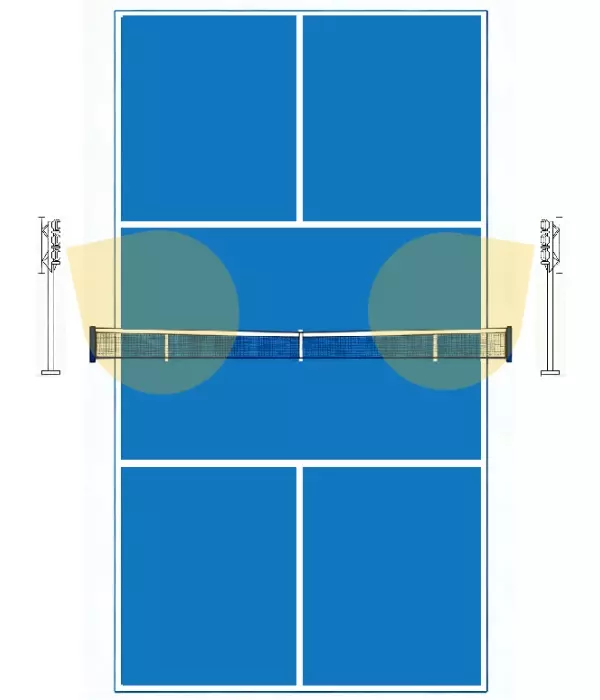
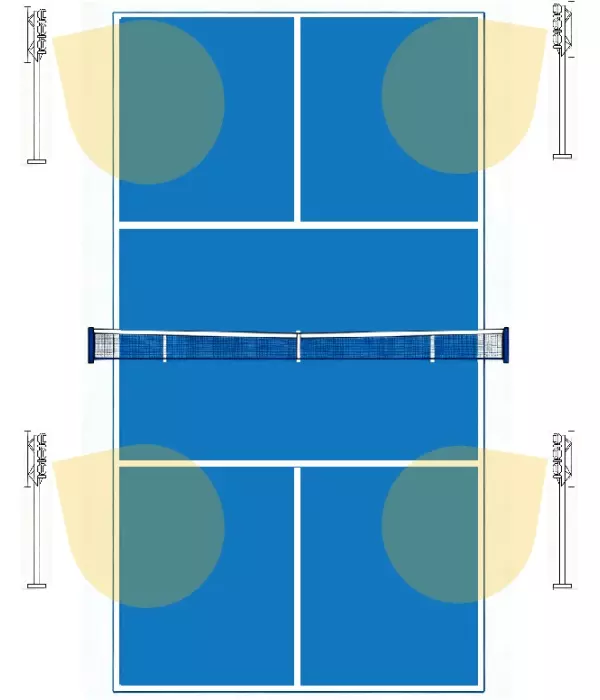
1. Single Court Layouts

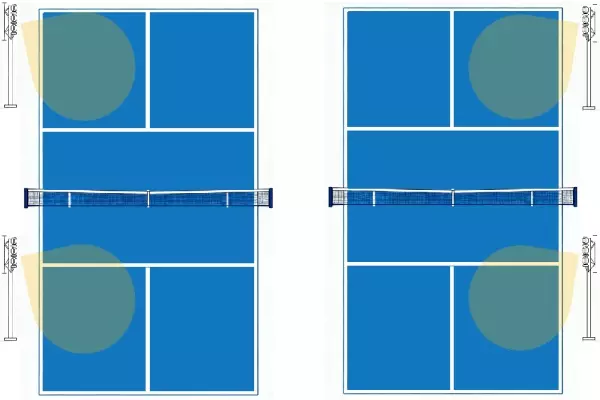
(1) 2-Pole Layout

Poles placed at opposite corners.

Affordable and quick to install.

Best for small backyards or casual play.

Uniformity is limited; corners may be darker.


(2) 4-Pole Layout

Two poles on each side of the court.

Provides better coverage and fewer shadows.

Ideal for home courts, community centers, and recreational facilities.

Slightly higher cost due to extra poles and fixtures.


单人匹克球场地,带2根球杆                单人匹克球场地,带4根球杆

                             Single-Court-with-2-poles                                                                     Single-Court-with-4-poles


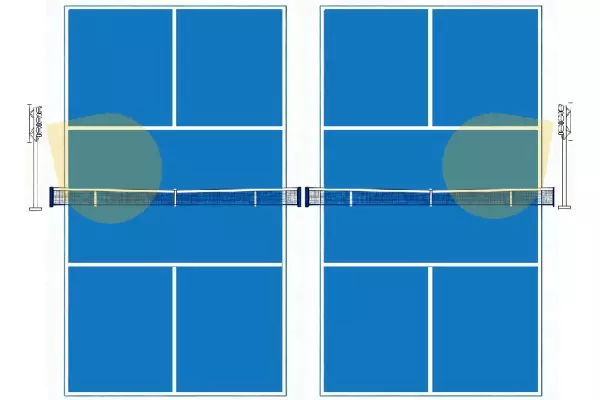
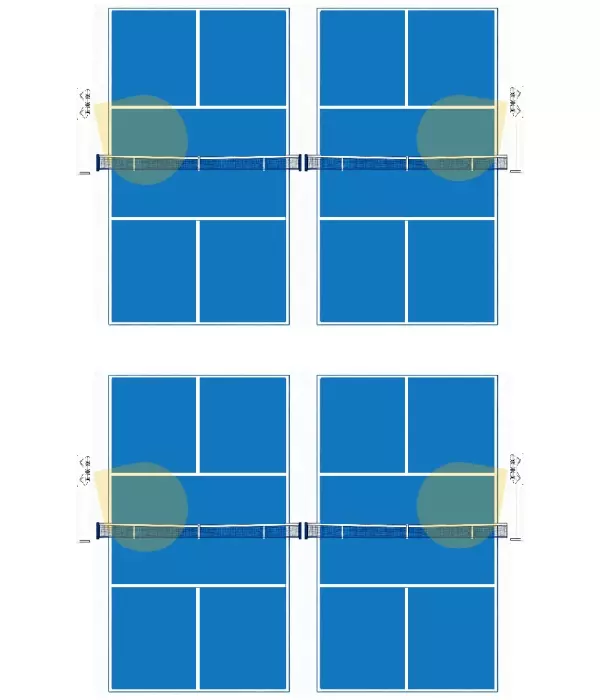
2. Two Courts Side-by-Side  

(1) 2-Pole Shared Layout

One pole at each end of the combined courts.

Can work for casual play if courts are aligned properly.

Risk of uneven lighting, especially at outer edges.


(2) 4-Pole Shared Layout

Two poles per side of the combined courts.

Provides more even illumination, reduces shadows between courts.

Mid-range budget solution for clubs or schools with two courts.


两个带两根柱子的匹克球场地          两个带4根球杆的匹克球场地

                                   Two-Courts-with-2-poles                                                                                 Two-Courts-with-4-poles


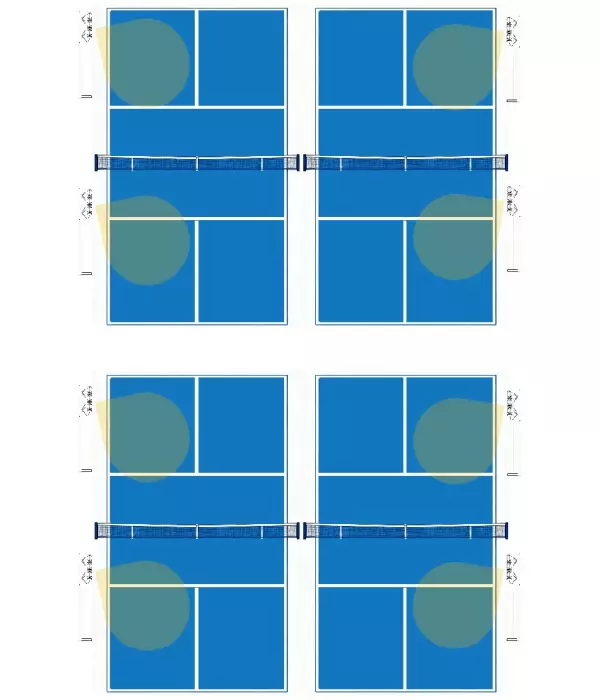
3. Four-Court or Multi-Court Layouts

(1) 4-Pole Layout

One pole at each corner of the entire complex.

Can cover multiple courts but uniformity is lower.

Works for casual or community play, not ideal for tournaments.


(2) 8-Pole Layout

Two poles per side of each court cluster.

Ensures uniform, competition-level lighting across all courts.

Supports higher lux requirements and reduces glare.

Most expensive option due to additional poles, fixtures, wiring, and stronger foundations.


四人匹克球场地,带 4 个球杆     四个匹克球场地,共 8 个球杆

                                    Four-Courts-with-4-poles                                                                             Four-Courts-with-8-poles


Key Considerations

Light Placement: Poles should avoid blocking sightlines and minimize shadows.

Spill-Light Control: More poles allow better control with visors or shields.

Energy Efficiency: Extra poles increase upfront cost but can improve uniformity, reducing wasted energy from over-lighting corners.


Choosing the right layout depends on number of courts, usage type, and budget. Recreational facilities may get by with fewer poles, while clubs and tournament venues benefit from larger layouts with higher uniformity.


LED vs Traditional Lighting — Which Is More Cost-Effective?

When comparing lighting options, most buyers look at upfront price vs long-term cost. For pickleball courts, LED almost always wins over traditional metal halide (MH).


LED lights use 60–70% less energy than metal halide.
This cuts monthly electricity bills immediately, especially for facilities that run lights several hours a night.


Maintenance is another major difference.
LED fixtures can run
50,000–100,000 hours with minimal servicing.
Metal halide bulbs often need replacement every 6–18 months, which adds both material and labor cost.


Light quality also matters in sports.
LED delivers
stable, flicker-free light, better color clarity, and quicker response.
Metal halide needs warm-up time and tends to dim as it ages, which affects visibility and consistency.


Lifespan is where LED saves the most money.
You may pay more upfront, but the long service life means fewer replacements, fewer lift rentals, and far less downtime.


In short, the LED pickleball lighting cost is higher at the beginning, but it provides the lowest lifetime cost and the best playing experience. For most courts—recreational or competitive—LED is the more cost-effective choice.


How to Reduce Pickleball Court Lighting Cost (Practical Tips)

You can cut your lighting budget by making a few smart decisions before installation. Below are the most practical ways to save money without hurting lighting quality.


Tip 1: Choose the Right Lighting Level

Recreational courts don’t need tournament-level lux.

Staying within the correct brightness range avoids unnecessary fixtures.

Less overdesign = lower equipment and energy costs.


Tip 2: Select High-Lumen-Per-Watt LED Fixtures

These LEDs deliver more brightness using less power.

Higher efficiency means fewer fixtures and reduced long-term bills.

This is one of the easiest ways to save without sacrificing quality.


Tip 3: Use Integrated Pole + Fixture Packages

Buying poles, brackets, and LED lights from one supplier prevents mismatched components.

Package pricing is usually lower than buying parts separately.

Installation becomes faster and cheaper.


Tip 4: Combine Circuits for Multi-Court Layouts

Shared wiring and trenching significantly reduce labor hours.

Electricians need fewer conduits and shorter cable runs.

Ideal for clubs planning two or more courts.


Tip 5: Work With Experienced Lighting Designers

Poor layouts lead to shadows or glare, which often requires rework.

专业设计确保杆的高度、间距和光学性能正确。

第一次就做对才能省钱。


建议六:规划未来扩张

如果以后可能会增加球场,现在就要确定电力系统的规模。

避免将来进行代价高昂的重新布线和挖沟作业。

这些策略有助于降低匹克球场照明的总成本,同时保持安全、稳定的照明。


结论

匹克球场照明成本通常差异很大取决于灯杆高度、灯具数量和安装条件。但在大多数情况下, LED 照明系统 凭借其节能、长寿命和低维护成本,可提供最低的终身成本。 


如果您想获得准确的预算,下一步最好的办法是根据场地尺寸和当地的安装要求,索取一份定制的照明报价 。量身定制的方案可以帮助您避免超支,并确保照明满足您的运动需求和长期预期。


关于匹克球场照明成本的常见问题

匹克球场地需要多少盏灯?
大多数球场使用
4-6 盏灯。四盏灯足以满足休闲娱乐的需求,而六盏灯则能为竞技选手提供更好的照明效果和更少的阴影。


最佳灯杆高度是多少?
典型的灯杆高度在
20 至 26 英尺之间。较高的灯杆可以减少眩光并提高光线均匀性,但也会增加材料和安装成本。


理想的功率是多少?大多数室外球场使用300瓦至400瓦的LED灯具
效果都很好
。这个功率范围既能提供充足的亮度,又不会浪费能源或产生过多的眩光。


我可以自己安装匹克球场照明灯吗?
通常不行。照明灯安装涉及
高压线路、混凝土基础和结构安全。大多数城市都要求由持证电工或合格的承包商进行这项工作。


LED匹克球灯的寿命有多长?
高品质的LED灯通常可以使用
5万至10万小时。这意味着多年持续稳定的照明输出,维护成本极低,长期成本也更低。


是否有官方的照明标准?
目前没有统一的国家标准,但大多数指南建议照度在
150-300 勒克斯以上。休闲球场的照度通常较低,而竞技球场则需要更高的亮度和更好的均匀性。


联系我们进行项目评估和精确报价

给我们打电话 +86 0755 23000096, 给我们发邮件 [email protected] 或提交表单以获取更多信息或获得个性化报价。