_thumb.jpg)
Guide complet des coûts d'éclairage des terrains de pickleball 2026
Table des matières
Quels sont les facteurs qui déterminent le coût de l'éclairage d'un terrain de pickleball ?
Coût de l'éclairage d'un terrain de pickleball : ventilation des prix moyens
Scénarios spéciaux de coûts d'éclairage (rénovations, mises à niveau et conversions)
Six configurations d'éclairage courantes et leurs différences de coût
Éclairage LED ou éclairage traditionnel ? Lequel est le plus rentable ?
Comment réduire les coûts d'éclairage d'un terrain de pickleball (Conseils pratiques)
FAQ sur le coût de l'éclairage d'un terrain de pickleball
Il est essentiel de comprendre le coût de l'éclairage d'un terrain de pickleball, que vous envisagiez un aménagement dans votre jardin, la rénovation d'un terrain communautaire ou la construction d'une installation commerciale.
Ce guide détaille les prix réels en 2025, y compris les fourchettes de prix, les principaux facteurs qui affectent votre budget, les configurations d'éclairage courantes et les questions fréquemment posées, afin que vous puissiez planifier en toute confiance et éviter les dépenses inutiles.
Quels sont les facteurs qui déterminent le coût de l'éclairage d'un terrain de pickleball ?
Plusieurs facteurs clés influent sur le coût total de l'éclairage d'un terrain de pickleball. Comprendre chacun d'eux vous aide à établir un budget réaliste et à éviter les mauvaises surprises.
1) Type d'éclairage : LED ou halogénures métalliques
Les luminaires LED coûtent plus cher à l'achat, mais consomment beaucoup moins d'énergie et ne nécessitent quasiment aucun entretien.
Les halogénures métalliques (MH) sont moins chers à l'achat, mais consomment plus d'énergie, ont un temps de chauffe plus long et une durée de vie plus courte.
La plupart des nouveaux courts optent pour les LED car cela réduit les coûts d'exploitation à long terme.
2) Nombre de luminaires et puissance
Un court typique utilise des luminaires LED de 300W à 600W .
Plus de puissance = luminosité plus élevée.
Plus de luminaires = meilleure uniformité et moins d'ombres.
La puissance et la quantité augmentent directement le coût de l'équipement.
3) Poteaux d'éclairage (hauteur, matériau, quantité)
Des poteaux plus hauts (6 à 8 mètres) améliorent la couverture, mais coûtent plus cher.
Les poteaux en acier sont la norme ; les poteaux plus robustes augmentent le prix.
Une configuration de base peut utiliser 4 poteaux , tandis que les configurations plus grandes ou professionnelles peuvent nécessiter 6 à 8 poteaux .
4) Agencement des courts : Court unique ou multiple
Un seul terrain nécessite moins de luminaires et de poteaux.
Les courts côte à côte nécessitent un éclairage plus uniformément réparti afin d'éviter les zones d'ombre.
Les complexes multicourts présentent naturellement le coût total le plus élevé.
5) Exigences d'éclairage (niveau de lux)
La norme européenne EN 12193:2017 classe les performances d'éclairage sportif en trois catégories officielles . Le pickleball appartient à la même catégorie que les autres sports de balle courte en extérieur ; le même cadre s'applique donc :
• Classe I – Compétitions internationales et nationales (≥ 500 lux)
Ce niveau est adapté au jeu rapide, aux matchs professionnels et à une éventuelle diffusion télévisée.
Les joueurs bénéficient d'une excellente visibilité grâce à une uniformité très élevée et un contrôle strict des reflets.
L'obtention de ce niveau nécessite généralement davantage de mâts, des luminaires à plus forte intensité lumineuse et un réglage précis.
• Classe II – Compétition régionale/club (300–500 lux) :
Convient aux ligues de clubs, aux centres d’entraînement et aux compétitions régulières.
Les joueurs peuvent suivre confortablement les tirs rapides grâce à une luminosité équilibrée et une bonne uniformité.
La plupart des clubs de pickleball commerciaux visent cette fourchette.
• Classe III – Loisirs / Jeux communautaires (200–300 lux)
Conçue pour les parcs, les terrains municipaux et l'entraînement général.
Offre un éclairage sûr et confortable à un coût abordable, comparable à celui des systèmes de compétition.
Un nombre réduit de luminaires et un flux lumineux plus faible permettent de maîtriser le budget.
Pourquoi le coût est proportionnel à la classe :
passer de la classe III à la classe I exige un flux lumineux plus élevé, une uniformité plus stricte (objectifs U0/U1) et une meilleure optique pour contrôler l’éblouissement et la lumière parasite. Des performances supérieures impliquent généralement davantage de luminaires, des mâts plus robustes et une ingénierie plus poussée, ce qui augmente directement le coût total du projet.
6) Difficulté d'installation
Les coûts augmentent avec la complexité des tranchées, du câblage, des conduits et des fondations de poteaux .
Un sol dur, de longues distances de câbles ou un terrain accidenté augmentent le temps de travail.
7) Type de système de contrôle
Les interrupteurs de base sont peu coûteux.
Les commandes intelligentes (minuteries, accès à distance, variation d'intensité lumineuse) ajoutent du confort mais coûtent plus cher.
Ces facteurs expliquent ensemble pourquoi les prix de l'éclairage des terrains de pickleball varient considérablement d'un projet à l'autre.
Coût de l'éclairage d'un terrain de pickleball : ventilation des prix moyens
Comprendre le prix actuel de l'éclairage pour terrains de pickleball vous permettra d'établir un budget réaliste. Vous trouverez ci-dessous une ventilation détaillée des coûts pour 2025, incluant l'équipement, l'installation et le coût total du projet.
1. Coût total typique (estimations 2025)
Terrain individuel : 6 000 $ à 12 000 $. Convient aux résidences, aux petites collectivités et aux besoins récréatifs de base.
Deux terrains (côte à côte) : 10 000 $ à 18 000 $. Les poteaux partagés réduisent le coût par terrain, ce qui rend cette configuration plus économique.
Courts de compétition : 18 000 $ à 30 000 $. Une luminosité plus élevée, un plus grand nombre de poteaux et une uniformité plus stricte font augmenter le prix.
Ces chiffres incluent l'équipement et l'installation, mais varient selon le lieu et la complexité du projet.
2. Ventilation des coûts d'équipement
Le matériel d'éclairage représente généralement la part la plus importante du budget.
Luminaires LED : 300 $ à 800 $ l’unité. Le prix varie en fonction de la puissance, de l’optique et de la qualité de la marque.
Poteaux : 400 $ à 1 500 $ chacun. Les poteaux plus hauts ou plus épais coûtent plus cher.
Matériel de montage : 100 $ à 300 $. Comprend les supports, les bras et les raccords étanches.
Systèmes de contrôle : 200 $ à 1 200 $. Les interrupteurs de base se situent dans la fourchette basse ; les systèmes de contrôle intelligents coûtent plus cher mais permettent d’économiser de l’énergie.
3. Ventilation des coûts d'installation
La main-d'œuvre et les travaux sur site peuvent avoir une influence significative sur le prix final.
Main-d'œuvre : 1 000 $ à 3 000 $. Les tarifs dépendent des électriciens locaux et de l'envergure du projet.
Câblage et tranchées : 800 $ à 2 000 $. Les longs trajets ou les sols durs augmentent le coût.
Travaux de fondation : 500 $ à 2 000 $ Les bases des poteaux doivent être suffisamment stables pour supporter les charges du vent.
Ces éléments expliquent le coût d'installation d'un éclairage pour un terrain de pickleball et les variations de prix d'un projet à l'autre. Ce détail vous donne une idée réaliste du coût avant de demander un devis complet.
Scénarios spéciaux de coûts d'éclairage (rénovations, mises à niveau et conversions)
Moderniser ou transformer un terrain de pickleball ne signifie pas forcément repartir de zéro. Le coût varie selon les installations existantes et les éléments réutilisables. Vous trouverez ci-dessous les scénarios les plus courants et une estimation des dépenses.
1. Remplacement des anciens équipements uniquement
Si vos poteaux sont encore en bon état, remplacer vos anciens éclairages MH par des LED est la mise à niveau la plus simple et la moins coûteuse.
Coût : 2 000 $ à 6 000 $ par tribunal
Kits de remplacement ou de conversion LED 1:1
Main-d'œuvre minimale car les fondations et les poteaux restent inchangés
Il peut être nécessaire de refaire le câblage si les anciens circuits ne prennent pas en charge les drivers LED.
Cette option est idéale lorsque la configuration répond déjà à vos besoins en éclairage.
2. Remplacement des luminaires et des poteaux
Certains terrains ont besoin de plus que de nouveaux éclairages, surtout si les poteaux sont trop courts, rouillés ou mal positionnés.
Coût : 6 000 $ à 14 000 $ par tribunal
Comprend de nouveaux poteaux, des supports de fixation et des fondations neuves.
Permet la mise à niveau vers des hauteurs de poteaux modernes qui améliorent l'uniformité.
Souvent nécessaire pour les courts visant un éclairage de niveau tournoi
Choisissez cette solution lorsque vos poteaux existants ne répondent plus aux normes structurelles ou d'éclairage.
3. Ajout de nouveaux accessoires (visières, boucliers, outils de visée et plus encore)
Les accessoires permettent de résoudre les problèmes d'éclairage sans remplacer l'ensemble du système. Ils sont particulièrement utiles pour contrôler la diffusion de la lumière et améliorer l'uniformité de l'éclairage.
Types d'accessoires courants et fourchettes de prix :
Visières / Pare-lumière — 50 $ à 150 $ chacune.
Réduisent la pollution lumineuse latérale dans les zones résidentielles. Utiles lorsque les voisins habitent près du terrain de sport.
Écrans de coupure totale — 120 $ à 250 $ par luminaire.
Offrent un contrôle plus strict de la lumière. Idéaux lorsque les terrains de sport bordent des maisons, des routes ou des zones sensibles.
Pare-soleil — 80 $ à 180 $ par projecteur.
Réduisent l’éblouissement pour les joueurs. Utiles lorsque les poteaux sont plus bas que recommandé ou de hauteurs différentes.
Supports de visée / Fixations réglables — 60 $ à 200 $ l'unité.
Améliorent la précision de visée. Couramment utilisés lors de la conversion de courts de tennis en courts de pickleball ou pour les installations plus anciennes présentant des angles de visée inadéquats.
Kits de contrôle du rétroéclairage — 150 $ à 300 $ par luminaire.
Réduisent la lumière parasite derrière le luminaire. Utile près des allées, des parkings et des limites de propriété.
Tenons supérieurs de poteau / traverses — 40 $ à 120 $ chacun.
Nécessaires pour ajouter des luminaires supplémentaires à un poteau ou pour ajuster la disposition pour des configurations multi-terrains.
Quand avez-vous besoin de ces accessoires ?
À proximité des habitations → visières, écrans, kits de rétroéclairage
Prévention de l'éblouissement → pare-soleil
Conversion des courts de tennis → supports de visée
Augmentation du nombre de fixations → nouveaux tenons ou traverses
Les accessoires offrent un excellent rapport qualité-prix car ils permettent d'ajuster l'éclairage sans travaux importants.
4. Construction d'un nouveau terrain de pickleball à partir de zéro
Les nouveaux courts nécessitent un système d'éclairage complet, comprenant poteaux, luminaires, câblage et fondations.
Coût : 6 000 $ à 12 000 $ pour l’éclairage seulement
La tarification est plus prévisible car l'agencement et l'emplacement des poteaux suivent les normes établies.
Idéal pour les collectivités, les clubs et les particuliers qui souhaitent une solution d'éclairage durable.
Cette option garantit une uniformité optimale, une maîtrise des déversements et une durabilité à long terme.
5. Transformer un court de tennis en terrain de pickleball
Transformer un court de tennis en terrain de pickleball est une solution économique pour les clubs et les installations sportives. Un court de tennis standard mesure 18 m × 36 m , soit bien plus que la surface recommandée de 9 m × 18 m pour un seul terrain de pickleball . Cet espace supplémentaire permet d'aménager plusieurs terrains de pickleball sur la surface existante, ce qui réduit les coûts de construction.
Combien de terrains de pickleball peuvent être aménagés ?
1 court de tennis → 2 terrains de pickleball (espacement confortable)
1 court de tennis → 4 terrains de pickleball (utilisation maximale, courant dans les clubs)
1 court de tennis → 6 terrains de pickleball (espacement réduit, zones à forte demande)
Compatibilité de l'éclairage :
Les courts de tennis utilisent souvent des poteaux de 10,5 à 12 m , positionnés loin de l'aire de jeu. Les courts de pickleball utilisent des poteaux de 6 à 8 m, plus proches des lignes de touche. En raison de cette différence :
Il peut être nécessaire de réorienter les luminaires pour maintenir un éclairage uniforme.
Certains terrains nécessitent des poteaux plus courts ou des équipements supplémentaires .
Les éclairages de tennis plus anciens peuvent créer des zones d'éblouissement sur les petits terrains de pickleball.
Coût de conversion typique
3 000 $ à 10 000 $ par tribunal, selon la quantité d'infrastructures existantes qui peuvent être réutilisées.
Poteaux bien positionnés → Remplacement des luminaires LED uniquement.
Poteaux mal alignés → de nouveaux poteaux, traverses ou fixations supplémentaires peuvent être nécessaires.
Les aménagements multi-terrains nécessitent souvent des accessoires de contrôle de la lumière parasite pour répondre aux normes d'uniformité.
La conversion des courts de tennis permet aux clubs de réduire les espaces inutilisés et d'augmenter la capacité d'accueil des terrains de pickleball sans avoir à construire de nouveaux bâtiments. La modernisation de l'éclairage garantit un éclairage moderne et efficace tout en préservant la majeure partie des infrastructures existantes.
Six configurations d'éclairage courantes et leurs différences de coût
L'agencement de l'éclairage de votre terrain de pickleball influe sur la visibilité et le coût total. Le nombre de poteaux, leur emplacement et l'angle des luminaires déterminent l'uniformité de l'éclairage et l'efficacité énergétique. Voici un guide pratique par numéro de terrain et type d'agencement.
1. Configurations de terrain à un seul court
(1) Disposition à 2 pôles
Poteaux placés aux coins opposés.
Abordable et rapide à installer.
Idéal pour les petits jardins ou les jeux occasionnels .
L'uniformité est limitée ; les coins peuvent être plus foncés.
(2) Disposition à 4 pôles
Deux poteaux de chaque côté du terrain.
Offre une meilleure couvrance et moins d'ombres .
Idéal pour les terrains de sport à domicile, les centres communautaires et les installations récréatives.
Coût légèrement supérieur en raison des poteaux et fixations supplémentaires.
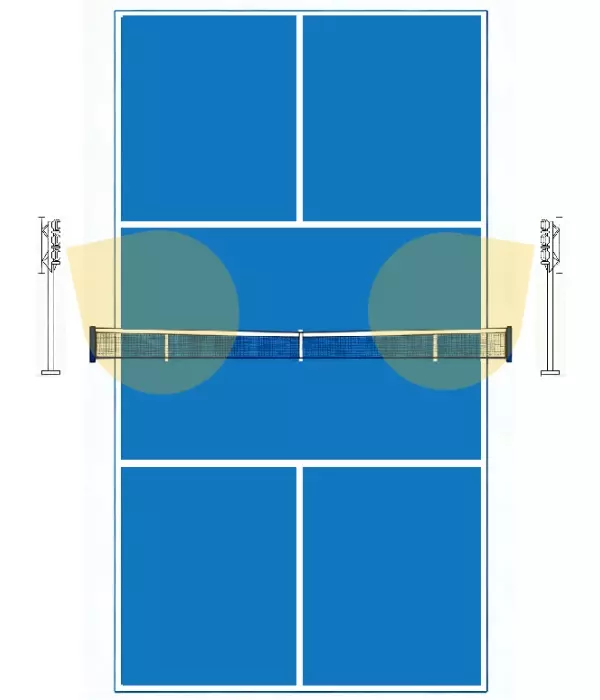
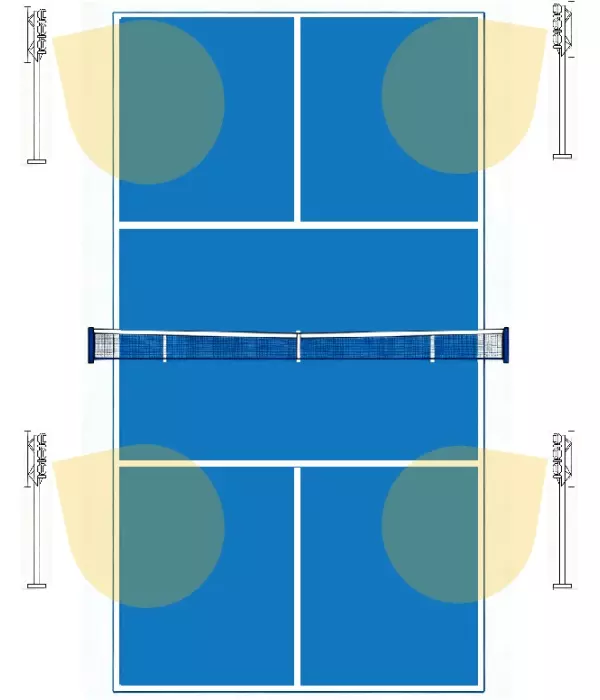
Terrain à un seul poteau (2 poteaux) Terrain à un seul poteau (4 poteaux)
2. Deux terrains côte à côte
(1) Configuration partagée à 2 pôles
Un poteau à chaque extrémité des courts réunis.
Peut convenir pour une partie occasionnelle si les terrains sont correctement alignés.
Risque d'éclairage inégal, notamment sur les bords extérieurs.
(2) Configuration partagée à 4 pôles
Deux poteaux de chaque côté des terrains réunis.
Assure un éclairage plus uniforme , réduit les ombres entre les courts.
Solution de milieu de gamme pour les clubs ou les écoles disposant de deux terrains.
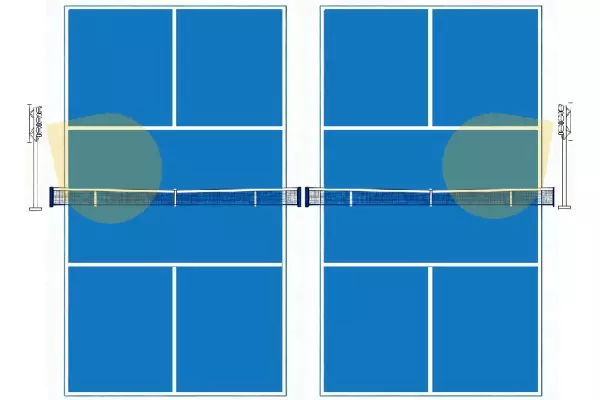
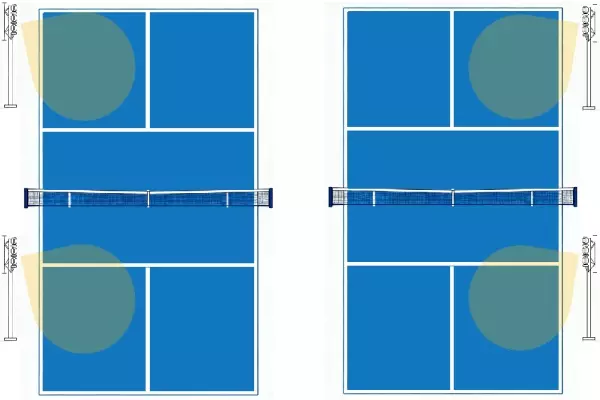
Deux terrains avec 2 poteaux Deux terrains avec 4 poteaux
3. Configurations à quatre courts ou à plusieurs courts
(1) Disposition à 4 pôles
Un poteau à chaque coin de l'ensemble du complexe.
Peut couvrir plusieurs terrains, mais l'uniformité est moindre.
Convient pour le jeu occasionnel ou communautaire , mais pas idéal pour les tournois.
(2) Disposition à 8 pôles
Deux poteaux de chaque côté de chaque groupe de terrains.
Assure un éclairage uniforme et conforme aux normes de compétition sur tous les courts.
Répond aux exigences de luminosité plus élevées et réduit l'éblouissement.
Option la plus coûteuse en raison des poteaux, des fixations, du câblage supplémentaires et des fondations plus robustes.
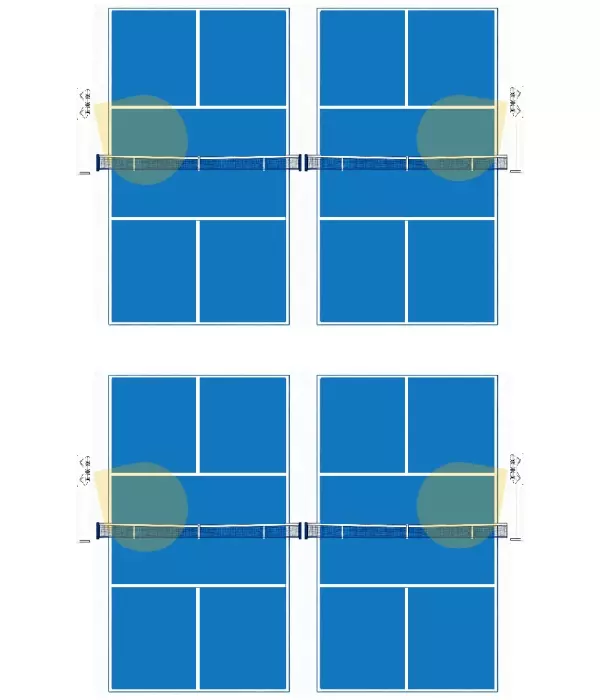
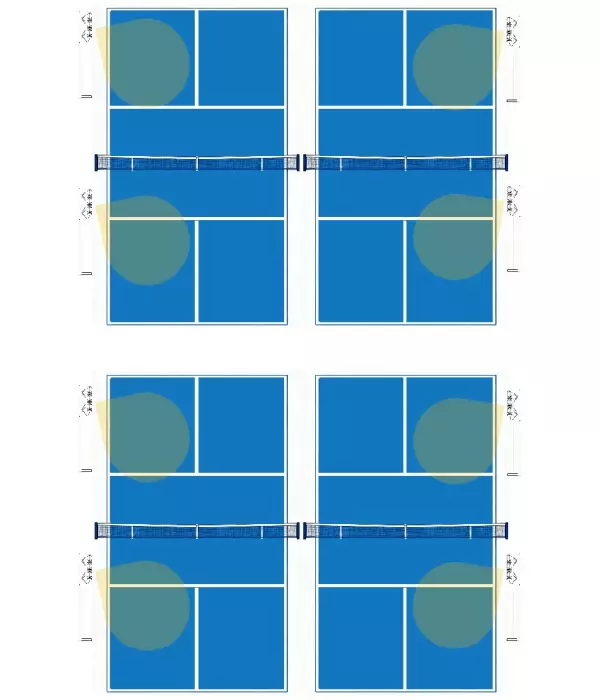
Terrains de quatre courts avec quatre poteaux Terrains de quatre courts avec huit poteaux
Considérations clés
Positionnement des luminaires : Les poteaux doivent éviter d’obstruer la vue et minimiser les ombres.
Contrôle de la lumière parasite : Un plus grand nombre de poteaux permet un meilleur contrôle avec les visières ou les écrans.
Efficacité énergétique : Les poteaux supplémentaires augmentent le coût initial, mais peuvent améliorer l’uniformité, réduisant ainsi le gaspillage d’énergie dû à un éclairage excessif des coins.
Le choix de la configuration idéale dépend du nombre de terrains, de leur utilisation et du budget . Les installations de loisirs peuvent se contenter de moins de poteaux, tandis que les clubs et les sites de compétition bénéficient de configurations plus vastes et plus uniformes.
Éclairage LED ou éclairage traditionnel ? Lequel est le plus rentable ?
Lorsqu'ils comparent les options d'éclairage, la plupart des acheteurs examinent le prix initial par rapport au coût à long terme . Pour les terrains de pickleball, les LED l'emportent presque toujours sur les lampes à halogénures métalliques traditionnelles (MH).
Les lampes LED consomment 60 à 70 % d'énergie en moins que les lampes à halogénures métalliques.
Cela permet de réduire immédiatement les factures d'électricité mensuelles, notamment pour les établissements qui utilisent l'éclairage plusieurs heures par nuit.
L'entretien constitue une autre différence majeure.
Les luminaires LED peuvent fonctionner de 50 000 à 100 000 heures avec un minimum d'entretien.
Les ampoules aux halogénures métalliques doivent souvent être remplacées tous les 6 à 18 mois, ce qui engendre des coûts supplémentaires liés aux matériaux et à la main-d'œuvre.
La qualité de l'éclairage est également importante dans le sport.
Les LED offrent une lumière stable et sans scintillement , une meilleure clarté des couleurs et une réponse plus rapide.
Les lampes aux halogénures métalliques nécessitent un temps de chauffe et ont tendance à perdre en intensité avec le temps, ce qui affecte la visibilité et la constance de l'éclairage.
C’est grâce à leur longue durée de vie que les LED permettent de réaliser les plus grandes économies.
Certes, leur coût initial est plus élevé, mais leur longévité exceptionnelle réduit considérablement les remplacements, les locations de nacelles et les temps d’arrêt.
En résumé, l' éclairage LED pour pickleball coûte plus cher à l'achat, mais il offre le coût total le plus bas et une expérience de jeu optimale. Pour la plupart des terrains, qu'ils soient de loisirs ou de compétition, l'éclairage LED est le choix le plus rentable.
Comment réduire les coûts d'éclairage d'un terrain de pickleball (Conseils pratiques)
Vous pouvez réduire votre budget éclairage en faisant quelques choix judicieux avant l'installation. Voici les solutions les plus pratiques pour économiser de l'argent sans compromettre la qualité de l'éclairage.
Conseil 1 : Choisissez le bon niveau d’éclairage
Les courts de loisirs n'ont pas besoin d'un éclairage de niveau compétition.
Rester dans la plage de luminosité appropriée permet d'éviter les luminaires inutiles.
Moins de surdimensionnement = coûts d'équipement et d'énergie réduits.
Conseil n° 2 : Choisissez des luminaires LED à haut rendement lumineux (lumens par watt)
Ces LED offrent une luminosité accrue en consommant moins d'énergie.
Une efficacité accrue signifie moins d'équipements et des factures réduites à long terme.
C'est l'un des moyens les plus simples d'économiser sans sacrifier la qualité.
Conseil 3 : Utilisez des ensembles poteau + luminaire intégrés
L'achat des poteaux, des supports et des éclairages LED auprès d'un seul fournisseur permet d'éviter les problèmes de compatibilité des composants.
Le prix du forfait est généralement inférieur à celui des pièces achetées séparément.
L'installation devient plus rapide et moins coûteuse.
Conseil 4 : Combiner les circuits pour les configurations à plusieurs tribunaux
Le câblage et le creusement de tranchées partagés réduisent considérablement les heures de travail.
Les électriciens ont besoin de moins de conduits et de câbles plus courts.
Idéal pour les clubs qui prévoient deux courts ou plus.
Conseil n° 5 : Travaillez avec des concepteurs d’éclairage expérimentés
Une mauvaise disposition des éléments entraîne des ombres ou des reflets, ce qui nécessite souvent des retouches.
Une conception professionnelle garantit une hauteur de poteau, un espacement et une optique corrects.
Réussir du premier coup permet d'économiser le plus d'argent.
Conseil n° 6 : Prévoyez votre expansion future
Si vous envisagez d'ajouter d'autres courts ultérieurement, dimensionnez dès maintenant votre installation électrique.
Permet d'éviter des travaux de recâblage et de tranchées coûteux à l'avenir.
Ces stratégies permettent de réduire le coût total de l'éclairage du pickleball tout en maintenant un éclairage sûr et constant.
Conclusion
Le coût de l'éclairage d'un terrain de pickleball varie généralement considérablement en fonction de la hauteur des poteaux, du nombre de luminaires et des conditions d'installation. Cependant, dans la plupart des cas, les systèmes LED offrent le coût total le plus bas grâce à leurs économies d'énergie, leur longue durée de vie et leur entretien minimal.
Pour obtenir un budget précis, la meilleure solution est de demander un devis d'éclairage personnalisé, établi en fonction des dimensions de votre terrain et des contraintes d'installation locales. Un plan sur mesure vous permettra d'éviter les dépenses excessives et garantira que l'éclairage réponde à vos besoins de jeu et à vos attentes à long terme.
FAQ sur le coût de l'éclairage d'un terrain de pickleball
Combien de projecteurs faut-il pour un terrain de pickleball ?
La plupart des terrains utilisent 4 à 6 projecteurs . Quatre projecteurs suffisent pour une partie amicale, tandis que six offrent un meilleur éclairage et moins d’ombres pour les joueurs de compétition.
Quelle est la hauteur de poteau idéale ?
La hauteur de poteau standard se situe entre 6 et 8 mètres . Des poteaux plus hauts réduisent l’éblouissement et améliorent l’uniformité, mais ils augmentent également les coûts des matériaux et de l’installation.
Quelle puissance est idéale ?
La plupart des terrains extérieurs fonctionnent bien avec des luminaires LED de 300 à 400 W. Cette gamme offre une forte luminosité sans gaspillage d’énergie ni éblouissement excessif.
Puis-je installer moi-même l'éclairage d'un terrain de pickleball ?
Généralement non. L'installation d'éclairage nécessite des câblages haute tension, des fondations en béton et le respect des normes de sécurité structurelle . La plupart des villes exigent qu'un électricien agréé ou un entrepreneur qualifié effectue les travaux.
Quelle est la durée de vie des lampes LED pour pickleball ?
Les LED de haute qualité ont généralement une durée de vie de 50 000 à 100 000 heures . Cela garantit des années d’éclairage constant avec un minimum d’entretien et des coûts réduits à long terme.
Existe-t-il des normes d'éclairage officielles ?
Il n'existe pas de norme nationale unique, mais la plupart des recommandations préconisent un éclairage de 150 à 300 lux, voire plus . Les terrains de loisirs restent dans la fourchette basse, tandis que les terrains de compétition nécessitent une luminosité plus élevée et une meilleure uniformité.