_thumb.jpg)
Guía completa del costo de la iluminación de canchas de pickleball (2026)
Tabla de contenido
¿Qué determina el costo de iluminación de la cancha de pickleball?
Costo de la iluminación de la cancha de pickleball: desglose del precio promedio
Escenarios especiales de costos de iluminación (remodelaciones, actualizaciones y conversiones)
Seis diseños de iluminación comunes y sus diferencias de costo
Iluminación LED vs. iluminación tradicional: ¿cuál es más rentable?
Cómo reducir el coste de la iluminación de la cancha de pickleball (Consejos prácticos)
Preguntas frecuentes sobre el costo de la iluminación de canchas de pickleball
Comprender el costo de iluminación de la cancha de pickleball es esencial ya sea que esté planeando instalar una cancha en el patio trasero, mejorando una cancha comunitaria o construyendo una instalación comercial.
Esta guía desglosa los precios reales en 2025, incluidos rangos de costos, factores clave que afectan su presupuesto, diseños de iluminación comunes y preguntas frecuentes, para que pueda planificar con confianza y evitar gastos innecesarios.
¿Qué determina el costo de iluminación de la cancha de pickleball?
Varios factores clave determinan el costo total de la iluminación de una cancha de pickleball. Comprender cada uno de ellos te ayudará a calcular un presupuesto realista y evitar sorpresas.
1) Tipo de iluminación: LED vs. haluro metálico
Las luminarias LED cuestan más inicialmente, pero consumen mucha menos energía y prácticamente no requieren mantenimiento.
El haluro metálico (MH) es más barato inicialmente, pero consume más energía, se calienta más lentamente y tiene una vida útil más corta.
La mayoría de los tribunales nuevos eligen LED porque reduce los costos operativos a largo plazo.
2) Número de luminarias y potencia
Una cancha típica utiliza luminarias LED de 300W a 600W .
Más potencia = mayor brillo.
Más luminarias = mejor uniformidad y menos sombras.
Tanto el vataje como la cantidad aumentan directamente el costo del equipo.
3) Postes de iluminación (altura, material, cantidad)
Los postes más altos (de 20 a 26 pies) mejoran la cobertura pero cuestan más.
Los postes de acero son estándar; los postes más pesados aumentan el precio.
Una configuración básica puede utilizar 4 postes , mientras que las configuraciones más grandes o profesionales pueden necesitar entre 6 y 8 postes .
4) Disposición de la cancha: Cancha única vs. Cancha múltiple
Una sola cancha necesita menos luces y postes.
Las canchas contiguas requieren una iluminación distribuida de manera más uniforme para evitar zonas oscuras.
Los complejos con múltiples canchas naturalmente tienen el costo total más elevado.
5) Requisitos de iluminación (nivel de lux)
La norma europea EN 12193:2017 divide el rendimiento de la iluminación deportiva en tres clases oficiales . El pickleball se clasifica en la misma categoría que otros deportes al aire libre de pelota pequeña, por lo que se aplica el mismo marco:
• Clase I – Competición Internacional y Nacional (≥500 lux).
Este nivel permite jugar a alta velocidad, partidos profesionales y su posible uso en retransmisiones.
Los jugadores disfrutan de una excelente visibilidad con una uniformidad muy alta y un estricto control del deslumbramiento.
Alcanzar esta clase suele requerir más postes, luminarias con mayor luminosidad y una puntería precisa.
• Clase II – Competición Regional/Club (300–500 lux)
Ideal para ligas de clubes, centros de entrenamiento y competiciones regulares.
Los jugadores pueden seguir tiros rápidos cómodamente gracias a su brillo equilibrado y buena uniformidad.
La mayoría de los clubes de pickleball comerciales apuntan a este rango.
• Clase III – Juego recreativo/comunitario (200–300 lux)
Diseñado para parques, canchas comunitarias y prácticas generales.
Proporciona una iluminación segura y cómoda sin el coste de los sistemas de competición.
Menos luminarias y menor flujo luminoso permiten un presupuesto asequible.
Por qué el costo se ajusta a la clase:
Pasar de la Clase III a la Clase I requiere una mayor salida de lúmenes, una uniformidad más precisa (objetivos U0/U1) y mejores ópticas para controlar el deslumbramiento y la dispersión de luz. Un mayor rendimiento generalmente implica más luminarias, postes más resistentes y una ingeniería más detallada, lo que aumenta directamente el costo total del proyecto.
6) Dificultad de instalación
Los costos aumentan con zanjas complejas , cableado, conductos y cimientos de postes .
Los suelos duros, las largas distancias de cables o los terrenos irregulares aumentan las horas de trabajo.
7) Tipo de sistema de control
Los interruptores básicos son económicos.
Los controles inteligentes (temporizadores, acceso remoto, atenuación) agregan comodidad pero cuestan más.
Estos factores juntos explican por qué los precios de iluminación de las canchas de pickleball varían tanto de un proyecto a otro.
Costo de la iluminación de la cancha de pickleball: desglose del precio promedio
Conocer los precios más recientes de la iluminación para canchas de pickleball te ayudará a planificar un presupuesto realista. A continuación, se presenta un desglose claro de costos para 2025, que incluye equipo, instalación y el alcance total del proyecto.
1. Costo total típico (estimaciones para 2025)
Cancha individual: $6,000–$12,000 Adecuada para hogares, comunidades pequeñas y necesidades recreativas básicas.
Dos canchas (una al lado de la otra): $10,000–$18,000 Los postes compartidos reducen el costo por cancha, lo que hace que esta configuración sea más económica.
Canchas de nivel de competencia: $18,000–$30,000 Un mayor brillo, más postes y una uniformidad más estricta aumentan el precio.
Estos números incluyen equipo + instalación, pero varían según la ubicación y la complejidad del proyecto.
2. Desglose del costo del equipo
El equipo de iluminación suele representar la mayor parte del presupuesto.
Luminarias LED: $300–$800 cada una El precio cambia según el vataje, la óptica y la calidad de la marca.
Postes: $400–$1,500 cada uno Los postes más altos o de mayor calibre cuestan más.
Herrajes de montaje: $100–$300 Incluye soportes, brazos y accesorios resistentes a la intemperie.
Sistemas de control: $200–$1,200 Los interruptores básicos se encuentran en el extremo inferior; los controles inteligentes cuestan más, pero ahorran energía.
3. Desglose del costo de instalación
La mano de obra y el trabajo en obra pueden influir significativamente en el precio final.
Mano de obra: $1,000–$3,000 Las tarifas dependen de los electricistas locales y del tamaño del proyecto.
Cableado y zanjas: $800–$2,000 Los tramos más largos o el suelo duro aumentan el costo.
Trabajos de cimentación: $500–$2,000 Las bases de los postes deben ser lo suficientemente estables para soportar cargas de viento.
En conjunto, estos elementos explican el costo de instalar la iluminación de una cancha de pickleball y por qué el precio varía de un proyecto a otro. Este desglose le ofrece un punto de partida realista antes de solicitar un presupuesto detallado.
Escenarios especiales de costos de iluminación (remodelaciones, actualizaciones y conversiones)
Modernizar o convertir una cancha de pickleball no siempre implica empezar desde cero. El costo varía según lo que ya exista en el lugar y cuánto se pueda reutilizar. A continuación, se presentan los escenarios más comunes y el gasto estimado.
1. Reemplazo de accesorios antiguos únicamente
Si sus postes aún están en buenas condiciones, cambiar las viejas luces MH por LED es la actualización más simple y económica.
Costo: $2,000–$6,000 por cancha
Reemplazos de LED 1:1 o kits de modernización
Mano de obra mínima porque los cimientos y los postes permanecen iguales
Puede requerir un nuevo cableado si los circuitos antiguos no admiten controladores LED
Esta opción es ideal cuando el diseño ya satisface sus necesidades de iluminación.
2. Reemplazo de luminarias y postes
Algunas canchas necesitan más que luces nuevas, especialmente si los postes son demasiado cortos, están oxidados o no están ubicados correctamente.
Costo: $6,000–$14,000 por cancha
Incluye nuevos postes, soportes de luminarias y cimientos nuevos.
Permite actualizar a alturas de postes modernas que mejoran la uniformidad.
A menudo es necesario para canchas que buscan una iluminación de nivel de torneo.
Elija esta ruta cuando sus postes existentes ya no cumplan con los estándares estructurales o de iluminación.
3. Añadir nuevos accesorios (visores, escudos, herramientas de puntería y más)
Los accesorios ayudan a solucionar problemas de iluminación sin tener que reemplazar todo el sistema. Son especialmente útiles para controlar la dispersión de luz y mejorar la uniformidad.
Tipos de accesorios comunes y rangos de costos:
Viseras/Protectores de luz: $50–$150 cada una.
Reducen la dispersión de luz lateral en zonas residenciales. Útiles cuando los vecinos viven cerca de la cancha.
Protectores de corte completos: $120–$250 por luminaria
. Ofrecen un control de iluminación más estricto. Ideales para áreas contiguas a viviendas, carreteras o zonas sensibles.
Campanas Antideslumbrantes: $80–$180 por luminaria.
Reducen el deslumbramiento para los jugadores. Útiles cuando los postes son más bajos de lo recomendado o tienen alturas desiguales.
Soportes de puntería/Montajes ajustables: $60–$200 cada uno.
Mejoran la precisión de puntería. Comunes en conversiones de tenis a pickleball o en instalaciones antiguas con ángulos deficientes.
Kits de control de retroiluminación: $150–$300 por luminaria.
Reducen la dispersión de luz detrás de la luminaria. Útiles cerca de aceras, estacionamientos y límites de propiedad.
Espigas/crucetas para extremos de postes: $40–$120 cada una.
Se requieren cuando se agregan accesorios adicionales a un poste o se ajusta el diseño para configuraciones de varias canchas.
¿Cuándo necesitas estos accesorios?
Cerca de casa → viseras, protectores, kits de retroiluminación
Prevención del deslumbramiento → campanas antideslumbrantes
Conversión de pistas de tenis → soportes de puntería
Ampliación del número de accesorios → nuevas espigas o crucetas
Los accesorios ofrecen un valor excelente porque ajustan la iluminación sin necesidad de realizar grandes obras.
4. Construir una nueva cancha de pickleball desde cero
Las canchas nuevas requieren un paquete de iluminación completo, incluidos postes, accesorios, cableado y cimientos.
Costo: $6,000–$12,000 solo por iluminación
Los precios son más predecibles porque el diseño y la ubicación de los postes siguen pautas estándar
Ideal para comunidades, clubes y propietarios que desean una solución de iluminación a largo plazo.
Esta opción garantiza una uniformidad adecuada, control de derrames y durabilidad a largo plazo.
5. Convertir una cancha de tenis en una de pickleball
Convertir una cancha de tenis a pickleball es una opción rentable para clubes e instalaciones. Una cancha de tenis estándar mide 18,3 x 36,6 metros , mucho más grande que el área recomendada de 9,1 x 18,3 metros para una sola cancha de pickleball . Este espacio adicional permite que varias canchas de pickleball quepan en el espacio existente, ahorrando costos de construcción.
¿Cuántas canchas de Pickleball caben?
1 cancha de tenis → 2 canchas de pickleball (distancia cómoda)
1 cancha de tenis → 4 canchas de pickleball (utilización máxima, común en clubes)
1 cancha de tenis → 6 canchas de pickleball (espacios reducidos, áreas de alta demanda)
Compatibilidad de iluminación.
Las canchas de tenis suelen usar postes de 10 a 12 metros , ubicados lejos del área de juego. Las canchas de pickleball usan postes de 6 a 7 metros, más cerca de las líneas laterales. Debido a esta diferencia:
Es posible que sea necesario reorientar las luminarias para mantener una iluminación uniforme.
Algunas canchas requieren postes más cortos o accesorios adicionales .
La iluminación de tenis más antigua puede crear puntos de deslumbramiento en canchas de pickleball más pequeñas.
Costo de conversión típico
Entre 3.000 y 10.000 dólares por cancha, dependiendo de cuánta infraestructura existente se pueda reutilizar.
Postes bien posicionados → Solo reemplazo de luminarias LED.
Postes desalineados → es posible que se requieran nuevos postes, crucetas o accesorios complementarios.
Las conversiones de múltiples canchas a menudo necesitan accesorios de control de luz difusa para cumplir con los estándares de uniformidad.
La conversión de canchas de tenis permite a los clubes reducir el espacio de tenis no utilizado y aumentar la capacidad de pickleball sin tener que construir desde cero. La modernización de la iluminación garantiza una iluminación moderna y eficiente, manteniendo intacta la mayor parte de la infraestructura existente.
Seis diseños de iluminación comunes y sus diferencias de costo
La distribución de la iluminación de su cancha de pickleball afecta tanto la visibilidad como el costo total. La cantidad de postes, la ubicación y los ángulos de las luminarias determinan la uniformidad de la iluminación y la eficiencia energética. Aquí tiene una guía práctica según el número de cancha y el tipo de distribución.
1. Diseños de cancha única
(1) Disposición de 2 polos
Postes colocados en esquinas opuestas.
Asequible y rápido de instalar.
Ideal para patios pequeños o juegos informales .
La uniformidad es limitada; las esquinas pueden ser más oscuras.
(2) Disposición de 4 polos
Dos postes a cada lado de la cancha.
Proporciona una mejor cobertura y menos sombras .
Ideal para canchas locales, centros comunitarios e instalaciones recreativas.
Costo ligeramente mayor debido a postes y accesorios adicionales.
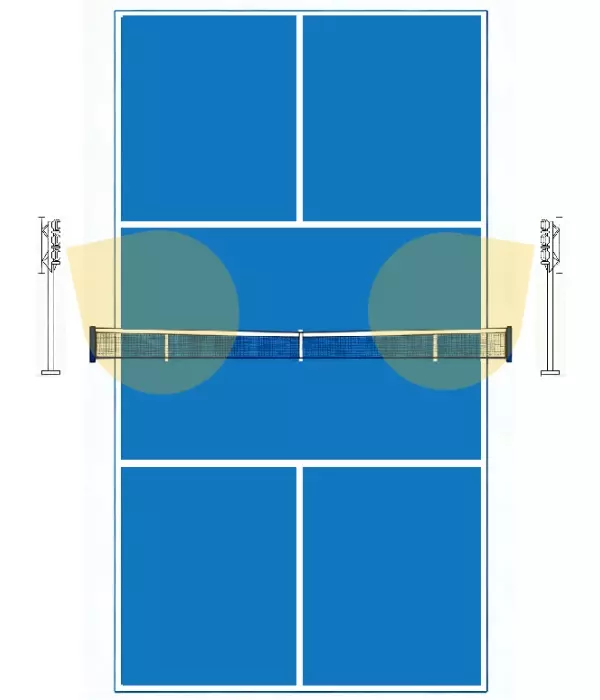
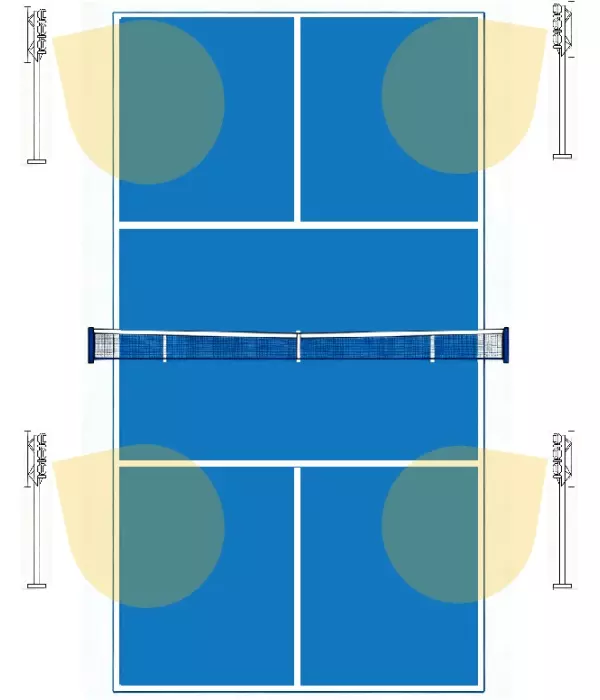
Cancha única con 2 postes Cancha única con 4 postes
2. Dos canchas una al lado de la otra
(1) Disposición compartida de 2 polos
Un poste en cada extremo de las canchas combinadas.
Puede funcionar para juegos casuales si las canchas están alineadas correctamente.
Riesgo de iluminación desigual, especialmente en los bordes exteriores.
(2) Disposición compartida de 4 polos
Dos postes por lado de las canchas combinadas.
Proporciona una iluminación más uniforme , reduce las sombras entre pistas.
Solución de presupuesto medio para clubes o escuelas con dos canchas.
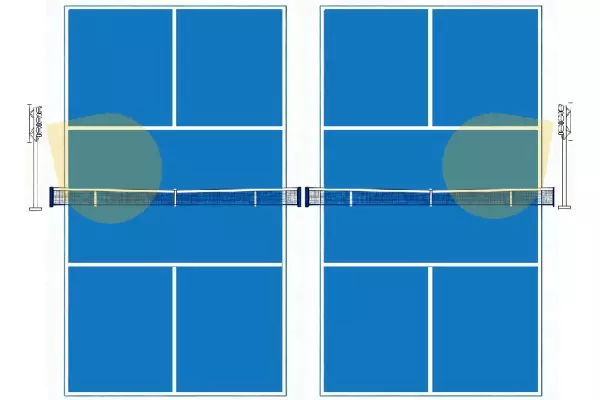
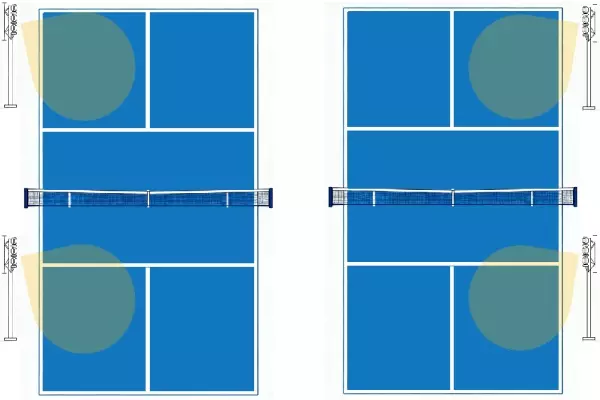
Dos canchas con 2 postes Dos canchas con 4 postes
3. Diseños de cuatro canchas o de varias canchas
(1) Disposición de 4 polos
Un poste en cada esquina de todo el complejo.
Puede cubrir varias canchas pero la uniformidad es menor.
Funciona para juegos casuales o comunitarios , no es ideal para torneos.
(2) Disposición de 8 polos
Dos postes por lado de cada grupo de canchas.
Garantiza una iluminación uniforme y de nivel competitivo en todas las canchas.
Admite mayores requisitos de lux y reduce el deslumbramiento.
La opción más cara debido a los postes, accesorios y cableado adicionales y cimientos más fuertes.
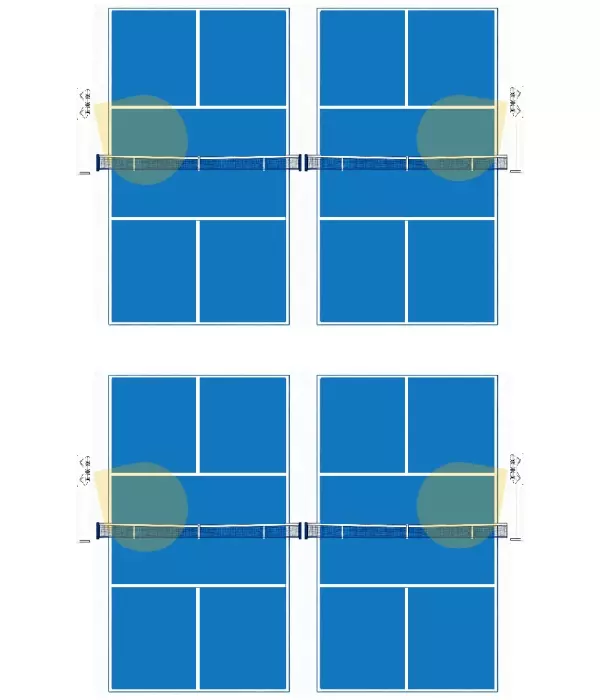
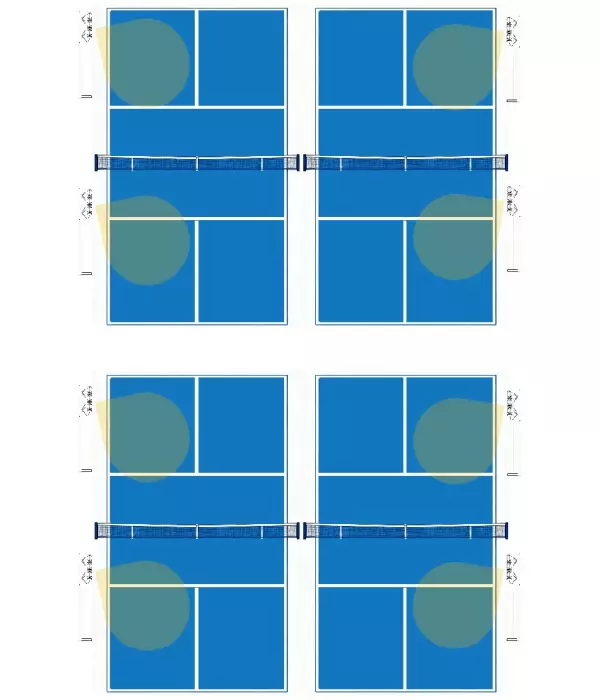
Cuatro canchas con 4 postes Cuatro canchas con 8 postes
Consideraciones clave
Ubicación de la iluminación: Los postes deben evitar bloquear las líneas de visión y minimizar las sombras.
Control de derrame de luz: más postes permiten un mejor control con viseras o protectores.
Eficiencia energética: Los postes adicionales incrementan el costo inicial pero pueden mejorar la uniformidad, reduciendo el desperdicio de energía por iluminación excesiva en las esquinas.
La elección del diseño adecuado depende del número de canchas, el tipo de uso y el presupuesto . Las instalaciones recreativas pueden funcionar con menos postes, mientras que los clubes y recintos de torneos se benefician de diseños más amplios y con mayor uniformidad.
Iluminación LED vs. iluminación tradicional: ¿cuál es más rentable?
Al comparar opciones de iluminación, la mayoría de los compradores se fijan en el precio inicial frente al coste a largo plazo . Para las canchas de pickleball, la iluminación LED casi siempre supera a la tradicional de halogenuros metálicos (MH).
Las luces LED consumen entre un 60 % y un 70 % menos de energía que las de halogenuros metálicos.
Esto reduce inmediatamente las facturas mensuales de electricidad, especialmente en instalaciones que utilizan las luces varias horas por noche.
El mantenimiento es otra diferencia importante.
Las luminarias LED pueden funcionar entre 50 000 y 100 000 horas con un mantenimiento mínimo.
Las bombillas de halogenuros metálicos suelen necesitar cambiarse cada 6 a 18 meses, lo que aumenta el coste de material y mano de obra.
La calidad de la luz también es importante en los deportes.
El LED ofrece una luz estable y sin parpadeos , mayor claridad de color y una respuesta más rápida.
El haluro metálico necesita tiempo de calentamiento y tiende a atenuarse con el tiempo, lo que afecta la visibilidad y la consistencia.
La vida útil es donde los LED ahorran más dinero.
Puede que pague más al principio, pero su larga vida útil implica menos reemplazos, menos alquileres de ascensores y mucho menos tiempo de inactividad.
En resumen, la iluminación LED para pickleball es más cara al principio, pero ofrece el menor coste de vida útil y la mejor experiencia de juego. Para la mayoría de las canchas, tanto recreativas como competitivas, la iluminación LED es la opción más rentable.
Cómo reducir el coste de la iluminación de la cancha de pickleball (Consejos prácticos)
Puedes reducir tu presupuesto de iluminación tomando algunas decisiones inteligentes antes de la instalación. A continuación, te presentamos las maneras más prácticas de ahorrar dinero sin sacrificar la calidad de la iluminación.
Consejo 1: Elija el nivel de iluminación adecuado
Las canchas recreativas no necesitan lujos a nivel de torneo.
Mantenerse dentro del rango de brillo correcto evita luminarias innecesarias.
Menos sobrediseño = menores costos de equipo y energía.
Consejo 2: Seleccione luminarias LED con alto contenido de lúmenes por vatio
Estos LED proporcionan más brillo utilizando menos energía.
Una mayor eficiencia significa menos accesorios y facturas más bajas a largo plazo.
Esta es una de las formas más fáciles de ahorrar sin sacrificar la calidad.
Consejo 3: Utilice paquetes integrados de postes y accesorios
Comprar postes, soportes y luces LED de un solo proveedor evita que los componentes no coincidan.
El precio del paquete suele ser más bajo que comprar las piezas por separado.
La instalación se vuelve más rápida y económica.
Consejo 4: Combine circuitos para diseños de varias canchas
El cableado y las zanjas compartidos reducen significativamente las horas de trabajo.
Los electricistas necesitan menos conductos y tramos de cable más cortos.
Ideal para clubes que planean dos o más canchas.
Consejo 5: Trabaje con diseñadores de iluminación experimentados
Los diseños deficientes generan sombras o reflejos que a menudo requieren revisión.
Un diseño profesional garantiza la altura, el espaciado y la óptica correctos de los postes.
Hacerlo bien la primera vez es lo que ahorra más dinero.
Consejo 6: Planifique la expansión futura
Si es posible agregar más canchas más adelante, dimensione el sistema eléctrico ahora.
Evita costosos recableados y zanjas en el futuro.
Estas estrategias ayudan a reducir el costo total de iluminación del pickleball y al mismo tiempo mantienen una iluminación segura y constante.
Conclusión
El costo de la iluminación de una cancha de pickleball suele variar considerablemente , dependiendo de la altura de los postes, la cantidad de luminarias y las condiciones de instalación. Sin embargo, en la mayoría de los casos, los sistemas LED ofrecen el menor costo de vida útil gracias a su ahorro de energía, larga vida útil y mínimo mantenimiento.
Si desea un presupuesto preciso, lo mejor es solicitar un presupuesto de iluminación personalizado según el tamaño de su cancha y las necesidades de instalación locales. Un plan a medida le ayuda a evitar gastos excesivos y garantiza que la iluminación satisfaga sus necesidades de juego y expectativas a largo plazo.
Preguntas frecuentes sobre el costo de la iluminación de canchas de pickleball
¿Cuántas luces necesito para una cancha de pickleball?
La mayoría de las canchas usan de 4 a 6 luces . Cuatro luces son suficientes para el juego casual, mientras que seis ofrecen mejor cobertura y menos sombras para los jugadores competitivos.
¿Cuál es la altura ideal para los postes?
La altura típica de los postes oscila entre 6 y 8 metros . Los postes más altos reducen el deslumbramiento y mejoran la uniformidad, pero también aumentan los costos de material e instalación.
¿Cuál es la potencia ideal?
La mayoría de las pistas exteriores funcionan bien con luminarias LED de 300 W a 400 W. Esta gama ofrece una gran luminosidad sin desperdiciar energía ni deslumbrar excesivamente.
¿Puedo instalar las luces de pickleball yo mismo?
Generalmente no. La instalación de iluminación implica cableado de alto voltaje, cimientos de concreto y seguridad estructural . La mayoría de las ciudades exigen un electricista certificado o un contratista calificado para realizar el trabajo.
¿Cuánto duran las luces LED para pickleball?
Las luces LED de alta calidad suelen durar entre 50 000 y 100 000 horas . Esto significa años de iluminación constante con un mantenimiento mínimo y menores costes a largo plazo.
¿Existen estándares oficiales de iluminación?
No existe un estándar nacional único, pero la mayoría de las directrices recomiendan entre 150 y 300 lux o más . Las canchas recreativas se mantienen en el extremo inferior, mientras que las de competición necesitan mayor luminosidad y uniformidad.