_thumb.jpg)
Understanding BUG Rating Lighting - Ceramiclite
When designing an outdoor illumination project, whether for a commercial parking lot or a sports complex perimeter, controlling where the light goes is just as crucial as the light itself. This is where bug rating lighting standards come into play. Developed by the Illuminating Engineering Society (IES) and the International Dark-Sky Association (IDA), the BUG rating system is a comprehensive method used to evaluate and limit the amount of stray light emitted by outdoor light fixtures.
In this complete guide, we will break down what BUG stands for, explore the core issues of light pollution it solves, and provide the essential Maximum Zonal Lumens charts you need to select the perfect compliant LED fixtures for your next project.
The Problem: Light Trespass, Sky Glow, and Glare
The BUG Rating Charts: Maximum Zonal Lumens Explained
Applying BUG Ratings: The 5 Lighting Zones (LZ0 - LZ4)
Physical Shielding: The Hardware Side of Light Control
Other Factors Preventing Glare and Light Trespass
The Problem: Light Trespass, Sky Glow, and Glare
Before diving into the numbers and photometric charts, it is essential to understand why the IES created this system. Historically, older technologies like HID lamps or poorly designed non-shielded LEDs emitted light in almost all directions. This lack of optical control leads to three major environmental and safety issues in outdoor spaces:
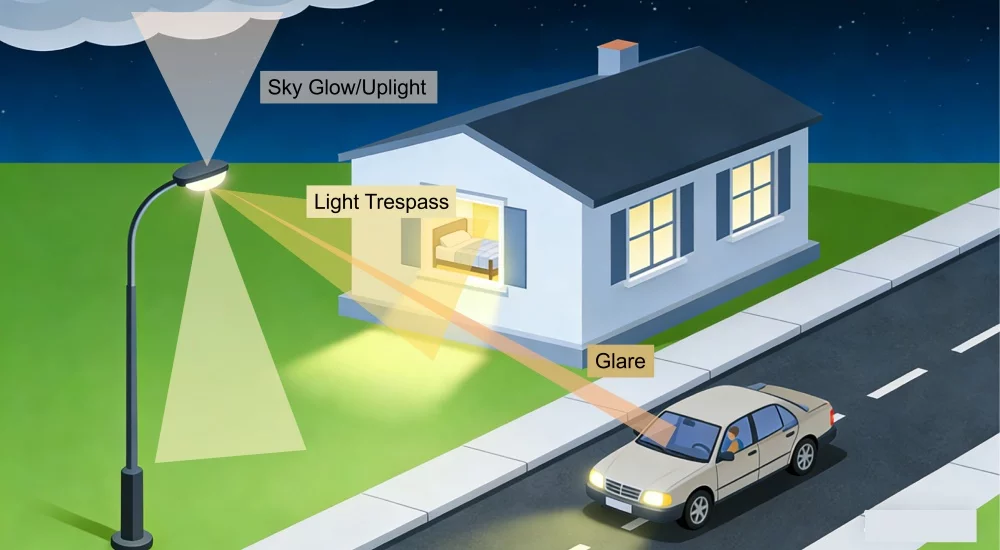
l Light Trespass: This occurs when unwanted light spills over property lines. A classic example is a harsh street pole light shining directly into a neighboring residential bedroom window, causing nuisance, sleep disruption, and potential legal complaints.
l Light Pollution (Sky Glow): When light is directed upward into the night sky, it scatters in the atmosphere, washing out the starlight and creating a glowing orange dome over cities. Sky glow not only wastes massive amounts of energy but also disrupts human circadian rhythms and wreaks havoc on nocturnal wildlife ecosystems.
l Glare: Glare happens when excessively bright, high-angle light enters the human eye directly from the light source. It causes severe visual discomfort and, in worst-case scenarios, creates "disability glare"—temporarily blinding drivers or pedestrians and creating significant safety hazards.
The BUG system was specifically engineered by lighting professionals to quantify and restrict these three exact problems.
Learn more: How does stadium lighting reduce glare?
What Does B.U.G. Stand For?
The acronym B.U.G. stands for Backlight, Uplight, and Glare. The system assigns a numeric value from 0 (most stringent optical control) to 5 (least control/most stray light) for each of these three metrics.
These ratings are not guessed; they are precisely calculated based on the luminaire's photometric data (often via an IES file). The system measures the lumen output within specific 3D angular zones—known as solid angles or the Luminaire Classification System (LCS)—around the fixture.
Here is what each letter represents in practical project terms:
B - Backlight (Controlling Light Trespass)
Backlight refers to the light emitted behind the luminaire. Imagine you are installing a perimeter area light on the property line of an industrial facility. You want the light to project forward into your own parking lot, not backward onto the adjacent property. A strict (low) Backlight rating ensures zero or minimal light trespass behind the pole, keeping you compliant with local property regulations.
U - Uplight (Controlling Sky Glow)
Uplight measures any light directed at or above the horizontal plane (90 degrees and higher) of the luminaire. This is the primary culprit behind light pollution. To meet Dark Sky compliance or achieve LEED certification credits, outdoor fixtures must typically achieve a strict U0 rating, meaning absolutely zero light is wasted by being emitted upward into the night sky.
G - Glare (Controlling Visual Discomfort)
Glare evaluates the forward light emitted at high angles (usually between 60 and 90 degrees). While you need forward light to illuminate the ground effectively, if the angle is too high, it hits the eyes of drivers instead of the pavement. A low Glare rating ensures the light beam is pushed downward where it is actually needed, protecting visual comfort and maintaining site safety.
The BUG Rating Charts: Maximum Zonal Lumens Explained
Understanding that B.U.G. stands for Backlight, Uplight, and Glare is only the first step. To truly utilize the system, lighting designers need to know how a fixture earns its specific rating (from 0 to 5).
These ratings are not arbitrary. According to the IES TM-15-11 standard, the 0-5 scale is strictly determined by the Maximum Zonal Lumens—the absolute maximum amount of light (measured in lumens) a fixture is allowed to emit within specific three-dimensional angular zones. A rating of "0" indicates the strictest optical control (lowest lumens allowed), while a "5" indicates the most lenient control.
Below are the detailed IES tables showing the lumen limits for each rating.
Backlight Ratings (B0 - B5)
Backlight is evaluated across several vertical zones behind the luminaire. To achieve a specific B rating, the fixture's lumen output must not exceed the limits in any of these zones:
Ø BVH (Backlight Very High): 80° - 90°
Ø BH (Backlight High): 60° - 80°
Ø BM (Backlight Mid): 30° - 60°
Ø BL (Backlight Low): 0° - 30°
Backlight Rating | BVH (80°-90°) Max Lumens | BH (60°-80°) Max Lumens | BM (30°-60°) Max Lumens | BL (0°-30°) Max Lumens |
B0 | 10 | 110 | 220 | 110 |
B1 | 110 | 500 | 1,000 | 500 |
B2 | 225 | 1,000 | 2,500 | 1,000 |
B3 | 500 | 2,500 | 5,000 | 2,500 |
B4 | 500 | 5,000 | 8,500 | 5,000 |
B5 | > 500 | > 5,000 | > 8,500 | > 5,000 |
Uplight Ratings (U0 - U5)
Uplight evaluates the light spilling above the horizontal plane. It is divided into two primary zones:
Ø UH (Uplight High): 100° - 180° (Directly into the sky)
Ø UL (Uplight Low): 90° - 100° (Just above horizontal)
Expert Note: If you are aiming for Dark Sky compliance or LEED certification for an outdoor project, U0 is the industry standard. It guarantees zero lumens are wasted on sky glow.
Uplight Rating | UH (100°-180°) Max Lumens | UL (90°-100°) Max Lumens |
U0 | 0 | 0 |
U1 | 10 | 10 |
U2 | 50 | 50 |
U3 | 500 | 500 |
U4 | 1,000 | 1,000 |
U5 | > 1,000 | > 1,000 |
Glare Ratings (G0 - G5)
Glare is uniquely evaluated because the acceptable amount of forward and backward high-angle light depends heavily on the fixture's optic type. The IES provides two separate tables based on whether the luminaire has an Asymmetrical (directional) or Symmetrical (circular/square) light distribution.
Table A: Glare Rating for Asymmetrical Luminaire Types
(Applies to Type I, II, III, and IV optics—commonly used in streetlights, shoebox lights, and forward-throw area lights. Limits are generally stricter because the light is pushed directionally.)
Glare Rating | FVH (Forward Very High 80°-90°) | FH (Forward High 60°-80°) |
G0 | 10 | 110 |
G1 | 250 | 250 |
G2 | 225 | 400 |
G3 | 500 | 750 |
G4 | 750 | 1,200 |
G5 | > 750 | > 1,200 |
Table B: Glare Rating for Symmetrical Luminaire Types
(Applies to Type V and Type V Square optics—commonly used in the center of parking lots or high mast lighting, where light is distributed evenly in a 360-degree pattern.)
Glare Rating | FVH & BVH (80°-90°) Max Lumens | FH & BH (60°-80°) Max Lumens |
G0 | 10 | 110 |
G1 | 250 | 250 |
G2 | 225 | 400 |
G3 | 500 | 1,000 |
G4 | 750 | 1,500 |
G5 | > 750 | > 1,500 |
(Note: G-ratings also evaluate Backlight High/Very High zones depending on the exact photometric distribution, but forward high-angle lumens are the primary driver of the rating).
Applying BUG Ratings: The 5 Lighting Zones (LZ0 - LZ4)
Having a chart of Maximum Zonal Lumens is powerful, but a BUG rating is meaningless without environmental context. For instance, an area light with a B3 rating might be perfectly acceptable in downtown Chicago, but it would be a legal and environmental disaster if installed near Yellowstone National Park.
To solve this, the IES and IDA created Lighting Zones (LZ). When selecting outdoor lighting, you must first identify your site's LZ, which dictates the maximum allowable BUG rating.
Ø LZ0 (No Ambient Lighting): Pristine natural environments, national parks, and astronomical observatories. Lighting is only installed if absolutely necessary. Requirement: Extremely strict. Often mandates B1-U0-G0.
Ø LZ1 (Low Ambient Lighting): Rural areas, small towns, and residential outskirts. Wildlife and night skies are highly sensitive here.
Ø LZ2 (Moderate Ambient Lighting): Standard suburban commercial areas, residential neighborhoods, and light industrial parks. This is the most common zone for general outdoor applications.
Ø LZ3 (Moderately High Ambient Lighting): Large commercial districts, heavy industrial facility perimeters, and major highway intersections.
Ø LZ4 (High Ambient Lighting): Dense urban centers and high-activity entertainment districts (e.g., Times Square). High ambient light already exists, so higher BUG ratings (like B3 or B4) are often permissible.
Physical Shielding: The Hardware Side of Light Control
While BUG ratings are data-driven results calculated by photometric software (like DIALux or AGi32), how does a manufacturer actually achieve a B1, U0, or G1 rating? The answer lies in the physical hardware—specifically, the luminaire's shielding classification.
The design of the fixture's housing and lens directly dictates where the lumens can physically travel:
Ø Non-shielded: These fixtures (like traditional glass globe lights or bare wall packs) offer no optical control. Light radiates in all 360 degrees. They generate severe sky glow and glare, resulting in terrible BUG ratings (often U4/U5 and G4/G5).
Ø Semi-shielded: The housing blocks some upward light, but the lens typically drops below the fixture frame, allowing a significant amount of high-angle glare and lateral light trespass.
Ø Shielded: Designed to push the majority of light downward, but due to slightly exposed optics, a small fraction of light may still escape above the 90-degree horizontal line.
Ø Fully-shielded / Full Cutoff: The gold standard for modern LED outdoor lighting. In a full cutoff fixture, the LED modules are recessed, and the lens is completely flat with the housing. 0% of the light is emitted above 90 degrees.
If your project requires strict Dark Sky compliance, minimizing light trespass, or securing a perfect U0 rating, selecting a Full Cutoff LED fixture is the most reliable physical solution.
Other Factors Preventing Glare and Light Trespass
As a lighting professional, it is crucial to understand that you cannot evaluate an outdoor lighting project based solely on its BUG rating. While achieving a perfect B1-U0-G1 rating on a spec sheet is excellent, a poorly planned layout can still result in severe light trespass, glaring hot spots, and a rejected installation.
To create a truly compliant and comfortable outdoor environment, you must evaluate the BUG rating in conjunction with these critical optical and electrical factors:
Lumen Output and Over-Lighting
A common misconception is that a "Full Cutoff" fixture with a U0 (zero uplight) rating eliminates all sky glow. However, if you install a 60,000-lumen area light when a 15,000-lumen fixture would suffice, the sheer volume of light hitting the pavement will reflect upward. This reflected light contributes significantly to ambient sky glow and secondary glare. Always size your lumen output to meet the exact footcandle requirements of your task area—never over-light simply because LEDs are energy-efficient.
Kelvin / Correlated Color Temperature (CCT)
The color of the light matters just as much as its direction. The International Dark-Sky Association (IDA) strongly recommends an upper limit of 3000K for outdoor nighttime lighting. Why? Because higher color temperatures (like 4000K or 5000K) contain a much higher percentage of short-wavelength blue light. Blue light scatters much more aggressively in the earth's atmosphere (the same reason the sky is blue during the day), dramatically increasing the severity of sky glow and disrupting nocturnal wildlife. Even a perfectly shielded B0-U0-G0 fixture can be harmful to a Dark Sky environment if the CCT is 5000K.
Footcandles and Max/Min Ratio (Uniformity)
Glare is largely subjective and depends heavily on contrast. If a parking lot has extreme bright spots directly under the poles and dark shadows between them (a poor Max/Min Ratio), the human eye struggles to adapt. As pedestrians or drivers move from dark areas into the intense light, their pupils must rapidly constrict, causing severe discomfort glare. A well-designed photometric plan focuses on high uniformity (e.g., a Max/Min ratio of 3:1 or 4:1) rather than just pushing raw footcandles. A uniformly lit site with lower overall light levels is always safer and more visually comfortable than a high-contrast, glaring environment.
Conclusion
The BUG rating lighting system is the foundation of modern, responsible outdoor illumination. By rigorously measuring and controlling the Backlight, Uplight, and Glare through strict Maximum Zonal Lumen limits, we can effectively combat light trespass, preserve our night skies (sky glow), and eliminate dangerous visual discomfort.
Whether you are illuminating a commercial parking lot, securing an industrial facility perimeter, or designing exterior lighting for a community sports complex, understanding how to match your fixture's BUG rating to your specific Lighting Zone (LZ) is essential for compliance, safety, and community relations.
Don't navigate complex photometric requirements alone. At Ceramiclite, our engineering team specializes in high-performance, precision-optic LED lighting designed for the most demanding outdoor environments.
If your next project requires strict Dark Sky compliance, full-cutoff shielded designs, or precise IES photometric layouts to guarantee optimal B.U.G. ratings, we are here to help. Contact Ceramiclite's Lighting Experts today for a free consultation, custom photometric analysis, and a comprehensive overview of our low-glare LED area and floodlight solutions.