_thumb.jpg)
How to Reduce Glare in Sports Stadium Lighting?
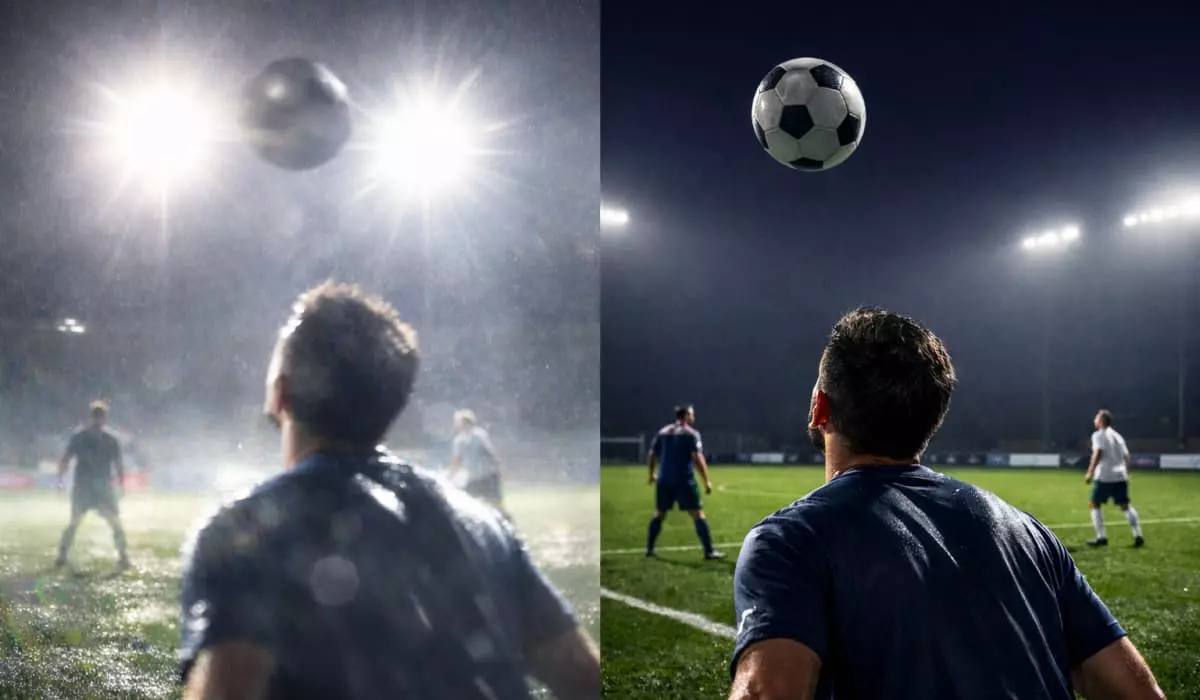
Imagine the final seconds of a championship match. A striker looks up to track a high ball, but for a split second, he is blinded by a piercing light. The ball is lost, the goal is missed, and the game is over.
This is the cost of uncontrolled glare.
In sports lighting, brightness (Lux) is not the only metric that matters. Visual comfort is equally critical. Whether you are managing a local tennis court or a professional football stadium, glare can turn a high-quality facility into a visual hazard.
Table of Contents
Why Glare Control is Non-Negotiable?
4 Core Strategies to Minimize Glare
Spotlight on CeramicLite: Engineered for Visual Comfort
Retrofitting Old Stadiums: A Quick Glare-Fix Guide
Why Glare Control is Non-Negotiable?
Many facility managers overlook glare until complaints start rolling in. However, in modern sports lighting design, minimizing glare is not a luxury—it is a necessity. Here is why:
(1) Player Safety & Injury Prevention
In high-speed sports like tennis, badminton, or baseball, players must frequently look up. If a lighting fixture creates a "blind spot" in their visual field, they lose track of fast-moving objects.
The Risk: A momentary loss of vision can lead to collisions, missed steps, or impact injuries.
The Reality: Safety standards require that lighting should never interfere with a player's spatial awareness.
(2) Fairness and Performance
Glare doesn't just hurt eyes; it hurts the game. "Disability Glare" reduces contrast, making it difficult to distinguish the ball from the background.
For Referees: It can lead to incorrect calls on crucial plays.
For Players: It causes rapid visual fatigue, reducing reaction times as the game progresses.
(3) Broadcast Quality & Spectator Experience
For stadiums hosting televised events, lighting must meet strict camera requirements.
TV Cameras: Lenses are more sensitive to high-contrast hotspots than the human eye. Uncontrolled glare causes lens flares and "washed out" images on HD/4K broadcasts.
Spectators: Fans in the stands should not have to squint to watch the action. Poor glare control can force spectators to shield their eyes, ruining the live experience.
Key Takeaway: Good lighting is invisible. It should highlight the game, not the light source itself.
The Metrics: UGR vs. GR
One of the biggest misconceptions in sports lighting is the standard for measuring glare. You will often hear the term UGR (Unified Glare Rating), but it is not always the right metric to use.
To ensure your facility is compliant, you must use the correct standard for your specific environment:
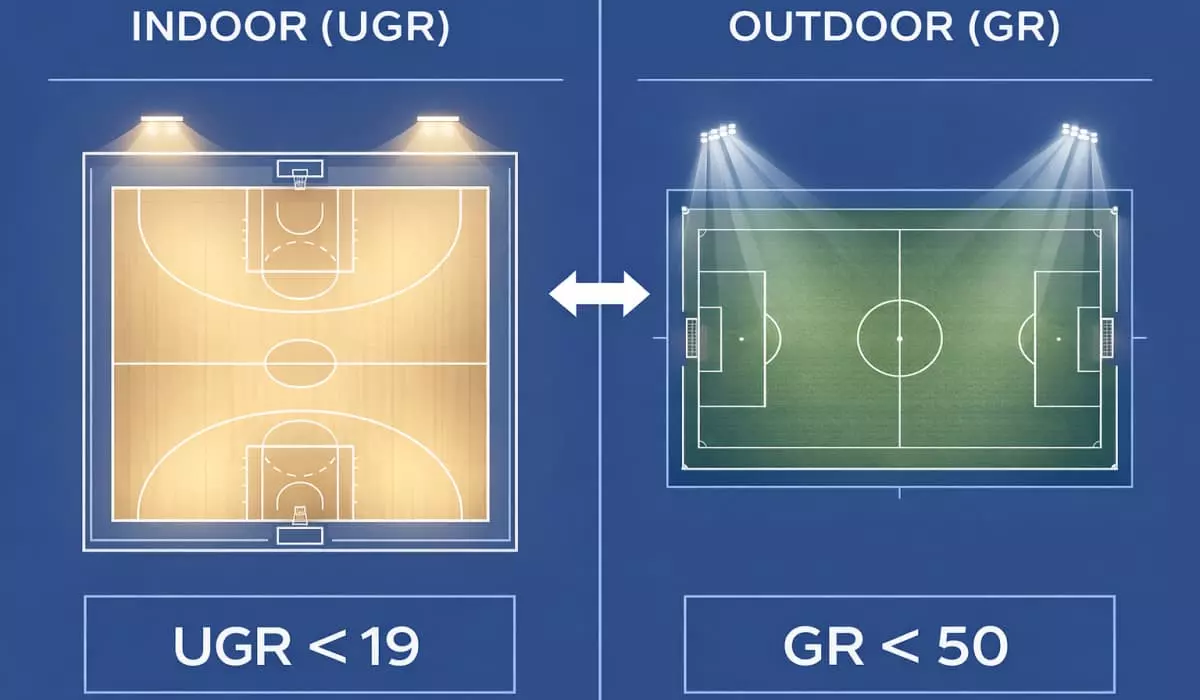
UGR (Unified Glare Rating) – For Indoor Sports
UGR is primarily calculated for indoor spaces like basketball arenas, badminton halls, or swimming pools. It measures the psychological glare response in a room with walls and ceilings.
How to read it: The lower the number, the better.
Common Standards (EN 12464-1):
Ø UGR ≤ 22: Acceptable for training and recreational use.
Ø UGR ≤ 19: Required for elite competitions and broadcasting.
GR (Glare Rating) – For Outdoor Sports
For outdoor fields (football, soccer, tennis), UGR is mathematically invalid because there are no reflective walls. Instead, we use GR (CIE 112).
How to read it: The scale runs from 10 (unnoticeable) to 90 (unbearable).
Common Standards (EN 12193):
Lighting Class | Application Level | Max GR Limit |
Class III | Recreational / Training | GR ≤ 55 |
Class II | Regional Competition | GR ≤ 50 |
Class I | National / International / TV | GR ≤ 40 |
Pro Tip: Do not trust a manufacturer who gives you a "UGR" value for an outdoor street or floodlight. They likely do not understand sports lighting engineering. For outdoor stadiums, always ask for the GR calculation based on your specific pole height and layout.
4 Core Strategies to Minimize Glare
Eliminating glare isn't magic; it is engineering. To achieve a glare-free stadium, you need to attack the problem from four angles: fixture design, installation geometry, environment, and control.
1. Fixture Design: Controlling Glare at the Source
This is the most critical step. 70% of glare issues stem from choosing the wrong luminaire. Cheap, generic LED floodlights often use clear glass covers and wide beam angles, causing light to scatter uncontrollably in all directions.
To solve this, look for Anti-glare LED sports lights with these features:
① Strict Shielding Angle (Cut-off):
A professional sports light must have a "cut-off" design. This means the light source is recessed deep into the housing.
The Standard: For outdoor stadiums, look for a physical cut-off angle of ≥45°. The deeper the light source is hidden, the harder it is for a player to look directly into the chip.
② Precision Optics:
Instead of a single large reflector, high-end fixtures use individual lenses (PC or PMMA) for each LED chip.
The Benefit: This creates a tight beam angle, directing light strictly onto the field and preventing "stray light" from escaping sideways into the eyes of spectators. Accessories like honeycomb louvers or frosted lenses can further break up the light intensity to soften the glow.
③ Fixture Choice:
Don't just look at the lens; look at the housing structure.
Pro Tip: Always specify fixtures with a "Deep-Recessed" or "Full Cut-off" design. This is the core engineering philosophy behind our CeramicLite series. By positioning the optical lenses deep inside the fixture body (rather than flush with the surface), we physically shield the high-intensity light source from the peripheral view.
The Result: Players can look across the field without their eyes being assaulted by the bright LED chips, creating a "quiet" visual environment.
2. Installation Geometry: Precision Aiming
Even the best light will cause glare if it is installed incorrectly. The geometry between the pole, the field, and the player is paramount.
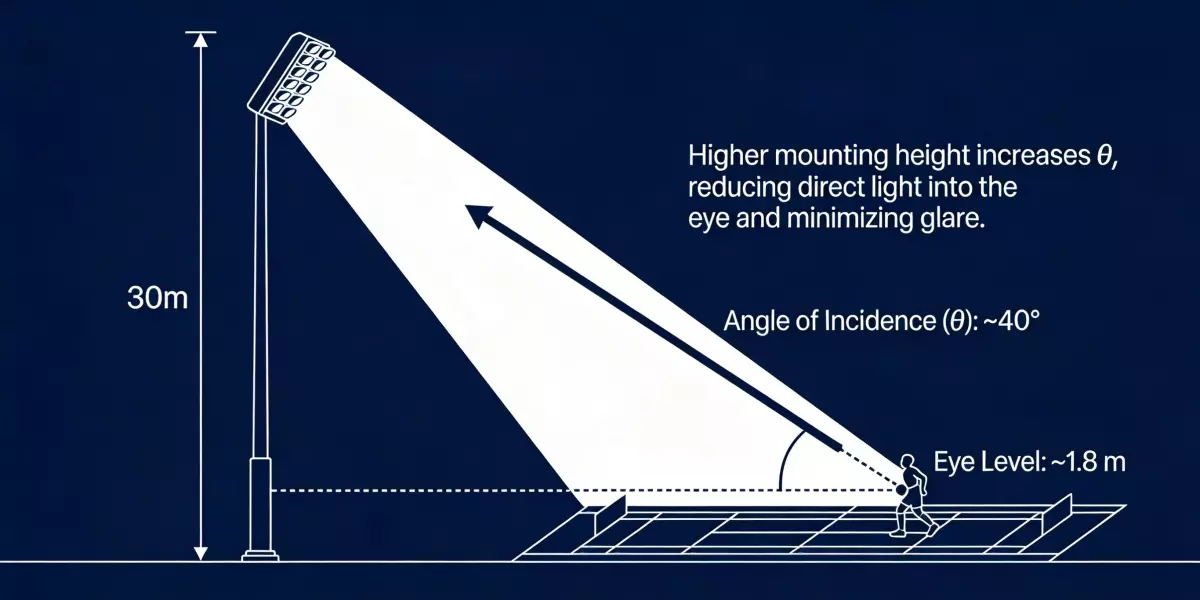
① Mounting Height (Higher is Better):
Low poles are the enemy of visual comfort. The lower the light, the flatter the angle, meaning the light shines directly into players' faces.
Rule of Thumb:
Indoor: ≥ 9m for volleyball/badminton.
Outdoor: ≥ 20m for recreational fields; ≥ 35m for professional stadiums.
Why: Higher mounting points allow for steeper aiming angles, keeping the light source above the players' normal line of sight.
② Aiming Angles (The "Tilt"):
The tilt of the fixture determines how much light hits the eye.
The Limit: The maximum aiming angle should generally be < 70° from the vertical.
The Projection Rule: Ensure the projection line doesn't cross the field at a shallow angle (< 30°), which creates a "searchlight" effect that blinds goalkeepers or outfielders.
③ Layout Strategy:
Avoid placing poles directly behind goalposts or in the corners for sports like tennis or badminton. Side lighting (placing poles along the sidelines) is almost always superior for reducing glare during gameplay.
3. Environmental Factors
Glare is often exacerbated by the surroundings.
The Problem: High-gloss surfaces act like mirrors. A polished gym floor or a white, shiny wall can reflect light up into players' eyes (Reflected Glare).
The Solution:
Flooring: Use matte-finish wood or non-reflective synthetic surfaces (Reflectance ≤ 20%).
Walls: Paint walls in matte, neutral colors (light grey or beige). Avoid pure white or glossy finishes near the ceiling line.
4. Smart Control Systems
Do you need championship-level brightness for a Tuesday night training session? No. High brightness often equals higher glare potential.
The Solution: Implement a DALI or 0-10V dimming system.
Ø Training Mode: Dim lights to 300 Lux (reducing glare potential significantly).
Ø Match Mode: Increase to 500 Lux.
Ø Broadcast Mode: Full power.
This dynamic approach minimizes visual fatigue for daily users while saving energy.
Spotlight on CeramicLite: Engineered for Visual Comfort
Theory is one thing, but hardware is another. While many floodlights on the market rely on brute brightness (High Lumen), CeramicLite prioritizes the quality of that light.
We designed CeramicLite not just to illuminate a pitch, but to meet the rigorous visual standards of HDTV broadcasting and elite player safety. Here is how our engineering tackles the glare problem:
1. Precision Optics (The "Lens" Strategy)
Unlike generic COB floodlights that use simple glass covers, CeramicLite utilizes high-grade, UV-stabilized PC/PMMA optical lenses.
How it works: Each LED chip has its own dedicated lens that strictly controls the photon path.
The Benefit: By tightening the beam angle, we drastically reduce "stray light" (scattering). This ensures that light lands on the grass, not in the air, creating a crisp, high-contrast visual environment without the "foggy" glare effect.
2. Integrated Glare Visor (The "Shield" Strategy)
We understand that sometimes, optical design alone isn't enough for sensitive residential areas or strict camera angles.
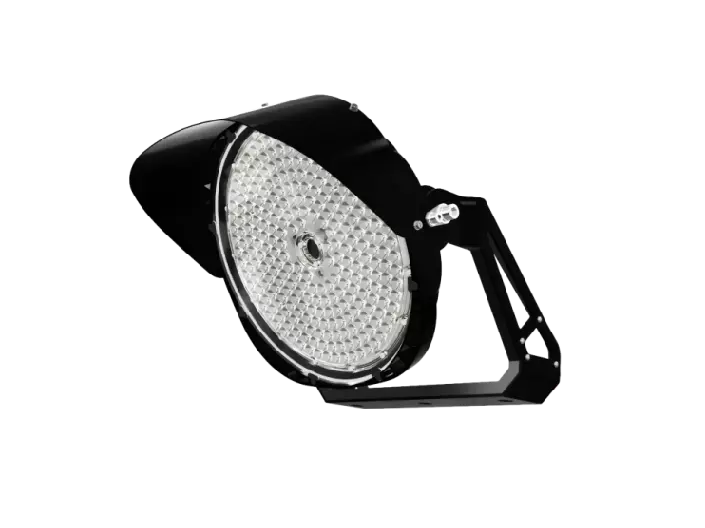
Sports Light SL04 from Ceramiclite
Visor-Ready Design: CeramicLite fixtures are engineered to accept a customized physical glare shield (Visor).
The Benefit: Acting like the brim of a baseball cap, this visor physically cuts off the upper hemisphere of light. It guarantees that spectators in the upper stands—and cameras positioned high up—never look directly into the light source.
3. Secondary Reflection Control
High-intensity point sources can be painful to look at.
Texture Matters: We employ specialized textures on our optical elements to soften the light output.
Flicker-Free: Glare is often made worse by imperceptible strobing. CeramicLite’s advanced drivers deliver a <0.2% ripple current, ensuring a completely stable light output. This eliminates the "strobing glare" that causes headaches and ruins slow-motion replays.
The Result?
With CeramicLite, facilities can achieve professional glare ratings—GR < 50 for clubs and GR < 40 for national stadiums—effortlessly. It is the bridge between high performance and human comfort.
Scenario-Specific Solutions
One size does not fit all. A lighting setup that works for a football pitch could be disastrous for a tennis court. Here is how to tackle the unique glare challenges of specific sports:
1. Badminton & Tennis (The "Look-Up" Sports)
These are the hardest sports to light because players spend 40-60% of the game looking upwards to track a shuttlecock or ball.
The Pain Point: Any light fixture placed directly above the court or behind the baseline acts as a blinding trap.
The Solution:
Side Lighting Only: Fixtures must be mounted along the sidelines, parallel to the direction of play.
The "No-Fly Zone": Never install lights directly over the playing area or directly behind the baseline (which blinds the serving/receiving player).
Standard: Strict UGR control is vital (Target UGR < 19 for professional play).
2. Football & Athletics (Large Fields)
Outdoor stadiums require lights to project beams over long distances (50m+).
The Pain Point: To throw light that far, fixtures often use intense beams. If the angle is too flat, these beams hit the eyes of goalkeepers or spectators on the opposite side.
The Solution:
High Mast Strategy: You need height. Poles should be 30m-50m high to ensure light hits the pitch at a steep angle (>25°), rather than horizontally.
Narrow Beams + Visors: Use narrow-beam optics (e.g., 15° or 30°) to punch light to the center of the field, combined with glare visors to cut off spill.
3. Swimming Pools (The Reflection Challenge)
Water acts as a mirror. Even if the light doesn't hit the swimmer's eye directly, the reflection from the water surface can be blinding (veiling reflection).
The Pain Point: Glare on the water surface prevents lifeguards from seeing swimmers underwater—a major safety risk.
The Solution:
Asymmetric Lighting: Use fixtures with asymmetric lenses mounted on the side walls or pool deck ceiling. They throw light "forward" across the pool without reflecting back into the eyes.
Indirect Lighting: If the ceiling allows, bouncing light off a white ceiling creates a soft, glare-free ambiance (though less energy-efficient).
Retrofitting Old Stadiums: A Quick Glare-Fix Guide
Upgrading from Metal Halide (MH) or High-Pressure Sodium (HPS) to LED? Be careful. LEDs are directional sources, making them inherently "punchier" and potentially more glaring if mishandled.
1. Avoid the "Wattage Trap" (Direct Replacement)
Do not simply replace a 2000W Metal Halide lamp with a 2000W LED.
The Reality: LEDs are far more efficient. A 600W-800W CeramicLite LED can often replace a 2000W MH.
The Risk: If you stick to the old wattage, you will drastically over-light the stadium, causing unbearable glare and wasting energy. Always calculate based on Lux levels, not Watts.
2. The Cost-Effective Fix: Add Visors
If you have already installed LEDs and are receiving glare complaints, you don't always need to buy new lights.
The Fix: Retrofitting your existing fixtures with external glare shields (visors) is the most cost-effective way to salvage a project. These metal hoods physically block the offending viewing angles.
3. Best Practice: The Simulation First
Old lighting designs (for MH lamps) rarely work for LEDs. The beam spreads are different.
The Rule: Before buying a single fixture, insist on a DIALux Photometric Simulation. This software models your exact stadium dimensions and predicts the UGR/GR values before installation, guaranteeing you don't spend money on a "glare bomb."
Conclusion
Glare control is not a guessing game; it is a science.
Whether it’s the microscopic design of a lens, the precise angle of a high-mast pole, or the specialized needs of a badminton court, every detail matters. High-quality lighting is about balance—delivering the brightness needed for peak performance while ensuring the visual comfort that keeps players safe and fans happy.
Don't let glare ruin the game.
Ready to See the Difference?
Unsure if your current design meets professional glare standards? Don't guess.
Send us your stadium layout or project details today. Our engineering team will run a Free DIALux Simulation (including UGR/GR analysis) to help you visualize the perfect, glare-free lighting solution before you commit.