_thumb.jpg)
Guía de iluminación para ganado: El elemento oculto para aumentar la producción de leche
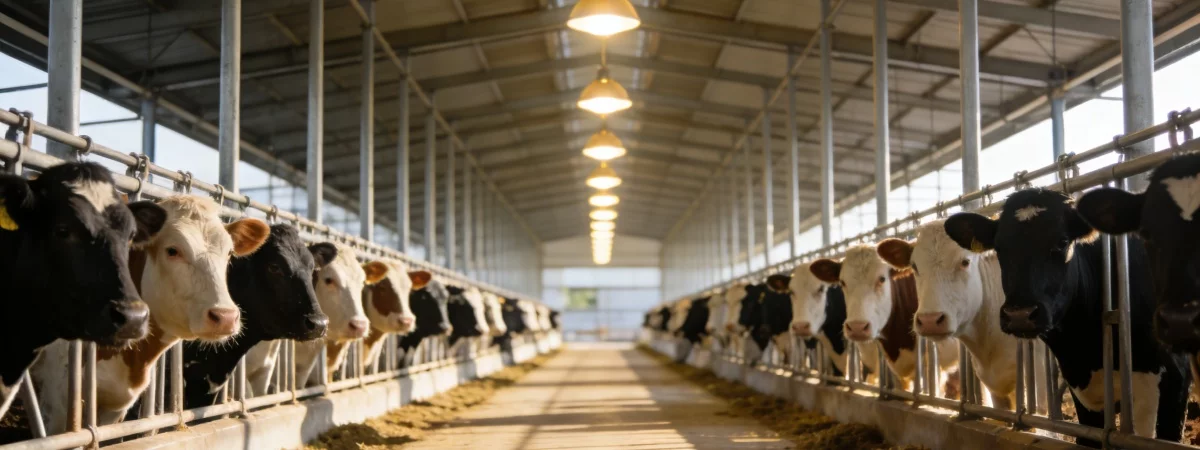
En el competitivo mundo de la ganadería moderna, la eficiencia no es solo un objetivo, sino la clave para la supervivencia. Los administradores de granjas y nutricionistas experimentados suelen recurrir a la " Regla del Diamante para la Comodidad de las Vacas " para evaluar el potencial de su rebaño.
Esta regla establece que siete elementos críticos deben estar perfectamente equilibrados para lograr el máximo rendimiento:
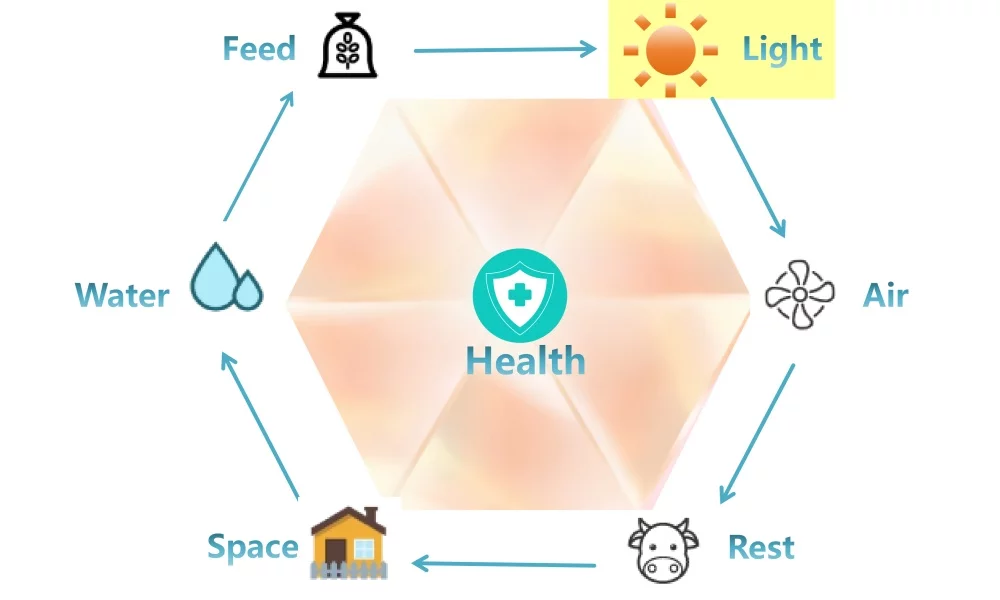
l Alimento
l Agua
l Espacio
l Descanso/Calma
l Aire
l Salud
l Luz
La mayoría de los administradores de ranchos invierten mucho en los primeros seis. Calculan las raciones de alimento hasta el gramo, instalan sistemas de ventilación de alta gama y monitorean la salud del rebaño diariamente. Sin embargo, la luz es con frecuencia el factor más subestimado en esta ecuación
Para muchos, la iluminación del establo es simplemente una herramienta para la visibilidad humana, una forma de ver a las vacas durante los ordeños matutinos o los controles nocturnos. Esta es una idea errónea y costosa.
La luz no es sólo para la visión: biológicamente es un nutriente.
Según datos publicados en el reciente 3.er Foro de Tecnología de Frontera de la Industria Láctea, las estrategias optimizadas de iluminación (conocidas como Manejo del Fotoperiodo ) pueden liberar un potencial biológico significativo. Al regular el entorno lumínico, las granjas pueden suprimir la producción de melatonina y estimular las hormonas IGF-1, lo que resulta en un aumento del 5 al 16 % en la producción de leche y mejores tasas de crecimiento del ganado vacuno.
Pero no toda la luz es igual. Las vacas tienen un sistema visual único, diferente al de los humanos, por lo que los LED industriales estándar a menudo no ofrecen estos resultados.
En esta guía, exploraremos la ciencia detrás de la iluminación para ganado , los estándares de lux específicos para las diferentes etapas de producción y cómo las soluciones de iluminación profesional, como la tecnología resistente a la corrosión de Ceramiclite , pueden convertir el sistema de iluminación de su establo en un activo generador de ganancias.
Índice
La ciencia detrás de la iluminación para el ganado: Por qué la luz es un nutriente
Estándares óptimos de iluminación: Desde ganado lechero hasta ganado de carne
Las 8 dimensiones de la iluminación profesional de establos para ganado
Caso práctico: De zonas muertas a centros de beneficios
Resumen de valores fundamentales
La ciencia detrás de la iluminación para el ganado: Por qué la luz es un nutriente
Para entender por qué las mejoras en la iluminación conducen a un aumento del 8 % en la producción de leche, debemos analizar la biología de la vaca. No es magia; es endocrinología
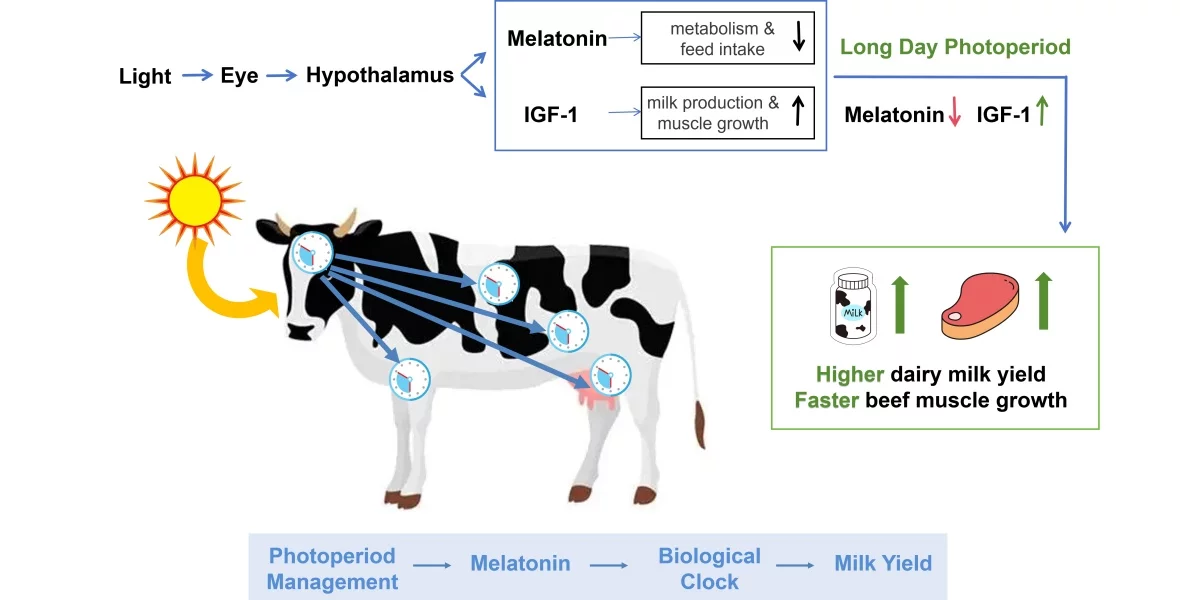
La luz actúa como regulador del reloj biológico de la vaca. El proceso comienza cuando la luz entra en el ojo de la vaca, estimulando específicamente la retina. Esta señal se transmite directamente al hipotálamo, la parte del cerebro responsable de regular la secreción hormonal.
Esta vía ( Luz → Ojo → Hipotálamo ) controla la producción de dos sustancias críticas:
Melatonina : Conocida a menudo como la "hormona del sueño", la melatonina se produce durante la oscuridad. Altos niveles de melatonina indican al cuerpo que debe descansar, lo que ralentiza el metabolismo y la ingesta de alimentos.
Ø IGF-1 (Factor de crecimiento similar a la insulina) : Esta es la hormona responsable de impulsar la producción de leche y el crecimiento muscular.
Mecanismo de acción:
Al implementar un fotoperiodo de día largo (mayor número de horas de luz), suprimimos eficazmente la secreción de melatonina. Unos niveles bajos de melatonina desencadenan una reacción en cadena: la glándula pituitaria libera más hormonas del crecimiento, lo que a su vez aumenta los niveles de IGF-1 en sangre.
El resultado es un rebaño más activo. Las vacas experimentan un mayor apetito y metabolismo, lo que se traduce directamente en una mayor producción de leche en las vacas lecheras y un desarrollo muscular acelerado en el ganado vacuno de carne.
Las vacas ven diferente: la importancia del espectro
Uno de los errores más comunes en la iluminación del ganadoSe supone que si la luz parece brillante para los humanos, es efectiva para las vacas.
Las vacas tienen visión dicromática (similar al daltonismo rojo-verde en los humanos). Mientras que los humanos tienen tres tipos de receptores de color (conos), las vacas solo tienen dos.
Esto crea una clara diferencia en cómo perciben su entorno en comparación con nosotros.
Ø Alta sensibilidad (azul/verde) : Las vacas son más sensibles a las longitudes de onda cortas y medias (luz azul y verde, con picos alrededor de 444 nm y 555 nm ). Este rango es crucial para regular su reloj biológico y suprimir la melatonina.
Ø Insensibilidad espectral (la "brecha roja") : A diferencia de los humanos, las vacas carecen del receptor para longitudes de onda largas (luz roja). Tienen muy baja sensibilidad a la luz roja, percibiéndola deficientemente (probablemente como un gris amarillento apagado). Esto significa que las luces "blancas cálidas" o amarillentas a menudo no proporcionan la estimulación biológica que necesitan las vacas.
Ø Percepción UV : Las vacas pueden percibir partes del espectro ultravioleta que son invisibles para los humanos, lo que ayuda en su navegación e interacción.
Por qué esto es importante para la producción:
Debido a esta realidad biológica, la Calidad de la Luz (Espectro) es tan importante como la cantidad.
La investigación presentada en el reciente 3er Foro de Tecnología de Frontera de la Industria Láctea enfatiza que la fuente de luz ideal debe ofrecer un espectro completo continuo que imite la luz solar natural.
Los LED estándar a menudo tienen "espacios espectrales", especialmente en el rango azul-verde, donde las vacas son más sensibles, o desperdician energía en el rango rojo, donde las vacas son menos sensibles.
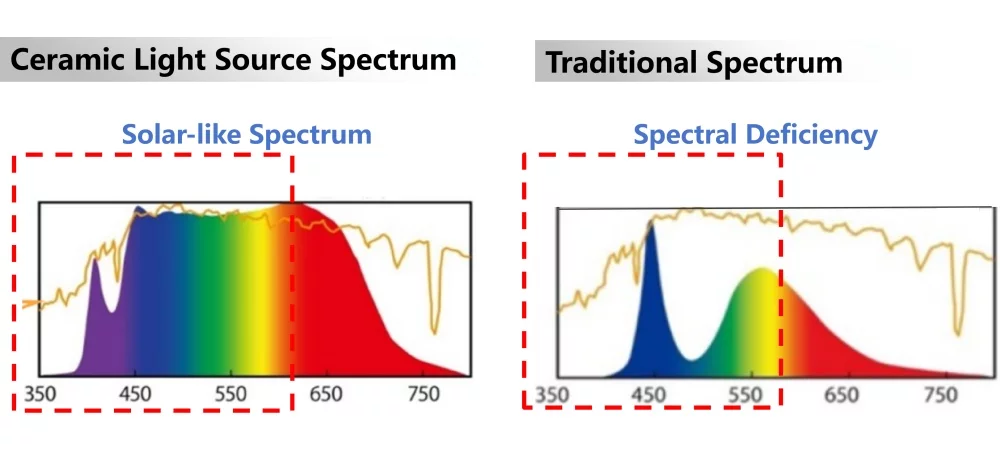
Una fuente continua de espectro completo (como la tecnología cerámica utilizada en los accesorios Ceramiclite) garantiza:
1. Máxima estimulación biológica : suprime eficazmente la melatonina para aumentar la producción de leche.
2. Beneficios para la salud : Promueve la conversión de 7-dehidrocolesterol en vitamina D3 , que es crucial para la absorción de calcio, huesos más fuertes y la reducción de problemas en las patas en vacas de alto rendimiento.
Estándares óptimos de iluminación: Desde ganado lechero hasta ganado de carne
En la era de la agricultura de precisión, la gestión eficaz de la luz no consiste sólo en instalar bombillas, sino en imitar un entorno biológico específico.
Para diseñar el plan de iluminación perfecto, primero debemos respetar las limitaciones visuales únicas de la vaca. Las vacas tienen un campo de visión panorámico de 330° , pero una percepción de profundidad débil debido a una pequeña superposición binocular. Además, son dicromáticas (similar al daltonismo rojo-verde en humanos) y extremadamente sensibles al movimiento.
Además, su sensibilidad espectral alcanza su punto máximo en azul y verde (370-650 nm), pero disminuye significativamente en el rango de 495-525 nm , y tienen baja sensibilidad a la luz roja.
Por lo tanto, un sistema de iluminación que ignore estas características biológicas no logrará mejorar la producción, independientemente de lo brillante que sea.
A continuación se presentan los estándares precisos de fotoperíodo e iluminancia necesarios para desencadenar las respuestas fisiológicas deseadas.
Tabla de referencia: Fotoperíodo e iluminancia recomendados por categoría (Nota: Los niveles de lux se refieren a la iluminancia mantenida, teniendo en cuenta la disminución de la luz con el tiempo)
Categoría de ganado | Iluminancia (Lux) | Fotoperiodo (Horas) |
Vacas lactantes | 200 - 240 | 16 - 18 |
Vacas secas | 200 - 230 | 8 - 10 |
Terneros | 150 - 200 | 10 - 12 |
Novillas (en desarrollo) | 150 - 200 | 10 - 16 |
Novillas preñadas (en crecimiento) | 150 - 200 | 8 - 12 |
Toros reproductores | 200 - 230 | 10 - 14 |
(Nota: 10 lux ≈ 1 pie-candela)
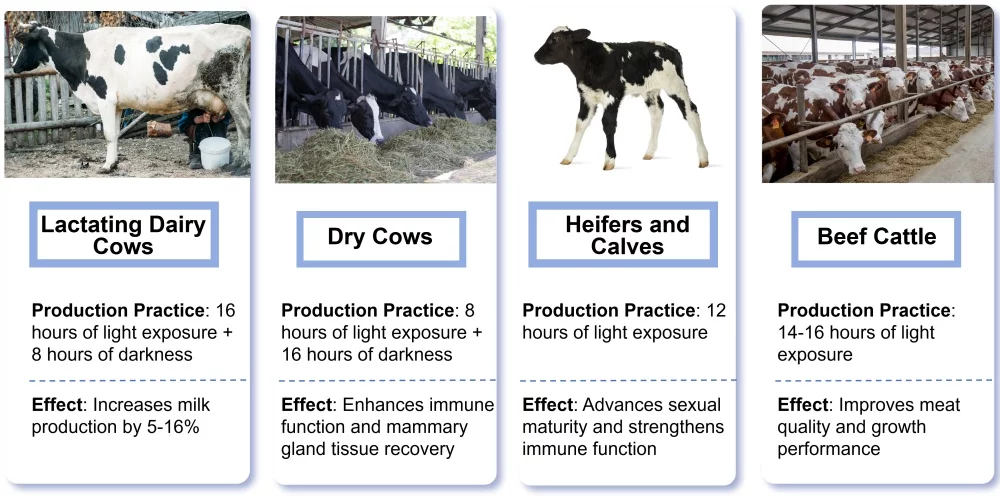
Vacas lactantes: La importancia de la oscuridad
l Objetivo : 16 h de luz / 8 h de oscuridad
l Intensidad : 200-240 Lux en el comedero
En vacas lactantes, el objetivo es maximizar los niveles de IGF-1 para estimular la actividad mamaria. Los datos de campo confirman que este régimen 16:8 suele producir un aumento del 5-16% en la producción de leche .
Advertencia crítica : Más luz no siempre es mejor. El período de 8 horas de oscuridad es innegociable . Si las vacas están expuestas a luz continua (24 horas), se vuelven refractarias al estímulo del fotoperiodo, lo que elimina el posible aumento de la producción. La oscuridad "reinicia" su reloj biológico, permitiendo que la luz haga su trabajo al día siguiente.
Vacas secas: el reinicio del "día corto"
l Objetivo : 8 h de luz / 16 h de oscuridad
l Intensidad : 200-230 Lux
Las vacas secas requieren el enfoque opuesto. Exponerlas a un fotoperiodo de "día corto" ayuda a restaurar la sensibilidad de sus glándulas mamarias y refuerza su función inmunitaria.
Los estudios demuestran que las vacas que se mantuvieron con días cortos durante el período seco y luego cambiaron a días largos después del parto, obtuvieron mejores resultados que las vacas que se mantuvieron con días largos durante todo el ciclo. Esta fase es esencial para preparar la ubre para la siguiente lactación de alto rendimiento.
Terneros y novillas: construyendo el rebaño del futuro
l Objetivo : ~12 horas (día largo)
l Intensidad : 150-200 Lux
Para los animales jóvenes, la iluminación es fundamental para su desarrollo. Un fotoperiodo constante de unas 12 horas promueve un desarrollo ruminal más rápido y un crecimiento muscular más rápido. Esta ventaja en el crecimiento temprano se traduce en una madurez temprana y un sistema inmunitario más fuerte, lo que contribuye a un rebaño más eficiente para el futuro.
Ganado vacuno: Acelerando el crecimiento y la calidad
l Objetivo : 14-16 horas de luz
l Intensidad : Se refiere a la iluminación estándar del granero (garantiza uniformidad)
Aunque a menudo se pasa por alto, la iluminación es una herramienta poderosa para la producción de carne. La evidencia indica que mantener un fotoperiodo de 14 a 16 horas aumenta la ganancia diaria promedio (GDP) .
Dado que el ganado vacuno es muy sensible al estrés (y al movimiento, debido a su naturaleza visual), una iluminación constante y sin parpadeos reduce los niveles de ansiedad. Un menor estrés se correlaciona directamente con una mejor calidad de la carne y una mayor eficiencia de conversión alimenticia.
Las 8 dimensiones de la iluminación profesional de establos para ganado
Un establo lechero es uno de los entornos más hostiles para los equipos electrónicos. El aire está lleno de gases corrosivos, la humedad es alta y los protocolos de higiene exigen lavado a alta presión.
Instalar LED industriales estándar en un granero suele ser un error costoso. Suelen fallar en un plazo de 1 a 3 años debido a la corrosión o el sobrecalentamiento. Para garantizar una vida útil de 10 años y resultados biológicos óptimos, un sistema de iluminación debe cumplir con estas 8 dimensiones críticas :
1. Espectro (calidad de la luz)
Las vacas necesitan una fuente de luz continua de espectro completo que imite la luz solar natural.
l El problema : Los LED tradicionales a menudo tienen "espacios espectrales" (longitudes de onda faltantes).
l El estándar : Se requiere un espectro similar al solar no sólo para la visión, sino también para facilitar la síntesis de vitamina D3 (a través de la conversión de 7-dehidrocolesterol), que favorece la salud de los huesos y la absorción de calcio.
2. Durabilidad extrema y anticorrosión (el factor azufre)
Aquí es donde fallan la mayoría de las luces. El aire del establo contiene amoníaco ( NH₃ ) procedente de la orina y el estiércol , y sulfuro de hidrógeno ( H₂S ) .
Por qué fallan los LED estándar : Los LED tradicionales utilizan pegamento de silicona y polvo de fósforo. La estructura porosa del silicio permite que el gas de azufre penetre y reaccione con la capa plateada de la fuente de luz. Esto provoca sulfuración (ennegrecimiento) , lo que provoca una grave degradación de la luz, cambios de color y, finalmente, la pérdida de la iluminación debido al desprendimiento de las uniones de los hilos de oro.
Datos : Los LED estándar a menudo pierden el 30% de su flujo después de solo 168 horas de exposición al azufre.
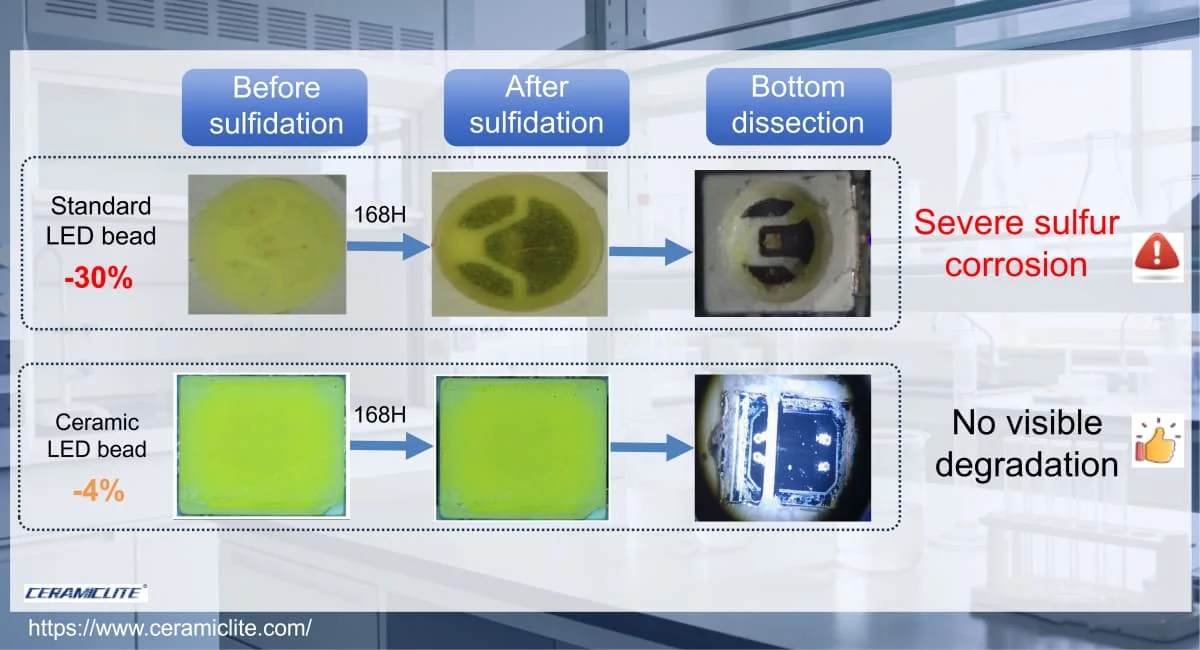
La ventaja de la cerámica : Las fuentes encapsuladas en cerámica están herméticamente selladas y son altamente resistentes al azufre.
Datos: Las fuentes de cerámica muestran solo un 4% de pérdida bajo la misma prueba de azufre, lo que garantiza una vida útil de 100.000 horas (2,77 veces más que las 36.000 horas estándar).
3. Estabilidad térmica (gestión del calor)
Los graneros pueden calentarse y los LED generan calor.
Extinción térmica : La calidad de los fósforos estándar se degrada rápidamente con el aumento de la temperatura. A 150 °C, la eficiencia del fósforo estándar disminuye un 22 % .
Rendimiento cerámico : La tecnología cerámica fluorescente es increíblemente estable, con una disminución de la eficiencia cuántica de tan solo el -1 % a 150 °C . Esto significa que la luz se mantiene brillante y constante año tras año, independientemente de las fluctuaciones de temperatura.
4. Uniformidad (sin sombras)
Para diseñar el plan de iluminación perfecto, primero debemos respetar las limitaciones visuales únicas de las vacas. No basta con iluminar el establo; debemos adaptarnos a su forma de desenvolverse en su entorno.
Comprensión de la visión bovina:
Visión panorámica de 340° : El ganado lechero tiene un campo de visión total de aproximadamente 340° . Pueden ver en todas las direcciones excepto por un pequeño punto ciego directamente detrás de ellos. Esto significa que se ven estimulados visualmente por casi todo lo que sucede simultáneamente en el establo
Mala percepción de la profundidad : Las vacas dependen en gran medida de la visión monocular (usando un ojo a la vez) en lugar de la binocular. Como resultado, les cuesta estimar la distancia y la profundidad.
La implicación de la iluminación:
Debido a su limitada percepción de profundidad, las vacas no pueden distinguir fácilmente entre una sombra y un agujero físico en el suelo
Baja uniformidad (sombras) : En un establo mal iluminado, las sombras oscuras creadas por las vigas o los establos parecen barreras o fosos profundos para la vaca. Esto provoca vacilación (rechazo), ralentiza el flujo de vacas y aumenta los niveles de estrés.
Alta uniformidad (la solución) : Por eso, la uniformidad de la luz (≥ 0,8) es fundamental. Un entorno de luz uniforme elimina estas distracciones visuales, lo que permite que las vacas se desplacen con confianza hacia los comederos y bebederos.
Así que, aquí está el resumen simple:
El estándar:
Uniformidad del carril de alimentación: ≥ 0,8
Otras áreas: ≥ 0,6
Comparar: Las luces de almacén estándar a menudo producen una uniformidad de solo 0,21-0,45, lo que crea un estresante "tablero de ajedrez" de luz y oscuridad.
5. Sin parpadeos (reducción del estrés)
Las vacas tienen capacidades débiles de regulación de la pupila, lo que las hace mucho más sensibles a los cambios de luz que los humanos.
El riesgo: el parpadeo elevado desencadena estrés crónico, ansiedad y una menor ingesta de alimento.
El estándar: la profundidad del parpadeo debe controlarse a ≤ 3% (más estricto que el estándar humano de ≤ 5%).
6. Iluminancia (Brillo de precisión)
"Suficientemente brillante" no es un número.
El estándar: Los carriles de alimentación de vacas lactantes requieren una iluminación mantenida de 200 a 240 Lux .
La realidad: las luminarias estándar a menudo varían enormemente de 9 Lux (demasiado tenues para estimular las hormonas) a 2000 Lux (deslumbrantes), sin lograr ningún beneficio biológico.
7. Resistente al agua y al polvo (IP69K)
La higiene del establo exige una limpieza rigurosa. Los accesorios deben soportar lavados a alta presión y temperatura.
El estándar: Clasificación IP69K.
La prueba: Los accesorios deben soportar una presión de agua de 8000-10000 kPa a 80 °C ±5 °C . Cualquier valor inferior (como IP65) eventualmente sufrirá la entrada de agua y fallas
8. Ritmos Inteligentes (Biosimulación)
No se puede simplemente encender y apagar un interruptor. Los cambios repentinos de luz asustan al ganado.
El estándar: los sistemas deben utilizar atenuación de 0 a 10 V para simular un amanecer y un atardecer naturales.
El protocolo: un aumento gradual de la intensidad de la luz durante 15 a 30 minutos permite que las pupilas de reacción lenta de las vacas se adapten cómodamente, manteniendo un rebaño tranquilo y productivo.
Caso práctico: De zonas muertas a centros de beneficios
La teoría es buena, pero los resultados son mejores. Para comprender el verdadero impacto de la gestión profesional del fotoperiodo, analicemos un proyecto de renovación real para un importante grupo lechero.
La realidad común (antes de la renovación)
Antes de la actualización, esta granja enfrentaba problemas típicos del 80% de las instalaciones existentes (denominadas "Caso A").
Fallo de hardware : Las luminarias existentes utilizaban casquillos E27 estándar, que no eran impermeables. Las superficies traseras rugosas acumulaban suciedad y bacterias, lo que impedía su limpieza eficaz.
Iluminación "muerta" : la simulación de luz reveló un entorno caótico.
l Iluminancia promedio: solo 11,0 Lux (frente al objetivo de 200 Lux).
l Uniformidad: La relación mín./máx. fue de 0,001, lo que creó graves efectos de "resalte".
Resultado : Un ambiente oscuro y estresante con intensos reflejos y brechas espectrales que hacen imposible cualquier regulación biológica.
La transformación (después de la solución Ceramiclite)
La granja reemplazó el sistema defectuoso con un sistema de iluminación cerámica inteligente .
La solución:
Accesorios : Construcción completa de tubo de PC, clasificación IP69K para lavado a alta presión
l Durabilidad : Probado contra H2S (15 ppm/168 h) y amoníaco (28 %/72 h) para garantizar cero corrosión.
l Control : Atenuación automática de 0 a 10 V para simular el amanecer y el atardecer.
Los datos hablan por sí solos:
al optimizar el diseño y actualizar la tecnología, la granja logró lo "imposible": más luz con menos energía.
Indicador | Antes (LED tradicional) | Después (Cerámica inteligente) | El impacto |
Consumo de energía (kWh/día/granero) | 1411 | 1069 | Ahorro de energía: 32 % |
Iluminancia media (lux) | 60 | 233 | Brillo: +3,88x |
Uniformidad (escala 0-1) | 0,43 | 0,81 | Uniformidad: +1,88x |
Vida útil de la luminaria | 1-3 años | 8-10 años | Vida útil: +3x |
El retorno de la inversión financiera: ¿es rentable?
Para los propietarios de granjas, la lógica de inversión es sencilla. Calculemos el retorno de la inversión (ROI) para un rebaño típico de 5000 cabezas lactantes:
1. Aumento de ingresos (aumento del rendimiento):
Con un aumento conservador del 5% en la producción de leche (basado en el promedio científico del 5-16%) y un rendimiento base de 33 kg/día:
Resultado: 2.475 toneladas adicionales de leche al año.
Valor: Aproximadamente $1,02 millones de dólares en nuevos ingresos por año.
2. Reducción de costos (energía y mantenimiento):
Energía: Ahorro de aproximadamente USD 5.700 por establo, por año.
Mantenimiento: Elimina los costos de mano de obra y hardware de reemplazar luces corroídas cada 2 años.
Resumen de valores fundamentales
Implementar un sistema de iluminación científica para el ganado no es un gasto; es un activo estratégico. Al adherirse a las 8 dimensiones de la iluminación profesional, las granjas logran:
1. Aumento de la producción : aumento validado del rendimiento de leche del 5-16% (promedio 8%).
2. Costos más bajos : Se redujo el consumo de energía de iluminación en más del 30% mientras se triplicaron los niveles de iluminación.
3. Bajo mantenimiento : vida útil de 8 a 10 años gracias a la tecnología anticorrosión de cerámica (en comparación con 1 a 3 años para los LED).
4. Sostenibilidad : una solución verde y baja en carbono que mejora el bienestar animal y la eficiencia económica simultáneamente.
Conclusión
No dejes que tu iluminación sea el cuello de botella.
La "Regla del Diamante" de la comodidad de las vacas está incompleta sin luz. Ya sea que busques una mayor producción de leche en las vacas lecheras o un aumento de peso más rápido en el ganado vacuno, si tu establo tiene rincones oscuros, luces LED parpadeantes o accesorios corroídos, estás perdiendo dinero todos los días
Ceramiclite se dedica a la fabricación eficiente de entornos de iluminación. No solo vendemos lámparas; ofrecemos una herramienta de gestión biológica para la agricultura moderna.
¿Listo para ver la diferencia?
Contacte con nuestro equipo hoy para una simulación de entorno de iluminación gratuitaPermítanos mostrarle exactamente cuánto rendimiento está perdiendo y cómo recuperarlo.