_thumb.jpg)
Livestock Lighting: How Light Affects Health and Productivity
Table of Contents
Livestock Lighting Is Not Just Farm Illumination
How Livestock Actually Perceive Light?
5 Core Metrics That Define Effective Livestock Lighting
Livestock Lighting Requirements by Species
Why You Should Optimize Your Livestock Lighting?
How to Choose the Right Livestock Lighting System?
Livestock Lighting Is Not Just Farm Illumination
For decades, livestock facilities have been illuminated mainly for human visibility. As modern farming moves toward precision management, lighting is increasingly recognized as a biological factor that directly affects animal behavior, health, and productivity.
Livestock lighting in barns is no longer just about brightness. It influences how animals see their environment, how they behave, and how efficiently they grow or produce.
From Human-Centered Lighting to Animal-Centered Design
The traditional assumption in farm lighting has been simple: if people can see clearly, the lighting is sufficient. As a result, many barns still use standard industrial fixtures designed for warehouses rather than animals.
The problem is that livestock do not perceive light the same way humans do. Differences in visual sensitivity, spectral response, and tolerance to flicker mean that lighting acceptable to workers may cause stress or behavioral changes in animals.
Animal-centered lighting shifts the goal from human convenience to biological suitability. In this approach, light becomes a management tool that supports animal welfare and stable production, rather than just a basic utility.
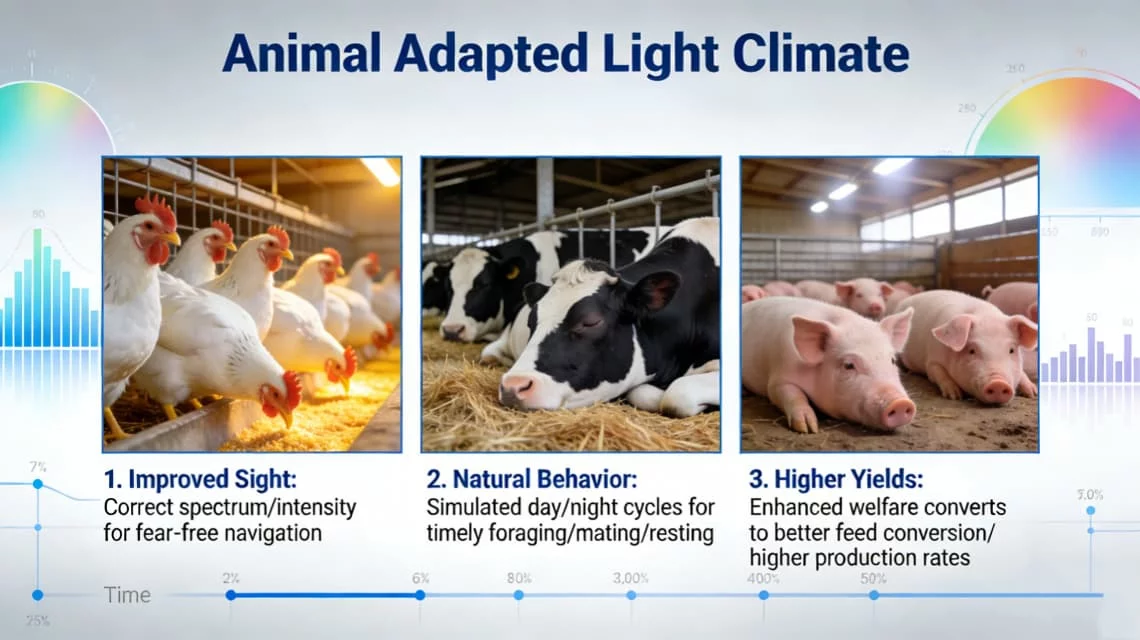
This guide explains livestock lighting from two levels:
Shared principles that apply across livestock environments
Species-specific lighting approaches for poultry, swine, cattle, and horses
Each species section outlines practical lighting strategies and links to dedicated guides for deeper technical and management details. Readers can use this page as an overview or follow links to explore lighting solutions for specific animals.
How Livestock Actually Perceive Light?
Effective livestock lighting starts with understanding how animals perceive light differently from humans. Visual sensitivity, spectral range, and temporal response all shape how animals interact with their environment.
Animal Vision vs. Human Vision
Humans and livestock do not perceive light within the same visual spectrum. While humans typically see wavelengths from approximately 400 to 700 nanometers, livestock species differ in both spectral range and sensitivity, which directly affects how they respond to artificial lighting.
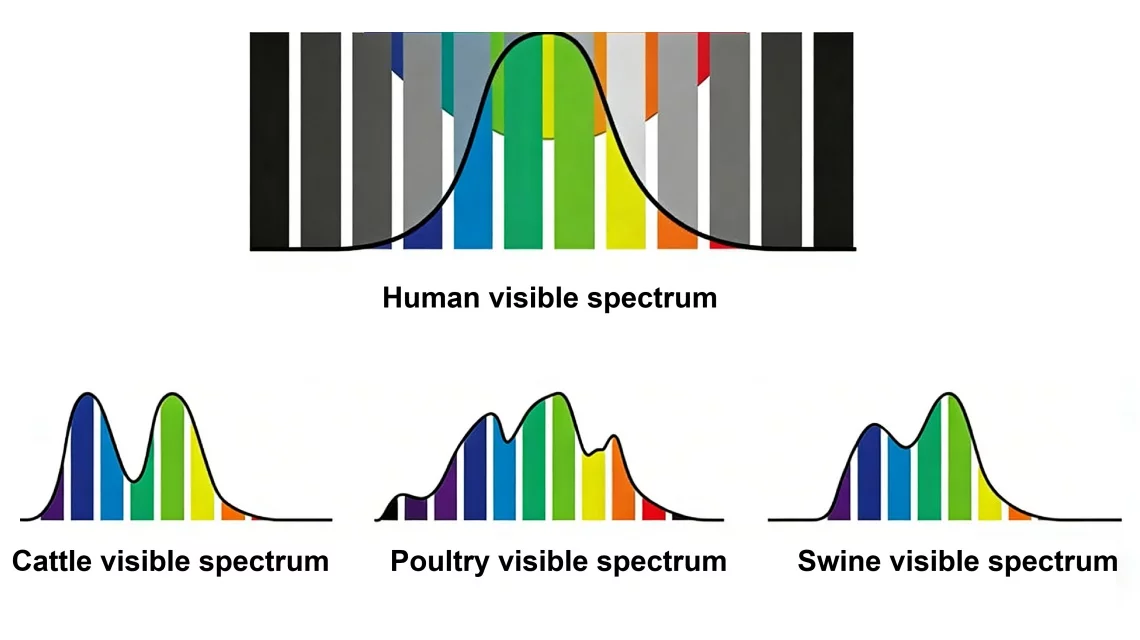
Understanding these differences helps explain why lighting that appears “normal” to people may feel uncomfortable, stressful, or biologically ineffective to animals.
Humans
Human vision is most sensitive in the green–yellow range of the visible spectrum. Lighting standards such as lux, CCT, and visual comfort are largely based on this human response and do not account for how animals perceive color or contrast.
Cattle
Cattle vision is most sensitive to blue and green wavelengths, with relatively low sensitivity to red light. They rely more on brightness, contrast, and uniform illumination than on color detail. Sudden changes in light intensity or shadow are more likely to trigger startle responses than color shifts.
Swine
Swine have limited color discrimination and are most responsive to blue–green wavelengths, similar to cattle. Their reduced sensitivity to red light makes red-spectrum illumination suitable for night-time inspection, allowing caretakers to monitor animals with minimal disturbance to rest and circadian rhythms.
Poultry
Poultry have the most complex visual system among common livestock species. In addition to strong sensitivity in the blue–green range, they can perceive ultraviolet (UV) wavelengths beyond human vision. This expanded spectrum influences feeding behavior, social interaction, and spatial awareness, making spectrum quality and consistency especially critical in poultry lighting.
As illustrated in the spectrum comparison image, each species perceives only part of the light emitted by a fixture. Effective livestock lighting must therefore be designed around animal visual sensitivity, not human perception alone.
Flicker: The Invisible Stressor in Livestock Facilities
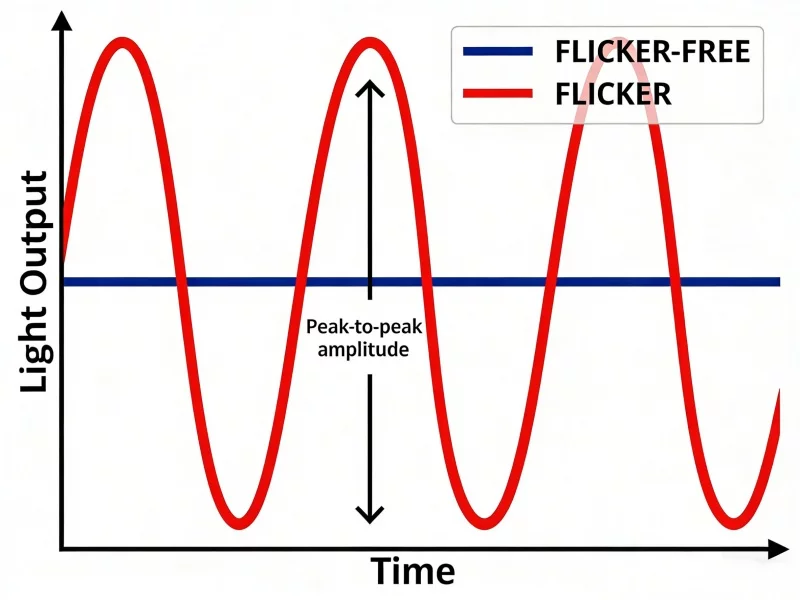 Flicker is a rapid fluctuation in light output that is often invisible to the human eye but detectable by many animals.
In livestock environments, especially poultry houses, flicker can act as a continuous source of low-level stress. Animals exposed to unstable lighting may show increased agitation, abnormal behavior, or changes in feeding and movement patterns over time.
Because flicker does not appear as a visible defect, it is frequently overlooked when industrial LED fixtures are used in barns. For livestock lighting, stable, flicker-free performance is a basic requirement, not an optional feature, to ensure consistent welfare and reliable production outcomes.
5 Core Metrics That Define Effective Livestock Lighting
Once animal perception is understood, effective livestock lighting can be evaluated using a set of biological and engineering metrics rather than traditional human lighting standards. These metrics help ensure that lighting supports animal welfare, stable behavior, and long-term farm performance.
Spectrum: Matching Light to Species-Specific Sensitivity
Livestock lighting should provide a broad and balanced spectrum that aligns with how animals naturally perceive light. Narrow or incomplete spectra may distort how animals see their environment, even if the light appears “white” to humans.
A broad-spectrum approach helps avoid spectral “blind spots” that can interfere with feeding behavior, social interaction, and spatial awareness—especially in visually sensitive species such as poultry. Rather than optimizing light for human comfort, spectrum design should prioritize biological completeness.
Intensity & Photoperiod: Why Lux Alone Is Misleading
Lux is a human-centered measurement that describes how bright light appears to people. While useful for reference, it does not fully describe how animals respond to light.
For livestock, photoperiod—how long light is provided each day—is often more important than peak brightness. Light duration plays a central role in regulating circadian rhythms, hormone secretion, and rest–activity cycles. Incorrect photoperiod management can disrupt feeding patterns and reduce production efficiency, even when light levels seem adequate.
CCT & CRI: Visibility, Inspection & Welfare
Correlated color temperature (CCT) influences animal behavior and alertness. Cooler light tends to promote activity, while warmer light can support calmer conditions when appropriate. Selecting CCT should therefore align with the management goal of each space.
Color rendering index (CRI) is equally important. CRI values above 80 allow caretakers to accurately assess skin condition, injuries, and overall animal health. In livestock environments, CRI is not an aesthetic feature—it is a practical tool that supports daily inspection and welfare management.
Flicker Control & Dimming Stability
Flicker and unstable dimming can undermine livestock welfare even when other lighting parameters are correct. Many animals can detect rapid fluctuations in light output that humans do not notice.
Poor dimming performance may cause sudden intensity changes that startle animals or disrupt rest cycles. In contrast, stable, flicker-free dimming enables smooth transitions between lighting phases and supports management practices such as gradual light reduction or red-light night inspection.
Durability & Materials in Livestock Environments
Ingress protection (IP) and impact resistance (IK) ratings are basic requirements for livestock lighting, but they are not sufficient on their own. Barn environments expose fixtures to ammonia, humidity, temperature fluctuations, and corrosive gases.
Material stability plays a critical role in long-term performance. Fixtures designed with chemically stable materials maintain light quality and output over time, reducing maintenance needs and ensuring consistent biological conditions for animals.
Reference:
https://en.wikipedia.org/wiki/Photoperiodism
https://en.wikipedia.org/wiki/Circadian_rhythm
Livestock Lighting Requirements by Species
While the core lighting principles remain consistent, effective livestock lighting must be adapted to the biological traits, behavior patterns, and management needs of different species. Below are practical, species-specific lighting strategies commonly used in modern farms.
Poultry Lighting: Spectrum Accuracy, Flicker Control & Growth Performance
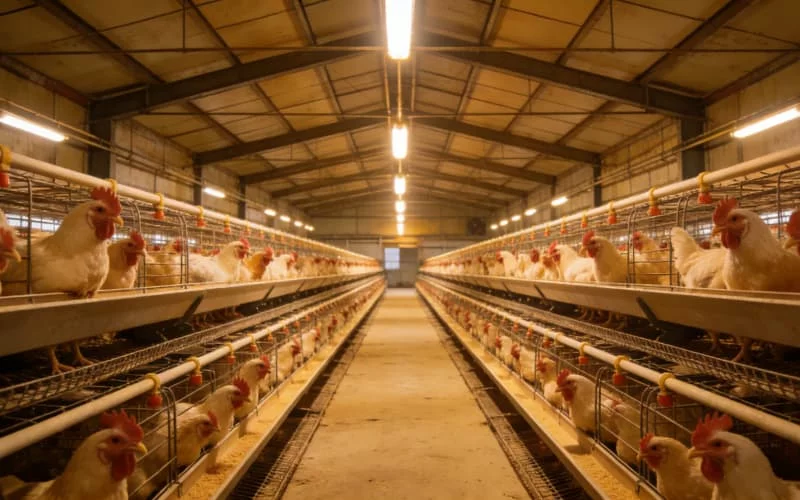 Poultry require lighting systems that prioritize spectral accuracy and visual stability. Because birds are sensitive to spectrum quality and flicker, lighting directly affects feeding behavior, social interaction, and growth performance.
Recommended approach:
Use high CRI (>80) lighting to accurately reveal feather condition, skin color, and feeding activity
Ensure flicker-free drivers to prevent chronic stress
Maintain stable, broad-spectrum output to support natural behavior and spatial awareness
Common mistakes:
Using standard industrial high-bay fixtures without considering flicker or spectrum quality
Ignoring dimming performance during lighting phase transitions
For a deeper analysis of how lighting influences poultry growth and production, see our detailed guide on how poultry lighting affects production and growth.
Swine Lighting: Durable Fixtures and Red-Light Night Inspection
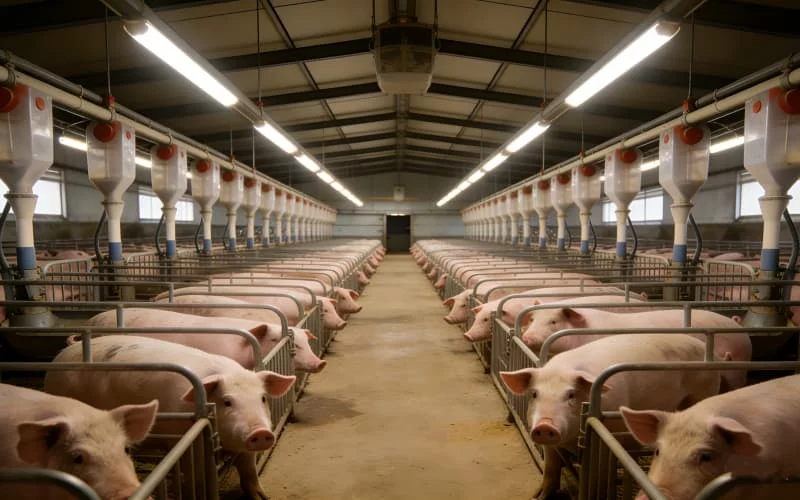 Swine lighting must balance mechanical durability with practical management needs. Pigs are curious and physically active, making fixture protection and stability essential.
Recommended approach:
Use enclosed fixtures with high IK ratings to resist impact and tampering
Apply dim-to-red lighting for night-time inspection without disturbing rest cycles
Select materials resistant to ammonia and moisture for long-term reliability
Management value:
Reduced fixture damage and replacement frequency
More efficient and less disruptive night-time monitoring
Cattle & Dairy Lighting: Long-Day Photoperiod and Uniform Illumination
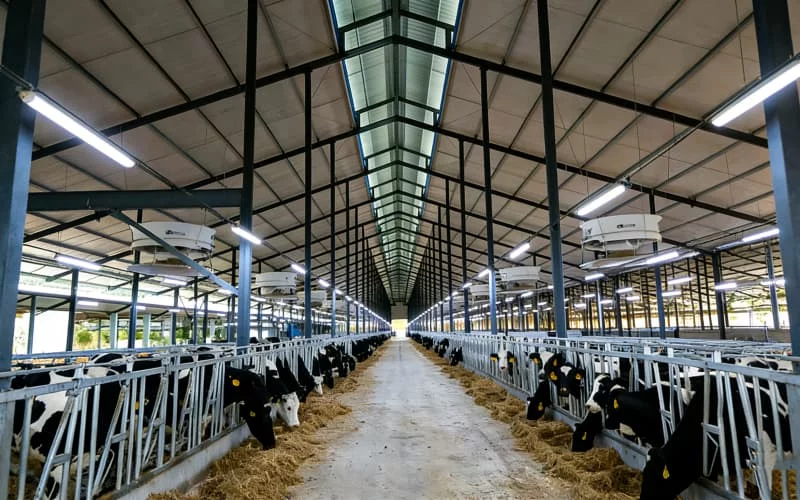 In cattle and dairy operations, lighting is closely tied to photoperiod management and visual comfort. Long-day lighting strategies are commonly used to support milk production and overall activity levels.
Recommended approach:
Implement structured long-day photoperiods, not simply longer daily lighting
Maintain high illumination uniformity to reduce shadows
Control glare to minimize startle responses and improve movement safety
Core logic:
Photoperiod → hormonal regulation → milk yield and productivity
Explore detailed strategies in our Cattle Lighting Guide.
Equine Lighting: Safety-First Design and Shadow Reduction
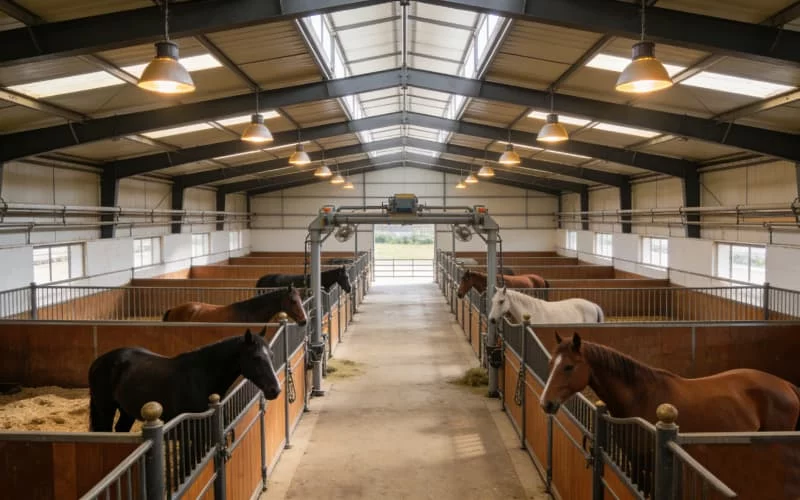 Equine lighting places a strong emphasis on safety and visual comfort. Horses are highly sensitive to contrast, shadow edges, and sudden brightness changes.
Recommended approach:
Provide uniform, low-glare illumination
Minimize harsh shadows in stalls and walkways
Prioritize fixture protection and placement over maximum brightness
Why You Should Optimize Your Livestock Lighting?
Beyond animal welfare, livestock lighting directly affects farm economics through productivity, labor efficiency, and long-term operating costs. When lighting is designed around animal biology rather than human convenience, the return on investment becomes measurable and sustainable.
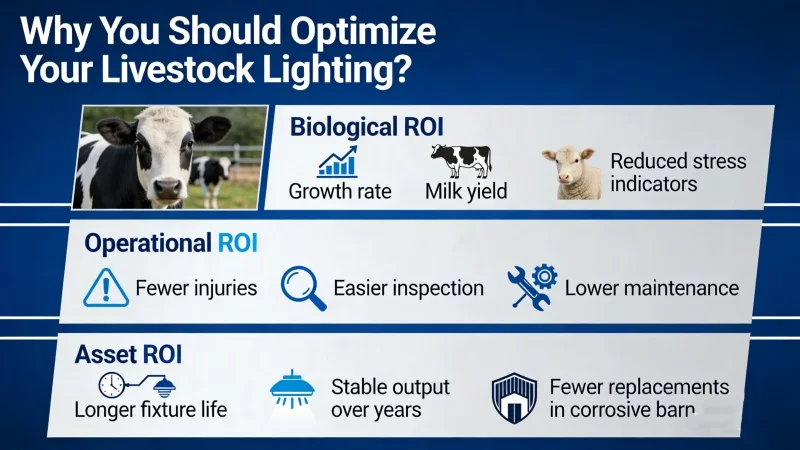
Biological ROI: Productivity and Welfare Outcomes
Properly designed lighting directly influences animal physiology.
For poultry and swine, stable spectrum and flicker-free illumination support normal feeding behavior, reduce chronic stress, and improve growth consistency. In dairy cattle, biologically correct long-day photoperiods are closely linked to hormonal regulation, translating into higher and more stable milk yields.
Equally important, reduced stress levels lead to better immune response, fewer health incidents, and more predictable performance across the herd or flock. These biological improvements compound over time, forming the foundation of long-term productivity gains rather than short-term spikes.
Operational ROI: Easier Management and Lower Losses
Lighting quality also affects how efficiently farms are managed.
High color rendering and uniform illumination make it easier for workers to identify injuries, illness, or abnormal behavior during routine inspections. Flicker-free and glare-controlled environments improve worker comfort and safety, especially during long shifts.
In species such as swine, the use of dim-to-red lighting for night inspections allows non-intrusive monitoring without disrupting rest cycles. This improves inspection frequency while reducing stress-related losses, equipment damage, and handling risks.
Asset ROI: Lighting That Performs Over Time
Livestock facilities are among the most aggressive environments for lighting systems. High humidity, ammonia, dust, and temperature fluctuations accelerate lumen depreciation and fixture failure.
A true return on investment depends on long-term output stability. Systems designed with chemically stable materials and corrosion-resistant structures maintain consistent spectrum and intensity over years of operation. Lower replacement rates, reduced maintenance labor, and predictable performance make lighting a durable asset rather than a recurring expense.
How to Choose the Right Livestock Lighting System?
Understanding lighting principles is only the first step. Implementing them requires systems specifically engineered for livestock environments, where biological performance and material durability must work together.
Why Purpose-Built Livestock Lighting Matters
Generic industrial luminaires are designed around human visual tasks and clean environments. When used in barns, they often suffer from rapid degradation, unstable output, poor dimming performance, and biological mismatch with animal vision.
Effective livestock lighting is not a single fixture choice—it is a system-level decision. Spectrum design, driver stability, thermal management, and material selection must be optimized together to deliver consistent biological outcomes under harsh conditions.
CeramicLite Livestock Lighting Solutions
CeramicLite approaches livestock lighting from a biological-first perspective.
Broad and stable spectral output aligns with species-specific visual sensitivity, while flicker-free drivers ensure stress-free illumination throughout the photoperiod.
Material stability plays an equally critical role. Ceramic-based LED technologies offer superior resistance to heat, moisture, and chemical corrosion, supporting consistent light quality in ammonia-rich, humid barns where conventional materials degrade quickly.
The result is a lighting system engineered for long-term reliability, biological consistency, and predictable performance—key factors for modern livestock operations focused on efficiency and sustainability.
Ready to upgrade your farm? Browse our full range of Professional Livestock Lighting Solutions.

Conclusion
Livestock lighting is not an electrical decision — it is a biological and economic one. So, designing light for animals, not just buildings!
When light is designed around how animals see, behave, and respond physiologically, it becomes a management tool rather than a background utility. Farms that move beyond human-centered lighting standards gain measurable advantages in productivity, welfare, labor efficiency, and long-term operating costs.
In modern livestock facilities, the question is no longer whether lighting matters—but whether it has been designed for the animals that live under it.