_thumb.jpg)
Flicker-Free LED Lights: Everything You Need to Know
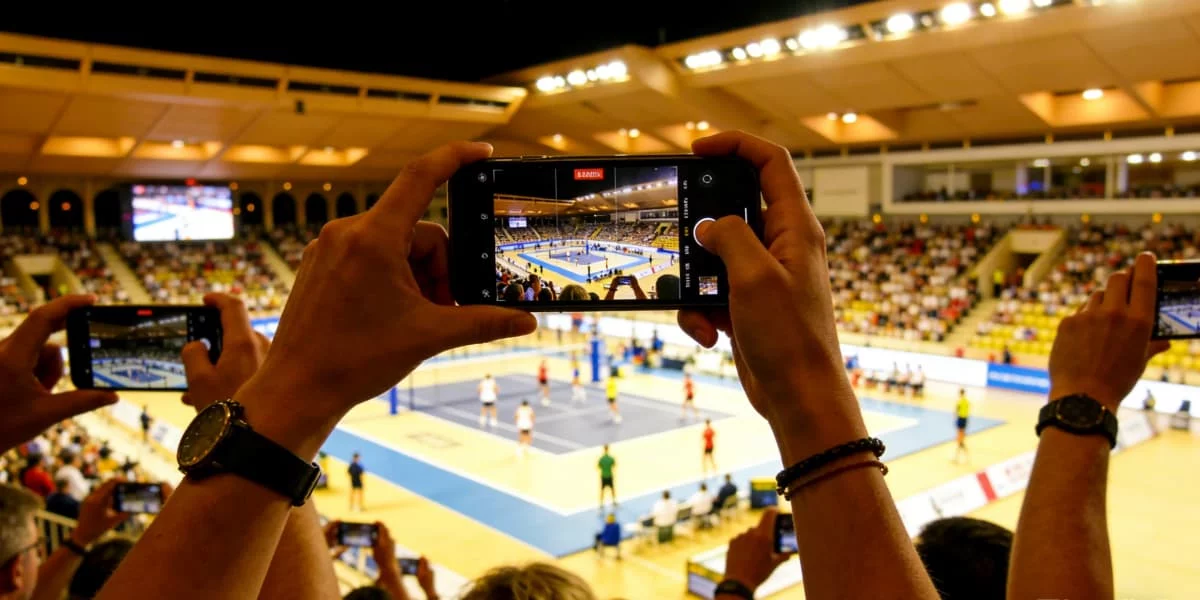
Table of Contents
What Are Flicker Free LED Lights?
Why Do LED Lights Flicker? (Problems & Solutions)
How to Measure Flicker: Moving Beyond the Basics
How to Detect Flicker with a Smartphone?
Flicker-Free Standards and Recommended Limits
How to Choose Flicker-Free LED Lights?
When you are selecting lighting fixtures for a dairy barn, a sports arena, or an industrial warehouse, you likely focus on lumens, wattage, or color temperature. But is flicker on your checklist? If not, it is time to take a closer look at how light stability impacts your environment.
There is a common misconception that LEDs are the only light sources that create unpleasant strobe-like effects. The reality is more complex. While it is true that LEDs can flicker, so does almost every other electric light source, including halogens, metal halides, and fluorescent tubes.
The difference lies in why they flicker and how we can fix it. Here are the facts about what flicker actually is, why it happens, and how to choose flicker-free LED lights.
What Are Flicker Free LED Lights?
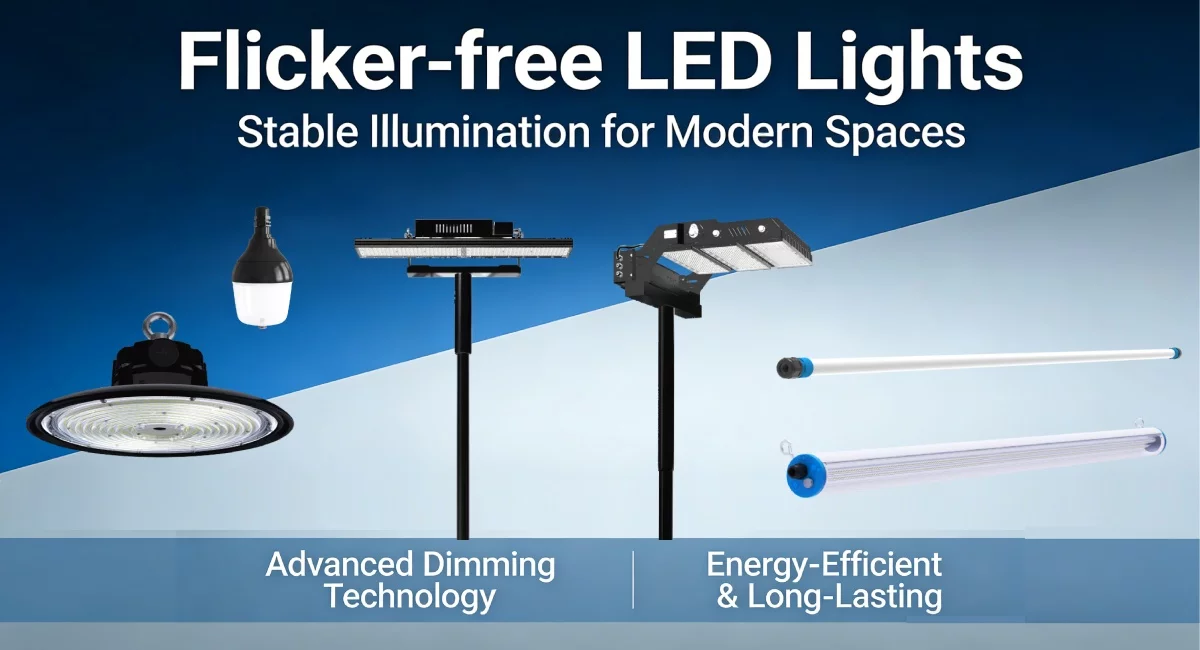
Flicker-free LED lights are lighting systems designed to keep light output fluctuations within safe and stable limits. In practice, no light source is completely free of modulation. Instead, flicker-free means the flicker level is low enough to meet recognized industry standards for visual comfort, health, and operational safety.
Low-flicker performance depends primarily on the electrical design. Key technical features include:
l High-quality constant-current driver
l Low ripple current output
l High-frequency operation to avoid visible or biological effects
l Stable performance under voltage fluctuations and dimming conditions
A well-designed low ripple LED driver ensures consistent light output without noticeable or harmful modulation.
Why we need flicker free LED lights?
The risks of flicker go beyond visual discomfort:
(1) Human impact
l Eye strain and headaches
l Fatigue and reduced concentration
l Lower workplace productivity
(2) Safety risks
l Stroboscopic effect that makes rotating machinery appear stationary or slowed
(3) Equipment impact
l Camera flicker and video banding
l Errors in machine vision, barcode scanning, or inspection systems
Since most problematic flicker is invisible, visual checks are not reliable. This is why modern lighting projects increasingly specify low-flicker or flicker-free LED lighting verified by objective measurements.
Where do we need flicker free LED lights?
Flicker-free lighting is critical in applications where visual stability matters:
² Industrial facilities and manufacturing lines
² Warehouses and logistics centers
² Sports lighting and broadcasting
² Offices, schools, and healthcare environments
² Video production and camera-sensitive spaces
² Livestock barns and farms
To verify whether a lighting system truly meets flicker-free requirements, objective metrics such as Percent Flicker, Flicker Index, and Stroboscopic Visibility Measure (SVM) must be evaluated, as explained in the next section.
What is Light Flicker?
To clear the problem, we first need to define it clearly.
 The Definition
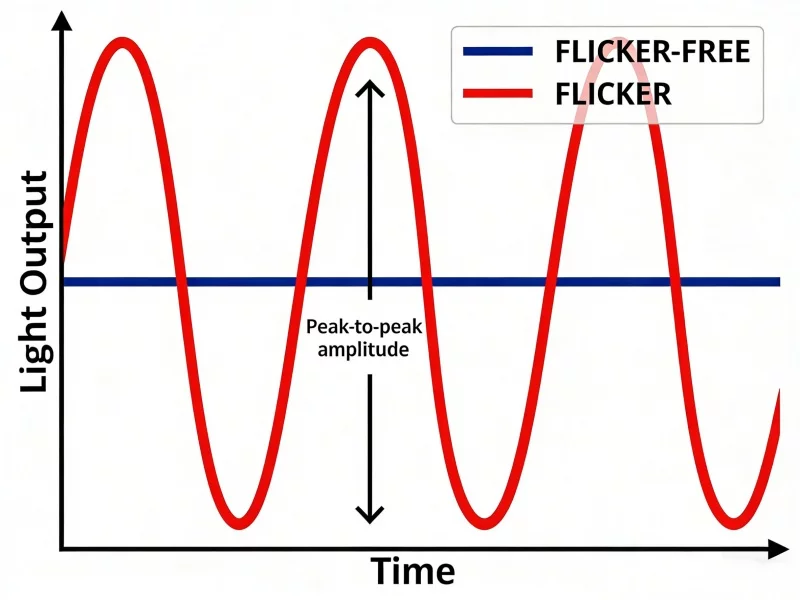
Flicker is the rapid on-off cycling of a light source.
Imagine a light switch being flipped on and off hundreds of times per second. That is essentially what is happening inside a flickering fixture. The light output is not a steady stream; instead, it fluctuates in intensity over time. While this can be intentional (like a strobe light in a nightclub), in professional settings, it is almost always an unwanted nuisance.
Two Types of Flicker
Flicker manifests in two distinct forms depending on its speed (frequency):
Ø Visible Flicker (<100 Hz):
This type occurs slowly enough—usually 100 times a second or less—that your eyes can directly detect the flashing. It is immediately noticeable and distracting.
Ø Invisible Flicker (>100 Hz):
This occurs when the light cycles so fast that your eyes cannot consciously see the flashing. However, just because you cannot see it does not mean it is harmless. Your brain and body still process these rapid changes, which can lead to negative effects such as headaches, eyestrain, and reduced concentration. In industrial environments, this invisible flicker causes the stroboscopic effect, making moving machinery appear dangerous still.
Reference: https://en.wikipedia.org/wiki/Flicker_(light)
Pro Tip: Flicker vs. Glare - What’s the Difference?
Do not confuse these two visual hazards.
l Flicker happens in Time: It is the rapid fluctuation of light brightness (on/off cycling). It causes neurological stress.
l Glare happens in Space: It is excessive brightness or contrast that creates visual discomfort (like looking directly at the sun). Want to solve this? Read our guide on how to reduce glare in sports lighting.
Why Do LED Lights Flicker? (Problems & Solutions)
An oft-repeated myth is that "LEDs just flicker naturally." That is false. LEDs themselves are stable; the problem lies in how we power them and how we control them.
Here are the two main causes of flicker and how to fix them.
Cause #1: The AC Power Supply
The Problem: Alternating Current (AC)
Most of the world’s electricity is delivered as Alternating Current (AC).
l The Wave: AC power flows in a wave (Sine wave), changing direction 50 to 60 times a second (50-60Hz).
l The Gap: Every time the current reverses direction, the voltage drops to zero.
l The Result: When the voltage hits zero, the light loses power for a fraction of a second.
Note: Old incandescent bulbs didn't flicker much because their hot filaments kept glowing during these gaps. LEDs, however, respond instantly. If the power cuts for a millisecond, the LED goes dark for a millisecond. This creates a rapid strobing effect.
The Solution: High-Quality Drivers (AC to DC Conversion)
You cannot change the power grid, but you can change how your light receives power. The solution is the LED Driver.
What it does: The driver acts like a bridge. It takes the "wavy" AC power and converts it into "flat" Direct Current (DC).
Quality Matters:
l Cheap Drivers: They do a poor job of smoothing out the wave, letting the "ripple" pass through to the LED. Result: Flicker.
l High Quality Drivers: They use high-quality components (like capacitors) that act like a reservoir, filling in the power gaps. This ensures the LED receives a constant, steady current. Steady Current = No Flicker.
Cause #2: Improper Dimming
The Problem: Old Dimmers on New Lights
Flicker often happens when you try to dim an LED using technology built for the 1980s.
l Phase Cutting (TRIAC): Traditional wall dimmers work by "chopping" the AC sine wave, effectively turning the power off for longer periods to reduce brightness.
l The Conflict: While incandescent bulbs tolerated this well, LED electronics often struggle with chopped power waves. This mismatch causes the LED to behave erratically, leading to visible buzzing or flashing.
The Solution: Modern Dimming Protocols
To achieve flicker-free dimming, you need to upgrade the control system.
l 0-10V or DALI Systems: Instead of chopping the power wire, these systems use a separate signal to tell the driver exactly how bright to be. The driver then adjusts the current smoothly without creating the violent on/off gaps of old dimmers.
Summary: If your LEDs are flickering, it is likely due to a cheap driver failing to convert AC power, or an incompatible dimmer chopping the signal. The solution is always high-quality, purpose-built electronics.
How to Measure Flicker: Moving Beyond the Basics
To truly evaluate safety, we cannot simply ask "does it flicker?" We must quantify how it flickers. A successful measurement must account for three critical characteristics:
1. Magnitude: How much does the light intensity change?
2. Frequency: How fast does it happen?
3. Waveform: What is the shape of the on/off cycle?
Here is the technical evolution of flicker metrics, from basic amplitude calculations to advanced frequency-domain analysis.
Method 1: Percent Flicker (Measuring Magnitude)
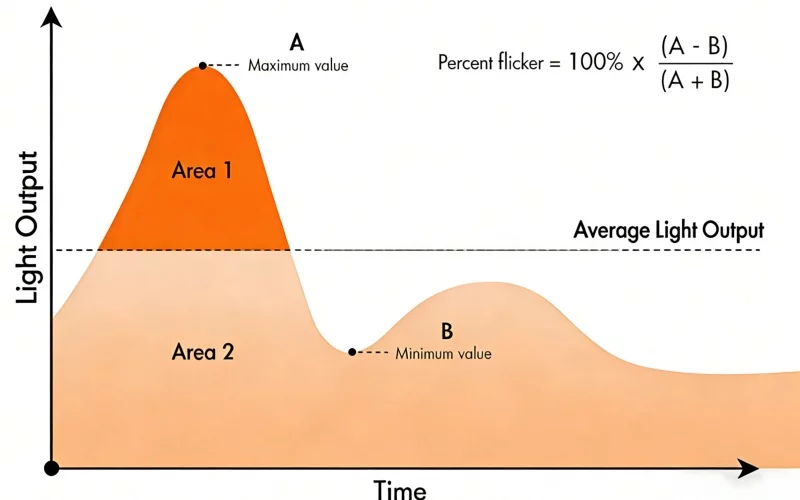
Likely the easiest metric to understand, Percent Flicker measures the magnitude (depth) of the modulation. It is strictly an amplitude calculation.
How it is calculated:
It takes the difference between the maximum light output (Peak) and the minimum light output (Trough), divided by the sum of those two values.
Percent Flicker=Max−MinMax+Min×100%Percent Flicker=Max+MinMax−Min×100%
The Scale:
0%: A perfectly steady light.
100%: The light turns completely OFF and then ON (like a strobe).
The Critical Limitation:
While easy to calculate, Percent Flicker completely ignores frequency and waveform.
Why this matters: A light with 100% flicker at 50Hz is a visual disaster. A light with 100% flicker at 10,000Hz (common in high-frequency PWM) is usually invisible and safe. Relying solely on Percent Flicker can accidentally disqualify suitable high-tech fixtures while failing to catch harmful low-frequency lights.
Method 2: Flicker Index (Measuring Waveform)
Flicker Index is a step up. Instead of just looking at the high and low points, it looks at the shape of the light output curve.
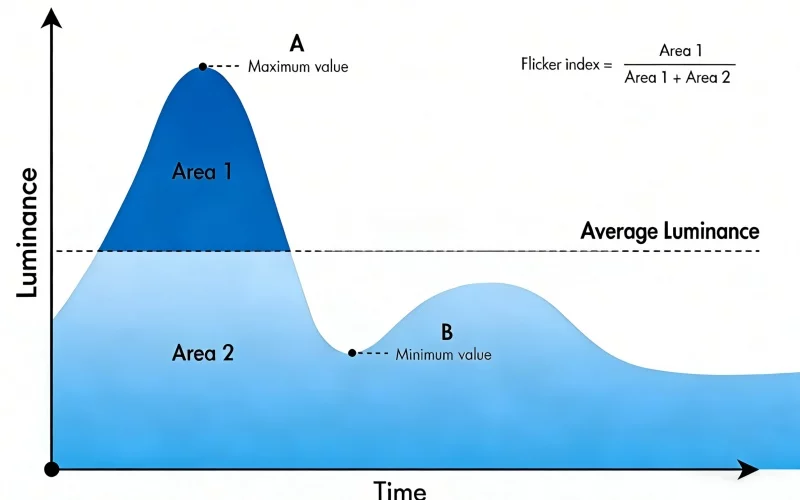
How it is calculated:
It measures the area under the light output waveform. Specifically, it divides the Area above the average light output by the Total area of the light output curve.
The Scale:
Ranges from 0 to 1 (lower is better).
Why it is better:
It accounts for the Duty Cycle (the percentage of time the light is effectively "on"). Two lights might have the same Percent Flicker, but if one stays "off" for longer periods during each cycle, it will have a worse (higher) Flicker Index. This makes it a more accurate representation of light stability than percentage alone.
Method 3: Frequency-Domain Analysis (The "Perception" Standards)
The latest and most accurate techniques—such as SVM and IEEE 1789—move beyond simple time-based measurements. They use Frequency-Domain Analysis.
l The Science (Fourier Transform):
These metrics rely on a mathematical process called a Fourier Transform. This converts the light signal from the "Time Domain" into the "Frequency Domain," breaking complex light signals into their fundamental frequency building blocks.
l Why this is the Gold Standard:
Unlike the previous methods, this approach accounts for Human Perception. It compares the light's frequencies against empirical data on how human eyes and brains actually react. It weights the data: lower frequencies (which hurt us more) are penalized heavily, while ultra-high frequencies are penalized less.
Key Standards Using This Method:
1. IEEE Std 1789-2015 (The Safety Guide)
The Institute of Electrical and Electronics Engineers (IEEE) combined biology and physics to create a definitive safety chart. It expands the analysis range up to 3000Hz to account for biological effects.
It defines three zones:
ü The No-Effect Region (Green): Safe for all applications.
ü The Low-Risk Region (Yellow): Acceptable for general use.
ü The High-Risk Region (White): Unsafe for industrial or biological environments.
2. SVM (Stroboscopic Visibility Measure)
This metric specifically evaluates the Stroboscopic Effect—the danger of moving objects appearing still. It focuses on frequencies >80Hz.
Target: SVM should be ≤ 1.0. For high-precision industrial tasks, you want this value closer to 0.
Recommended Table: Key Flicker Metrics Comparison
Metric | What It Measures | Pros | Cons | Verdict |
Percent Flicker (PF) | The difference between max & min brightness (0-100%). | Easy to calculate and understand. | Ignores frequency. Fails to detect high-speed invisible flicker. | Outdated. Only useful for basic checks. |
Flicker Index (FI) | The shape and duty cycle of the light waveform (0-1.0). | More accurate than PF; considers the "off" time. | Still doesn't fully account for human perception frequencies. | Better, but not complete. |
SVM (Stroboscopic Visibility Measure) | The visibility of strobe effects in moving environments. | The Gold Standard. Accounts for human sensitivity and speed. | Requires professional equipment to measure. | Essential for Industrial & Sports safety. |
Pst LM (Short Term) | Visible flicker perception over a short period. | Excellent for detecting visible (<80Hz) nuisance flicker. | Complex calculation; less focused on high-speed machinery. | Standard for Office & General lighting. |
How to Detect Flicker with a Smartphone?
In many projects, lighting issues are reported only after installation. While professional flicker measurement requires specialized equipment, a smartphone can be used for a quick preliminary screening.
Step-by-step method
1. Open your phone’s camera and switch to Slow-Motion (Slo-Mo) mode.
2. Point the camera directly at the light source.
3. Record for 3–5 seconds.
4. Replay the footage and observe the light pattern.
What to look for
l Rolling dark bands moving across the image
l Visible flashing or pulsing
l Uneven brightness cycles
These effects indicate significant light modulation and potential flicker problems.
Important limitation
This method is qualitative only. It cannot measure Percent Flicker, frequency, SVM, or compliance with IEEE 1789. For industrial facilities, sports venues, or livestock environments, always verify performance using LM-79 flicker data or third-party test reports.
Use smartphone screening only as a quick field check—final decisions should always be based on verified measurement results.
Flicker-Free Standards and Recommended Limits
While the previous section explains how flicker is measured, decision-making requires a different perspective: what levels are actually considered safe and acceptable in real-world applications.
Industry standards define recommended limits to ensure lighting operates within biologically and visually safe ranges. The following reference values summarize widely accepted thresholds used to evaluate lighting stability and safety across common applications.
Metric | Recommended Value | Application |
Percent Flicker | < 5% (ideal < 1–3%) | General / Industrial |
Flicker Index | < 0.1 | Offices / Commercial |
IEEE 1789 | No-Effect Region | Human safety |
SVM | ≤ 1.0 | Industrial / Sports |
Pst LM | ≤ 1.0 | Visible flicker control |
Lighting systems that meet these limits provide stable visual conditions, reduce eye strain and neurological stress, and minimize stroboscopic risks. In demanding environments such as factories, sports facilities, and livestock operations, meeting these thresholds is essential for safety, productivity, and long-term performance.
How to Choose Flicker-Free LED Lights?
Not all products labeled “flicker-free” deliver the same level of performance. In many cases, the term is used as a marketing claim rather than a measurable specification. To ensure true light stability, buyers should verify key flicker metrics instead of relying on product descriptions alone.
1. Percent Flicker
Check the Percent Flicker value provided in the test data. For most applications, the value should be below 5%. In sensitive environments such as industrial facilities, sports broadcasting venues, healthcare spaces, or livestock farms, a stricter range of 1–3% or lower is recommended to minimize biological stress and visual fatigue.
2. IEEE 1789 Compliance
The lighting system should operate within the No-Effect Region defined by IEEE 1789-2015. This standard evaluates both modulation depth and frequency to ensure the light will not trigger neurological or physiological risks.
3. Stroboscopic Visibility (SVM)
For locations with moving machinery, rotating equipment, or high-speed cameras, verify the SVM value. The recommended threshold is SVM ≤ 1.0, while high-precision environments such as manufacturing lines or broadcast venues should aim for SVM < 0.4.
Finally, always request a flicker test report or LM-79 data from the manufacturer. Verified measurements are the only reliable way to confirm true flicker-free performance.
Conclusion
Lighting is often an afterthought, but it shouldn't be.
Saving a small amount of money on LED fixtures with cheap drivers is a false economy. The hidden costs—whether it is compromised worker safety, reduced milk yield in your dairy barn, or poor video quality in your arena—far outweigh the initial savings.
Flicker-free LED lights are an investment in safety, productivity, and welfare.
Ready to Upgrade?
Do not guess about your lighting quality. If you are looking for a verified, high-performance solution for industrial, sports, or livestock applications, let’s talk.
Consult with a Ceramiclite engineer today to design a lighting plan that is safe for your team, your animals, and your business.