_thumb.jpg)
High Mast Lighting Systems: The Ultimate Engineering Guide
Modern large-scale infrastructure—from sprawling international airports to complex highway interchanges and massive industrial ports—relies on one non-negotiable factor: safe, uniform, and reliable illumination. When a vast outdoor area requires high-intensity lighting with minimal ground-level obstructions, a standard street light simply won't suffice. This is where high mast lighting becomes the ultimate engineering solution.
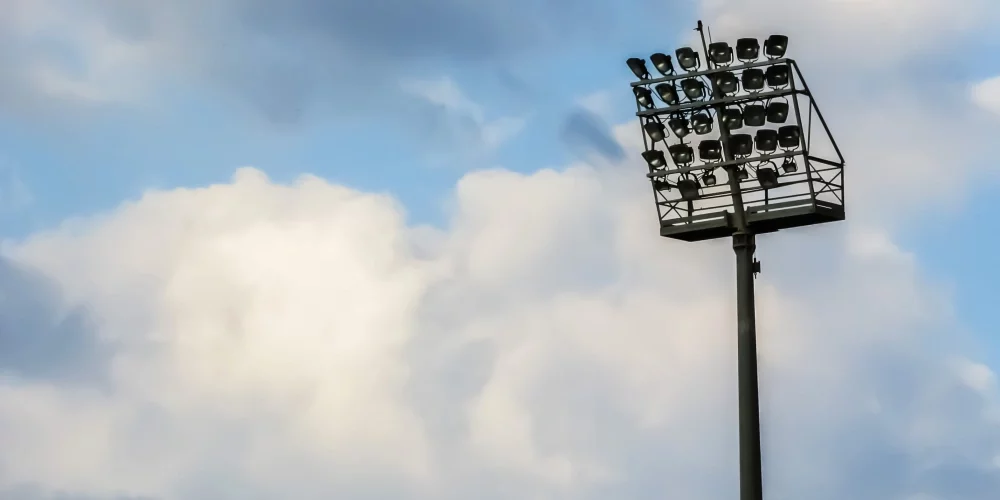
If you frequently ask, "What is a high mast lighting system?", the definition is straightforward but highly technical. It is a specialized, towering lighting structure typically ranging from 20 meters (65 feet) to over 45 meters (150 feet) in height, designed to carry a ring of multiple high-lumen luminaires. Its primary goal is to illuminate massive areas with extreme uniformity while minimizing glare and ground-level clutter.
In this comprehensive guide, we will break down the complex anatomy of these massive structures, explore the critical differences between high mast and regular flood lights, delve into the intricacies of LED retrofitting (including EPA and weight limits), and discuss foundational engineering rules to help you make informed project decisions.
Table of Contents
The Anatomy of a High Mast Lighting System
High Mast Lighting vs. Flood Lighting: What’s the Difference?
Wide-Ranging Applications of High Mast Lights
Why and How to Retrofit High Mast Lights with LED?
Engineering Basics: Pole Foundation & Installation Rules
What is High Mast Lighting Costs and TCO?
The Anatomy of a High Mast Lighting System
A common misconception is that a high mast is just an exceptionally tall pole with lights on top. In reality, it is a complex, engineered system designed for extreme weather endurance and safe, ground-level maintenance. A complete setup consists of four main components:
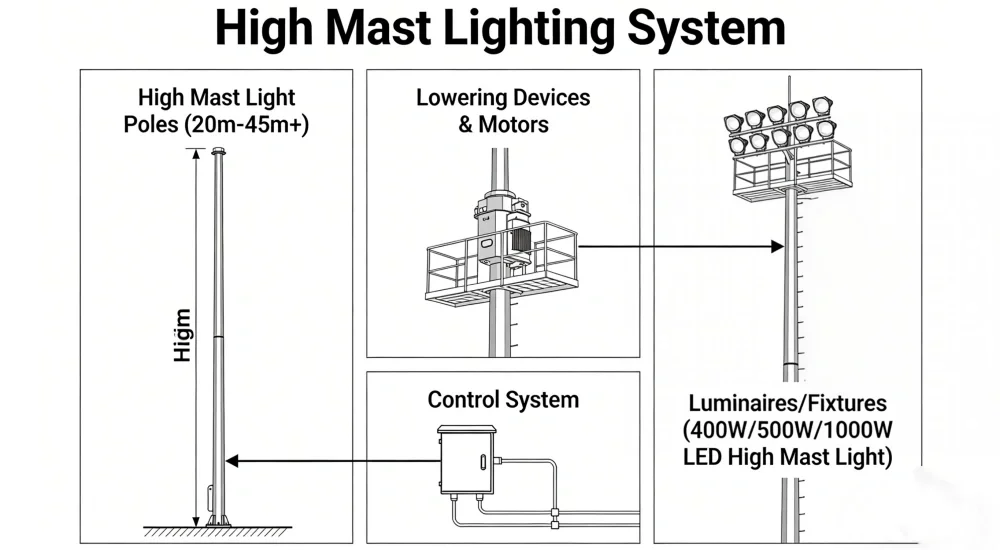
1. High Mast Light Poles (The Structural Backbone)
The high mast light pole is typically constructed from high-strength, hot-dip galvanized polygonal steel. Designed to withstand severe wind loads and vibrations, these poles taper from a wide, heavily reinforced base to a narrower top. If you are wondering "How tall are high mast lights?", the industry standards for large-area illumination usually feature 25m high mast lighting and 30m high mast lighting specifications, though they can be custom-engineered for even greater heights depending on the application.
2. Lowering Devices & Motors (The Maintenance Core)
Maintaining light fixtures at 100 feet in the air using a bucket truck is incredibly dangerous and expensive. Therefore, most modern systems utilize an internal lowering device. This mechanism features a movable headframe (lowering ring) connected to heavy-duty aircraft-grade steel cables. Powered by a specialized high mast light motor (winch) located at the base of the pole, the entire ring of lights can be safely lowered to the ground by a single operator for cleaning, repair, or LED retrofitting.
3. Luminaires / Fixtures (The Light Source)
Mounted symmetrically or asymmetrically on the lowering ring are the high mast light fixtures. Historically, these were equipped with energy-draining 1000W to 2000W High-Pressure Sodium (HPS) or Metal Halide (MH) lamps. Today, the industry has aggressively shifted to LED technology. Upgrading to a highly efficient 400W LED high mast light, 500W LED high mast light, or 1000W LED high mast light not only cuts energy consumption by up to 60% but also eliminates the severe lumen depreciation associated with traditional HID bulbs.
4. Control Systems (The Brain)
Tucked safely inside the base of the pole is the high mast light control panel. This electrical hub distributes power to the internal motor and the fixtures above. It typically houses crucial components such as circuit breakers, photocell override switches (for automated dusk-to-dawn operation), and industrial-grade surge protection devices to defend the delicate LED drivers against lightning strikes.
High Mast Lighting vs. Flood Lighting: What’s the Difference?
When planning lighting for a large site, facility managers often search for "high mast lighting vs flood lighting" to determine the best approach. While they might seem similar to the untrained eye, a flood light high mast setup is fundamentally different from standard area floodlighting in terms of optics, structural engineering, and maintenance protocols.
Here is a clear breakdown of the core differences:
Feature / Specification | Standard Flood Lighting | High Mast Lighting Systems |
Mounting Height | Typically 10m to 20m (30ft to 65ft). | 20m to 45m+ (65ft to 150ft+). |
Light Distribution (Optics) | Symmetric, wide beam angle. Projects light forward to a specific target. | Asymmetric or symmetric distribution. Designed to push light straight down and outward, maximizing the high mast lighting coverage area with extreme uniformity. |
Vibration Resistance | Standard resistance. | Extreme resistance. Due to extreme wind speeds at 100ft+, fixtures must pass rigorous 3G vibration tests. |
Glare Control | Higher risk of glare for drivers/players due to lower mounting heights and direct aiming. | Low glare. The extreme height allows light to fall naturally, reducing harsh direct glare for pilots, drivers, or athletes. |
Maintenance Method | Requires a cherry picker or boom lift (expensive and highly disruptive). | Ground-level maintenance via internal lowering rings and winches. |
Wide-Ranging Applications of High Mast Lights
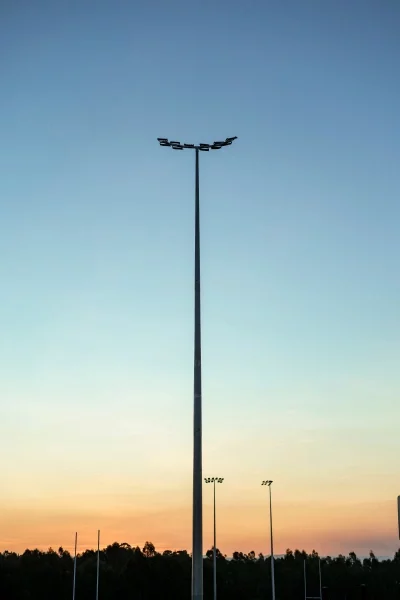 Because of their ability to illuminate massive footprints with minimal poles, high mast systems are the undisputed champions for critical outdoor environments. Their applications span across several demanding sectors:
l Transportation Infrastructure: For massive transit hubs, safety is paramount. Freeway high mast lighting at complex interchanges and toll plazas ensures drivers have shadow-free visibility without blinding glare. Similarly, airport high mast lighting on tarmacs and aprons provides brilliant, uniform light for ground crews and pilots, strictly adhering to FAA or ICAO optical regulations.
l Industrial & Security Sites: Environments that operate 24/7, such as seaports, container yards, and railway switching yards, require rugged illumination. High mast fixtures in these areas must feature marine-grade, corrosion-resistant coatings to withstand salt spray and harsh weather conditions while providing unparalleled security lighting.
l Sports & Commercial Complexes: For large-scale events, high mast stadium lighting delivers the high Color Rendering Index (CRI) and flicker-free performance required for HD television broadcasting, while effectively controlling light spill into neighboring residential areas. Furthermore, sprawling retail centers and logistics hubs rely on high mast parking lot lights to ensure pedestrian safety and deter vandalism with fewer poles cluttering the space.
Learn more about high mast lighting solution for stadiums.
Why and How to Retrofit High Mast Lights with LED?
Building a brand-new high mast system from scratch—including soil excavation, pouring massive concrete foundations, and erecting custom steel poles—requires a staggering capital investment. Fortunately, the galvanized steel poles and the internal lowering systems are generally engineered to last 30 to 50 years. The weakest link is typically the outdated HID luminaires at the top.
Therefore, keeping the existing structural infrastructure and merely upgrading the old fixtures to a modern LED high mast light (a process known as retrofitting) is the most cost-effective and efficient strategy in the industry. However, retrofitting is not as simple as swapping a light bulb. To ensure structural safety and optimal high mast lighting design, engineers must rigorously evaluate the following factors:
Strict Weight Limits on Lowering Rings
Every lowering mechanism, consisting of a motorized winch and steel cables, has a strictly defined Safe Working Load (SWL). Older 1000W Metal Halide fixtures had a specific weight profile. If a replacement LED fixture is excessively heavy due to bulky heat sinks, it can overload the existing steel cables, causing the winch motor to jam or, worse, leading to catastrophic cable failure. Partnering with a skilled high mast light manufacturer that engineers lightweight, high-efficiency LED fixtures is imperative for a safe retrofit.
EPA (Effective Projected Area) and Wind Load Safety
According to rigorous AASHTO (American Association of State Highway and Transportation Officials) standards, every existing pole was engineered with a maximum allowable wind load capacity. The EPA—the measurable surface area of the fixture that resists wind—is a critical metric. If your new LED fixtures have a larger EPA than the original HID lamps, the pole could face excessive aerodynamic drag during a storm, risking structural collapse. Upgrading to LED fixtures with a compact, aerodynamic, and low-EPA housing ensures the structural integrity of the mast remains uncompromised.
Standard Mounting Compatibility
A common concern for contractors during a retrofit is whether the new LED fixtures will physically attach to the old lowering ring. Modern LED high mast luminaires are designed for seamless integration. They typically come equipped with standard slipfitters or heavy-duty trunnion mounts, which slide directly onto or bolt securely to the standard 2-inch or 2-3/8-inch vertical or horizontal tenons found on almost all existing lowering rings. This allows for a fast, plug-and-play installation without the need for expensive custom fabrication.
Superior Optical Performance
By replacing a legacy 1000W high-pressure sodium lamp with a premium 400W or 500W LED fixture, facilities can instantly eliminate the severe lumen depreciation (fading light output) that plagues traditional bulbs. Advanced LED optics direct the light precisely where it is needed, drastically improving ground-level uniformity and eliminating the "dark spots" common in older installations.
Engineering Basics: Pole Foundation & Installation Rules
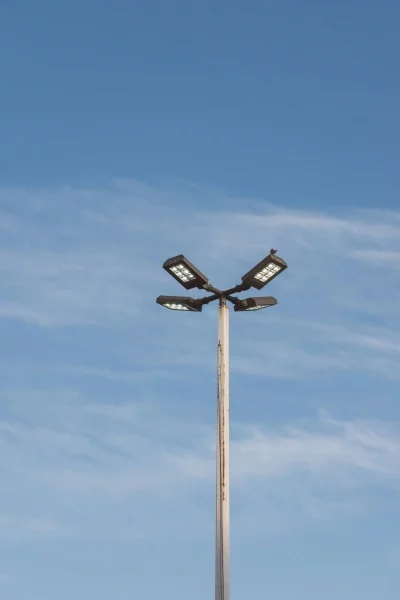
For civil engineers and electrical contractors, the physical erection of these massive towers requires meticulous planning. A frequently asked question in the industry is, "How deep should a 20-foot pole be in the ground?" or "What size concrete base for a light pole?"
 Foundation Depth & Concrete Base Rules
While a general industry rule of thumb suggests that the burial depth of a standard pole should be roughly 10% of its total height plus 2 feet, high mast towers operate under entirely different physical forces. Because a 30-meter pole with multiple fixtures acts like a massive sail in the wind, a proper high mast lighting foundation design cannot be guessed.
It must be calculated by a licensed structural engineer. The design relies heavily on local soil geotechnical reports, frost line depth, and regional wind zones. The foundation typically involves deep, reinforced concrete drilled shafts (caissons) packed with heavy-duty anchor bolts to ensure the high mast light pole design can withstand hurricane-force winds.
Installation Safety protocols
High mast light pole installation is a major logistical operation. It requires a heavy-duty crane to hoist the multi-section steel mast. Safety protocols dictate that the concrete foundation must fully cure (often 28 days) before the pole is erected. Furthermore, all internal lowering cables and the motorized winch must be thoroughly inspected and tested at ground level before the mast is lifted into its vertical position.
What is High Mast Lighting Costs and TCO?
When budgeting for a project, understanding the high mast lighting price structure is crucial. Facility managers often seek the total high mast light cost, which must be broken down into an initial capital expenditure and Long-term Total Cost of Ownership (TCO).
Capital Cost Breakdown
In a complete new installation, the luminaires are just one piece of the puzzle. The massive steel structure accounts for the majority of the high mast light pole cost, often followed closely by the civil engineering required for the deep concrete foundation. The mechanical lowering device and winch motor also represent a significant portion of the budget.
TCO (Total Cost of Ownership) and ROI
This is exactly why retrofitting existing poles with LED technology is so financially attractive. While an industrial-grade LED fixture may carry a higher initial price tag than a replacement HID bulb, the ROI (Return on Investment) is usually realized within 2 to 3 years. By cutting energy consumption by up to 60% and completely eliminating the need to rent specialized bucket trucks every three years to replace burnt-out HID lamps, the maintenance savings alone cover the cost of the LED upgrade.
Conclusion
Whether illuminating an international airport tarmac or upgrading a major highway interchange, high mast systems are the undisputed standard for large-area, shadow-free lighting. However, as the industry transitions rapidly away from outdated HID technology, understanding the engineering nuances of LED retrofits—particularly weight limits, EPA wind loads, and optical precision—is the key to a successful project.
Whether you are planning a completely new foundational build or seeking a safe, compliant LED retrofit for your existing HPS systems, selecting the right fixture is critical. As one of the premier LED high mast light manufacturers and trusted high mast light suppliers, Ceramiclite engineers high-performance LED luminaires specifically designed for these demanding environments. Our fixtures boast ultra-low EPA profiles, lightweight thermal management designs, and standard mounting compatibilities to ensure a safe, efficient, and seamless upgrade for your infrastructure.
Ready to transform your facility's illumination? Contact the experts at Ceramiclite today to request detailed product specifications or to receive a complimentary, custom DIALux lighting design calculation for your next high mast project.