_thumb.jpg)
Industrial Lighting Standards OSHA Compliance Guide

Table of Contents
Why OSHA Lighting Standards Matter in Industrial Environments?
OSHA Lighting Requirements Explained
Minimum Illumination Levels by Work Area
OSHA Light Fixture and Cover Requirements
Common Compliance Gaps and OSHA Violations
How to Ensure OSHA Compliance in Industrial Lighting?
Benefits of Meeting OSHA Lighting Standards
Why OSHA Lighting Standards Matter in Industrial Environments?
In industrial workplaces, proper illumination isn’t just a convenience — it’s a legal and safety requirement. Industrial Lighting Standards OSHA set the baseline for how bright, uniform, and safe lighting should be across factories, warehouses, and production floors.
These standards, issued by the Occupational Safety and Health Administration (OSHA), are designed to protect workers from accidents, reduce eye strain, and ensure that every task is performed with accuracy and confidence.

When lighting levels fall below OSHA’s minimum requirements, the risks multiply — slips, misjudged distances, and operational errors become more likely. Poor visibility can slow down productivity, increase fatigue, and even cause costly downtime or legal penalties.
Many facility managers know the challenge firsthand — keeping lighting systems compliant while balancing cost and practicality isn’t always easy. Older fluorescent or metal halide fixtures might still “work,” but over time their brightness fades, leaving key work areas under-illuminated. Even when the lights seem bright enough, uneven distribution or glare can make it hard for workers to see clearly, increasing fatigue and mistakes.
In busy industrial environments, these small lighting issues often go unnoticed until they cause safety concerns or trigger an OSHA inspection.
Understanding and applying OSHA lighting standards for general industry helps ensure every workspace — from assembly lines to storage aisles — meets both safety and performance expectations.
OSHA Lighting Requirements Explained
OSHA’s lighting rules may look technical at first glance, but their goal is simple — to make every workplace safe and clearly visible.
The OSHA lighting standards are divided into several key sections:
OSHA 1910 covers general industry, including factories, warehouses, and workshops.
OSHA 1915 applies to shipyards and marine operations.
OSHA 1926 governs construction sites and temporary work zones.
Among these, OSHA 1910.37 is one of the most frequently referenced sections. It defines lighting requirements for exit routes and emergency paths, ensuring safe evacuation during power loss or emergencies. OSHA also often refers to ANSI/IES RP-7, a guideline from the American National Standards Institute (ANSI) and the Illuminating Engineering Society (IES), which recommends proper light levels for different industrial tasks.
Lighting performance is measured in foot-candles (fc) — one foot-candle equals the amount of light from a single candle one foot away. For international readers, 1 fc is roughly 10.76 lux. OSHA uses foot-candles as its measurement unit to set the minimum illumination levels for various work areas.
To verify compliance, inspectors measure light using a light meter positioned at the worker’s eye or task level. Readings are taken at multiple points across the area, then averaged to ensure consistent and adequate illumination — not just bright spots, but even, reliable lighting across the entire workspace.
For a detailed overview of OSHA’s illumination standards and measurement methods, visit the official OSHA Lighting Requirements page.
Minimum Illumination Levels by Work Area
Every work zone has its own lighting needs — a loading dock doesn’t require the same brightness as a laboratory. That’s why OSHA lighting standards for warehouse and other facilities define minimum illumination levels to maintain both safety and visibility.
These values are measured in foot-candles (fc), which can be converted to lux by multiplying by 10.76.
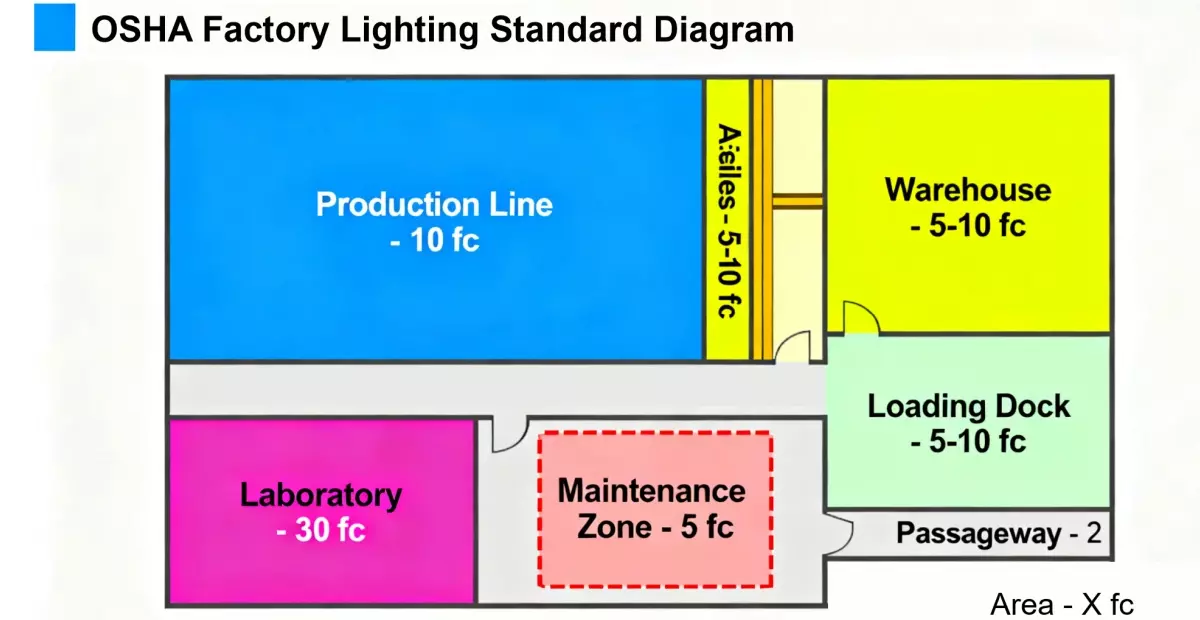
Below are the commonly accepted lighting levels recommended for industrial settings:
Factories and production lines: 10 fc (≈108 lux) – sufficient for general assembly and inspection.
Warehouses, loading docks, and aisles: 5–10 fc (≈54–108 lux) – enough for movement and material handling.
Laboratories and first-aid stations: 30 fc (≈323 lux) – ensures clear visibility for precision tasks and safety checks.
Stairways and passageways: 2 fc (≈22 lux) – prevents tripping and helps maintain safe navigation.
Maintenance zones, tunnels, and underground areas: 5 fc (≈54 lux) – provides adequate illumination for repair work.
OSHA-industrial-lighting-standard-diagram
Industrial lighting that’s too dim can hide obstacles and increase accident risk, while too bright lighting can cause glare, eye strain, and fatigue. The best approach is balanced illumination — bright enough for safety and accuracy, yet soft enough for comfort.
Consistent, well-distributed lighting helps workers perform tasks confidently and reduces errors — a crucial part of staying compliant with OSHA lighting standards for laboratory and warehouse environments alike.
OSHA Light Fixture and Cover Requirements
Beyond brightness levels, OSHA light cover requirements focus on fixture safety — ensuring lights themselves don’t become hazards. According to industrial lighting standards, every fixture in a workplace must be properly shielded, mounted, and protected against impact or breakage.
All light fixtures must have protective covers or shatterproof shields to prevent glass or debris from falling if a bulb breaks. In areas where equipment or forklifts operate, such as warehouses, fueling zones, or loading docks, this protection is especially critical.
Fixtures should be mounted at least 7 feet above the work surface. If they must be installed lower, OSHA requires a guard or protective cage to prevent accidental contact. No fixture may have exposed live parts or openings large enough for a finger to reach through, and every light must be securely fastened to prevent vibration-related loosening.
Meeting these requirements not only avoids compliance issues but also ensures a safer, longer-lasting lighting system — protecting workers, equipment, and inventory in demanding industrial environments.
Common Compliance Gaps and OSHA Violations
Even facilities with good lighting systems often fall short of OSHA industrial lighting standards in real operation. The following common violations are not just technical oversights — they are real risks that can lead to accidents, fines, and liability.
1. The “High Shelf Blind Zone”
In warehouses with tall racks, the upper layers often receive only a fraction of the required illuminance due to light decay and poor fixture positioning. Workers retrieving goods in these dim areas may misjudge distances or fail to spot obstacles, increasing the risk of falling objects and forklift collisions.
OSHA requires adequate illumination for all working levels, not just ground operations. Regular lux testing at different rack heights is essential to stay compliant.
2. The “Maintenance Trap”
During equipment or facility maintenance, workers often set up temporary lighting — handheld lamps, extension cords, or portable floodlights. However, many of these do not meet explosion-proof or waterproof ratings, especially in environments with dust, moisture, or volatile chemicals.
This creates a hidden hazard: short circuits, electrical shocks, or even fires.
OSHA 1926.405(a)(2)(ii)(J) mandates that all temporary lighting must meet the same safety standards as permanent installations.
3. The “Glare Hazard”
While insufficient light is a problem, excessive brightness or unshielded fixtures can be equally dangerous. In areas where workers operate forklifts or handle shiny metal surfaces, glare can cause temporary visual blindness — a split-second loss of sight that may lead to serious injury.
OSHA recommends using diffused or shielded lighting and ensuring luminance uniformity to prevent visual fatigue and glare-related accidents.
4. Ignoring Color Rendering and Contrast
Another overlooked issue is using lamps with poor color rendering. In manufacturing or inspection zones, low CRI (Color Rendering Index) lighting makes it difficult to identify wire colors, labels, or surface defects, which can directly lead to misconnections or product quality issues.
OSHA-compliant lighting should maintain a minimum CRI of 70 in most industrial environments to ensure safe recognition of colors and materials.
5. Lack of Routine Light Audits
Many facilities never recheck light levels after installation. Over time, dust buildup, lens yellowing, and LED lumen depreciation can reduce brightness by 20–30%. When accidents occur, post-incident investigations often reveal that the lighting system had fallen below OSHA’s minimum lux requirements.
Regular audits every 6–12 months and documenting results are vital to maintaining compliance and avoiding fines.
In short: OSHA violations often start small — a dim corner, a glare spot, or a neglected maintenance area — but they can end in costly incidents. Proactive inspection, appropriate lighting design, and adherence to OSHA lighting standards can keep your workplace both safe and compliant.
How to Ensure OSHA Compliance in Industrial Lighting?
Meeting industrial lighting standards isn’t just a box to tick — it’s how you protect workers, prevent fines, and maintain smooth operations. The best approach is to turn compliance into a simple, repeatable four-step cycle.
1. Audit – Measure the Real Situation
Start with a full lighting audit using a lux meter. Walk through production floors, warehouses, and loading zones at different times of day. Identify dark corners, glare zones, and uneven brightness. Record these readings to compare against OSHA-recommended lux levels.
2. Plan – Create a Smart Upgrade Map
Based on the audit results, draft a lighting improvement plan. Prioritize high-risk zones — such as forklift lanes, stairways, or assembly areas — where visibility directly impacts safety. Include layout changes, fixture positioning, and energy-efficiency goals.
3. Implement – Install Certified LED Lighting
Choose OSHA-compliant LED fixtures with the right certifications: UL, DLC, and CE. For harsh or hazardous areas, check for proper IP rating and explosion-proof standards.
High bay and energy-efficient industrial LED lighting systems are ideal choices — they deliver uniform brightness, long lifespan, and up to 70% energy savings.
4. Maintain – Keep Standards Over Time
Compliance doesn’t end after installation. Schedule lux checks every six months and clean fixtures regularly — even a thin dust layer can cut brightness by 20%. Add emergency lighting with backup power to cover outages and ensure continuous safety.
By following this simple Audit–Plan–Implement–Maintain loop, your facility can stay fully OSHA compliant, while benefiting from the efficiency, longevity, and cost savings of industrial LED lighting.
Benefits of Meeting OSHA Lighting Standards
Complying with OSHA lighting standards goes far beyond avoiding penalties — it’s an investment in your people and long-term productivity.
Safer, More Focused Work
Proper lighting helps workers see clearly, avoid hazards, and reduce fatigue. When every corner is well lit, the risk of slips, trips, and equipment mishandling drops dramatically.
Higher Efficiency and Morale
Good visibility keeps production lines running smoothly and supports precision tasks like assembly or inspection. Employees feel more confident and engaged in a well-lit environment.
Lower Energy and Maintenance Costs
Switching to LED lighting can cut energy consumption by 50–70%, while extending fixture lifespan and reducing maintenance downtime — a double win for both safety and sustainability.
Stronger Reputation and Compliance
Facilities that meet OSHA standards project professionalism and reliability. Compliance not only protects your workforce but also strengthens your brand during client audits and safety reviews.
In short, investing in compliant lighting means investing in sustainable performance and long-term success.
Conclusion
Understanding and following Industrial Lighting Standards OSHA isn’t just about meeting regulations — it’s about creating a safer, smarter, and more efficient workplace. Proper illumination protects workers, enhances visibility, and helps prevent costly accidents.
With modern LED lighting systems, achieving OSHA compliance has never been easier. LEDs deliver consistent brightness, lower energy bills, and require minimal maintenance — all while ensuring every area meets required illumination levels.
Invest in reliable, OSHA-compliant lighting and build a workplace that shines with safety and productivity.
Discover CeramicLite’s professional industrial lighting solutions today.