_thumb.jpg)
Understanding IP Rating for LED Lighting: From IP65 to IP69K
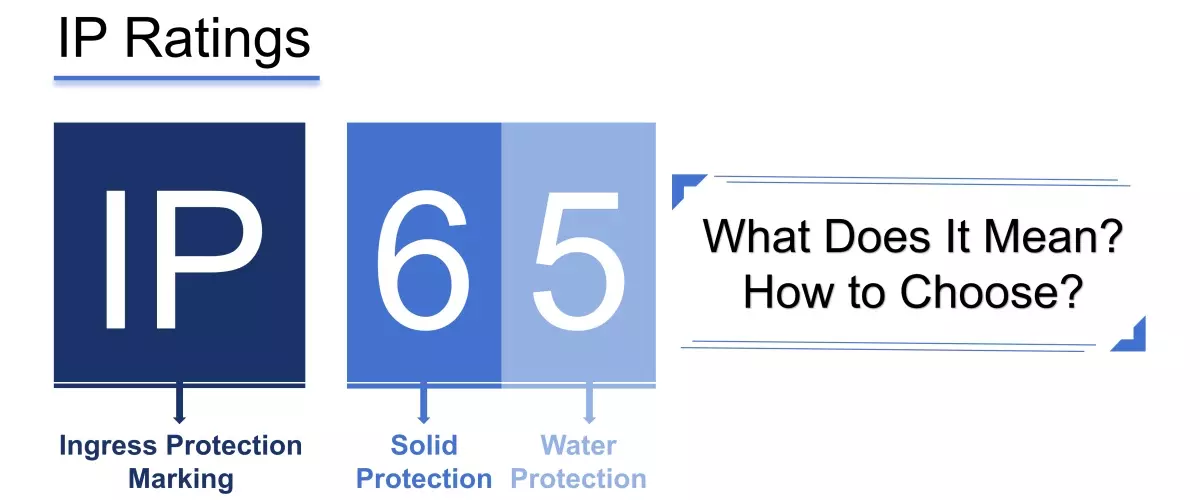
Table of Contents
Why IP Ratings Matter: The Cost of False Specs
IP Rating Chart: The Complete Breakdown
Common IP Ratings in LED Lighting & Applications
How to Choose the Waterproof LED Lights for Your Facility?
Frequently Asked Questions (FAQ)
Intro
Buying an LED fixture based solely on brightness (lumens) or power (watts) is a common mistake. If that fixture is installed in a dusty warehouse, a rainy stadium, or a livestock farm requiring high-pressure cleaning, its internal components are at risk from the moment it is switched on.
Water ingress and dust accumulation are the two leading causes of LED failure. To prevent this, the lighting industry relies on a global standard known as the IP Rating.
But what do these numbers actually mean? Is IP67 always better than IP65? And what is the difference between IP69 and the specialized IP69K?
In this comprehensive guide, we will break down the IP rating chart, explain the strict IEC standards, and help you choose the precise protection level to ensure your lighting investment lasts for years, not months.
What is an IP Rating?
IP stands for Ingress Protection (sometimes referred to as International Protection).
It is not a marketing term invented by lighting manufacturers. It is a rigorous international standard defined by the International Electrotechnical Commission (IEC), specifically under the standard IEC 60529. First established in 1976 and updated over the decades, this system classifies the degrees of protection provided by electrical enclosures against two types of intrusion:
l Solid Objects: Hands, tools, wires, and dust.
l Liquids: Water droplets, sprays, jets, and immersion.
How is it Certified?
A legitimate IP rating is not a guess. It involves strict laboratory testing. For a fixture to be certified (e.g., as IP66), it must undergo standardized tests—often conducted or verified by independent third-party bodies like TUV, SGS, or Intertek—using calibrated dust chambers and water nozzles to prove it meets the IEC criteria.
Why IP Ratings Matter: The Cost of False Specs
Why should a facility manager or contractor care about the difference between IP65 and IP66?
1. Operational Safety:
In industrial environments, conductive dust entering a fixture can cause short circuits and fire hazards. Water ingress can lead to electric shocks.
2. ROI and Maintenance Costs:
A fixture with an "optimistic" or false IP rating might survive the first month but will fail once the rainy season hits or the cleaning crew washes it down. Replacing a high-bay light at a height of 15 meters requires renting lifts and stopping production. The cost of the replacement labor often exceeds the cost of the light itself.
3. The "False Labeling" Trap:
Unfortunately, the market is flooded with cheap fixtures claiming "IP66" that barely meet IP54 standards. Understanding the specific definitions below will help you ask the right questions and demand valid test reports from your supplier.
IP Rating Chart: The Complete Breakdown
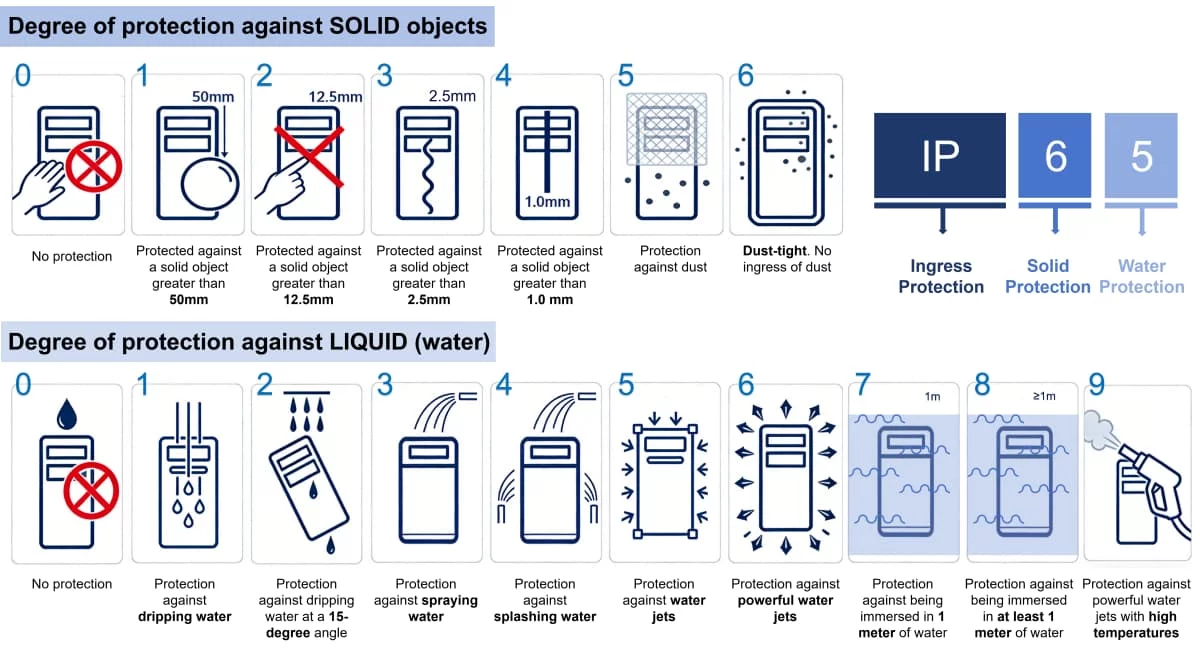
To understand any IP rating, you must separate the two digits. The IP Rating Chart below acts as your master key. You can combine any digit from the "Solids" table with any digit from the "Liquids" table to form a specific rating (e.g., IP + 6 + 5 = IP65).
First Digit: Solid Particle Protection (0-6)
This number indicates how well the fixture enclosure prevents solid objects—from human hands to microscopic dust—from entering.
1st Digit | Protection Level | Meaning & Test Definition | Typical Application |
0 | None | No protection against contact and ingress of objects. | Bare circuit boards (Internal use only). |
1 | Large Objects | Protected against solid objects > 50mm (e.g., accidental touch by back of hand). | Electrical rooms, restricted access areas. |
2 | Fingers | Protected against solid objects > 12.5mm (e.g., fingers). | IP20: Standard indoor office lighting, sockets. |
3 | Tools | Protected against solid objects > 2.5mm (e.g., screwdrivers, thick wires). | Enclosed electrical cabinets. |
4 | Wires | Protected against solid objects > 1mm (e.g., most wires, slender screws, large ants). | Top surface of some luminaires. |
5 | Dust Protected | Ingress of dust is not entirely prevented, but it must not enter in sufficient quantity to interfere with safe operation. | IP54/IP55: General purpose warehouse or sheltered outdoor areas. |
6 | Dust Tight | No ingress of dust. Complete protection against contact. (Tested with vacuum pressure). | IP65/IP66/IP67: Mandatory for heavy industry, outdoor sports, and livestock. |
Second Digit: Liquid Ingress Protection (0-9K)
The second digit indicates the level of protection against water ingress.
Note: Digits 0-9 are defined by the IEC 60529 standard. The special rating 9K is defined by DIN 40050-9 and ISO 20653, originally for road vehicles but widely adopted in food processing and agriculture.
2nd Digit | Protection Level | Technical Definition & Test Condition | Typical Application |
0 | None | No protection. | Dry indoor areas (IP20). |
1 | Dripping Water | Protected against vertically falling water drops. | Damp indoor areas. |
2 | Tilted Dripping | Protected against vertical drops when the enclosure is tilted up to 15°. | Damp storage rooms. |
3 | Spraying | Protected against spraying water at an angle up to 60° from vertical. | Sheltered outdoor porches. |
4 | Splashing | Protected against water splashing from any direction. | IP44: Bathroom mirrors, general garden lights. |
5 | Water Jets | Protected against water jets projected by a nozzle (6.3mm) from any direction. | IP65: General street lighting (Standard Waterproof). |
6 | Powerful Jets | Protected against powerful water jets (12.5mm nozzle) and heavy seas. | IP66: Sports stadiums, ship decks, car washes. |
7 | Immersion | Protected against the effects of temporary immersion in water (15cm to 1m depth for 30 mins). | IP67: Ground lights, temporary flood zones. |
8 | Submersion | Protected against continuous submersion in water (Depth and time specified by manufacturer, usually >1m). | IP68: Swimming pool lights, underwater equipment. |
9 | High Temp & Pressure (IEC) | IEC 60529 Standard. Protected against high-pressure (80-100 bar), high-temperature (80°C) water jets. | Heavy industrial equipment requiring washdowns. |
9K | Steam Jet Cleaning (DIN/ISO) | DIN 40050-9 / ISO 20653 Standard. Specifically designed for Road Vehicles. Withstands intensive steam cleaning at high pressure. | IP69K: Livestock farming, food processing, dump trucks, cement mixers. |
The Critical Distinction: IPX9 (IEC) vs. IP69K (DIN)
Many facility managers use these terms interchangeably, but they have different origins.
IPX9 (IEC 60529):
This is the official IEC rating for protection against high-pressure, high-temperature water jets. It was added to the IEC standard to harmonize with the needs of heavy industry.
IP69K (DIN 40050-9 / ISO 20653):
Originally developed in Germany for road vehicles (like cement mixers and dump trucks) that need to be blasted clean with steam. Because the testing requirements (80°C steam, 100 bar pressure) are virtually identical to IPX9, IP69K became the de facto "Gold Standard" term in the food processing and livestock industries.
Key Takeaway: If you see a Ceramiclite fixture rated IP69K, it means it is engineered to survive the most aggressive steam-cleaning sanitation protocols used in modern agriculture.
Common IP Ratings in LED Lighting & Applications
Now that we have decoded the numbers, let's look at the most common "Package Deals" you will find on LED datasheets and where they truly belong.
IP20: The Indoor Standard
Definition: Finger safe (2), no water protection (0).
Application: Dry warehouses, offices, and retail stores.
Note: IP20 fixtures have an open housing for heat dissipation but will fail instantly if exposed to humidity or dust.
IP65: Entry-Level Outdoor (The "Rain" Standard)
Definition: Dust tight (6), Water jets (5).
Market Reality: This is the most common rating for general-purpose outdoor floodlights.
Application: Parking lots and building facades.
Limitation: While IP65 is excellent for rain, it is not designed for high-pressure cleaning or brutal weather. It is the entry-level choice for waterproofing.
IP66: Heavy Duty Outdoor (The "Storm" Standard)
Definition: Dust tight (6), Powerful jets (6).
Application: Sports Stadiums, Sea Ports, Exposed Industrial Sites.
Why Upgrade? For coastal areas or regions with typhoon/hurricane risks, IP65 may fail. IP66 offers that extra layer of sealing against wind-driven rain.
IP67 / IP68: Immersion Protection
Definition: Dust tight (6), Temporary or Continuous Immersion (7/8).
Application: In-ground landscape lights, swimming pools.
The Myth: Do not assume IP67 is "better" than IP66 for a wall-mounted light. IP67 is designed to hold water out while submerged (static pressure), but it may not be designed to withstand the dynamic force of a high-pressure hose (dynamic pressure). For most non-submerged industrial applications, IP66 is often more practical than IP67.
How to Choose the Waterproof LED Lights for Your Facility?
Selecting the right fixture is about balancing budget, environment, and longevity. "Waterproof" is not a one-size-fits-all label. While a higher rating offers more protection, it often comes at a premium.
Here is a practical guide to help you assess your specific needs, looking beyond just the IP number.
1. Outdoor Sports Lighting (Stadiums & Courts)
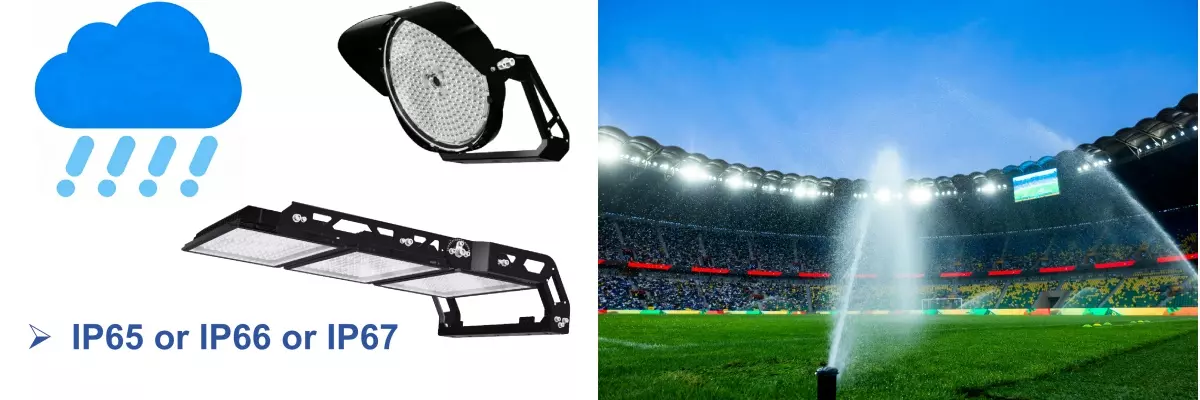
The Baseline (Budget-Friendly): IP65.
For many recreational courts or general parking areas, IP65 provides sufficient protection against standard rain and low-pressure water jets. If your facility is in a mild climate, this is a cost-effective choice.
The Pro Choice (High Durability): IP66/IP67.
If your stadium is located in a coastal area (high wind/salt spray) or faces heavy seasonal typhoons, IP66/IP67 is strongly recommended. It resists powerful water jets and heavy seas, offering a safety margin that IP65 cannot.
Beyond IP Ratings:
Don't forget IK Ratings: A waterproof light is useless if a tennis ball shatters the lens. Ensure your choice pairs a high IP rating with at least IK08 or IK10 impact protection.
2. Livestock Farming (Pigs, Poultry, Cows)
General Barns (No High-Pressure Wash): IP66 or IP67.
For general breeding areas where cleaning is done with low-pressure water or air, an IP66 or IP67 fixture is perfectly adequate and economical. It seals out dust and moisture effectively.
Intensive Sanitation Zones: IP69K.
If your biosecurity protocol involves daily sterilization with high-pressure (100 bar) hot steam, standard IP66 lights will eventually fail due to seal fatigue. In these specific washdown zones, IP69K is the only reliable option.
Beyond IP Ratings:
Corrosion Resistance: In a pig or poultry house, Ammonia is a silent killer. An IP69K rating stops water, but it doesn't stop chemical corrosion. You must ensure the fixture housing is made of specialized materials (like PMMA or chemically resistant coatings) designed to withstand acidic environments.
3. Food Processing & Industrial Washdowns
The Requirement: IP69K.
Food safety regulations often mandate rigorous cleaning. Here, IP69K is not a luxury; it is a necessity to prevent water ingress during hot water cleaning cycles, which could lead to bacterial growth inside the fixture.
4. General Industry & Warehousing
Dry Areas: IP20 - IP54. Focus on dust protection (First digit 5 or 6).
Wet/Humid Areas: IP65. Sufficient for occasional cleaning or humidity.
Beyond IP Ratings:
Consider Heat Dissipation. In dusty factories (IP6X), dust won't get inside the light, but it can accumulate outside. Ensure the fixture design allows for easy external cleaning to prevent overheating.
Conclusion
An IP rating is more than just a number on a box; it is a promise of reliability. Whether you are illuminating a dry warehouse or a wet livestock barn, the correct Ingress Protection rating safeguards your investment against the elements.
Ø Don't settle for "Waterproof": Demand to know the specific digits.
Ø Don't ignore the application: Use IP66 for storms, and IP69K for steam cleaning.
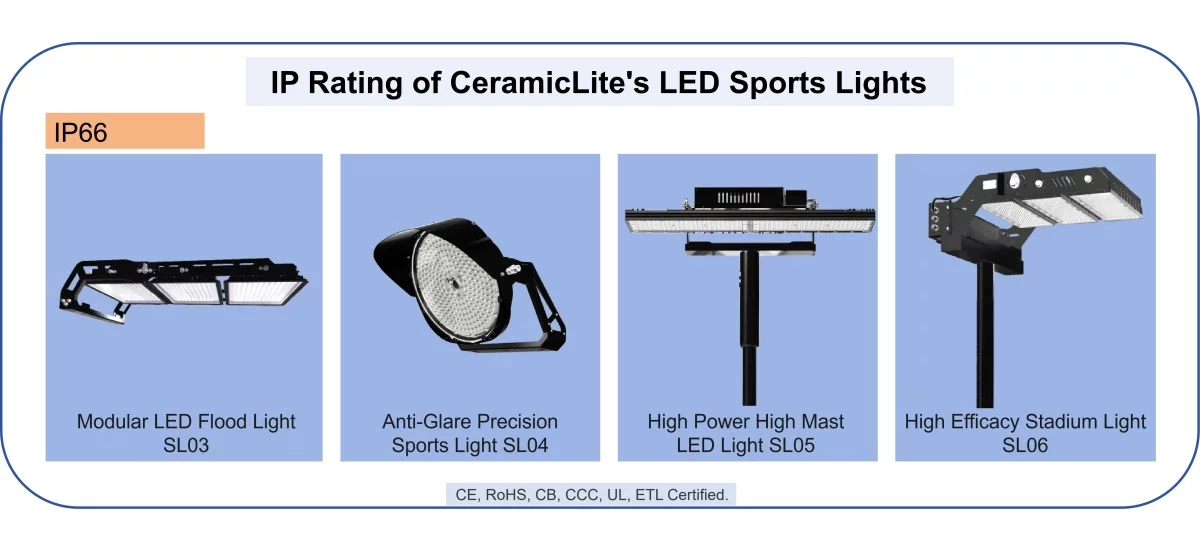
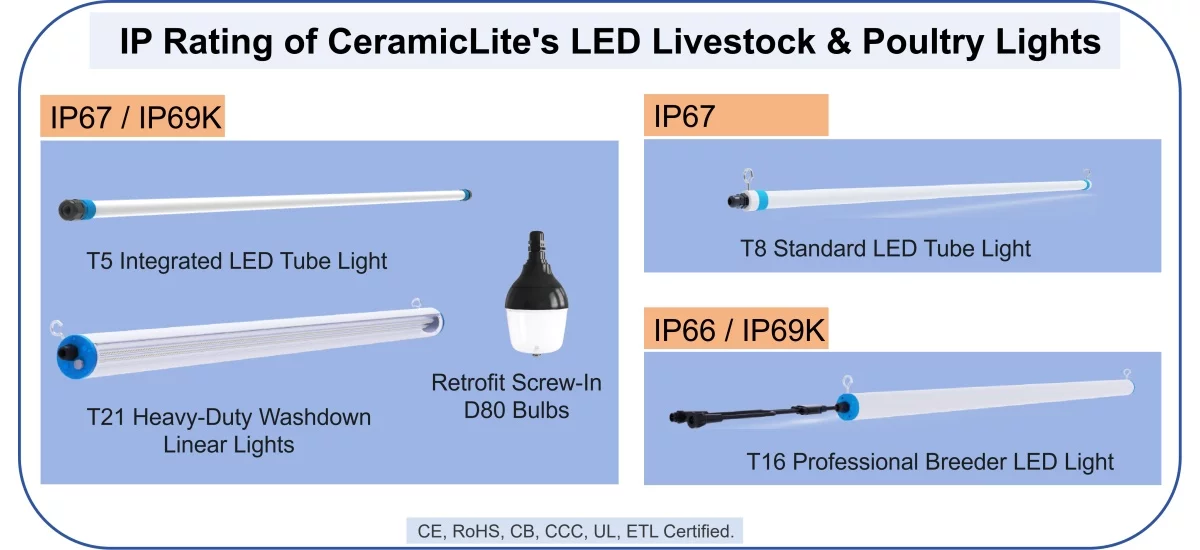
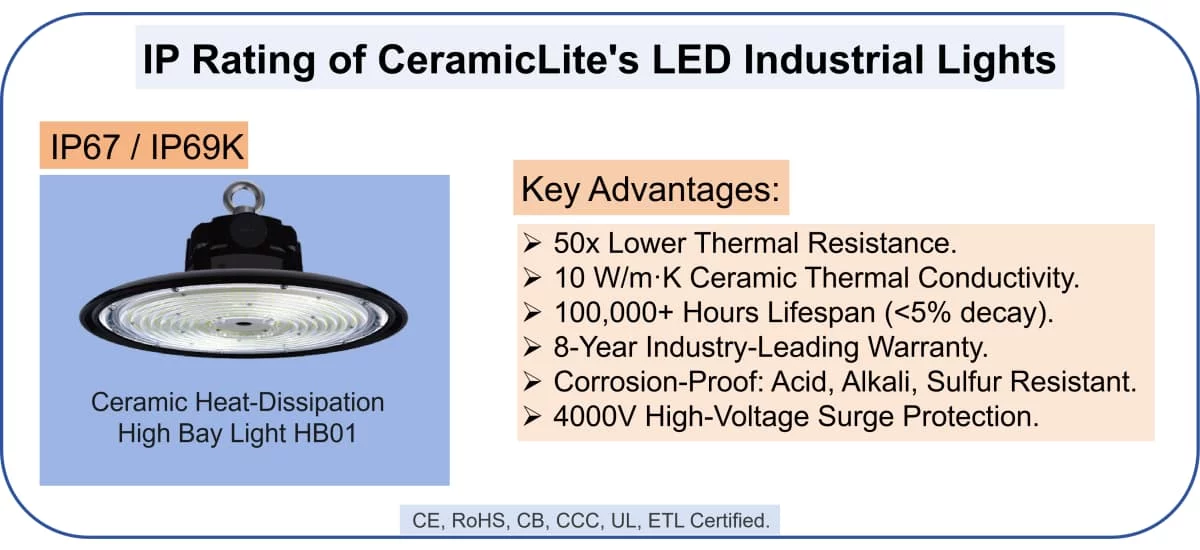
Ready to equip your facility with lighting that lasts? Explore Ceramiclite’s range of IP66 Sports Lights and specialized IP69K Livestock Fixtures today.
Frequently Asked Questions (FAQ)
Q: What does IP rating mean?
A: IP stands for Ingress Protection. It is an international standard (IEC 60529) that rates how well an electrical enclosure seals against solid objects (first digit) and liquids (second digit).
Q: Is IP44 or IP65 better?
A: IP65 is better. IP44 protects only against splashing water (good for bathrooms), while IP65 protects against low-pressure water jets and is dust-tight. For outdoor lighting, IP65 is the minimum requirement.
Q: Is IP65 or IP67 better?
A: It depends on the application. IP65 is designed for water jets (rain/cleaning), while IP67 is designed for temporary immersion (underwater). For street lights exposed to heavy rain, IP65 or IP66 is often more practical than IP67.
Q: Is IP65 ok for heavy rain?
A: Generally, yes. IP65 can withstand standard rain. However, for coastal areas with horizontal rain driven by strong winds (typhoons), IP66 is recommended as it handles higher water pressure.
Q: What's the highest IP rating?
A: The highest rating in the IEC standard is IP69 (High-pressure / High-temperature washdown). In the industrial and automotive sectors, this is commonly referred to as IP69K (DIN standard).
Q: Can IP65 devices be submerged in water?
A: No. IP65 is not designed for submersion. If a fixture might be underwater (even temporarily, like in a flood-prone ground well), you need IP67 or IP68.
Q: What IP Rating do I Need for Outdoor Lights?
A: For general outdoor wall lights, IP65 is standard. For exposed spots like pole lights or stadiums, aim for IP66. For ground lights (inground), use IP67.
Q: Which IP rating is 100% waterproof? Is it IP68 or IP67?
A: IP68 is the closest to "100% waterproof" for continuous underwater use (like swimming pools). IP67 is only waterproof for short periods (30 minutes) at shallow depths.