_thumb.jpg)
Explicación de la eficacia luminosa: significado y por qué es importante.
Al evaluar la iluminación LED para instalaciones industriales, estadios deportivos o explotaciones agrícolas a gran escala, comparar únicamente la potencia en vatios es una estrategia errónea. Para comprender realmente cuánta iluminación se obtiene por la electricidad que se paga, es necesario analizar la eficacia luminosa .
Como métrica de referencia para la eficiencia lumínica, este parámetro determina los costos de energía operativa. En esta guía, explicaremos el significado exacto de la eficacia luminosa, proporcionaremos la fórmula de cálculo principal y explicaremos por qué es fundamental ir más allá de este valor básico en entornos extremos.
Tabla de contenido
¿Cómo calcular la eficacia luminosa?
Eficacia luminosa frente a eficiencia
Tabla comparativa de la eficacia luminosa de diferentes fuentes de luz
¿Por qué es importante la eficacia luminosa en entornos específicos?
¿Qué factores influyen en la eficacia luminosa de las luces LED?
Consideraciones finales: Cómo tomar decisiones informadas sobre la iluminación
¿Qué es la eficacia luminosa?
En esencia, la definición de eficacia luminosa es la medida de la eficacia con la que una fuente de luz convierte la energía eléctrica en radiación electromagnética visible para el ojo humano.
Para comprender plenamente qué es la eficacia luminosa , primero es necesario entender el flujo luminoso . El flujo luminoso es la cantidad total de luz visible emitida por una luminaria, medida en lúmenes (lm). Por lo tanto, la eficacia luminosa simplemente indica cuántos lúmenes de luz se producen por cada vatio (W) de electricidad consumida.
La unidad de medida estándar es lúmenes por vatio (lm/W) .
Desde una perspectiva estrictamente física, la visión fotópica humana (visión diurna) es más sensible a la luz verde con una longitud de onda de 555 nanómetros. A esta longitud de onda específica, la eficacia luminosa máxima teórica es de 683 lm/W. Si bien la iluminación comercial no puede alcanzar este límite físico absoluto debido al calor y las pérdidas ópticas, la tecnología LED de gama altaActualmente, suele alcanzar entre 150 y 220 lm/W.
¿Cómo calcular la eficacia luminosa ?
La fórmula de eficacia luminosa es sencilla. Es el cociente del flujo luminoso total dividido por la potencia total de entrada.
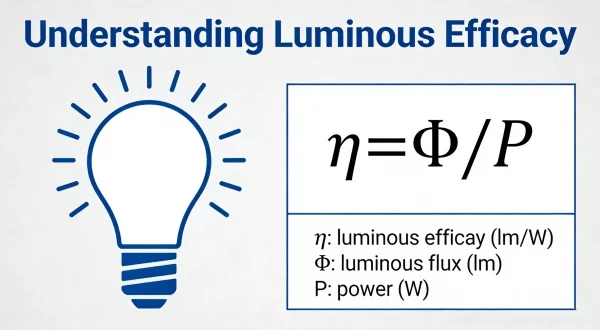 La ecuación estándar de eficacia luminosa es: η=Φ/P
Dónde:
Ø η (Eta) : El símbolo estándar de eficacia luminosa (medido en lm/W).
Ø Φ (Phi) : El flujo luminoso total (medido en lúmenes, lm).
Ø P : La potencia eléctrica total consumida (medida en vatios, W).
¿Cómo calcular la eficacia luminosa en la práctica?
Analicemos un cálculo práctico de eficacia luminosa. Supongamos que está adquiriendo luminarias LED de alta potencia para una planta de fabricación. La hoja de especificaciones indica que una luminaria de 150 W emite 24 000 lúmenes de luz.
Para calcular la eficacia luminosa, se aplica la fórmula:
24.000 lm ÷ 150 W = 160 lm/W.
En este caso, la luminaria proporciona 160 lúmenes de luz visible por cada vatio de energía que consume. Cuanto mayor sea este valor, más eficiente energéticamente será la fuente de luz, lo que se traduce directamente en facturas de electricidad más bajas para grandes proyectos comerciales.
Eficacia luminosa frente a eficiencia
En la industria de la iluminación, dos términos se usan frecuentemente de forma indistinta: eficacia luminosa y eficiencia . Si bien suenan similares, representan parámetros físicos completamente diferentes. Comprender esta distinción es fundamental al evaluar las hojas de especificaciones.
Eficiencia luminosa:
Se trata de una relación adimensional, expresada como porcentaje (%). Mide la cantidad de energía eléctrica total que se convierte en radiación electromagnética (luz visible, calor infrarrojo y ultravioleta). Por ejemplo, las bombillas incandescentes tradicionales convierten aproximadamente el 90 % de su energía en calor, lo que resulta en una pésima eficiencia luminosa de menos del 10 % para la luz visible.
Eficacia luminosa:
Expresada específicamente como eficacia luminosa en lúmenes por vatio (lm/W) , esta métrica mide estrictamente la conversión de energía eléctrica en luz visible que el ojo humano puede detectar.
Para proyectos de iluminación comercial e industrial, siempre debe fijarse en el valor de eficacia (lm/W). Este valor indica con precisión la cantidad de brillo útil que se obtiene en relación con el consumo eléctrico.
Tabla comparativa de la eficacia luminosa de diferentes fuentes de luz
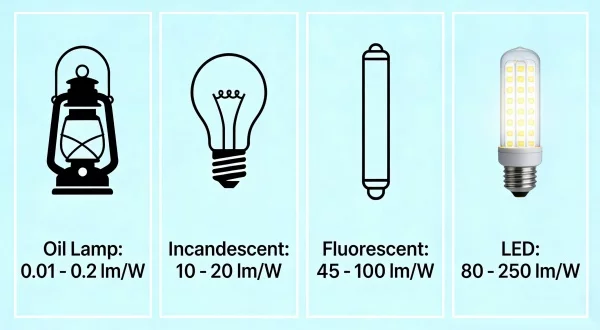
Las distintas tecnologías de iluminación poseen capacidades muy diferentes para convertir la electricidad en luz. A continuación, se presenta una tabla comparativa exhaustiva de la eficacia luminosa que ilustra la evolución de la tecnología de iluminación.
Tecnología de fuente de luz | Eficacia luminosa media (lm/W) | Desperdicio de energía (Calor/IR) |
Bombillas incandescentes | 10 - 20 lm/W | Extremadamente alto |
Lámparas halógenas | 15 - 24 lm/W | Alto |
Tubos fluorescentes (T8/T5) | 50 - 100 lm/W | Moderado |
Halogenuro metálico (MH) | 65 - 115 lm/W | De moderado a alto |
Sodio a alta presión (HPS) | 85 - 150 lm/W | Moderado |
LED estándar (de malo a bueno) | 90 - 140 lm/W | Bajo |
Luminarias LED de primera categoría | 150 - 220+ lm/W | Extremadamente bajo |
Al analizar la eficacia luminosa de las distintas fuentes de luz en esta tabla, la superioridad de la iluminación de estado sólido resulta innegable. Actualmente, la eficacia luminosa de los LED avanzados representa la mayor eficacia luminosa disponible para su implementación comercial a gran escala, superando con creces a las luminarias HPS y MH tradicionales.
¿Por qué es importante la eficacia luminosa en entornos específicos ?
Si bien alcanzar 170 lm/W suena impresionante sobre el papel, utilizar este indicador como único criterio de compra es un error grave. En aplicaciones comerciales extremas, la eficacia luminosa inicial puede resultar engañosa. A continuación, se detallan los aspectos que debe considerar según su entorno operativo específico.
Instalaciones industriales: El impacto oculto del calor
En entornos industriales pesados, como acerías, fundiciones o plantas de fabricación de alta temperatura, el calor es el enemigo de la eficiencia de los LED.
Cuando un chip LED funciona a altas temperaturas ambiente, experimenta una " caída térmica ". Este fenómeno físico provoca que la eficacia luminosa disminuya drásticamente a medida que aumenta la temperatura de la unión interna del diodo.
Una luminaria industrial de alta potencia con una eficiencia lumínica de 160 lm/W en un laboratorio a 25 °C puede experimentar una disminución del 15 al 30 % en su eficacia luminosa en un almacén a 50 °C debido al aumento de la temperatura de las uniones y las pérdidas del sistema. Si no está diseñada adecuadamente para altas temperaturas ambiente, también puede sufrir una depreciación acelerada del flujo luminoso o una reducción de su vida útil.
Conclusión : En iluminación industrialUna alta eficiencia lumínica (lm/W) resulta inútil sin disipadores de calor de aluminio de alta resistencia y diseño específico para disipar la carga térmica y mantener la eficacia a largo plazo.
Estadios deportivos: Eficacia bruta frente a "lúmenes útiles"
La iluminación de los estadios deportivos requiere una potencia lumínica extremadamente alta para cubrir grandes áreas de juego. Sin embargo, existe una disyuntiva inherente entre maximizar la eficacia luminosa y lograr un control óptico preciso.
Las fuentes LED sin recubrimiento con emisión de ángulo amplio (lambertiana) ofrecen la máxima eficacia lumínica gracias a sus mínimas pérdidas ópticas. Sin embargo, en aplicaciones para estadios, la distribución incontrolada de la luz provoca deslumbramiento en los jugadores y dispersión de la luz hacia el cielo nocturno.
Para solucionar este problema, las luminarias incorporan ópticas antirreflejo avanzadas y lentes de PC/PMMA para dirigir la luz con precisión hacia el campo de visión. Estos componentes ópticos introducen inevitablemente pérdidas por transmisión y reflexión, lo que suele reducir la eficacia del sistema entre un 5 % y un 15 % .
Conclusión : En iluminación deportiva, no busques la máxima eficacia teórica. Prioriza los "lúmenes útiles": la cantidad real de luz controlada que llega al área objetivo sin causar un deslumbramiento excesivo.
Ganadería y agricultura: El concepto erróneo del espectro
Uno de los aspectos más ignorados del diseño de iluminación reside en sus aplicaciones agrícolas y avícolas.
La eficacia luminosa estándar (lm/W) se basa en la visión fotópica humana, que alcanza su máximo a 555 nm en el espectro verde. Sin embargo, las aves de corral presentan una sensibilidad espectral más amplia y desplazada , con fuertes respuestas a las longitudes de onda rojas y azul-violetas que influyen en los ritmos circadianos, el crecimiento y la producción de huevos.
Conclusión: Un LED blanco de alta luminancia (lm/W) optimizado para la visión humana puede no proporcionar suficiente contenido espectral, especialmente en el rango rojo, para mantener un rendimiento óptimo del rebaño. En la iluminación agrícolaAlinear la emisión espectral con las necesidades biológicas de los animales suele ser más importante que maximizar la eficacia luminosa según la percepción humana.
¿Qué factores influyen en la eficacia luminosa de las luces LED?
Si bien la eficacia luminosa de los LED es fundamentalmente superior a la de la iluminación tradicional, no todas las luminarias LED son iguales. El rendimiento final de una luminaria comercial viene determinado por una combinación de componentes de hardware de alta calidad y un diseño de sistema acertado.
Para evaluar por qué un accesorio supera a otro, debe tener en cuenta estos cuatro factores críticos:
l Calidad y clasificación de chips LED : El diodo semiconductor central determina la tasa de conversión base. Los chips LED premium utilizan fabricación avanzada y una estricta " clasificación "."Procesos para garantizar la máxima emisión de luz posible con mínimas variaciones de voltaje."
l Conversión de potencia del controlador : El controlador LED convierte la corriente alterna (CA) proveniente de la red eléctrica en la corriente continua (CC) necesaria para los diodos. Un controlador de estado sólido de alta calidad funciona con una eficiencia de conversión eléctrica del 90 % al 95 %. Un controlador más económico e ineficiente disipa energía en forma de calor interno, lo que reduce drásticamente el rendimiento general del sistema (en lúmenes por vatio).
Disipación de calor (disipadores) : Como se destaca en las aplicaciones industriales, el calor es el principal factor que degrada el rendimiento. Los disipadores de calor de aluminio fundido a presión de alta resistencia extraen rápidamente la energía térmica de la placa de unión LED. Una gestión térmica adecuada garantiza que la luminaria mantenga su brillo durante una vida útil de 50 000 horas sin experimentar una caída de rendimiento por sobrecalentamiento.
l Transmitancia de la lente óptica : Cada cubierta protectora, difusor o lente antirreflejo colocada sobre una matriz de LED absorbe una pequeña fracción de luz. El uso de materiales de grado óptico como el policarbonato (PC) o el PMMA de alta transmitancia minimiza esta pérdida óptica, preservando la salida de luz original generada por los chips.
Consideraciones finales: Cómo tomar decisiones informadas sobre la iluminación
Seleccionar la infraestructura de iluminación adecuada para grandes instalaciones comerciales, agrícolas o deportivas va mucho más allá de simplemente buscar la cifra más alta en una hoja de especificaciones. Es necesario equilibrar el brillo con la estabilidad térmica, un control óptico preciso para reducir el deslumbramiento y el espectro biológico específico que requiere el entorno particular.
La modernización de instalaciones industriales, deportivas o agrícolas requiere planificación estratégica y profundos conocimientos técnicos. Al consultar con especialistas experimentados que comprenden las exigencias de estos entornos extremos, protege su presupuesto operativo de posibles pérdidas de rendimiento. En definitiva, tomar decisiones basadas en datos y en la eficacia lumínica real es la forma más fiable de garantizar un retorno de la inversión a largo plazo en iluminación.
Referencias y lecturas adicionales
Sociedad de Ingeniería de Iluminación (IES): Eficacia luminosa de una fuente
ScienceDirect : Eficiencia luminosa - Temas de ingeniería
l Enciclopedia de Fotónica RP: Eficacia y Eficiencia Luminosa
Wikipedia : Eficacia luminosa