_thumb.jpg)
Lux vs Lumens vs Candela : Le guide ultime de l’éclairage
Table des matières
Introduction : Le piège à « haute luminosité »
Lux vs Lumens vs Candela : Tableau des principales différences
Comment convertir des lux en lumens ?
Quel indicateur est le plus important pour votre projet ?
Arrêtez de deviner. Commencez à concevoir.
Introduction : Le piège à « haute luminosité »
Vous est-il déjà arrivé d'acheter une ampoule LED vantée pour son flux lumineux élevé (« lumens »), pour ensuite constater, une fois installée, que la pièce reste sombre ? Vous n'êtes pas seul. C'est l'erreur la plus fréquente lors de la rénovation d'un éclairage.
De nombreux acheteurs pensent que les lumens sont le seul critère de mesure de la luminosité. Or, l'éclairage est en réalité un phénomène tridimensionnel. Qu'il s'agisse d'éclairer un jardin, un entrepôt ou un stade, se fier uniquement aux lumens peut entraîner une mauvaise visibilité et un gaspillage d'énergie.
Pour véritablement contrôler votre environnement lumineux, vous devez comprendre le « triangle de la lumière » : lux, lumens et candela .
Dans ce guide, les experts de Ceramiclite décryptent ces trois termes complexes pour les rendre plus simples. Nous vous expliquerons leurs interactions, leur importance et comment passer du hasard au calcul précis de l'éclairage dont vous avez besoin.
Qu'est-ce que le lumen ?
Lorsqu'on consulte une fiche technique, le flux lumineux (lm) est souvent la première valeur qui attire l'attention. Techniquement appelé flux lumineux , il représente la quantité totale d'énergie lumineuse visible émise par une source dans toutes les directions. On peut le comparer à la puissance de votre système d'éclairage : il indique le potentiel brut du luminaire.
Cependant, dans le secteur de l'éclairage commercial, le flux lumineux (en lumens) peut s'avérer très trompeur s'il est considéré isolément. Un flux lumineux élevé indique simplement que les puces LED génèrent beaucoup de lumière, sans tenir compte de sa diffusion.
Cela engendre une frustration fréquente chez les acheteurs : la différence entre les lumens émis et les lumens délivrés . De nombreux fabricants mettent en avant le flux lumineux théorique de la puce LED (lumens émis), ignorant les pertes de lumière dues à la lentille ou au dissipateur thermique du luminaire. Pour un responsable d'entrepôt ou un acheteur industriel, payer pour 30 000 lumens n'a aucun sens si une conception optique inefficace n'en délivre que 20 000. Un flux lumineux élevé associé à une faible efficacité (lumens par watt) se traduit simplement par un gaspillage d'électricité déguisé en luminosité.
Qu'est-ce que Lux ?
Alors que les lumens mesurent le flux lumineux émis par le luminaire, les lux (lx) mesurent l'éclairement qui atteint la surface éclairée. Il s'agit de l'unité de mesure de l'éclairement , c'est-à-dire l'intensité lumineuse reçue par une surface donnée. Dans le système métrique, un lux équivaut à un lumen sur un mètre carré.
Pour les professionnels, le lux n'est pas qu'un simple chiffre ; c'est la référence en matière de conformité et de réussite opérationnelle . Il traduit des données lumineuses abstraites en expériences utilisateur concrètes. Les exigences varient considérablement selon la précision de la tâche à accomplir.
Prenons l'exemple de l'élevage . Dans un poulailler, l'éclairage est soigneusement conçu ; on vise généralement un niveau uniforme de 20 à 30 lux au sol. Ce niveau est scientifiquement calibré pour favoriser l'alimentation des volailles sans provoquer d'agressivité ni de stress. À l'inverse, dans un atelier industriel de précision ou une chaîne de montage électronique, la norme grimpe considérablement à 750 lux , voire plus. Dans ces cas, un éclairage élevé est essentiel pour la sécurité et le contrôle qualité, permettant aux opérateurs de distinguer les détails microscopiques sans fatigue oculaire. En fin de compte, vous achetez des lumens, mais vous payez en lux.
Qu'est-ce que Candela ?
Dans le domaine de l'éclairage spécialisé, notamment pour les applications sportives et l'éclairage sur mâts de grande hauteur, la candela (cd) est sans doute le paramètre le plus important, et pourtant souvent négligé. Elle mesure l'intensité lumineuse , c'est-à-dire la « densité » de la lumière dans une direction donnée.
Si les lumens représentent le volume du réservoir d'eau, les candelas correspondent à la pression à la buse. Celle-ci détermine la portée et la pénétration du faisceau lumineux. C'est là que les projecteurs d'usage général sont moins performants que les projecteurs professionnels pour stades. Un projecteur peut avoir un flux lumineux important, mais s'il manque de candelas (intensité lumineuse), la lumière se dispersera dans l'atmosphère avant même d'atteindre le sol.
Cette distinction est cruciale pour les grands stades . Prenons l'exemple d'un stade de cricket où les projecteurs sont installés sur des mâts de 30 à 40 mètres de haut. La lumière doit parcourir une distance considérable tout en éclairant le terrain avec une intensité suffisante pour les caméras haute vitesse et les joueurs. Un projecteur à flux lumineux élevé (en lumens) mais à faible intensité lumineuse (en candelas) illuminera le ciel nocturne (créant ainsi une pollution lumineuse) et laissera le centre du terrain dans l'obscurité. Pour diriger la lumière du haut d'un mât jusqu'au guichet, il faut un angle de faisceau étroit et une intensité lumineuse élevée (en candelas). En résumé, l'intensité lumineuse (en candelas) est la force qui permet de diriger la lumière précisément là où on en a besoin, sur de longues distances.
Lux vs Lumens vs Candela : Tableau des principales différences
Pour vous aider à prendre la meilleure décision pour votre établissement, nous avons résumé les principales différences entre ces trois indicateurs. Notez que l'« Objectif principal » varie selon votre rôle dans le projet.
Métrique | Unité | Ce que cela mesure | La question simple à laquelle elle répond | Orientation principale de l'application |
lumens | lm | Production totale (flux lumineux) | «Quelle quantité de lumière totale produite par cette ampoule ?» | Efficacité énergétique (Comparaison de l'efficacité lm/W pour les rénovations industrielles). |
Lux | lx | Résultat sur la surface (éclairement) | « À quel point le sol/le bureau sera-t-il lumineux ? » | Conformité et sécurité (Respect des normes en matière d'espace de travail ou de bien-être animal). |
Candela | CD | Intensité directionnelle (intensité lumineuse) | « Quelle est la puissance du faisceau ? Quelle est sa portée ? » | Conception optique (essentielle pour l'éclairage des stades et des mâts d'éclairage de grande hauteur). |
La relation
Comprendre individuellement ces termes d'éclairage est utile, mais c'est la compréhension de leurs interactions qui distingue un professionnel de l'éclairage d'un novice. La manière la plus simple de visualiser cette relation est d'imaginer un tuyau d'arrosage.
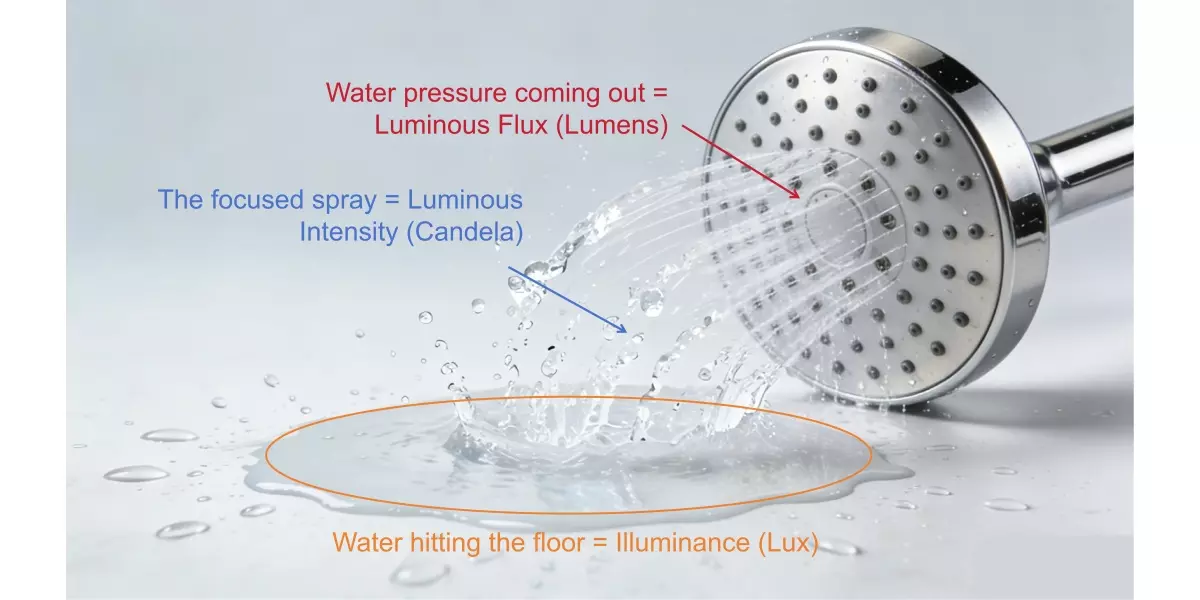 Le flux lumineux correspond au débit d'eau : imaginez que vous ouvrez le robinet. La quantité totale d'eau qui sort du tuyau chaque seconde représente les lumens . Que le jet soit large ou étroit, le volume total d'eau (énergie lumineuse) reste le même.
La candela correspond à la pression de la buse : imaginez que vous tourniez la buse pour concentrer le jet. L’eau jaillit plus loin et plus fort. Vous n’avez pas ajouté plus d’eau, mais vous l’avez concentrée dans une direction précise. Cette intensité accrue correspond à la candela .
Lux est la surface mouillée : enfin, observez le sol là où l’eau frappe. L’humidité de l’herbe représente Lux .
² Si vous utilisez un jet large (faible candela) , l'eau couvre une grande surface, mais le sol n'est que légèrement humide ( faible lux ).
² Si vous utilisez un jet concentré (High Candela) , vous couvrez une zone plus petite, mais cet endroit est instantanément imbibé ( High Lux ).
À retenir : En conception d’éclairage, on ne peut pas se contenter de demander « plus de lux » sans tenir compte de l’angle de faisceau (candela) et du flux lumineux total (lumens). Ces deux paramètres sont indissociables.
Référence:
https://en.wikipedia.org/wiki/Lux
https://en.wikipedia.org/wiki/Lumen_(unit)
https://en.wikipedia.org/wiki/Candela
https://www.britannica.com/science/candela
Comment convertir des lux en lumens ?
Dans de nombreux projets, on part d'un besoin en lux — par exemple, un responsable d'entrepôt sait qu'il a besoin de 200 lux au sol — et il faut remonter la chaîne pour déterminer le nombre de lumens à acheter.
La relation fondamentale est définie par la formule :
Lumens = Lux × Surface (mètres carrés)
Remarque : Si vous travaillez en pieds carrés (pieds-bougies), la logique est similaire, mais les unités diffèrent.
Calculatrice rapide
Utilisez notre outil ci-dessous pour obtenir une estimation de base des besoins de votre projet.
Convertisseur de lux en lumens
Résultat : 0 lumens
Pourquoi les « lumens calculés » sont rarement les « lumens requis »
Bien que le calculateur ci-dessus vous fournisse une base mathématique, veuillez l'utiliser avec prudence. La formule Lumens = Lux × Surface suppose un scénario idéal où 100 % de la lumière émise par le luminaire atteint le sol. En réalité, cela ne se produit jamais.
En tant qu'ingénieurs en éclairage chez Ceramiclite, nous prenons toujours en compte deux variables critiques que les calculatrices simples ne prennent pas en compte :
1. Facteur de perte de lumière (LLF) : Avec le temps, le flux lumineux des LED diminue légèrement et des saletés s’accumulent sur les lentilles. Nous intégrons un facteur de dépréciation (généralement 0,8 ou 0,9) dans nos conceptions afin de garantir un éclairage optimal de vos locaux, même après 5 ans.
2. Coefficient d'utilisation (Cu) : La lumière ne sort pas entièrement du luminaire dans la bonne direction. Une partie est absorbée par les murs ou perdue dans le plafond (notamment dans les applications en grande hauteur).
Conseil de pro : Le résultat affiché ci-dessus correspond au flux lumineux théorique minimal. Pour un éclairage industriel ou sportif performant, il est généralement nécessaire de prévoir un flux lumineux supérieur de 30 % à 50 % afin de compenser les pertes réelles.
Quel indicateur est le plus important pour votre projet ?
Le contexte est primordial. Un luminaire à forte intensité lumineuse, idéal pour un entrepôt, peut s'avérer catastrophique pour un poulailler. Maintenant que vous comprenez les définitions, voici comment les concepteurs d'éclairage professionnels hiérarchisent ces critères dans les trois secteurs d'activité principaux de Ceramiclite .
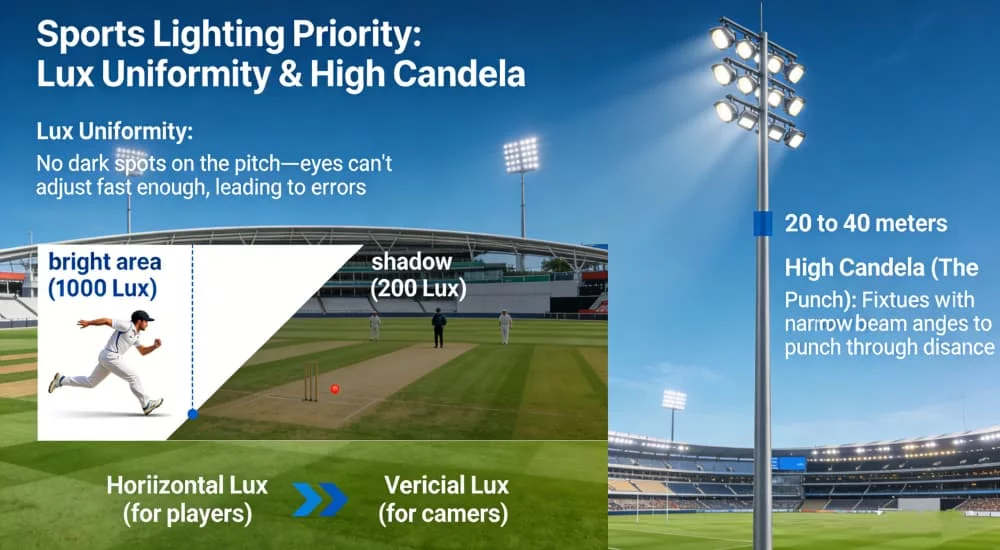
1. Éclairage sportif (terrains de cricket, stades de football)
Priorité : Uniformité de l'éclairement et forte intensité lumineuse
En éclairage sportif, « assez lumineux » ne suffit pas. La lumière doit être constante.
Pourquoi l'uniformité du lux ? Il est impératif d'éviter les zones d'ombre sur le terrain. Si le lanceur passe d'une zone lumineuse (1 000 lux) à une zone ombragée (200 lux), ses yeux ne pourront pas s'adapter assez rapidement, ce qui entraînera des erreurs. Nous privilégions le lux horizontal pour les joueurs et le lux vertical pour les caméras.
l Pourquoi Candela (The Punch) : Parce que les poteaux des stades mesurent souvent de 20 à 40 mètres de haut, il faut des projecteurs avec un Candela exceptionnellement élevé (angles de faisceau étroits) pour percer la distance.
l L'approche Ceramiclite : Nous privilégions les luminaires dotés d'optiques avancées qui délivrent une intensité élevée (candela) au centre du champ tout en minimisant la lumière parasite vers les voisins.
2. Éclairage pour l'élevage (élevages de volailles, étables laitières)
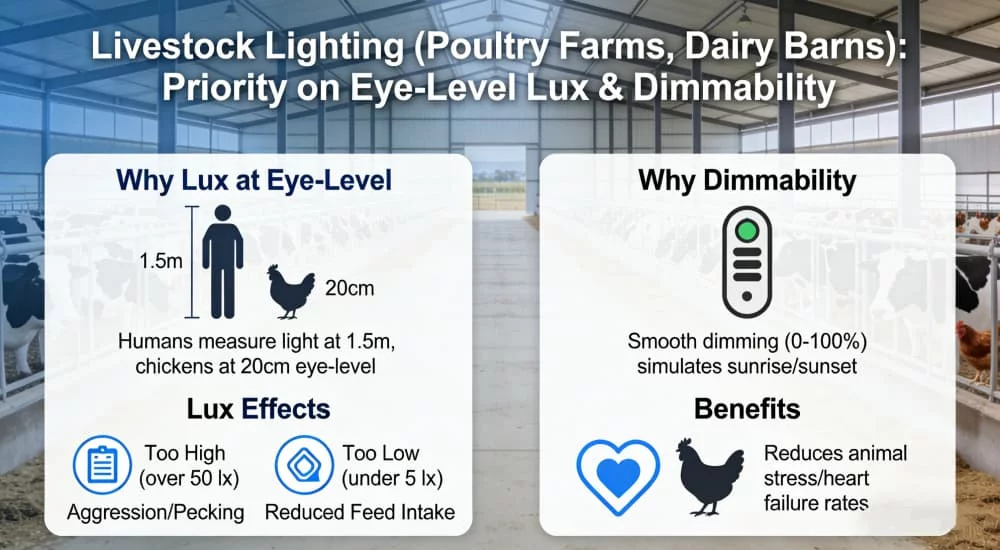
Priorité : Éclairage à hauteur des yeux et possibilité de variation d'intensité
Pour les animaux, la lumière est un signal biologique, et pas seulement un moyen de visibilité.
Pourquoi mesurer le lux à hauteur des yeux ? Un humain se tenant dans une étable peut mesurer la lumière à 1,5 mètre de hauteur, mais une poule vit à 20 cm. Nous calculons le lux à hauteur des yeux de l’animal . Un lux trop élevé (plus de 50 lx) peut provoquer de l’agressivité et des picages ; un lux trop faible (moins de 5 lx) réduit la consommation d’aliments.
Pourquoi la variation d'intensité ? Vous n'avez pas besoin d'une luminosité statique ; vous avez besoin de contrôle. Une variation progressive de l'intensité (0-100 %) est nécessaire pour simuler le lever et le coucher du soleil, réduisant ainsi le stress et les risques d'insuffisance cardiaque chez les animaux.
L' approche Ceramiclite : Nous nous concentrons sur le Lux spécifique au spectre (optimisé pour la vision animale) plutôt que sur les Lumens bruts, garantissant ainsi de meilleurs taux de croissance et un meilleur bien-être.
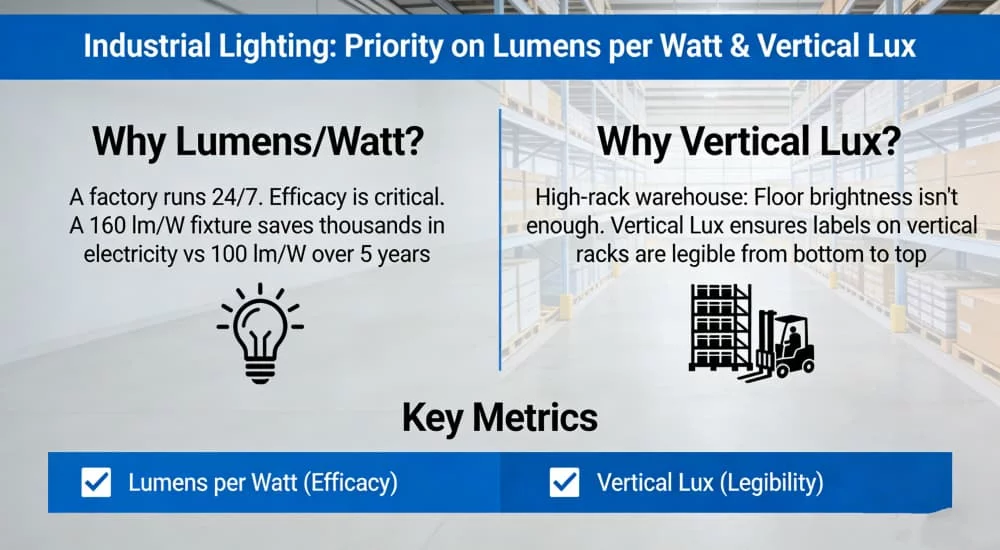
3. Éclairage industriel (entrepôts, fabrication)
Priorité : lumens par watt (efficacité) et lux vertical
Dans le secteur industriel, l'éclairage représente un coût opérationnel et un facteur de sécurité.
Pourquoi les lumens par watt ? Une usine fonctionne 24 h/24 et 7 j/7. L’indicateur le plus important est ici l’efficacité . Un luminaire fournissant 160 lumens par watt permettra d’économiser des milliers de dollars d’électricité sur cinq ans par rapport à un luminaire standard de 100 lm/W.
Pourquoi Vertical Lux ? Dans un entrepôt à rayonnages de grande hauteur, la luminosité du sol est inutile si le cariste ne peut pas lire l’étiquette sur l’étagère. Nous concevons pour Vertical Lux des étiquettes lisibles de bas en haut.
l L'approche Ceramiclite : Nous équilibrons un rendement élevé avec des lentilles optiques à faible éblouissement pour prévenir la fatigue du conducteur.
Arrêtez de deviner. Commencez à concevoir.
Les calculs d'éclairage sont complexes. Une simple erreur de calcul entre lux et lumens peut entraîner un stade plongé dans l'obscurité, du stress pour le bétail ou un lieu de travail dangereux.
Pourquoi risquer votre investissement sur une calculatrice théorique ?
Chez Ceramiclite, nous ne vendons pas seulement des luminaires ; nous vous offrons une solution fiable. Notre équipe d'ingénieurs utilise le logiciel de simulation professionnel DIALux pour créer un modèle 3D de votre installation. Nous calculons avec précision la réflexion, les angles de faisceau et les pertes lumineuses afin de vous garantir des résultats optimaux avant même l'achat du premier luminaire.
Prêt à voir votre projet sous son meilleur jour ?