_thumb.jpg)
Essential Lighting Terms Explained: Technical Glossary
Table of Contents
Part 1: The Physics of Light & Vision
Part 2: Photometrics: Quantifying Light
Part 3: Color Science & Quality
Part 4: Optical Distribution & Glare Control
Part 5: Electrical & Mechanical Terms
Part 6: The Complete A-Z Lighting Glossary
Intro
Have you ever looked at an LED specification sheet and felt like you were reading a different language? You are not alone.
From "L70" to "MacAdam Ellipse," the lighting industry is filled with complex acronyms and technical jargon. However, understanding these lighting terms is no longer optional.
Whether you are an engineer, a lighting designer, or a procurement manager, mastering this terminology is critical. It ensures you aren't just buying "bright lights," but are selecting products that deliver energy efficiency, visual comfort, and long-term reliability for your projects.
This guide goes beyond a simple dictionary. We have organized the most essential concepts into a logical structure to help you make better decisions:
l The Physics of Light: Understanding the spectrum and human vision.
l Photometrics: How we measure and quantify light (Lumens, Lux, etc.).
l Color Science: Mastering CCT, CRI, and TM-30.
l Electrical & Mechanics: Drivers, dimming, and protection ratings.
l The A-Z Glossary: A quick-reference index for everything else.
Part 1: The Physics of Light & Vision
Before we discuss lamp specifications, we must understand the nature of light itself and how our eyes perceive it.
 01. Light
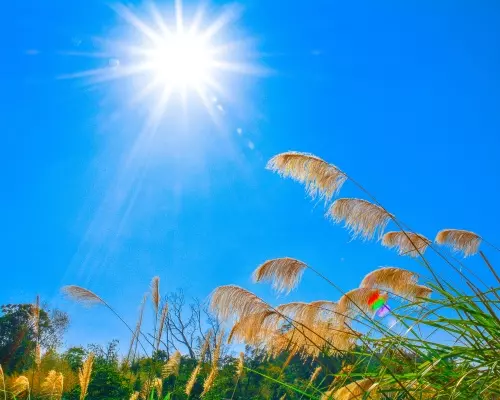
Physically speaking, light is a form of electromagnetic radiation energy. It travels in waves and moves in straight lines from a source. While light exists throughout the universe, what matters in our industry is the specific band of energy that the human eye can detect.
Reference: https://en.wikipedia.org/wiki/Light
02. Spectrum
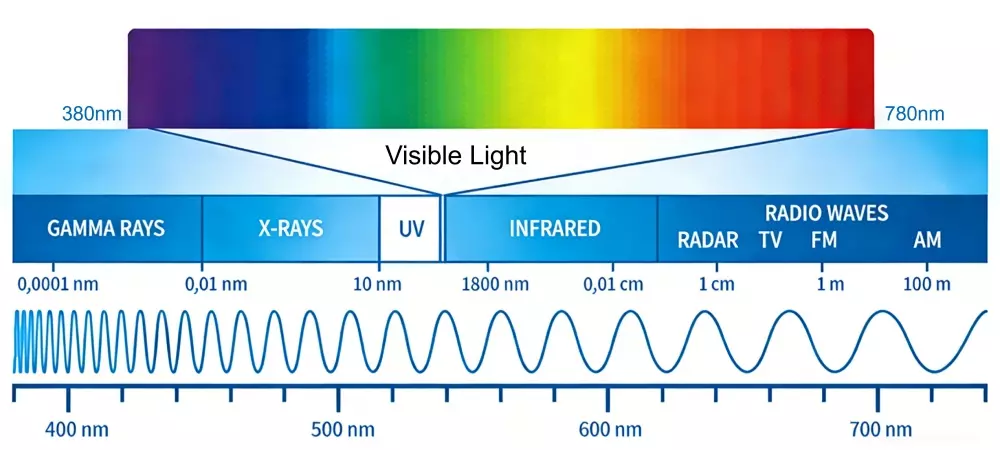
The "Visible Spectrum" is the segment of the electromagnetic spectrum that the human eye can perceive. It ranges in wavelength roughly from 380nm (Violet) to 780nm (Red).
Why it matters: Understanding the spectrum is the foundation for understanding Color Rendering (CRI) and plant growth lighting (PAR).
03. Human Vision (Photopic, Scotopic, Mesopic)
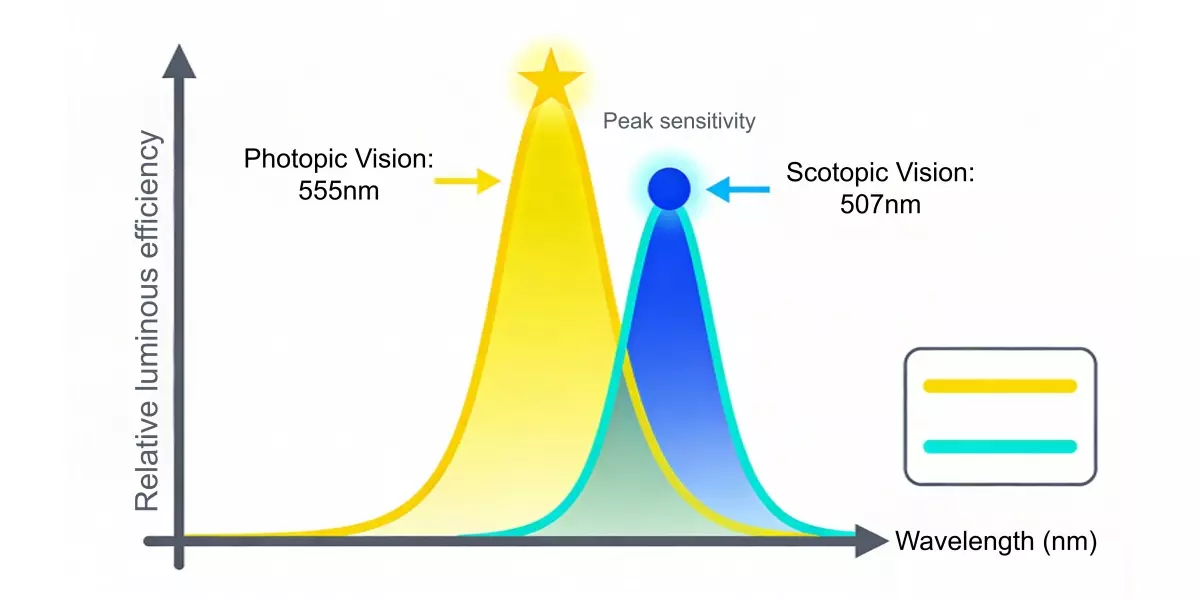
Not all light can be perceived in the same way. Our eyes use two types of photoreceptors: Cones (for bright light and color) and Rods (for dim light and movement). This leads to three distinct vision states:
Photopic Vision (Day Vision):
l Occurs in bright conditions (>3 cd/m²).
l Cones are active. We see color and detail clearly.
l Peak sensitivity is at 555nm (Green-Yellow). Most standard indoor lighting is designed for this state.
Scotopic Vision (Night Vision):
l Occurs in very dark conditions (<0.001 cd/m²).
l Rods are active. We see in black and white (greyscale).
l Peak sensitivity shifts to 507nm (Blue-Green).
Mesopic Vision (Intermediate Vision):
l The Crucial Zone: This happens between light and dark (like twilight or street lighting). Both Cones and Rods are active.
l Application: In Street Lighting design, we must account for Mesopic vision. A cooler white light (which stimulates rods better) often improves visibility for drivers at night compared to warm yellow light, even if the lumen output is the same.
Part 2: Photometrics: Quantifying Light
One of the biggest confusions in lighting terms is the word "Brightness." In engineering, we don't use that word. Instead, we use four precise metrics.
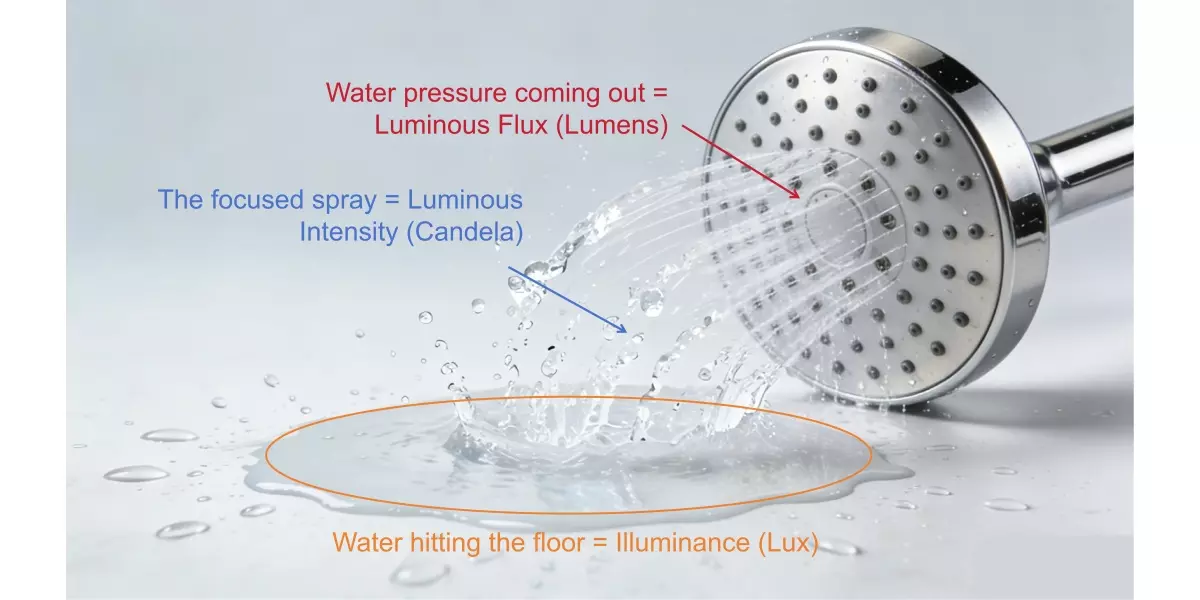
04. Luminous Flux (Lumens - lm)
"How much light is coming out?"
Luminous Flux is the total amount of visible light emitted by a source in all directions. It is the raw "power" of the lamp.
Note: Higher lumens do not always mean "brighter" on your desk—it depends on where that light goes.
05. Luminous Intensity (Candela - cd)
"How strong is the beam in one direction?"
This measures the force of light in a specific direction.
Example: A laser pointer has low Lumens (total output) but extremely high Candela (intensity) because the light is focused. A spotlight will have higher Candela than a generic light bulb of the same wattage.
06. Illuminance (Lux - lx & Foot-candles - fc)
"How much light hits the surface?"
This is the most important metric for project acceptance. It measures the luminous flux falling on a specific unit area (like a desk or floor).
Ø Lux (lx): Lumens per square meter (Metric system, used globally).
Ø Foot-candle (fc): Lumens per square foot (Imperial system, used in the USA).
Conversion Formula:
1 Foot-candle ≈ 10.76 Lux
(Rule of thumb: 1 fc is roughly 10 Lux)
07. Luminance (cd/m² or Nits)
"How bright does it look to the eye?"
Illuminance is the light hitting the wall; Luminance is the light reflecting off the wall and entering your eye. This is the only photometric value we actually see.
08. Luminous Efficacy (lm/W)
"How efficient is the conversion?"
This measures how well a light source converts electricity (Watts) into visible light (Lumens). It is the MPG (Miles Per Gallon) of the lighting world.
Light Source | Typical Efficacy (lm/W) | Efficiency Status |
Halogen / Incandescent | 10 - 20 lm/W | Very Low (Phased out) |
Fluorescent (T5/T8) | 50 - 80 lm/W | Moderate |
Modern LED | 130 - 180+ lm/W | High Efficiency |
09. Uniformity (U0)
Uniformity is the ratio of the minimum illuminance to the average illuminance on a surface (Emin / Eavg).
Why it matters: If a room has bright spots and dark spots (low uniformity), our eyes constantly have to adjust, causing visual fatigue. A uniformity ratio close to 1.0 is ideal but difficult to achieve; >0.4 is standard for most workspaces.
10. Reflectance
This is the percentage of light that a surface reflects rather than absorbs.
Design Tip: You can use the same lights in two different rooms, but if Room A has black walls (Low Reflectance) and Room B has white walls (High Reflectance), Room B will appear significantly brighter. Lighting design must always consider the material of the space.
11. Photometric Plan
A detailed lighting analysis that shows how light will be distributed in a space before installation. It includes calculated illuminance levels (lux or foot-candles), uniformity measurements, and fixture placement to verify that lighting meets design and safety requirements.
Read more: For a practical guide on how photometric plans are created and used in industrial lighting design, see our Photometric Plan Guide.
Part 3: Color Science & Quality
Most manufacturers stop at CRI. But for high-end projects—museums, retail, and luxury hospitality—standard metrics are no longer enough. Here is the deep dive into modern color quality.
12. CCT (Color Temperature) & The Kruithof Curve
CCT measures the "warmth" or "coolness" of light, measured in Kelvin (K). But specifying CCT isn't just about picking a number; it's about psychology and comfort.
This brings us to the Kruithof Curve. This principle explains that visual comfort depends on the specific combination of brightness (Lux) and color temperature (CCT).
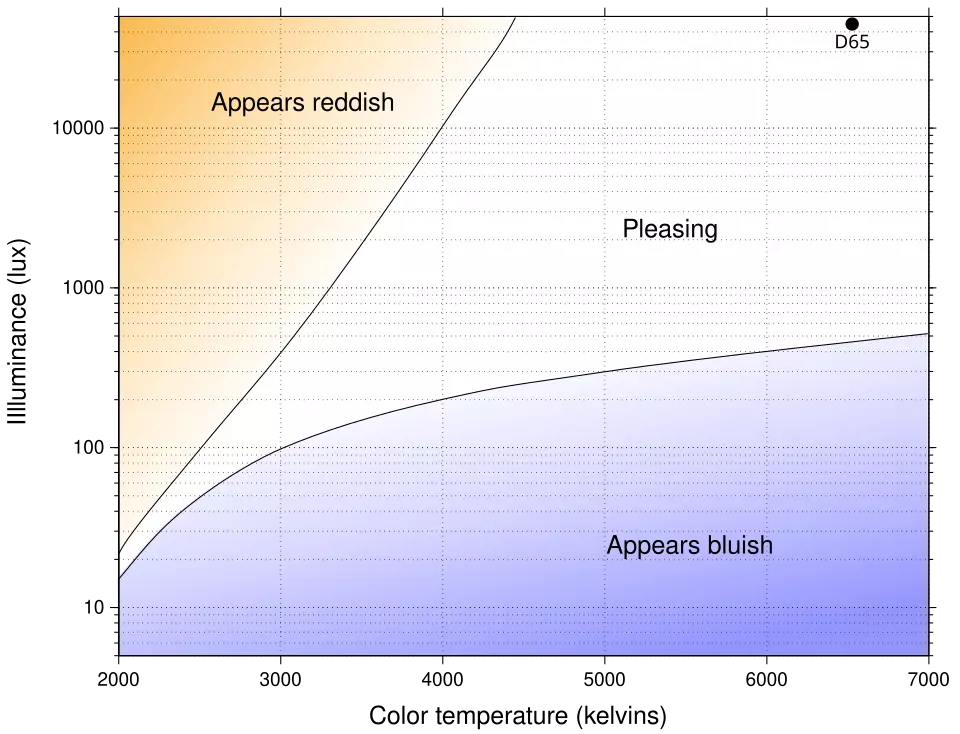
The Principle: Dim lighting looks natural when it's warm (think of a candle or sunset). Bright lighting looks natural when it's cool (think of a sunny blue sky).
The Trap: If you use a high color temperature (e.g., 6000K) at low brightness levels, the space will feel "eerie" or "cold," like a cloudy winter day. Conversely, high brightness with very warm light (e.g., 2700K) can feel intensely hot and unnatural.
Reference: https://en.wikipedia.org/wiki/Kruithof_curve
Read more: For a deeper understanding of the importance of color temperature and how to choose the right color temperature, please refer to our detailed guide on LED color temperature.
Read more: The Kruithof Curve offers a theoretical comfort range, but warehouse lighting decisions are driven by visibility, safety, and task performance. See how 4000K and 5000K compare in real warehouse environments.
13. CRI vs. TM-30 (Beyond Standard Color Rendering)
For decades, CRI (Ra) was the standard. It calculates the average score of 8 pastel colors (R1-R8).
Ø The Flaw of CRI: It ignores R9 (Saturated Red). A light source can score CRI 80 but fail miserably at rendering red tones (making skin look sickly or meat look brown). For quality projects, always demand R9 > 50.
Enter TM-30-15: The New High-Definition Standard
TM-30 is the modern, comprehensive system developed by the IES. It evaluates 99 color samples (instead of CRI's 8) and provides two critical metrics:
1. Rf (Fidelity Index): Similar to CRI, it measures how close the color is to natural light. (Scale 0-100).
2. Rg (Gamut Index): This measures saturation.
Rg = 100: Normal saturation.
Rg > 100: Colors look more vivid (oversaturated).
Rg < 100: Colors look dull (desaturated).
How to Read the Color Vector Graphic:
When looking at a TM-30 report, you will see a circle.
l Black Circle: Represents the reference source (Sunlight).
l Red Shape: Represents your LED light.
l Interpretation: If the red line pushes outside the black circle, that specific color (e.g., red or blue) will appear more vivid. If it shrinks inside, the color will look dull. This visual tool is essential for retail lighting design where "pop" is required.
Reference: https://en.wikipedia.org/wiki/Color_rendering_index
14. SDCM & Binning (MacAdam Ellipse)
Have you ever installed 10 downlights, and noticed that two of them look slightly pinkish or greener than the others? This is a Binning issue.
We measure color consistency using the MacAdam Ellipse (or SDCM - Standard Deviation Colour Matching).
l The Concept: It defines a zone on the color chart where the human eye cannot distinguish the difference between two colors.
l 3-Step MacAdam: The gold standard for architectural lighting. The color difference is virtually invisible to the human eye.
l 5-Step MacAdam: Acceptable for general spaces (like warehouses), but noticeable if you look closely.
l 7-Step MacAdam: Cheap LEDs. Visible color variations are guaranteed.
Part 4: Optical Distribution & Glare Control
A great chip is useless without a great lens. This section covers how we control light to ensure it lands where we want it—without hurting our eyes.
15. Glare (UGR)
Glare isn't just "too much light"; it's light entering the eye at the wrong angle, causing discomfort or disability. We quantify this using UGR (Unified Glare Rating). Lower numbers mean better visual comfort.
Standard UGR Thresholds:
UGR Value | Perception | Typical Application |
< 16 | Imperceptible | Technical Drawing, Operating Theatres |
< 19 | Comfortable | Offices, Classrooms (Standard) |
< 22 | Slightly Noticeable | Reception, Retail, Transit Areas |
> 25 | Uncomfortable | Industrial, Corridors |
> 28 | Intolerable | Avoid using indoors |
16. Shielding Angle (Cut-off Angle)
This is a physical attribute of the fixture design. It is the angle measured from the horizon down to the point where the light source first becomes visible.
Why it matters: A "Deep Baffle" design increases the shielding angle (e.g., >30°). This hides the bright LED chip from view, ensuring that you see the light effect on the object, not the light source itself. This is the hallmark of luxury lighting.
17. Beam Angle vs. Field Angle
These two are often confused, leading to messy lighting designs.
l Beam Angle (FWHM): The angle where light intensity drops to 50% of the center max brightness. This is your "primary" cone of light.
l Field Angle: The angle where light intensity drops to 10%.
l The Trap: A fixture might have a narrow 20° Beam Angle but a wide 60° Field Angle. This creates a "soft edge" or spill light that might unintentionally illuminate surrounding areas. For precise accent lighting, you want the Beam and Field angles to be relatively close.
18. Light Pollution (Dark Sky & ULR)
For outdoor projects, controlling where light doesn't go is as important as where it does go.
l ULR (Upward Light Ratio): The percentage of light emitted above the horizontal plane (skyward).
l Dark Sky Compliant: Fixtures designed with ULR = 0%. They eliminate "Sky Glow," protecting wildlife and our view of the stars. In many modern cities, this certification is mandatory for planning permission.
Part 5: Electrical & Mechanical Terms
The longevity of an LED fixture rarely depends on the LED chip itself. It depends on the electronics and the build quality. Here is what to check on the spec sheet.
19. LED Driver (Constant Current vs. Voltage)
The driver is the heart of the LED system.
l Constant Current (CC): The driver regulates the amperage (e.g., 350mA, 700mA). Used for most downlights, track lights, and high bays. It offers better efficiency and lifespan control.
l Constant Voltage (CV): The driver provides a fixed voltage (e.g., 12V, 24V). Primarily used for LED Strips and parallel circuits where the load length varies.
20. Voltage Drop (The "Dim Tail" Effect)
"Why are the lights at the end of the strip dimmer than the start?"
Voltage drop describes the loss of electrical potential (voltage) as current travels along a wire. Every wire has internal resistance, and the longer the wire, the more voltage is "lost" as heat.
The Symptom: In low-voltage installations (like LED strips), significant voltage drop causes the LEDs at the far end to appear dimmer or even shift color (e.g., white light turning yellowish).
The Solution:
l Higher Voltage: Using 24V or 48V systems instead of 12V dramatically reduces voltage drop, allowing for longer run lengths.
l Thicker Wires: Increasing the wire gauge reduces resistance.
l Looping: Powering the strip from both ends ("injecting power") ensures consistent brightness.
21. Power Factor (PF)
PF measures how effectively a device uses electricity, ranging from 0 to 1.
l The Benchmark: A PF > 0.9 is the industry standard for commercial lighting.
l The Reality: Cheap drivers often have a PF of 0.5. While this might not change the wattage bill for a home user, in a large commercial building, low PF causes "dirty power," stressing the electrical grid and potentially incurring utility penalties.
22. Dimming Protocols
Dimmers also come in different types.
l 0-10V: The analog standard for commercial offices. Simple and reliable.
l DALI (Digital Addressable Lighting Interface): The digital standard for smart buildings. It allows individual control and two-way communication (the light can report if it's broken).
l Triac (Phase-cut): The old-school method using existing mains wiring. Common in residential retrofits but less smooth than 0-10V.
l PWM (Pulse Width Modulation): A method of dimming by rapidly switching the LED on and off. High-frequency PWM is crucial to avoid "flicker" on cameras.
23. Junction Temperature (Tj) & Thermal Management
"How hot is too hot?"
When we talk about "temperature rise" in LEDs, we aren't just talking about the aluminum housing getting warm—that's actually a good sign that heat is moving away from the source. What really matters is the Junction Temperature (Tj).
Tj (Junction Temperature): This is the core temperature of the LED chip itself. It is the critical limit.
l If Tj stays below 85°C, the LED will last for years.
l If Tj exceeds the limit (often 105°C+), the internal materials degrade, leading to rapid Lumen Depreciation (light loss) and Color Shift (lights turning blue or purple).
Thermal Management: This refers to the engineering of the Heat Sink. A high-quality fixture is designed to efficiently transfer heat from the Junction to the outside air, keeping the internal "Temperature Rise" to a minimum. Heat is the #1 killer of LEDs, so good thermal design is non-negotiable.
24. Lifespan: L70B50
LEDs don't just "burn out" like light bulbs; they fade away. We measure this using L70.
L70: The estimated time (in hours) until the light output drops to 70% of its original brightness. This is considered the "end of useful life."
B50: Represents the statistical confidence. "L70B50 = 50,000 hours" means that at 50,000 hours, 50% of the tested units will have dropped below 70% brightness.
Pro Tip: High-spec industrial lights often quote L80 or L90, indicating superior longevity.
Read more: For a deeper understanding of LED lifespan—including how ratings like L70 are tested and how heat impacts long-term performance—see our detailed LED lifespan guide.
25. Protection Ratings (IP & IK)
IP Rating (Ingress Protection): Two numbers (e.g., IP65).
Ø First digit (Solid): 6 = Dust Tight.
Ø Second digit (Liquid): 5 = Protected against water jets. (Note: IP67 is needed for temporary submersion).
Read more: If you are interested in more details, read our full guide on IP ratings.
IK Rating (Impact Protection): Measures mechanical toughness.
Ø IK08: Can withstand a 1.7kg hammer blow.
Ø IK10: Vandal-proof (5kg hammer blow). Essential for public parks and sports stadiums.
Read more: Want to know more about what is IK rating? Here is our complete guide on IK ratings.
Part 6: The Complete A-Z Lighting Glossary
Need a quick definition? Here is your rapid-reference guide to essential lighting terminology, including terms not covered in the deep-dive sections above.
Click to Jump: A-C D-H I-L M-R S-Z
A-C
Ambient Lighting: The base layer of general illumination in a room that allows you to move around safely. Also known as "General Lighting."
Accent Lighting: Directional lighting used to highlight specific objects (like artwork or merchandise) to create visual interest.
Ampere (Amp): The unit of measurement for electrical current flow. Important for calculating how many fixtures can fit on one circuit breaker.
Beam Angle: The angle at which the light intensity drops to 50% of the maximum center intensity.
Binning: The process of sorting LEDs by color and brightness during manufacturing to ensure consistency (see MacAdam Ellipse).
Candela (cd): The unit of luminous intensity; how strong the light is in a single direction.
COB (Chip on Board): An LED technology where multiple LED chips are packaged directly onto a substrate to create a single, high-intensity module. Ideal for spotlights and downlights.
Color Temperature (CCT): A measure of the color appearance of light, from Warm (2700K) to Cool (6500K).
CRI (Color Rendering Index): A score (0-100) measuring how accurately a light source reveals colors compared to sunlight.
D-H
DALI (Digital Addressable Lighting Interface): A two-way digital communication protocol for controlling lighting, widely used in commercial smart buildings.
Dark Sky Compliant: Fixtures designed to minimize glare and light pollution by preventing light from traveling upward into the sky.
Diffuser: A translucent cover (glass or plastic) that spreads light to reduce glare and soften shadows.
Driver: The device that converts main building voltage (AC) into the correct current (DC) required by the LED.
Efficacy: The ratio of light output to energy consumption, measured in Lumens per Watt (lm/W).
Foot-candle (fc): The US standard unit for illuminance (light falling on a surface). 1 fc ≈ 10 lux.
Glare: Visual discomfort caused by excessive brightness or extreme contrast.
Heat Sink: A component (usually aluminum) designed to conduct heat away from the LED chip. Good heat sinking is the #1 factor in determining LED lifespan.
HVAC: Heating, Ventilation, and Air Conditioning. Lighting designs often need to coordinate with HVAC layouts.
I-L
IES File: A digital file containing the photometric data of a fixture, used by designers in software like DIALux to simulate lighting results.
Illuminance: The density of luminous flux incident on a surface, measured in Lux or Foot-candles.
IP Rating (Ingress Protection): A code classifying the degree of protection against dust (first digit) and water (second digit).
IK Rating: A code (00-10) measuring protection against external mechanical impact.
Kelvin (K): The base unit of thermodynamic temperature, used to describe Color Temperature.
L70: The point in time when an LED's light output has depreciated to 70% of its initial brightness.
Lumen (lm): The unit of luminous flux; the total quantity of visible light emitted by a source.
Lux (lx): The SI unit of illuminance. One lux is equal to one lumen per square meter.
M-R
MacAdam Ellipse: A region on a chromaticity diagram; LEDs within the same "step" (e.g., 3-step) appear consistent in color to the human eye.
Mesopic Vision: Vision in low-light conditions where both rods and cones are active (e.g., street lighting at night).
Photometrics: The science of the measurement of light.
Photometric Plan: A photometric plan is a pre-installation lighting analysis that shows how light will be distributed within a space. It includes calculated illuminance levels (lux or foot-candles), fixture placement, and uniformity data to verify that a lighting design meets safety, performance, and regulatory requirements.
Power Factor (PF): The ratio of real power to apparent power. High PF (>0.9) indicates efficient power usage.
PWM (Pulse Width Modulation): A digital technique for dimming LEDs by rapidly switching them on and off.
Retrofit: Replacing old lighting components (like bulbs or tubes) with new LED technology while keeping the existing fixture housing.
RGB / RGBW: Red-Green-Blue (and White). Color-changing LED systems used for decorative or stage lighting.
S-Z
SMD (Surface Mounted Device): A type of LED package where the chip is mounted directly on the circuit board surface. Common in LED strips and panel lights.
Spec Sheet (Specification Sheet): A technical document provided by manufacturers detailing the performance data of a product.
Thermal Management: The system of controlling the operating temperature of the LED to prevent failure (see Heat Sink).
THD (Total Harmonic Distortion): A measure of the distortion of the electrical current caused by the driver. Lower is better (<15%).
Troffer: A rectangular light fixture (usually 2x2 or 2x4 ft) designed to fit into a dropped ceiling grid.
Tunable White: LED technology that allows the user to adjust the color temperature from warm to cool (e.g., 2700K to 6500K) to mimic natural daylight.
UGR (Unified Glare Rating): A method of calculating glare from luminaires in an indoor environment.
Voltage Drop: The loss of voltage in a circuit over long wire runs, which can cause dimming in LED strips.
Wattage (W): The unit of electrical power consumption.
Zigbee: A wireless mesh network protocol used for low-power smart lighting control systems (alternative to Bluetooth or Wi-Fi).
Conclusion
Beyond the jargon, why specs matter?
Lighting is one of the few building materials that affects how we feel, how we work, and how we perceive architecture. But as we have explored in this guide, a simple "10W LED" label tells you almost nothing about the quality of that light.
Understanding these lighting terms—from the fidelity of TM-30 to the comfort of UGR—gives you the power to see past the marketing fluff. It allows you to select fixtures that don't just "turn on," but actually elevate your project, save energy, and last for years.
When reviewing your next specification sheet for LED lighting, look deeper. Don't just check the price and the watts. Check the thermal management, verify the MacAdam step, and demand the IES files. Your eyes (and your clients) will thank you.
Ready to Upgrade Your Lighting Knowledge?
Don't let technical specs slow down your project.
Unsure if you need COB or SMD? Confused about DALI vs. 0-10V? Contact our technical team today for a free consultation on your next lighting project.