_thumb.jpg)
Pole Barn Lighting Guide: Layouts, Lumens & Solutions
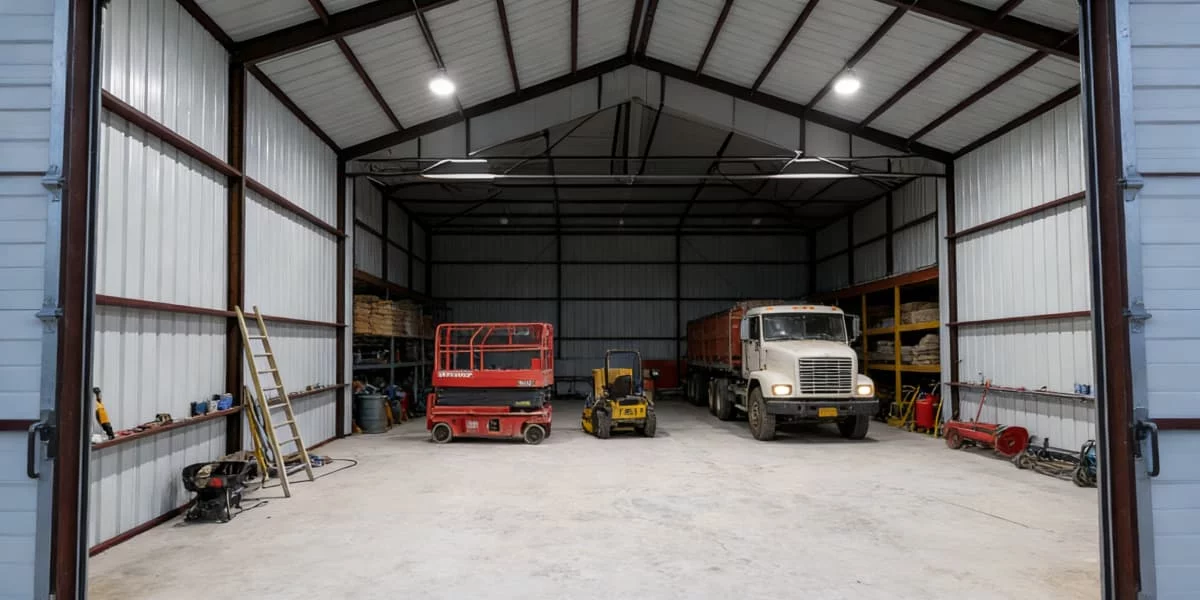
Table of Contents
Define Your Purpose (What is the Barn For?)
How to Choose the Right Fixture Type?
Essential Control Features Explained
Understanding the Specs: CCT, IP69K, and Photoperiod
The Hidden Weakness of Standard LEDs
Ceramiclite Solution: FTC Technology & Graphene Innovation
How to Calculate Pole Barn Lighting Precisely?
Introduction
A pole barn (professionally known as a post-frame building) is one of the most versatile structures on a property. Whether you are lighting a traditional wood-framed barn or modern steel buildings, the outside might look similar, but what you do inside dictates the exact lighting you need. One type of light does not fit all.
It is tempting to run to a big-box store like Lowe's or Home Depot and grab a cheap pack of standard LED shop lights. But here is the hard truth: consumer-grade fixtures are not built for commercial or agricultural use.
If you install a standard, big-box shop light in a dairy barn, the ammonia will corrode its cheap aluminum housing within months. Conversely, if you use dim, outdated agricultural bulbs in a machine shed, you won’t be able to see well enough to work safely.
Choosing the right pole barn lighting comes down to three things: what you are doing, how high your ceiling is, and how durable the fixture needs to be. This guide covers exactly what you need for professional, long-lasting applications.
Define Your Purpose (What is the Barn For?)
Before buying fixtures, identify the main use of your building. Lighting requirements change drastically depending on the work being done.
1. Warehousing & Equipment Storage
If you are just parking tractors or storing hay, you don't need expensive, high-intensity lights.
The Goal: Basic visibility.
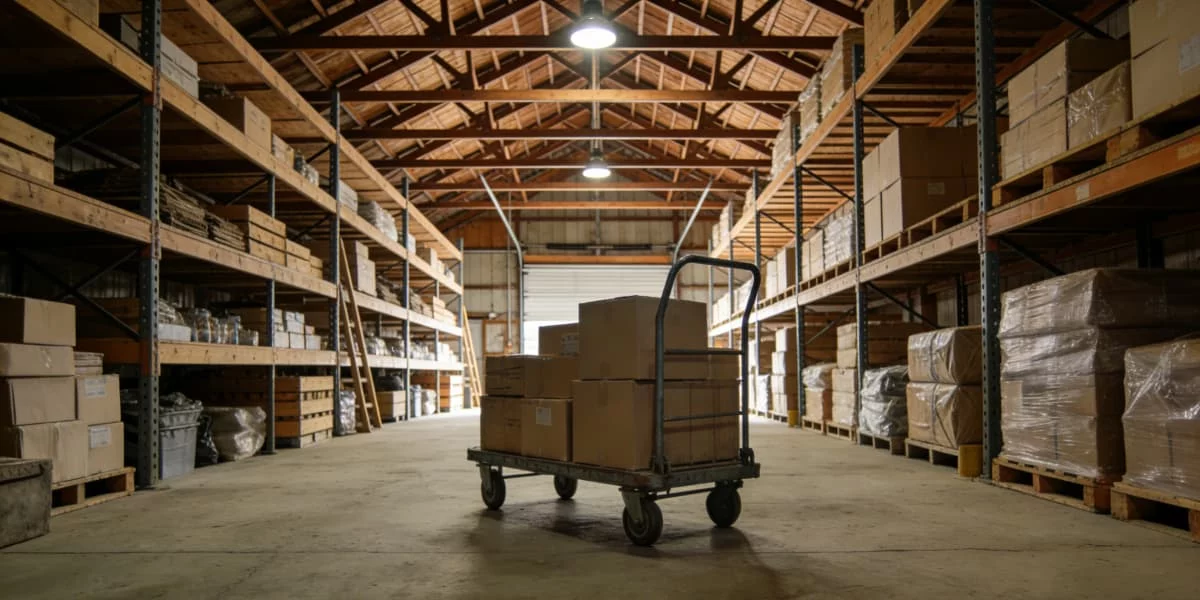
What You Need: Enough light to navigate safely and find tools. Instant-on LEDs are best for cold winters so you aren't waiting for lights to warm up.
2. Equipment Maintenance & Machine Sheds
If you are maintaining heavy agricultural machinery, welding tractor parts, or running a commercial workspace, you need bright, clean light.
The Goal: See details clearly and work safely.
What You Need: High brightness (Lumens) and a cool white color (5000K). You also need a high CRI (Color Rendering Index) to see true colors—essential when reading wiring diagrams or matching paint.
3. Horse Barns & Indoor Riding Arenas
Horses are highly sensitive to flickering lights, harsh shadows, and sudden glare, which can easily spook them.
The Goal: Safety for the animal and the handler.
What You Need: Flicker-free drivers are a must to keep animals calm. For riding arenas, anti-glare lenses are critical. Good color rendering (CRI 80+) also helps you spot health issues on the animal’s coat or hooves.
4. Livestock Farming (Poultry, Dairy, Swine)
This is the most demanding environment. Standard lights will inevitably fail here.
The Goal: Durability and production control.
What You Need: You face dust, moisture, and corrosive gases like ammonia and sulfur. You need sealed, corrosion-resistant fixtures. You also need dimming capabilities to control light cycles (photoperiods), which directly impacts milk yield and egg production.
How to Choose the Right Fixture Type for Barns?
Once you know the purpose of your pole barn, you need to pick the right shape and style of light. Ceiling height is usually the deciding factor.
Here is a breakdown of the three most common pole barn lighting types and the features you should look for.
1. UFO High Bay Lights
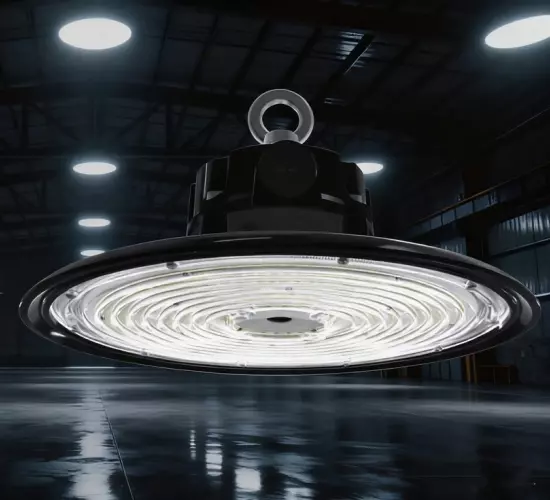 These are round, heavy-duty fixtures named for their saucer-like shape. They are the standard for industrial and large agricultural spaces.
ü Best For: Buildings with high trusses or high ceilings (15 ft and higher).
ü How They Work: UFO High Bays pack a massive power into a compact body. They use a lens to focus light downward, punching through the distance from a high truss to the floor.
ü Why You Need Them: If you have a large machine shed or an open-stall barn, you need raw power. A few of these can light up a massive space. They are also usually built tough (IP65+ waterproof ratings).
ü Product Recommendation: The UFO HB01 Series. Unlike standard aluminum lights, these use FTC technology to resist corrosion, making them perfect for wash-down bays.
2. Linear / Tube Lights
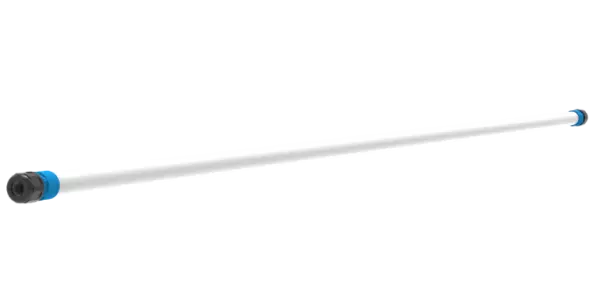 These are long, rectangular fixtures, similar to traditional fluorescent tube fixtures but engineered with much higher durability for post-frame buildings.
ü Best For: Low to Medium Ceilings (8 ft to 14 ft) or Long Aisles.
ü How They Work: Instead of a focused beam, linear lights have a wide angle (often 120 degrees or more). This spreads the light out horizontally.
ü Why You Need Them: If your ceiling is low, a High Bay light will be too intense in one spot and leave the rest dark. Linear lights eliminate shadows. They are ideal for over workbenches, in milking parlors, or down the center of an aisle.
ü Product Recommendation: The LED Barn Light T5/T16 Series. These are linkable (you can plug one into the next) and fully waterproof, ideal for over workbenches, in milking parlors, or down the center of a swine barn aisle.
3. LED Bulbs (Retrofit)
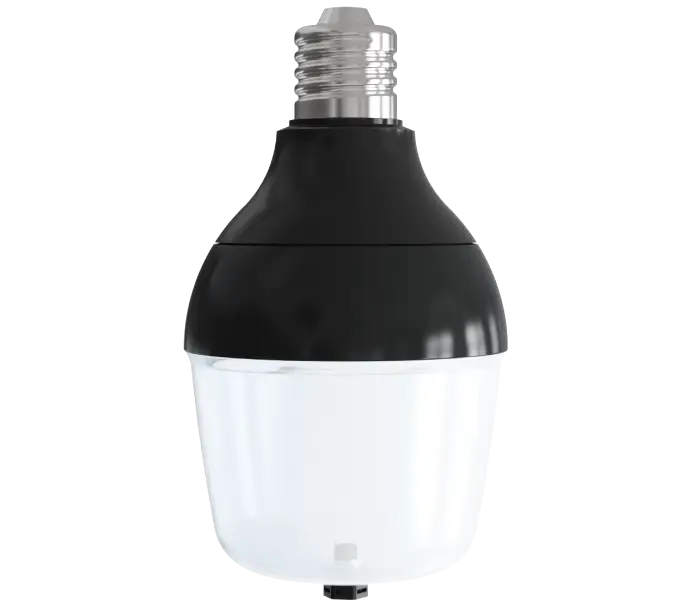 These look like standard light bulbs but are engineered for commercial use.
ü Best For: Upgrading existing fixtures without rewiring.
ü How They Work: They screw directly into standard E26 (medium) or E39 (mogul) sockets.
ü Why You Need Them: If you already have sockets installed and just want better light or energy savings, this is the cheapest route. However, they don't offer the same protection or coverage as a dedicated fixture.
ü Product Recommendation: The D80 LED Bulbs. These are specifically designed for poultry farms, offering smooth dimming that standard store-bought bulbs can't match.
Essential Control Features Explained
Beyond basic brightness and durability, advanced control features can save electricity and significantly improve the functionality of your post-frame building.
When specifying fixtures, look for these three critical options:
① 0-10V Dimming (Crucial for Livestock & Greenhouses)
What is it? A standard industrial method to control brightness smoothly from 100% down to 0%.
Why you need it: In an equipment maintenance bay, you might dim lights to reduce glare on metal parts. In a livestock barn, it is absolutely mandatory. You need to simulate sunrise and sunset to keep animals calm and regulate their biological cycles (such as extending photoperiods for dairy cows or poultry).
What to look for: Ensure the spec sheet says "0-10V Dimmable." (Note: This requires running low-voltage control wires and installing a compatible commercial dimmer switch).
② Motion Sensors (Microwave or PIR)
What is it? A sensor that automatically turns the light on when it detects movement (like a tractor pulling in) and off when the zone is empty.
Why you need it: Great for large hay storage barns, feed rooms, or equipment sheds where your hands are full. It slashes electricity costs by ensuring high-wattage lights aren't accidentally left on overnight.
What to look for: Many advanced UFO High Bays (like the Ceramiclite HB01) have a center port to simply screw in a plug-and-play microwave sensor.
③ Dusk-to-Dawn Photocell
What is it? A small sensor that detects natural sunlight. It turns the light on at sunset and off at sunrise automatically.
Why you need it: This is specifically for exterior pole barn lighting (such as over the large sliding doors). It provides perimeter security for your farm equipment without you having to remember to flip a switch every night.
What to look for: Look for exterior wall packs or yard lights labeled "with Photocell" or "Dusk-to-Dawn integrated."
Understanding Critical Specs: CCT, IP69K, and Photoperiod
When shopping for LED pole barn lights, you need to look past just "lumens." To ensure your investment survives, check these critical specifications:
1. Color Temperature (CCT) & CRI
u 5000K (Daylight): The standard for machine sheds. It mimics bright noon sunlight, keeping you alert for mechanical work.
u 3000K - 4000K (Warm/Neutral): Better for livestock and horse barns. A softer light is less stressful for animals.
u CRI (Color Rendering Index): Aim for 80+. High CRI allows you to easily differentiate between a red and an orange wire in a tractor, or spot a pale comb on a chicken.
2. IP Ratings & Biosecurity (IP65 vs. IP69K)
In livestock farming, biosecurity is everything. Barns must be washed down between flocks or herds.
u IP65 (Standard): Protects against dust and light water spray. Fine for storage, but will fail if hit with a pressure washer.
u IP69K (Professional): The highest protection rating. It means the fixture can withstand high-pressure, high-temperature water jets (1450 psi at 80°C). If you are washing down a dairy or poultry facility, IP69K is mandatory.
3. Photoperiod (Light Cycles)
This is critical for farmers. Photoperiod management means controlling how many hours of light your animals get each day.
u The Science: Light affects hormones. For chickens, longer days stimulate egg production. For dairy cows, extending "daylight" hours can increase milk yield.
u The Gear: To do this, you need lights that are compatible with dimmers and timers. You cannot manage photoperiods effectively with simple on/off switches.
4. Surge Protection & Safety Certifications
Rural farm grids are notorious for voltage spikes. Our commercial fixtures come with built-in 1KV to 2KV Surge Protection to prevent the driver from being fried by sudden grid fluctuations. Furthermore, always ensure the lights carry recognized safety marks like UL, ETL, CE, RoHS, or CCC to guarantee electrical safety in highly flammable environments (like hay storage).
The Hidden Weakness of Standard LEDs
Here is the uncomfortable truth about the commercial LED industry: Most so-called "agricultural lighting" sold today consists of just repackaged warehouse lights. They rely on cheap plastics and silicone that are fundamentally unsuited to survive harsh farm environments, where moisture, dust, and chemical gases are constantly present.
To understand why they fail, we have to look inside the chip.
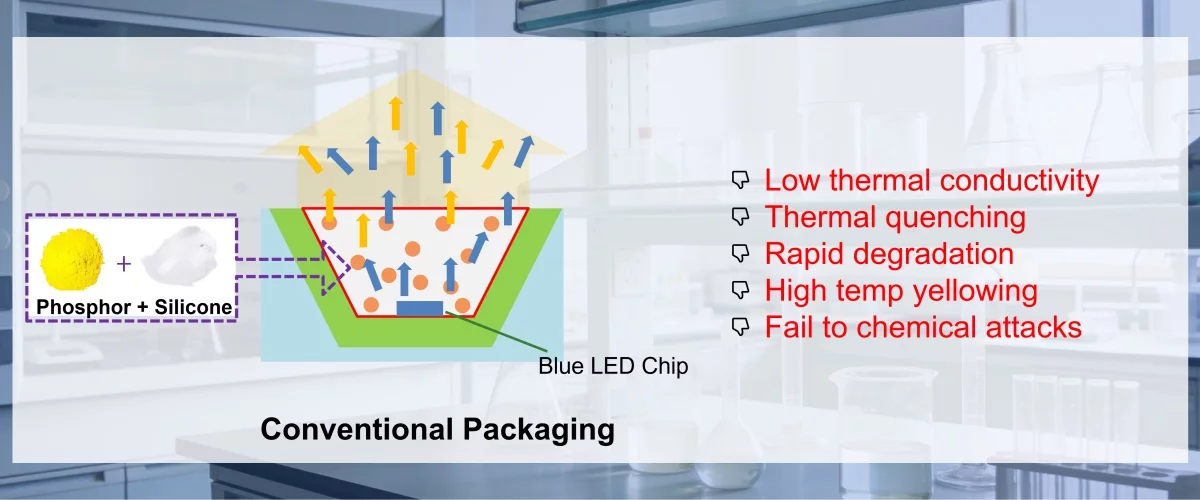
1. The Silicone & Phosphor Trap
Standard LED chips use a mixture of phosphor powder and silicone glue to encapsulate the chip and create white light.
u The Problem: Silicone is porous. Under the high heat of operation, the molecular structure of silicone expands.
u The Result: Moisture and corrosive gases penetrate the silicone barrier. Over time, the silicone yellows and cracks (carbonization). This causes "Color Shift"—your bright white light turns dim blue or purple after a year of use. Furthermore, because silicone is a poor heat conductor, heat gets trapped inside, frying the chip from within.
2. Vulnerability to Chemical Attacks (Sulfurization)
Livestock environments are rich in Sulfur (from manure and water) and Ammonia.
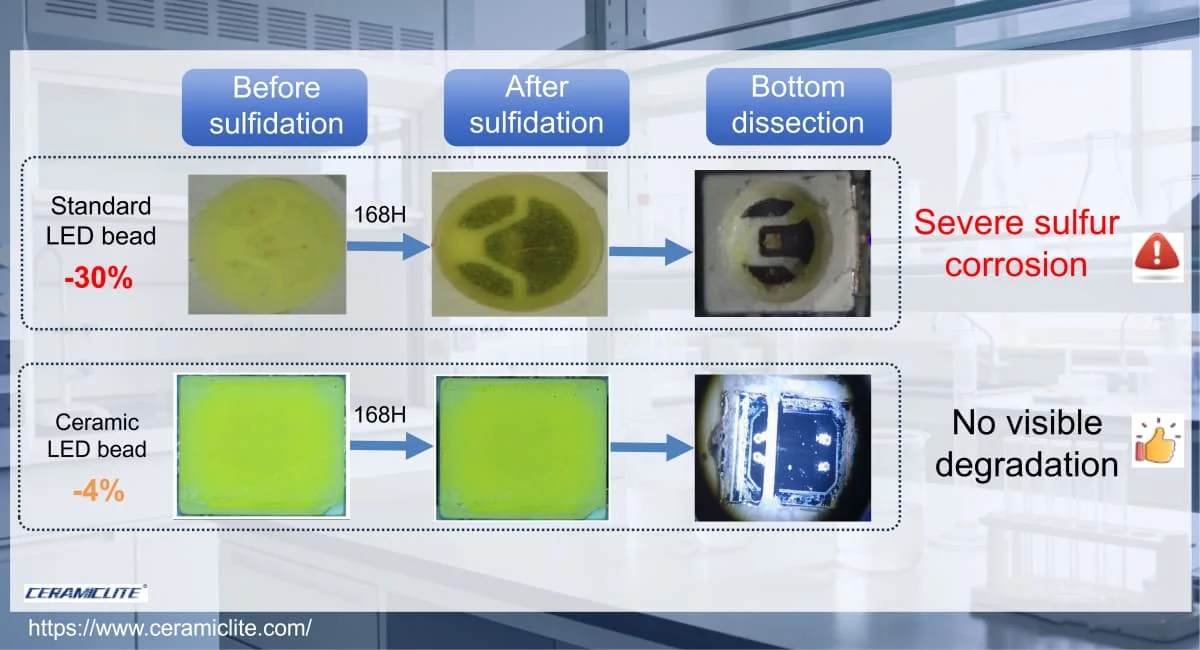
u The Reaction: Standard LEDs rely on silver-plated lead frames. Sulfur gas (Hydrogen Sulfide) easily penetrates the silicone packaging and reacts with the silver.
u The Failure: This reaction creates Silver Sulfide (Ag2S), a black compound. The reflective silver turns black, absorbing light instead of reflecting it. The result is rapid, irreversible light loss (lumen depreciation) and eventual total failure.
3. The Housing & Maintenance Nightmare
Standard UFO High Bays are designed for clean warehouses, not dirty barns.
u Corroding Aluminum: Most use die-cast aluminum housings. In an acidic barn environment (ammonia), aluminum oxidizes and corrodes, eventually compromising the waterproof seal.
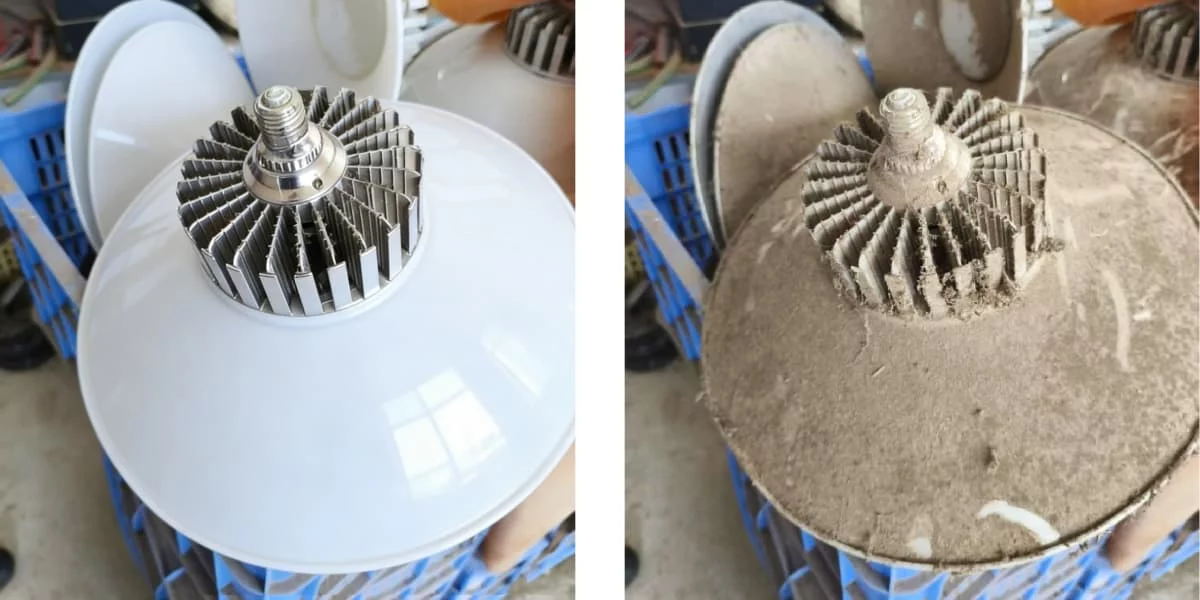
u Dust Traps: Standard heat sinks have deep, thin fins. These trap feathers, dust, and cobwebs, creating a "thermal blanket" that overheats the fixture.
u Impossible to Clean: Because they have complex fins and standard waterproofing (IP65), you cannot wash them with high-pressure jets. You are forced to leave them dirty, which further reduces lifespan.
Ceramiclite Solution: FTC Technology & Graphene Innovation
We didn't just tweak a standard light; we replaced the core materials. Ceramiclite’s solution is built on two pillars: FTC (Fluorescent Transparent Ceramic) LED Chip Technology and advanced Graphene Composite housings.
1. What is FTC Technology? (The Chip Revolution)
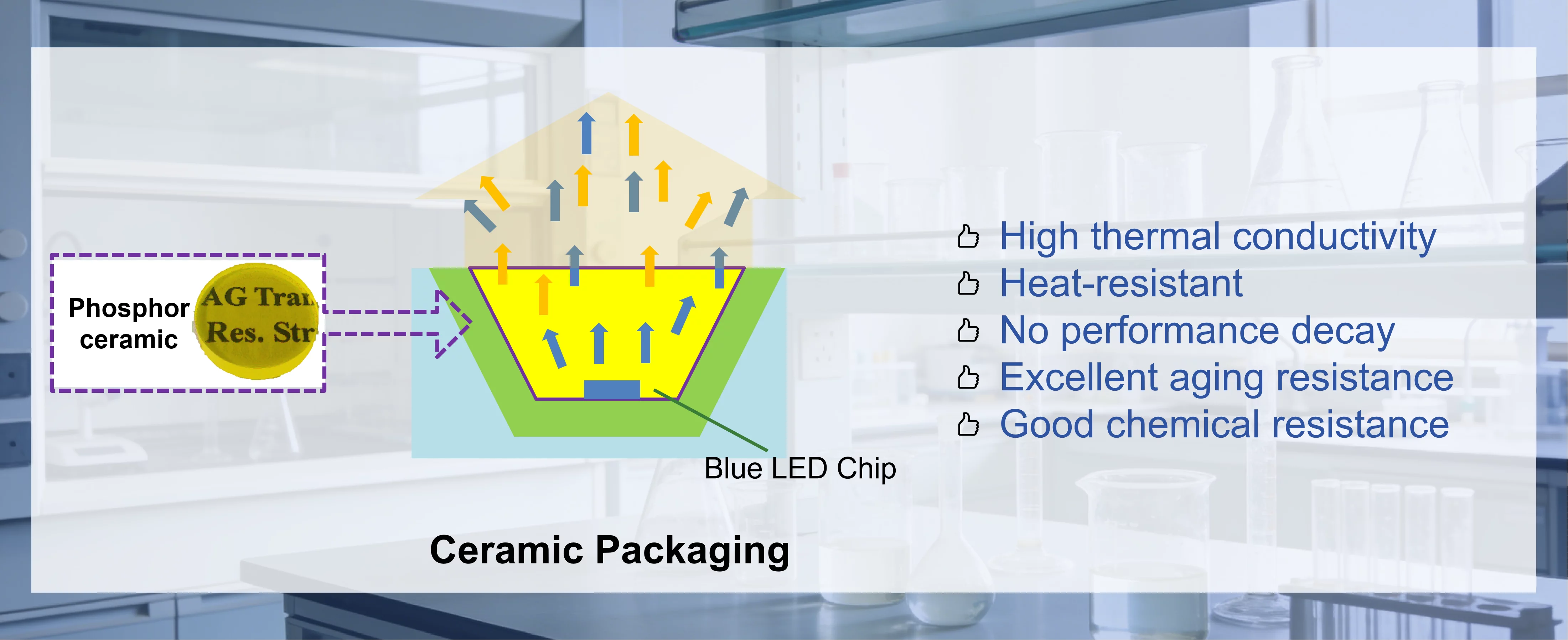
We have replaced the unreliable "phosphor powder + silicone" mixture with a solid-state Fluorescent Transparent Ceramic. This is a game-changer for industrial and agricultural lighting.
a. Solid-State Durability
FTC is a solid ceramic wafer. It does not use silicone glue. This gives it exceptional physical and chemical stability, making it immune to the aging and cracking that plagues standard LEDs.
b. Unmatched Thermal Conductivity
Silicone is an insulator. FTC ceramic is a conductor. It has a thermal conductivity of up to 10 W/m·K, and the thermal resistance is 50 times lower than traditional chips.
Why this matters: It pulls heat away from the light source instantly. Even under high power, the surface temperature remains low (e.g., only ~89°C at stable states for high-power COB), drastically extending lifespan.
c. Zero Color Shift
Because ceramic doesn't degrade like silicone, the light source maintains its original color temperature for years. There is no "drifting" to blue or purple.
2. Extreme Chemical Resistance
We tested FTC chips against the harshest elements.
The Sulfur Test: Under strictly controlled testing (15ppm Hydrogen Sulfide concentration for 168 hours), the Ceramiclite FTC chip surface showed no change.
The Result: Our chips are virtually impervious to acid, alkali, ammonia, and sulfur. This makes them the only logical choice for poultry and swine facilities.
3. Real-World Longevity (The Data)
This isn't just marketing; it's verified by LM-80 testing.
<5% Degradation: After 100,000 hours of operation, FTC-based LEDs show less than 5% luminous attenuation. Standard LEDs often lose 30% brightness in a fraction of that time.
This allows us to offer industry-leading warranties of 5 to 8 years.
4. Beyond the Chip: The HB01 Graphene Advantage
The chip is protected by an equally advanced housing. Our HB01 High Bay eliminates the weaknesses of aluminum.
u Graphene Material: We infuse the housing with graphene. This material dissipates heat faster than die-cast aluminum and is chemically inert—it will not corrode in ammonia environments.
u Smooth Surface Design: The HB01 is designed without the deep, dust-trapping fins of standard lights. Dust and feathers slide off, keeping the fixture running cool.
u IP69K Washdown Ready: These lights are sealed to the highest standard. You can clean them with high-pressure, high-temperature water jets (1450 psi at 80°C) without fear. This is essential for biosecurity in livestock farming.
How to Calculate Pole Barn Lighting Precisely?
Don't guess. A poorly planned layout creates shadows that can make work dangerous or startle livestock.
While you can run a quick estimate, we recommend a more scientific approach to ensure you aren't wasting money on too many lights or straining your eyes with too few.
Step 1: Define Your Target Foot-Candles (FC)
Lighting needs vary by task. Based on IES (Illuminating Engineering Society) standards, here are the targets you should aim for on your working surface (usually 30 inches off the floor):
Ø General Storage / Farm Machinery: 10 - 20 FC
Ø Livestock (General Handling): 20 - 30 FC
Ø Workshops / Repair Bays: 50 - 75 FC
Ø Detail Work (Painting/Fine Assembly): 75 - 100 FC
Step 2: Select the Right Fixture
Not all lumens are created equal. For efficiency, choose High Bay lights with a luminous efficacy of >130 lm/W.
Ø Color Temperature: Stick to 4000K-5000K for clarity.
Ø CRI: Aim for CRI ≥ 80 if color accuracy matters (e.g., matching paint or checking animal health), though CRI ≥ 70 is acceptable for general storage.
Ø Protection: Ensure IP65 or higher to resist dust and moisture.
Step 3: The Scientific Calculation Formula (Core)
To get a precise number, we need to account for light that gets absorbed by walls or lost over time (dirt accumulation).
Formula:
Number of Fixtures = (Area × Target FC) / (Lumens per Fixture × CU × MF)
Understanding the Factors:
CU (Coefficient of Utilization): How much light actually reaches the floor based on wall reflection.
For a typical pole barn with light-colored metal walls, use 0.6. For darker wood walls, use 0.5.
MF (Maintenance Factor): Accounts for lumen degradation and dirt buildup over time.
With regular cleaning, use 0.8. For a conservative estimate (or dusty environments), use 0.7.
Example Calculation:
Let’s light a 30x40 ft (1,200 sq. ft.) workshop.
Target: 50 FC (Workshop standard).
Fixture: Ceramiclite HB01 (20,000 Lumens).
Assumptions: Light metal walls (CU = 0.6), relatively clean (MF = 0.8).
Total Lumens Required = 1,200 sq. ft. × 50 FC = 60,000 Lumens
Effective Lumens per Light = 20,000 × 0.6 × 0.8 = 9,600 Lumens
Fixtures Needed = 60,000 / 9,600 = 6.25
Result: You need 7 fixtures to guarantee your light levels meet the 50 FC standard.
Step 4: Layout Best Practices
Ø Mounting Height: Hang lights high enough to clear trusses but low enough to maximize brightness.
Ø Spacing (S/MH Ratio): Check the manufacturer’s "Spacing-to-Mounting Height" ratio. If unavailable, a 1:1 ratio (spacing equals mounting height) is a safe starting point to ensure uniform overlap.
Ø Wall Distance: Place the first row of lights at a distance from the wall equal to 1/2 of your fixture spacing. This lights up the perimeter workbenches without wasting light on the wall itself.
Ø Zoning: Wire your lights on separate switches (e.g., Storage Zone vs. Workbench Zone). There is no need to light the whole barn at 100% brightness just to grab a screwdriver.
Need a Guarantee? Let Us Simulate It.
The calculation above is based on standard assumptions. However, every barn is unique—truss obstructions, wall colors, and machinery layouts all affect light.
Do you want a professional lighting plan that guarantees zero shadows and no glare?
Contact Ceramiclite today. Send us your barn dimensions, and our engineers will create a FREE DIALux lighting simulation tailored specifically to your space. Get it right the first time.
Conclusion
When building or upgrading a pole barn, lighting is often the last thing on the budget list. It is tempting to grab the cheapest "high-lumen" lights you can find online.
But as we have seen, brightness is only half the story.
If your pole barn is just a garage, standard LEDs are fine. But if your barn houses livestock, chemicals, or heavy machinery, those standard lights are on a countdown to failure from day one. The invisible enemies—ammonia, sulfur, heat, and moisture—will degrade the plastic and corrode the aluminum.
By choosing Ceramiclite’s FTC technology and Graphene-infused fixtures, you aren't just buying lights; you are investing in infrastructure.
ü You get fixtures that resist acid and corrosion for a decade, not just a year.
ü You get the ability to wash them down with high-pressure jets without fear.
ü You get the precise spectral control needed to keep your animals healthy and productive.
Your pole barn is built to last a lifetime. Your lighting should be too.
Ready to future-proof your barn?
Browse our specialized Pole Barn Lighting Collection or reach out to our team for a custom solution.
FAQ
1. How many lights do I need in my pole barn?
It depends entirely on the size and use. For a simple storage barn, you might only need 10-20 foot-candles (FC) of light. For a detailed workshop, you need 50+ FC. As a rule of thumb, aim for roughly 50 lumens per square foot for workshops. Use the formula in Chapter 7 to calculate exactly based on your square footage,or ask us for a free layout.
2. What is the best lighting for a 30x40 pole barn?
For a 30x40 ft pole barn (1,200 sq. ft.) with a 12-16 ft truss ceiling, we typically recommend 4 to 6 units of Ceramiclite 150W HB01 UFO High Bays. This setup provides excellent brightness for general mechanical and agricultural work. If the ceiling is lower (under 10 ft), use rows of T5 Linear Barn Lights to avoid shadows.
3. How many lumens do I need for a 40x60 agricultural building?
For a 40x60 ft pole barn (2,400 sq. ft.), you need approximately 120,000 lumens to achieve a bright 50 foot-candle standard for maintenance work. This typically requires 6 to 8 Ceramiclite HB01 High Bays. If the barn is used only for equipment storage (20 FC), about 48,000 lumens (3-4 fixtures) is sufficient.
4. How many lumens do I need to light a 30x40 pole barn?
To achieve a standard working brightness of 50 Foot-Candles, you generally need around 60,000 to 75,000 total lumens. This assumes light-colored metal walls. If your pole barn interior is dark wood, you may need to increase this by 20% to account for light absorption.
5. What is the best lighting layout for a pole barn?
The best layout minimizes shadows. For open workspaces, use a Grid Layout (e.g., 2 rows of 3 lights) to ensure uniform coverage. For aisles or dairy stanchions, use a Linear Layout running parallel to the work area. Always aim for a 1:1 spacing-to-height ratio—if lights are mounted 15 ft high, space them 15 ft apart.
6. Is 5000K or 6000K brighter?
Technically, they have similar brightness (lumens), but our eyes perceive them differently. 5000K (Daylight) is the industry standard—it is pure white and comfortable. 6000K has a blue tint; while it looks "glaringly" bright, it can cause more eye strain, distort colors, and is generally not recommended for professional workspaces. We recommend 5000K for detailed work and 4000K for livestock comfort.
7. How to choose LED lights for dairy barns?
Dairy barns are high-ammonia environments. Do not use standard aluminum LEDs. You must look for fixtures that are:
a. Corrosion-resistant (like Ceramiclite FTC chips and Graphene housings).
b. IP69K rated (to withstand high-pressure washdowns).
c. Dimmable (to extend photoperiods for higher milk yield).
8. Are LED barn lights difficult to install?
No, commercial fixtures are designed for efficient installation. UFO High Bays usually come with a simple hook mount—just hang them from a truss chain and plug them in. Linear Lights often use snap-on surface clips or suspension cables. (Safety Tip: Always ensure your wiring is rated for the environment and matches safety codes like UL/ETL, using conduit in wet areas).