Do Chickens Need A Light at Night? Science of Dark Periods

Table of Contents
The Biological Necessity of Darkness
The Exception: Why Commercial Farms Use Red Light
Can Chickens Sleep with a Light On? (Debunking Myths)
Implementing a "Dim-to-Red" Protocol
In the commercial poultry industry, lighting protocols are often focused solely on the "photoperiod"—the duration of light required to stimulate egg production or growth. However, the "scotoperiod," or the dark phase, is equally critical.
A common question among facility managers is: Do chickens need a light at night?
The short answer for professional poultry management is no, not white light. In fact, continuous white lighting is detrimental to flock health. However, there is a strategic exception: the use of monochromatic red light for specific management tasks. This article explores the biological necessity of darkness and how advanced red spectrum technology can improve operational efficiency.
The Biological Necessity of Darkness
Contrary to the myth that birds need night lights to prevent panic, poultry physiology demands a distinct period of darkness.
Melatonin and Immunocompetence
The primary reason to avoid continuous lighting is the regulation of melatonin. This hormone is synthesized by the pineal gland exclusively during darkness. Research published in Poultry Science indicates that melatonin is not merely a sleep regulator; it plays a vital role in immunocompetence (the ability of the body to produce a normal immune response) and thermoregulation.
Depriving a flock of darkness suppresses melatonin secretion, leading to:
l Compromised Immune Systems: Birds become more susceptible to infections.
l Reduced Bone Density: Melatonin influences calcium metabolism, which is critical for skeletal integrity in broilers and eggshell quality in layers.
The Cost of Continuous Lighting Stress
From a production efficiency standpoint, the impact of "Continuous Lighting Stress" (CLS) is directly measurable on the bottom line.
l Feed Conversion Ratio (FCR): Birds under 24-hour light often develop irregular feeding patterns, leading to reduced digestive efficiency and poorer FCR.
l Mortality Rates: Chronic stress elevates cortisol levels, which can increase mortality rates due to cardiovascular issues (such as ascites in broilers).
Therefore, establishing a minimum of 4-6 hours of continuous darkness is not just a welfare requirement; it is a production necessity.
The Exception: Why Commercial Farms Use Red Light
While white light must be eliminated during the sleep cycle, total darkness can present operational challenges, particularly for 24-hour facility management. This is where the specific physics of Red Spectrum Lighting (600nm+) becomes a powerful tool.
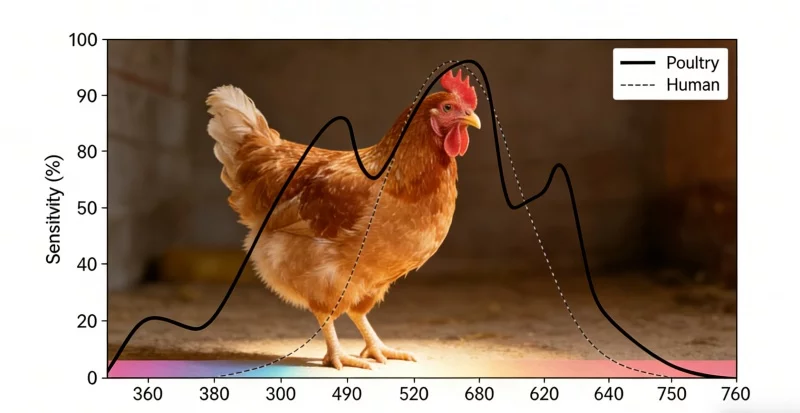
Poultry vision is tetrachromatic and highly sensitive to light intensity, but birds perceive the red spectrum differently than humans do. At low intensities, red light does not stimulate the hypothalamus to the same degree as white or blue light, meaning it has a minimal impact on the bird's perception of "daylight."
Use Case 1: Midnight Inspection (Non-Intrusive Management)
Staff often need to enter the coop at night to check equipment, monitor temperatures, or remove mortality. Using white flashlights or overhead lights can trigger hysteria or "piling," where birds panic and crowd into corners, leading to suffocation.
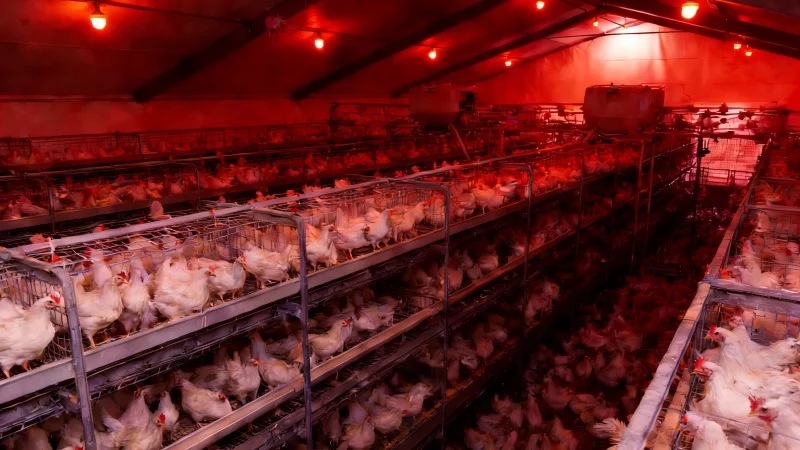
By utilizing dimmable red LEDs, farm personnel can navigate the facility and inspect the flock. The birds, perceiving the red light as darkness or a non-threatening twilight, remain on their roosts and undisturbed. This allows for essential maintenance without disrupting the flock's sleep cycle.
Use Case 2: Calming Aggression and Cannibalism
Feather pecking and cannibalism are significant economic risks in high-density housing. These behaviors are visually driven; birds are attracted to the sight of blood or raw skin.
Under red lighting, the contrast between blood and feathers is neutralized—red blood appears dark or grey. This visual masking effectively reduces the stimulus for aggressive pecking. Implementing a "red light strategy" during outbreaks is a proven method to immediately dampen aggression while nutritional or environmental root causes are addressed.
Pairing the controller with robust fixtures like the CeramicLite T21 LED Barn Light ensures that the dimming signal translates into stable, uniform light output, crucial for maintaining calm in high-density coops.
Can Chickens Sleep with a Light On? (Debunking Myths)
A frequent query in poultry management forums is: "Can chickens sleep with a light on?"
The physiological answer is nuanced. While chickens can physically close their eyes and "doze" under constant illumination, they cannot achieve the restorative state of Deep Sleep.

The Cortisol Connection
Like humans, poultry require darkness to reach the REM (Rapid Eye Movement) phase of sleep, which is essential for physiological repair. Under continuous white light, birds remain in a state of low-level alertness. This prevents the full reset of their neuroendocrine system.
The long-term consequence is a chronic elevation of cortisol (the stress hormone). High cortisol levels negatively impact production metrics in two specific ways:
l Reduced Reproductive Performance: In layers, chronic stress disrupts the hormonal cascade required for ovulation, leading to a gradual decline in lay rate.
l Poor Eggshell Quality: Stress affects calcium mobilization, resulting in thinner shells and higher breakage rates during collection and transport.
Defining "Effective Darkness"
To ensure flock health, facilities must provide a period of "Effective Darkness." Industry standards suggest a minimum of 6-8 hours where light intensity falls below 0.5 Lux. At this level, the bird's pineal gland perceives "night," allowing for full melatonin synthesis and deep, restorative sleep.
Implementing a "Dim-to-Red" Protocol
Modern poultry lighting is no longer just about "On" and "Off." Leading facilities are adopting advanced protocols that leverage the unique properties of the red spectrum to transition birds smoothly between day and night.
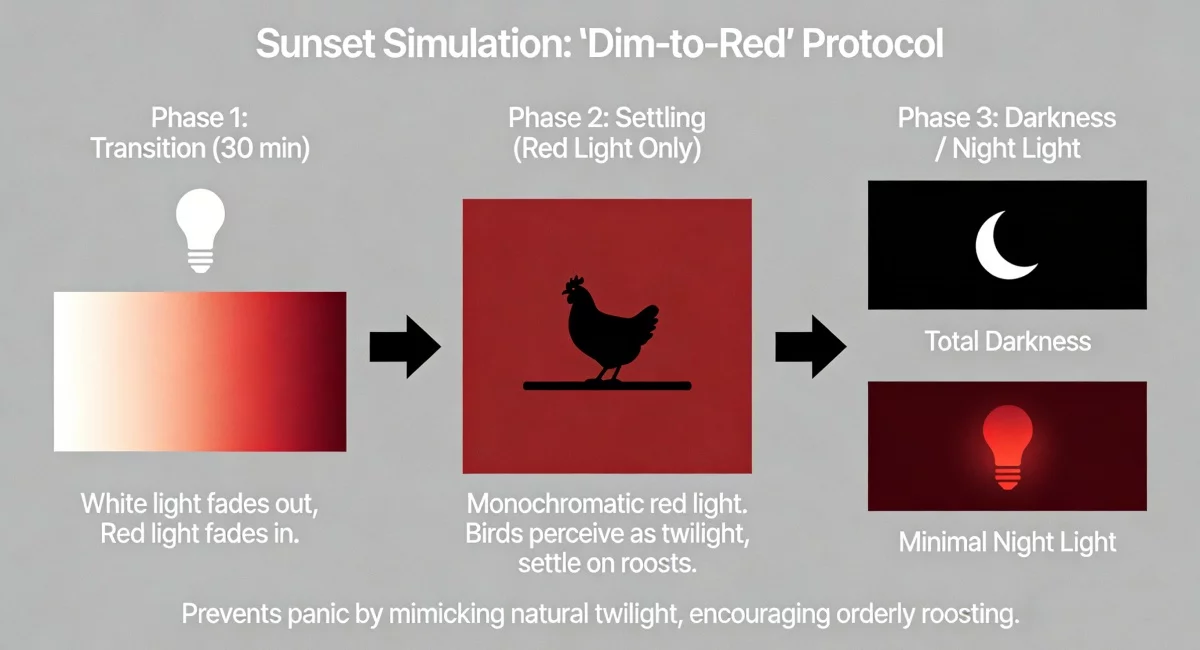
The Sunset Simulation
Abruptly cutting power to white lights can cause panic, leaving birds stranded on the floor away from their roosts. A "Dim-to-Red" protocol solves this:
Ø Phase 1 (Transition): 30 minutes before "lights out," the white spectrum fades down while the red spectrum ramps up.
Ø Phase 2 (Settling): The coop is bathed in warm, monochromatic red light. Birds perceive this as twilight, naturally encouraging them to settle and roost without the hysteria of sudden darkness.
Ø Phase 3 (Darkness or Night Light): The red light then slowly dims to zero (for total darkness) or remains at an extremely low intensity (for night inspection capability) depending on the farm's management style.

Technology Requirement: Precision Dimming
Executing this protocol requires equipment capable of smooth, flicker-free dimming. Standard residential dimmers often cause LEDs to strobe at low voltages, inducing stress.
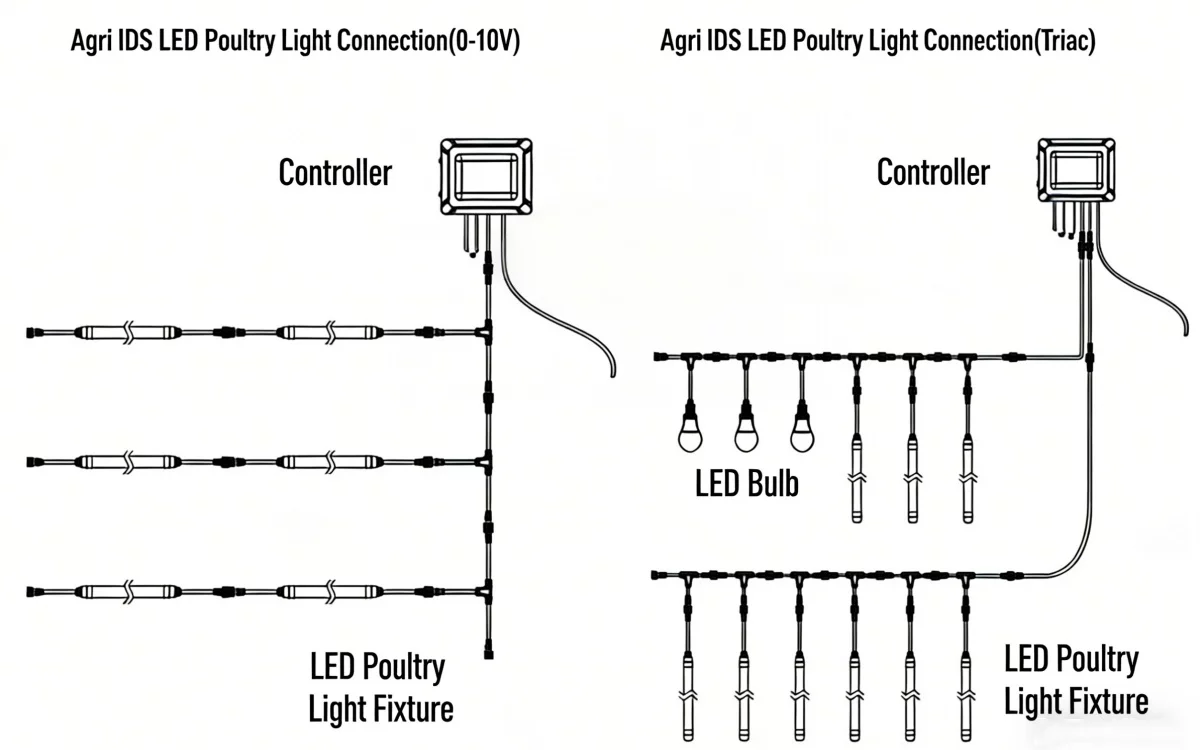
To execute this protocol flawlessly, precision is key. CeramicLite’s IDS Controller is the intelligent core designed for this exact purpose. Unlike basic timers, the IDS system features a built-in digital CPU that allows you to schedule complex daylight simulations with smooth, flicker-free transitions.
Whether you are managing broilers or layers, its 9999-day maintenance-free memory ensures your programmed light cycles remain intact even during power outages, guaranteeing consistent animal welfare without manual intervention.

Conclusion
In professional poultry farming, darkness is not wasted time; it is a critical component of productivity. A well-managed scotoperiod (dark phase) is as essential to your flock's performance as the feed formulation or water quality.
Relying on outdated, static lighting or cheap, flickering bulbs compromises your flock's biological rhythm and your farm's efficiency.
Is your lighting system working for your flock or against it?
Upgrade to CeramicLite’s intelligent poultry lighting solutions. With advanced red-spectrum capabilities and smooth dimming drivers, you can enhance flock welfare, reduce aggression, and streamline night management tasks.
Contact our team today to design a lighting protocol tailored to your facility.
![]()