_thumb.jpg)
Lighting Certification: UL, ETL, DLC, CE & Global Standards
Table of Contents
Introduction: Why Certifications Matter
Safety Certifications: The "Must-Haves"
Environmental & Durability Ratings
Regulatory & Specialized Compliance
The Buyer’s "Cheat Sheet": What to Look For
Introduction: Why Certifications Matter
When you review a specification sheet for an industrial high bay or a stadium floodlight, you are often greeted by a dense "alphabet soup" of acronyms: UL, ETL, CE, DLC, IP65. For many procurement managers and facility owners, these logos can feel like bureaucratic hurdles. However, in the world of professional lighting, these certifications are far more than just stickers—they are your primary defense against fire hazards, legal liability, and wasted capital.
To make an informed purchasing decision, it helps to view these standards through three specific lenses: Safety (ensuring the fixture won't cause a fire or shock), Performance (verifying the light output and lifespan claims), and Compliance (meeting environmental and legal regulations).
A Crucial Distinction: Product vs. Design
Before we explore the specific marks, it is important to clarify that this guide focuses exclusively on Product Certifications—the rigorous testing required for the hardware itself. If you arrived here searching for lighting design certifications (such as CLD or LC credentials for architects), this guide deals with the equipment reliability rather than professional qualifications.
Our goal is to cut through the confusion. Whether you are retrofitting a warehouse or lighting a livestock barn, understanding which certifications are mandatory "market entry tickets" versus which are voluntary "performance boosters" is the key to protecting your investment.
Safety Certifications: The "Must-Haves"
Safety certifications are the non-negotiable baseline for the lighting industry. In North America, the Occupational Safety and Health Administration (OSHA) requires that electrical equipment used in the workplace be tested and approved by a Nationally Recognized Testing Laboratory (NRTL).
Without a mark from one of these accredited labs, your installation could fail electrical inspection, void your insurance policy, or expose your company to significant liability.
UL Certification
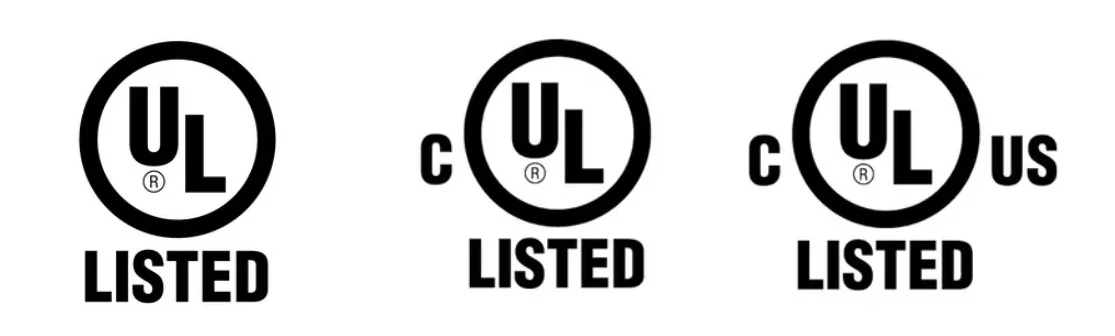
Underwriters Laboratories (UL) represents the bedrock of electrical safety in North America. Established over a century ago, the UL mark is arguably the most recognized and trusted symbol in the lighting industry.
When a luminaire carries a "UL Listed" mark, it signifies that the entire fixture has undergone rigorous testing to meet specific ANSI/UL safety standards, ensuring it is free from reasonably foreseeable risks of fire and electric shock. For many engineers and architects, specifying UL lighting certification is a reflexive best practice, making it the default standard for high-stakes commercial and industrial projects.
ETL Certification
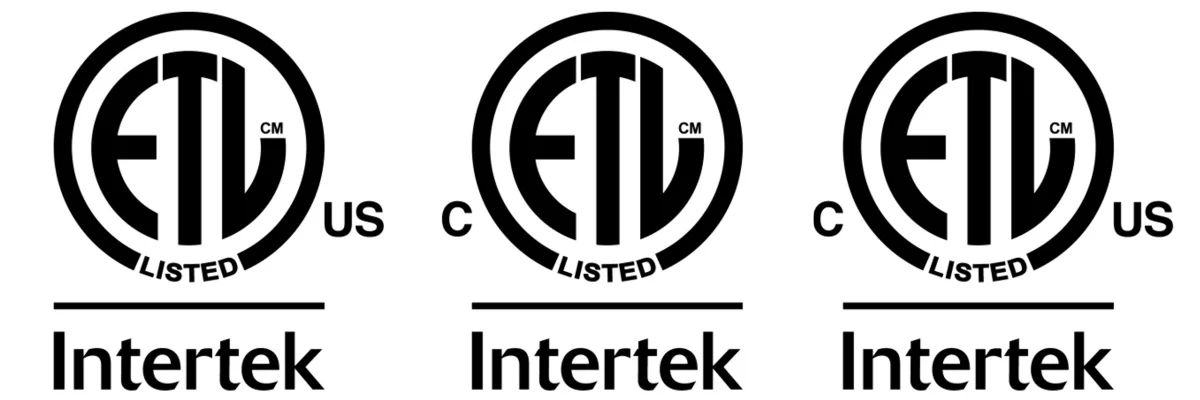
Issued by Intertek, the ETL Listed mark is another powerhouse in the North American safety landscape. A common misconception among buyers is that ETL is somehow "inferior" to UL. This is factually incorrect. Legally and technically, ETL certification is functionally equivalent to UL. Both laboratories are OSHA-accredited NRTLs, and both test to the exact same safety standards (such as UL 1598 for luminaires).
The primary difference lies in the process: many agile lighting manufacturers prefer ETL because Intertek often offers faster testing timelines, allowing new LED technologies to reach the market sooner without compromising safety. If a product is ETL Listed, it is fully accepted by electrical inspectors across the US and Canada.
Read more: A full guide about ETL certification is here.
CSA Certification
For projects located in Canada, the Canadian Standards Association (CSA) is the governing body for electrical safety. However, due to the integrated nature of the North American market, you will rarely see a product with only a CSA mark. Most modern industrial lighting fixtures carry a "cULus" or "cETLus" mark, indicating that the product has been tested and certified for use in both the United States and Canada simultaneously. This dual certification ensures that a single product line can be deployed across cross-border facilities without compliance friction.
CE Marking

Moving across the Atlantic, the CE lighting certification operates differently from the North American NRTL system. The CE mark is a mandatory "passport" for products sold within the European Economic Area (EEA).
Unlike UL or ETL, which involve third-party testing, CE is often a manufacturer's declaration that the product complies with all relevant EU directives—specifically the Low Voltage Directive (LVD) for electrical safety and Electromagnetic Compatibility (EMC) regulations.
For any buyer importing lighting into Europe, the CE mark is the first thing customs officers will look for to ensure the product meets strict health, safety, and environmental protection standards.
CB Scheme
The CB Scheme (IECEE) is the closest the world has to a universal lighting passport. It is an international system for the mutual acceptance of test reports and certificates. When a manufacturer holds a CB Test Certificate, it proves their product has passed the rigorous international IEC standards.
While the CB mark itself isn't always displayed on the product label, its existence is a strong indicator of a manufacturer's global maturity. It allows a company to take one set of test reports and quickly obtain national safety certifications in over 50 member countries, ensuring that the product quality is standardized for a global market.
SAA Certification
For lighting projects in Australia and New Zealand, standard international certificates are often not enough. Lighting products must comply with specific AS/NZS standards to be legally sold and installed. SAA certification is the evidence of this compliance.
Due to Australia's unique electrical grid and strict safety regulations, having the SAA mark is critical for avoiding heavy fines and ensuring the equipment is compatible with local infrastructure.
Performance & ROI Standards
While safety marks ensure a fixture won’t cause a fire, performance standards ensure it is actually worth buying. In the competitive world of commercial and industrial lighting, these standards are the difference between a high-efficiency asset that pays for itself and a cheap substitute that drives up maintenance costs.
DLC Listing (DesignLights Consortium)
For North American facility managers, the DLC logo is synonymous with financial return. Unlike Energy Star, which primarily targets residential consumer products like household bulbs, the DesignLights Consortium focuses exclusively on commercial-grade LED solutions. A product that is DLC Listed has met rigorous energy efficiency, warranty, and lumen maintenance requirements.
Why does this matter? Beyond just energy savings, DLC qualification is almost always the mandatory requirement for qualifying for utility rebates. In many states, these incentives can cover a significant portion of the upfront project cost, drastically shortening your ROI period. If you are retrofitting a warehouse or a manufacturing plant, ensuring your fixtures are DLC Premium or Standard is the smartest financial move you can make.
LM-79, LM-80 & TM-21 Reports
To separate professional-grade engineering from marketing hype, seasoned buyers look past the brochure and ask for the "Truth Series" of technical reports. These are not certifications you put on a box, but standardized test methods that prove the fixture performs as claimed.
LM-79 is the snapshot of the fixture’s reality. It tests the complete luminaire—not just the LED chip—measuring total luminous flux (lumens), electrical power, efficacy, and color characteristics. This report is the foundation of the IES files used by lighting designers to simulate how the light will actually look in your space.
However, a light that looks good on day one must also last. This is where LM-80 and TM-21 come into play. LM-80 tests the LED packages (chips) themselves, subjecting them to thousands of hours of extreme heat to measure how quickly they fade. TM-21 then takes that raw data and uses a mathematical algorithm to project the fixture’s long-term lifespan, such as the L70 rating (the time it takes for light output to drop to 70%). If a supplier promises a 50,000-hour lifespan but cannot produce a TM-21 report to back it up, that number is likely a guess, not a guarantee.
Environmental & Durability Ratings
A fixture might be electrically safe and highly efficient, but if it cannot survive its environment, it is a failed investment. Whether your project involves a dusty factory, a rainy outdoor stadium, or a sanitized food processing plant, understanding environmental ratings is critical for preventing premature failure.
IP Ratings (Ingress Protection)
The IP rating system is the global standard for defining how well an enclosure seals against the elements. It consists of two numbers: the first digit represents protection against solids (like dust), and the second digit represents protection against liquids (like water).
For most indoor commercial spaces like offices, an IP20 rating is sufficient. However, industrial environments demand much more. IP65 and IP66 ratings indicate that the fixture is dust-tight and protected against powerful water jets, making them the standard choice for outdoor floodlights and general industrial use.
For extreme environments, such as those requiring temporary submersion, an IP67 rating is necessary. At the top of the scale sits IP69K, the gold standard for hygiene-critical areas. An IP69K fixture can withstand high-pressure, high-temperature washdowns, making it indispensable for food processing facilities and environments requiring rigorous sanitation.
UL Location Ratings
While IP ratings tell you how sealed a fixture is, UL Location Ratings tell you where the National Electrical Code (NEC) permits you to install it. In North America, electrical inspectors often prioritize this rating over the IP code.
l Dry Locations: These fixtures are designed strictly for indoor areas not subject to dampness, such as offices or retail floors.
l Damp Locations: This rating is for fixtures installed in areas that may be subject to moisture or condensation but not direct water contact. This includes sheltered outdoor canopies, basements, or covered loading docks.
l Wet Locations: If a fixture will be exposed to rain, snow, or splashing water—such as open-air stadium lighting or building exteriors—it must be rated for Wet Locations. Installing a Damp Rated fixture in a Wet Location is a code violation that creates a serious safety hazard.
IK Ratings
Finally, for environments where physical durability is a concern, the IK Rating measures protection against mechanical impact. This scale ranges from IK00 (no protection) to IK10. In active industrial zones where forklifts are operating, or in public sports facilities where balls or vandalism are risks, specifying a high impact rating like IK08 or IK10 ensures the fixture won’t shatter upon impact, maintaining both safety and continuity of operations.
Regulatory & Specialized Compliance
Beyond basic safety and durability, professional lighting projects often face strict regulatory hurdles regarding electromagnetic interference, environmental impact, and premium quality assurance. Ignoring these standards can lead to operational disruptions or rejected shipments at customs.
FCC Certification
In the era of smart factories and automated agriculture, FCC certification is critical for preventing invisible chaos. The Federal Communications Commission regulates radio frequency emissions to ensure that electronic devices do not interfere with one another. For industrial lighting, this is not just a formality; a non-compliant LED driver can emit "noise" that disrupts Wi-Fi networks, sensitive sensors, or automated control systems.
By specifying fixtures that are FCC Part 15 compliant, facility managers ensure that their lighting upgrade won't accidentally shut down their communication infrastructure.
RoHS Compliance
As sustainability becomes a global mandate, RoHS (Restriction of Hazardous Substances) has become the gatekeeper for the European market. Often referred to as the "lead-free" directive, this standard restricts the use of specific hazardous materials found in electrical products, including lead, mercury, and cadmium.
While it originated in the EU, RoHS compliance is now a global benchmark for green building projects and corporate sustainability goals. Using RoHS-compliant fixtures ensures your facility is free from toxic heavy metals, making future disposal safer and protecting your company’s environmental reputation.
ENEC Certification
For buyers targeting the European market who demand a tier of quality above the standard CE mark, ENEC certification is the answer. While CE is often a mandatory self-declaration by the manufacturer, ENEC (European Norms Electrical Certification) is a voluntary mark that requires independent testing by a third-party institute.
It signifies that the product complies with European standards (EN) and that the manufacturer’s production facility is subject to regular inspections. Seeing the ENEC mark on a luminaire is a strong indicator of premium quality and rigorous reliability, often preferred for high-value public infrastructure and engineering projects.
The Buyer’s "Cheat Sheet": What to Look For
Navigating specifications can be overwhelming. To simplify your decision-making, we have compiled this reference guide based on application environment rather than specific industry verticals. This approach ensures you match the right level of protection to your actual operating conditions, avoiding the trap of under-specifying for safety or over-paying for unnecessary features.
Application Environment | Primary Safety | Performance | Environmental Rating |
Indoor Dry (Offices, Retail, Classrooms) | UL/ETL (Dry Listed), CE | DLC, TM-21 | IP20 |
Indoor Humid (Warehouses, Commercial Kitchens) | UL/ETL (Damp Listed), CE | DLC | IP54 - IP65 |
Outdoor / Wet (Exteriors, Stadium Floodlights) | UL/ETL (Wet Listed) | TM-21, DLC | IP65 - IP66 |
Harsh / Washdown (Food Processing, Cleanrooms) | UL/ETL (Wet Listed) | NSF (Optional) | IP67 - IP69K |
Hazardous Locations (Explosive Gas/Dust) | UL844 / HazLoc | - | Class I Div 1 / Div 2 |
Use this table to quickly audit supplier datasheets. If a fixture claims to be suitable for an outdoor stadium but lacks a "Wet Location" rating or high IP score, it is not a viable option regardless of its price.
Conclusion
Lighting certification is the universal language of quality. It is the only objective evidence that a product will perform safely, last for years, and meet the legal requirements of your facility.
The smartest procurement strategy is one of balance. Do not pay for certifications you don't need—an office ceiling light does not require an IP69K washdown rating. However, never compromise on the essentials. A missing UL/ETL mark poses a fire risk, and a missing TM-21 report often hides a short lifespan.
Whether your project is in a local warehouse or a multinational facility, insisting on products with authoritative validation—such as UL, ETL, CE, and CB—is the only way to ensure long-term safety and a secured return on investment. Before you sign your next purchase order, ask for the reports, check the logos, and build your infrastructure on a foundation of trust.