Swine Lighting Guide: Optimizing Production & Pig Welfare
Table of Contents
How Pigs See the World: Anatomy and Physiology
The Science of Production: Controlling the Biological Clock
Lighting Recommendations by Production Stage
The "Dim-to-Red" Strategy for Night Management
Choosing the Right Fixture: The Ammonia Challenge
Introduction
In the complex world of swine production, producers are constantly tweaking feed formulations, adjusting ventilation, and refining genetics to squeeze out every bit of efficiency. Yet, one of the most powerful environmental tools is often left as an afterthought: Lighting.
For years, barn lighting was viewed merely as a utility—something to help workers see their way down the aisle without tripping. But modern animal science tells a different story. Light is not just illumination; it is a biological signal. It sets the internal clock of your herd, influences hormone release, drives feed intake, and directly impacts animal behavior.
While electricity usage for lighting represents a small fraction of your total production costs, an optimized swine lighting system can significantly improve your bottom line. From reducing aggression in finishing pens to shortening the wean-to-estrus interval in sows, the right light—at the right time and intensity—is a low-input, high-return investment.
In this guide, we will move beyond the basics of "on and off." We will explore the biology of porcine vision, the strategy of Dim-to-Red night management, and how ammonia-resistant LED solutions can withstand the harsh realities of your farm.

How Pigs See the World: Anatomy and Physiology
To design an effective lighting plan, we must first stop looking at the barn through human eyes and start seeing it through the eyes of a pig. Their visual system is fundamentally different from ours, and understanding these differences is the key to improving welfare and reducing stress.
Eye Structure and Sensitivity
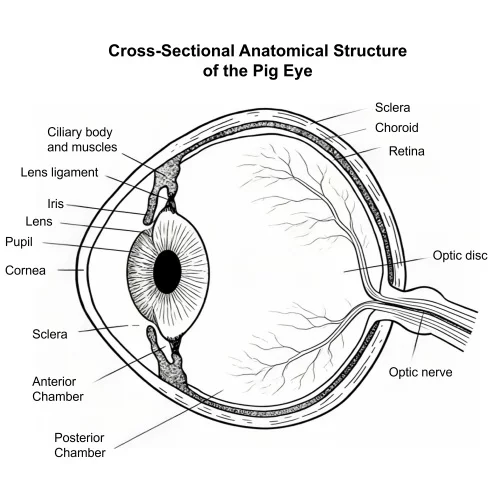
Physically, a pig’s eye is similar in size to a human eye (approx. 24mm), but there is a crucial difference: the pupil. Pigs have large, round pupils (5-11mm) that allow in significant amounts of light. This adaptation suggests that domestic pigs, like their wild boar ancestors, are not adapted to bright, direct sunlight.
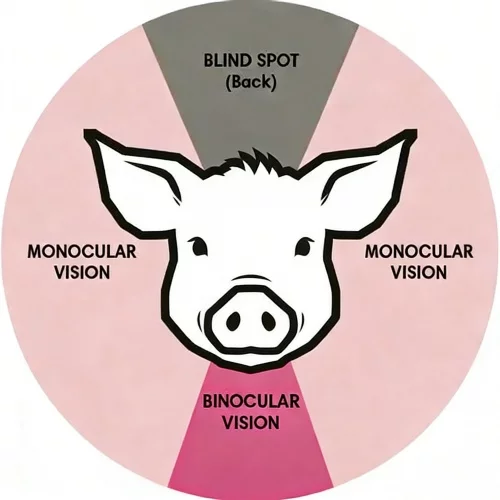
l Field of Vision: Pigs have a panoramic field of vision of about 310 degrees, allowing them to detect movement almost all around them. However, their binocular vision (where both eyes focus together) is narrow, only 35-50 degrees.
l Visual Acuity: Pigs are naturally near-sighted, with a visual acuity of about 1/6th that of humans. This means they rely heavily on lighting cues to navigate their environment safely.
The Visible Spectrum: Can Pigs See Red?
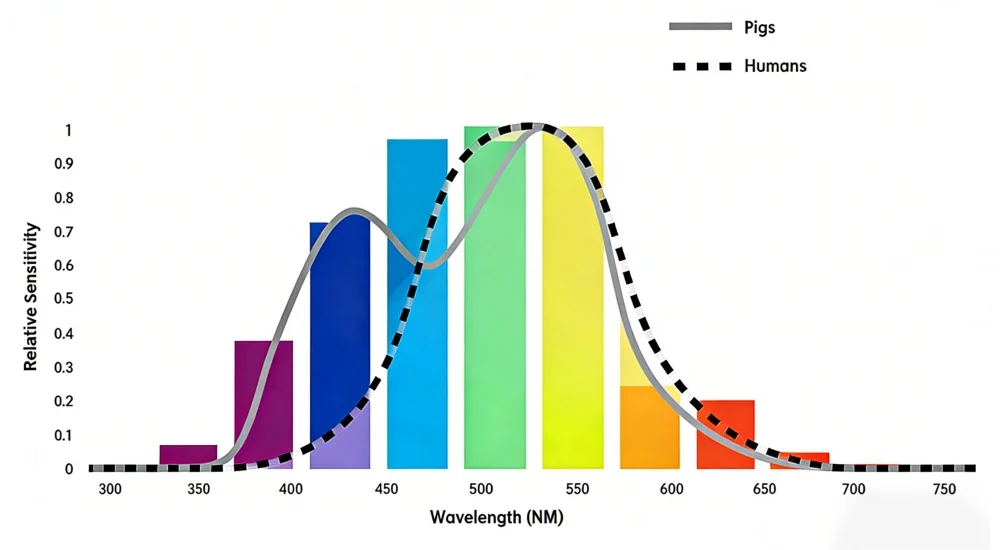
Humans are trichromatic (we see Red, Green, and Blue). Pigs are dichromatic. They have two types of cone cells in their eyes, with peak sensitivities at 439 nm (Blue) and 556 nm (Green-Yellow).

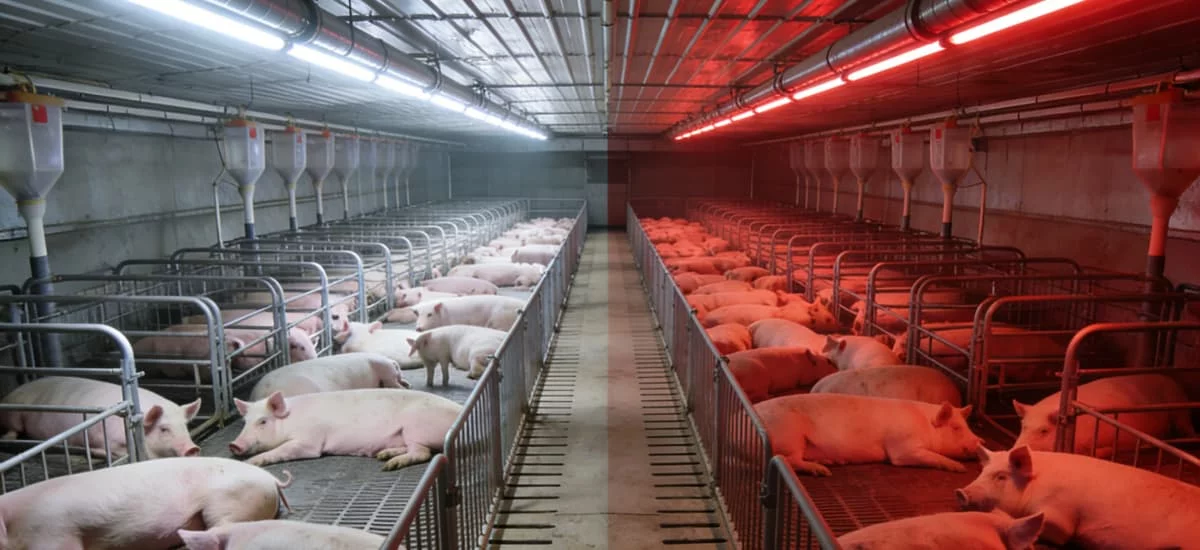
This means pigs are effectively red-green color blind. More importantly, pigs perceive red light as darkness. This biological quirk is a massive advantage for producers. By using specific red light spectrums during night hours, workers can inspect the barn, check feeders, or repair equipment without waking the animals or disrupting their melatonin cycles. To the pig, you are invisible; to you, the barn is visible.
Sensitivity to Flicker
Have you ever sat under a buzzing fluorescent light that gave you a headache? Pigs feel that same stress, but even more acutely.
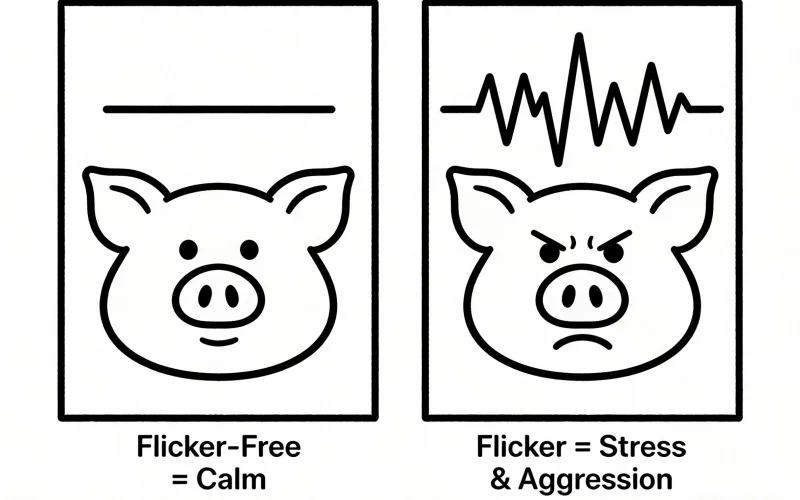
A light source that looks stable to humans may appear like a strobe light to a pig. This rapid flashing is called flicker. Since pigs recognize rapid movement as a threat, constant flickering can trigger chronic stress, leading to skittishness, headaches, and increased aggression (such as tail biting).
The Standard: For swine facilities, 100% Flicker-Free lighting is not a luxury; it is a necessity for animal welfare.

The Need for Light Uniformity
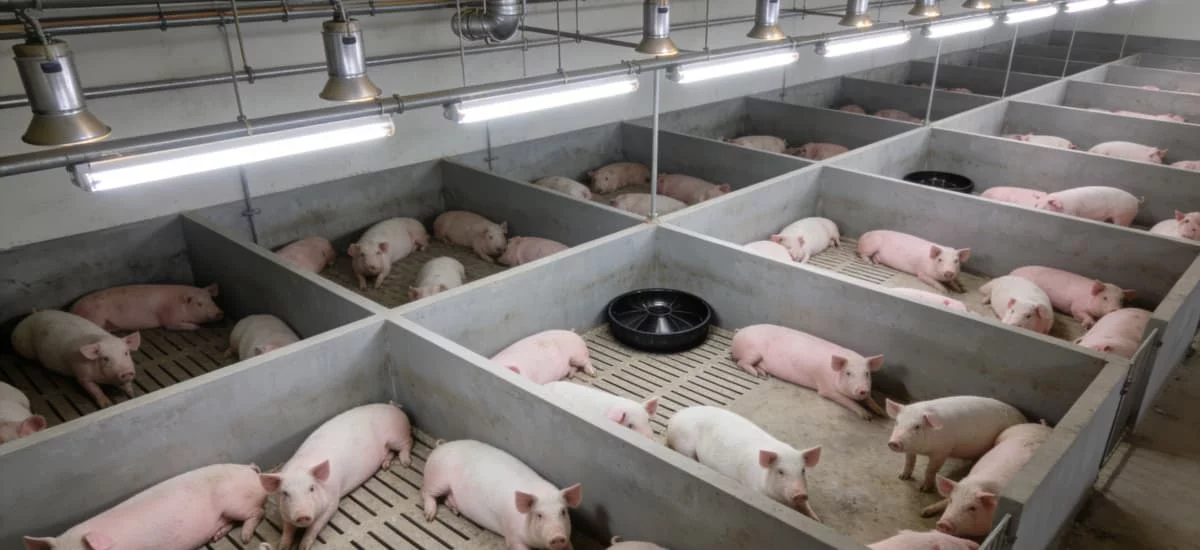
Because of their poor depth perception and wide monocular vision, pigs are notoriously fearful of high-contrast environments. Sharp shadows, bright spots on the floor, or painted black lines can look like physical barriers or holes in the ground to a pig.
This is why light uniformity is critical. A patchy lighting layout causes pigs to balk (refuse to move) when transferring between pens or loading onto trucks. A well-designed, uniform lighting plan eliminates these "phantom barriers," making animal handling smoother and faster.
The Science of Production: Controlling the Biological Clock
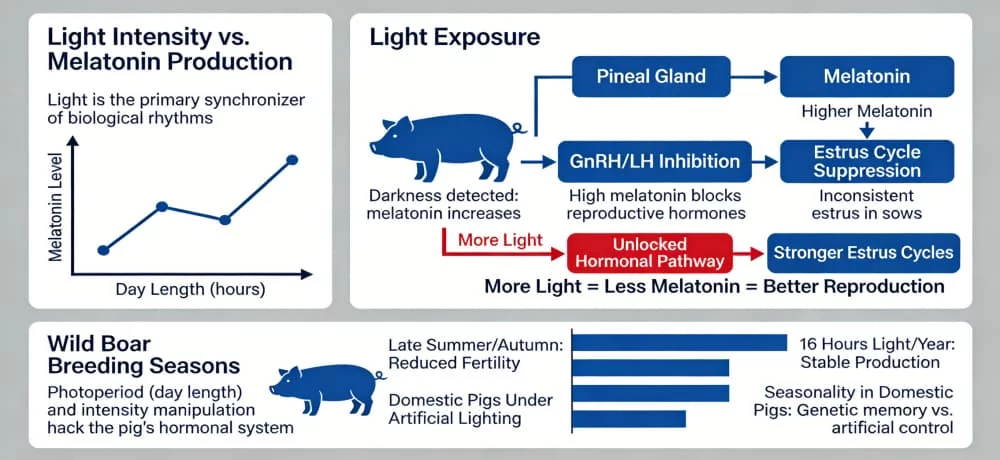
Light is the primary synchronizer of biological rhythms. By manipulating the photoperiod (day length) and intensity, producers can "hack" the pig's hormonal system to optimize reproduction and growth.

Melatonin and Reproduction
The link between light and fertility lies in a hormone called melatonin. When a pig's eyes detect darkness, the pineal gland releases melatonin, which signals the body to rest. However, high levels of melatonin can inhibit the release of GnRH (Gonadotropin-Releasing Hormone) and LH (Luteinizing Hormone)—the key drivers of the reproductive cycle.
By providing sufficient light intensity and extending the day length, we suppress melatonin production. This "unlocks" the hormonal pathway, stimulating follicle development in ovaries and promoting stronger, more consistent estrus cycles in sows. Simply put: More Light = Less Melatonin = Better Reproduction.
Seasonality in Domestic Pigs
Despite generations of domestication, modern pigs still carry the genetic memory of their wild ancestors. Wild boars are seasonal breeders, naturally becoming less fertile as days shorten in late summer and autumn to avoid farrowing in the harsh winter.
This "seasonal infertility" can cause a drop in farrowing rates on commercial farms. By implementing a consistent artificial lighting program (e.g., maintaining 16 hours of light year-round), producers can trick the sow's biological clock into thinking it is always spring—the peak season for fertility—thereby stabilizing production numbers throughout the year.
Lighting Recommendations by Production Stage
A "one-size-fits-all" approach does not work in swine production. Each stage of a pig's life requires a specific recipe of light intensity (Lux) and duration (Photoperiod) to maximize performance.
Breeding Gilts and Sows (Service Area)
This is the most critical zone for lighting investment.
Ø The Goal: Stimulate strong heat signs and reduce the wean-to-estrus interval.
Ø Recommendation: High intensity is non-negotiable here. Aim for 150-200 Lux at eye level for 16 hours a day.
Ø Pro Tip (High CRI): While pigs don't care about Color Rendering Index (CRI), your workers do. A high CRI light (>85) helps staff accurately detect the subtle redness and swelling of the vulva, ensuring timely insemination and higher conception rates.
Gestation Barns
Once pregnant, the priority shifts from stimulation to calmness and maintenance.
Ø The Goal: Stress reduction and environmental recognition.
Ø Recommendation: Maintain a photoperiod of 14-16 hours at a moderate intensity (50-70 Lux).
Ø Why: Adequate light allows sows to recognize their environment, locate feed and water easily, and identify pen-mates. This visual clarity reduces fear-based aggression and keeps the herd calm during gestation.

Farrowing Rooms
Light in the farrowing crate serves a dual purpose: stimulating the sow's milk production and guiding the piglets.
Ø The Goal: Maximize milk yield and piglet weaning weight.
Ø Recommendation: Implement a Long Day photoperiod (16-20 hours) with bright light (70+ Lux).
Ø The Science: Extended daylight stimulates suckling behavior in piglets. Studies have shown that a 16L:8D cycle can lead to a 20% increase in milk yield and significantly heavier litter weights at weaning compared to shorter days.

Nursery and Finishing
In the grow-finish phase, lighting focuses on feed conversion and behavior management.
Ø The Goal: Encourage early feed intake and minimize vices like tail biting.
Ø Recommendation: Provide 14 hours of light at approximately 80 Lux.
Ø Behavioral Insight: Pigs prefer to defecate in bright areas and rest in dim areas. Uniform lighting prevents dirty lying areas. Additionally, dimmable lighting is crucial here; if aggression breaks out, temporarily dimming the lights can help calm the herd (the "Dim-to-Calm" effect).

Boars (The Exception)
While sows thrive on long days, boars are the biological opposite.
Ø The Goal: Maximize libido, sperm count, and steroid production.
Ø Recommendation: Keep boars on a Short Day photoperiod (8-10 hours of light) with lower intensity.
Ø Why: Unlike females, male reproductive hormones (testosterone) are often boosted by shorter photoperiods. Keeping boars in a distinct, dimmer environment from the breeding sows can help maintain high semen quality.
The "Dim-to-Red" Strategy for Night Management
Modern livestock barn lighting is dynamic. Advanced LED systems now allow producers to implement the "Dim-to-Red" strategy, a method that aligns farm operations with the natural instincts of the pig.
Mimicking Sunrise and Sunset
In nature, the sun doesn't flip on like a switch. Sudden transitions from pitch black to 100% brightness can startle pigs, causing panic and increasing stress hormones (cortisol).
² The Strategy: Use programmable LEDs with ramping capabilities. By gradually brightening the lights over 15-30 minutes in the morning (simulating sunrise) and dimming them in the evening (sunset), you allow the animals to wake up and settle down naturally. This simple change promotes calmer behavior and easier handling.
Using Red Light for Night Inspections
Farm work doesn't stop when the sun goes down. Workers need to check heaters, repair feeders, or inspect sick animals at night. However, turning on the main white lights disrupts the herd's sleep cycle and melatonin production.
² The Solution: Since pigs are effectively red-blind, switching your system to a Red Light Mode at night renders the light invisible to them.
² The Benefit: To the pig, it is still dark, and they continue to sleep undisturbed. To the worker, the red spectrum provides sufficient visibility to navigate the barn and perform tasks safely. It’s the perfect compromise between operational needs and animal welfare.

Summer Night Feeding Tips
Heat stress is a major profit killer in finishing barns. When daytime temperatures soar, pigs lose their appetite, leading to stalled growth rates.
² The Pro Tip: Use your lighting system to shift the feeding window. By programming a "second day" or keeping lights at a lower intensity during the cool hours of the night, you encourage pigs to get up and eat when they feel most comfortable. This nocturnal feeding strategy can help maintain Average Daily Gain (ADG) even during the hottest months of the year.
Click here to check out our complete guide on the question: can pigs see green or red lights?
Choosing the Right Fixture: The Ammonia Challenge
You can have the perfect lighting plan, but if your fixtures fail within a year, it’s money wasted. The environment inside a pig barn is chemically aggressive, and standard lights are simply not built to survive it.
Why Standard LEDs Fail in Pig Barns
The culprit is Ammonia.
The manure in swine facilities generates high levels of ammonia gas. Most standard LED fixtures use lenses made of plastic (Polycarbonate or PMMA) and are sealed with silicone.
² The Failure Mode: Ammonia chemically attacks these materials. Over time, the plastic lenses turn cloudy, yellow, and brittle. Within 1-2 years, a fixture that started bright may lose 30-50% of its output due to this "ammonia fog," leaving your barn dark and your production potential unrealized.
The Ceramiclite FTC Advantage
This is where Ceramiclite changes the game. Our fixtures are engineered with Fluorescent Transparent Ceramic (FTC) technology, specifically for livestock environments.
l 100% Ammonia Resistance: Unlike plastic, ceramic is an inorganic material that is completely impervious to ammonia, acid, and sulfur. Our lenses stay crystal clear and maintain their original brightness for 10+ years, even in the harshest deep-pit barns.
l True Flicker-Free Dimming: Many LEDs start to flicker when dimmed low. Ceramiclite drivers are engineered to ensure 100% flicker-free performance across the entire dimming range—from 100% white down to deep red—protecting your herd from stress.
l Hygiene & Bio-Security: With an IP66+ rating, our seamless ceramic housing can withstand high-pressure washdowns and harsh disinfectants, ensuring your lighting system never compromises your bio-security protocols.
Conclusion
Lighting is no longer just a utility; it is a precision production tool. By mastering the three pillars of swine lighting—Spectrum (using red light for night), Intensity (bright for breeding/farrowing), and Photoperiod (long days for sows)—you can unlock the full genetic potential of your herd.
Don't let corroded, flickering lights hold your farm back. Upgrade to a lighting solution that understands biology and is built to last.
Ready to optimize your barn? Explore our Swine Lighting Solutions or Contact Us Today for a free custom lighting layout.