_thumb.jpg)
LED-Lagerbeleuchtung: Der vollständige Einkaufsratgeber
Inhaltsverzeichnis
Lösung Ihrer Beleuchtungsprobleme im Lager
Die unschlagbaren Vorteile der LED-Lagerbeleuchtung
Arten von LED-Leuchten für Lagerhallen
Wie wählt und plant man die LED-Beleuchtung für ein Lager?
Lösung Ihrer Beleuchtungsprobleme im Lager
Wer schon einmal in einem Lagerhaus mit alten Leuchtstoffröhren oder Natriumdampflampen gearbeitet hat, kennt die Frustration: dunkle Ecken, flackernde Röhren und Stromrechnungen, die einfach nicht sinken wollen. Schlechte Beleuchtung sieht nicht nur unschön aus, sie verlangsamt die Arbeit, führt zu Fehlern und kann sogar Sicherheitsrisiken bergen.
Deshalb rüsten viele Betriebe auf LED-Lagerbeleuchtung um – eine moderne, energiesparende Modernisierung, die einfach Sinn macht. Mit hellerem, gleichmäßigerem Licht und bis zu 70 % weniger Energieverbrauch verwandeln LEDs dunkle Räume in saubere, effiziente und produktive Arbeitsumgebungen.
Bei CeramicliteWir haben unzähligen Lagerhallen geholfen, veraltete Leuchten durch moderne LED-Systeme zu ersetzen, die sofortige Ergebnisse liefern: geringere Kosten, bessere Sichtverhältnisse und weniger Wartungsaufwand. Es geht nicht nur um neue Beleuchtung – es geht darum, Ihrer gesamten Anlage eine intelligentere Arbeitsgrundlage zu schaffen.
Deshalb setzen immer mehr Unternehmen auf LED – eine sicherere, sauberere und weitaus effizientere Beleuchtungslösung.
Die unschlagbaren Vorteile der LED-Lagerbeleuchtung
Die Modernisierung Ihrer Lagerbeleuchtung sorgt nicht nur für hellere Räume, sondern verändert die täglichen Arbeitsabläufe in Ihrem Betrieb grundlegend. Von deutlich reduzierten Energiekosten bis hin zu erhöhter Arbeitssicherheit – die Vorteile sind klar und messbar.
(1) Energie- und Kosteneinsparungen
Moderne LED-Systeme verbrauchen deutlich weniger Strom als herkömmliche Halogen- oder Leuchtstofflampen – in den meisten Fällen bis zu 70 % weniger Energie . Viele Unternehmen verzeichnen innerhalb des ersten Jahres eine Senkung ihrer gesamten Beleuchtungskosten um fast 60 % .
Und die Einsparungen beschränken sich nicht nur auf die Energiekosten. Eine geringere Wärmeabgabe bedeutet eine geringere Belastung Ihrer Kühlsysteme und sorgt so für zusätzliche Effizienz.
Energiesparen bedeutet nicht nur Kostensenkung, sondern auch, Budget für intelligentere Investitionen an anderer Stelle im Unternehmen freizusetzen .
(2) Sicherere, produktivere Arbeitsplätze
Bessere Beleuchtung bedeutet bessere Sicht. Eine klare, gleichmäßige Ausleuchtung hilft Mitarbeitern, Gefahren zu erkennen, Etiketten zu lesen und sich sicher in den Gängen zu bewegen – insbesondere in großen Lagerbereichen oder in der Nähe von Gabelstaplern.
Wenn Mitarbeiter gut sehen können, machen sie weniger Fehler und ermüden weniger schnell. Das Ergebnis? Weniger Unfälle, reibungslosere Arbeitsabläufe und eine messbare Produktivitätssteigerung.
(3) Geringer Wartungsaufwand, lange Lebensdauer
LED fixtures are built to last — over 50,000 hours on average. That’s years of continuous performance without the need for constant bulb changes or downtime for maintenance.
They’re also free of mercury and other pollutants, making them safer for your team and the environment. With fewer replacements and less waste, you save both time and labor while supporting sustainable practices.
Investing in high-quality industrial LED lighting turns your warehouse into a cleaner, safer, and more cost-efficient operation — one that’s built to perform reliably for years to come.
Types of Warehouse LED Fixtures
Every warehouse is different — ceiling heights, layouts, and work zones all require the right lighting design. Below is your quick guide to the main types of LED fixtures used in modern warehouses, along with where and why each one works best.
High Bay LED Lights
Best for: Ceilings above 20 feet (6 m) — common in large storage halls or manufacturing areas.
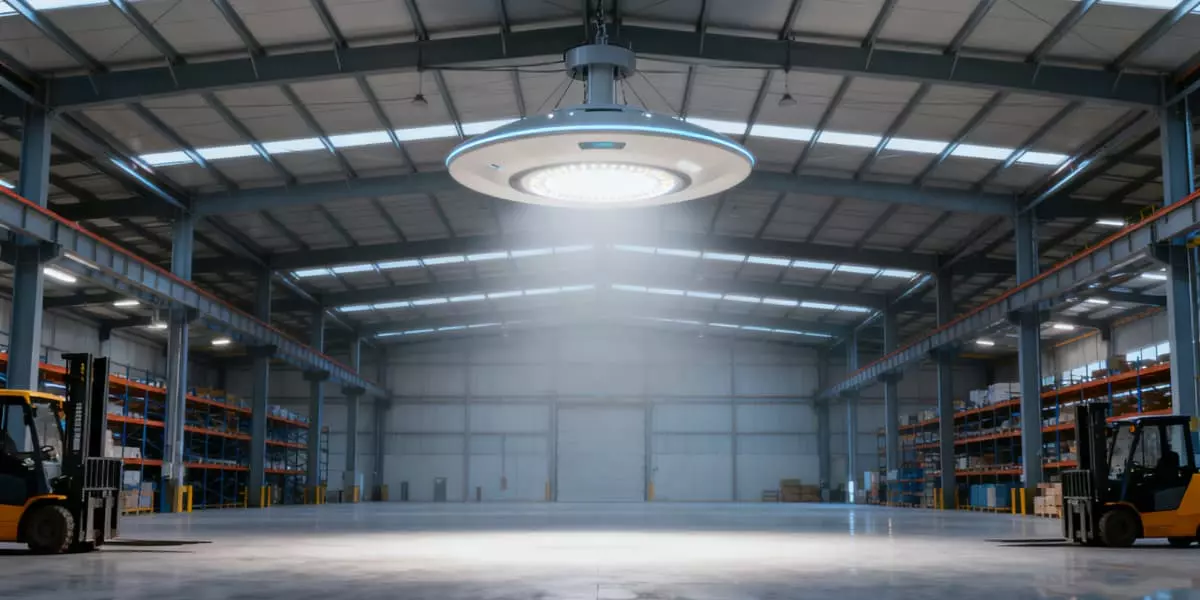
(1) Round High Bay Lights
Also known as UFO LED high bay lights, these are compact, powerful, and ideal for open spaces. Their circular beam spreads evenly across wide areas, providing bright, uniform illumination.
(2) Linear High Bay Lights
Shaped like long panels, they fit perfectly between warehouse racking. The linear beam pattern helps light up aisles evenly without glare or shadows.
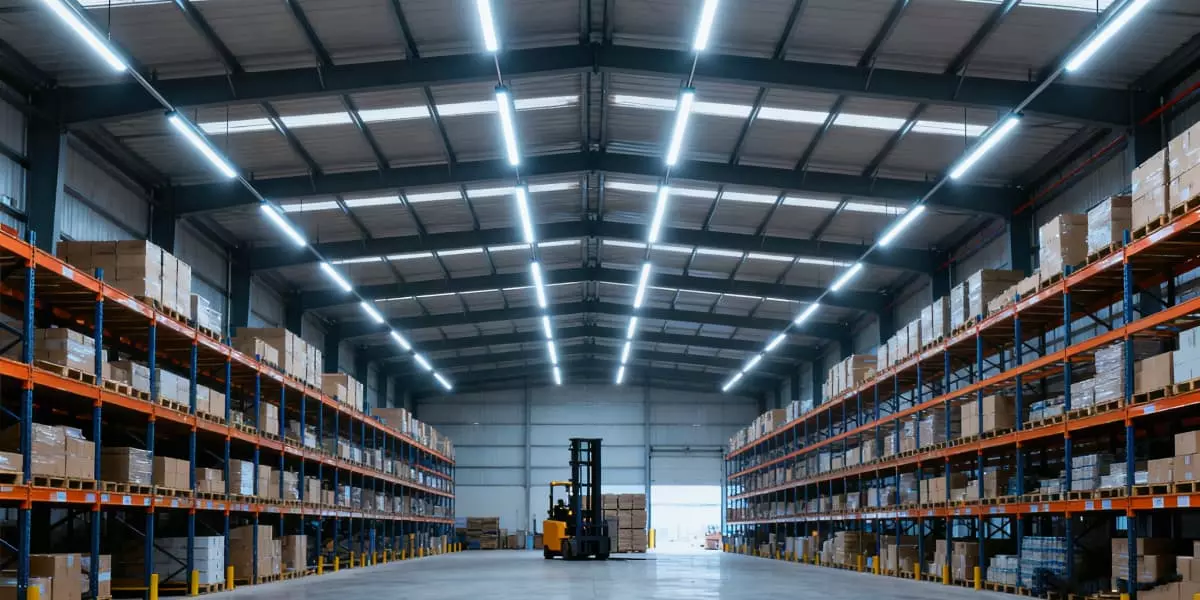
Typical mounting height: 20–40 ft (6–12 m) depending on lumen output.
Low Bay LED Lights
Best for: Ceilings below 20 feet (6 m), such as packing zones, workshops, or loading docks.
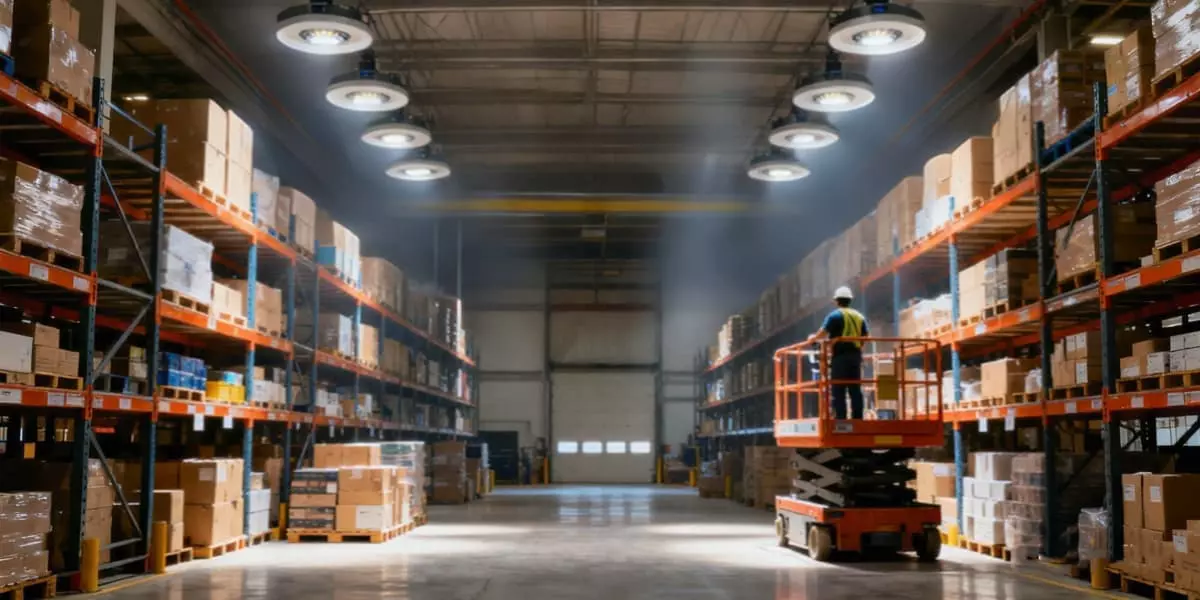
(1) Round Low Bay Lights
Compact and versatile, perfect for open workstations or areas that need broad light coverage.
(2) Linear Low Bay Lights
Slim, rectangular fixtures that create even light over tables and shelves — excellent for precision work or inspection zones.
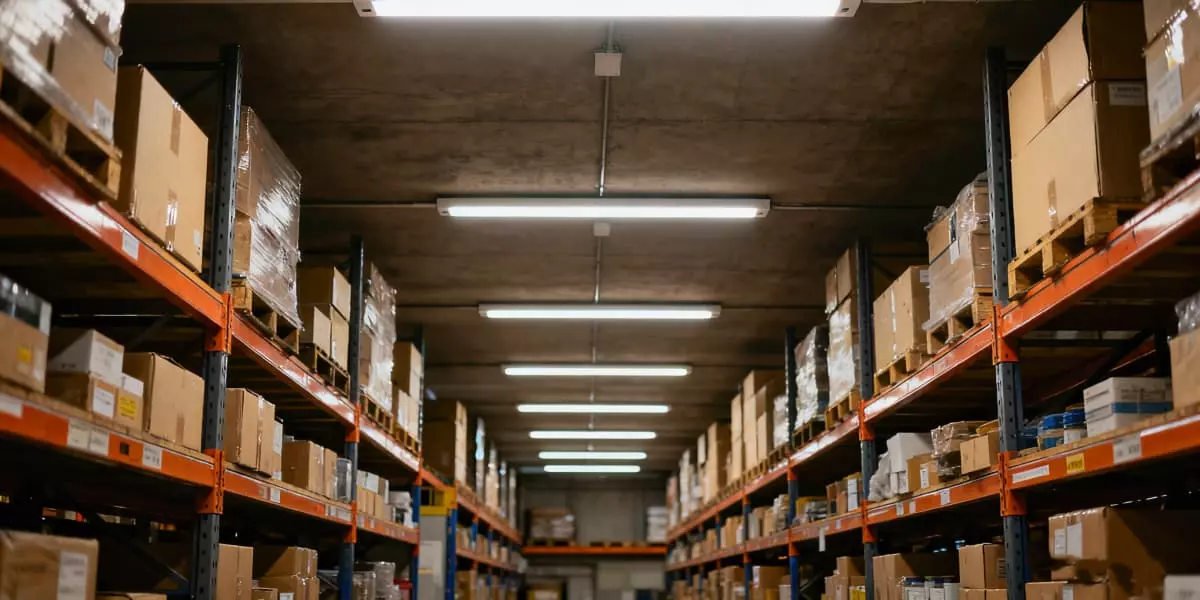
Typical mounting height: 10–20 ft (3–6 m) for balanced brightness and comfort.
LED Tube Lights
A direct upgrade from traditional fluorescent tubes. They’re ideal for corridors, small storage rooms, or maintenance areas.
Easy to install and energy-efficient, they offer consistent brightness without flickering or warm-up time.
Wall Packs
Used on interior or exterior walls, wall packs add extra visibility near entrances, exits, or loading docks. They enhance safety for both people and vehicles, especially in after-hours operations.
LED Emergency Lights & Exit Signs
These are essential safety fixtures that remain lit during power outages. They guide staff safely to exits and comply with fire and building codes.
Compact, durable, and battery-backed, they’re small but vital components of every warehouse lighting plan.
Choosing the right mix of fixtures ensures your facility is bright, compliant, and energy-efficient from floor to ceiling. Each type serves a purpose — together, they create a complete, reliable lighting ecosystem built for productivity and safety.
How to Choose & Plan Your LED Lighting for Warehouse?
Designing the right lighting system isn’t just about buying bright fixtures — it’s about balancing efficiency, safety, and visual comfort.
Here’s a simple, step-by-step guide to help you plan your warehouse LED lighting like a pro.
Step 1: Master the Key Specifications
1. Lumens, Not Watts
Forget watts — lumens measure actual light output.
A 100W LED light can produce 13,000–15,000 lumens, far brighter and more efficient than old metal halides.
Quick Lumen Reference Table:
Ceiling Height | Area Type | Recommended Lumens per Fixture |
10–15 ft | Packing / Sorting | 10,000–15,000 lm |
16–25 ft | Medium Storage | 16,000–20,000 lm |
26–35 ft | Large Warehouse | 22,000–30,000 lm |
36–45 ft | High Bay / Industrial | 30,000–40,000+ lm |
Rule of thumb: The higher the ceiling, the higher the lumens — but balance brightness to avoid glare.
2. Color Temperature (CCT)
Color temperature defines how “warm” or “cool” light feels:
4000K (Neutral White): Balanced brightness, ideal for general storage areas.
5000K (Cool White): Crisp daylight tone, improves alertness and visibility — perfect for logistics and production zones.
Most warehouses use 4000K–5000K for optimal performance.
3. Beam Angle
Think of the beam angle as how widely light spreads:
Narrow beam (60°–90°): Focused illumination for tall racks or spot lighting.
Wide beam (120°–150°): Broader coverage for open floor areas.
Visual tip: Narrow beams cut through high ceilings; wide beams fill large open spaces evenly.
4. CRI & IP Rating
CRI (Color Rendering Index): Aim for CRI ≥ 80 so workers can distinguish labels, wires, and products accurately.
IP Rating:
IP65 or higher for dusty or damp environments.
IP40–54 for clean indoor areas.
These specs ensure both color accuracy and fixture longevity.
Step 2: Plan Your Layout for Compliance & Efficiency
A well-planned layout ensures you meet safety standards and reduce energy waste.
1. Foot-Candles and Lux Explained
Foot-candle (fc): Light level measured in lumens per square foot.
Lux: Lumens per square meter. (1 fc ≈ 10.76 lux)
OSHA / Industry Recommendations:
Warehouse Area | Recommended Illumination |
Bulk Storage | 10–20 fc (≈100–200 lux) |
Active Aisles / Shelving | 20–50 fc (≈200–500 lux) |
Loading Docks | 30–50 fc |
Inspection / Workstations | 50–70 fc |
Meeting these levels helps you stay OSHA-compliant and ensures workers can operate safely.
2. The Calculation Guide
You don’t need advanced software — here’s a simple formula to estimate:
Number of Fixtures = (Area × Required Lux) ÷ (Fixture Lumens × Utilization Factor × Maintenance Factor)
For example:
Warehouse area: 1,000 m²
Required lux: 300
Fixture lumens: 20,000
Utilization × Maintenance = 0.8 × 0.9 = 0.72
Result: (1,000 × 300) ÷ (20,000 × 0.72) ≈ 21 fixtures
Or use a free online lighting calculator — many reliable ones allow you to input room size and mounting height for a quick estimate.
Step 3: Select the Right Mounting Option
Different ceiling heights and layouts call for different mounting styles.
Mounting Type | Ideal Ceiling Height | Best For | Advantages |
Direct Mount | 10–20 ft | Low bays / small warehouses | Sleek, space-saving |
Pendant Mount | 25–40 ft | High ceilings / open bays | Adjustable height, even coverage |
Chain Mount | 15–30 ft | Retrofit projects | Easy to install & maintain |
Hook Mount (UFO style) | 20–45 ft | Large industrial zones | Quick installation, flexible placement |
Tip: Use pendant or hook mounts for high ceilings, and direct mounts for tighter spaces where every inch matters.
✅ Pro Planning Checklist
Before you finalize your lighting plan:
 Measure your ceiling height & total area
Choose lumens & beam angles based on height
Match CCT to work zone type (4000K–5000K)
Check OSHA brightness levels (foot-candles)
Select mounting options for safety & ease
In short:
A smart lighting plan balances brightness, efficiency, and compliance.
Once you master the specs, layout, and mounting, your warehouse will not only look better — it’ll work better.
Conclusion
Switching to LED warehouse lighting isn’t just an upgrade — it’s a transformation.
It means better visibility, higher safety, lower energy bills, and a cleaner, more productive environment for everyone on the floor.
Modern LEDs have reshaped how warehouses operate.
From motion sensors that cut unnecessary power use to high-efficiency optics that reduce glare and improve accuracy — every detail now contributes to smarter, more sustainable operations.
If you’ve followed this guide, you now understand how to:
Choose the right lumen level and color temperature
Plan lighting layouts that meet OSHA standards
Pick mounting options that fit your ceiling height and workflow
Each of these steps helps you create a brighter, safer, and more cost-effective workspace.
Hope this guide has been helpful.
And if you’re ready to take the next step — why not start today?
Ready to transform your warehouse lighting and start saving?
Ceramiclite’s professional industrial lighting solutions are trusted by factories, fulfillment centers, and logistics hubs across Europe and the U.S.
Choose performance, reliability, and design expertise — choose Ceramiclite LED warehouse lighting.

Frequently Asked Questions
Q1: What is the best color temperature for warehouse lighting?
Most warehouses use 4000K to 5000K lighting.
4000K gives a neutral white tone suitable for general areas, while 5000K provides bright daylight-style light that enhances focus and visibility.
See the full explanation in Step 1: Color Temperature (CCT) above.
Q2: How many lights do I need for a 10,000 sq ft warehouse?
It depends on ceiling height, lumen output per fixture, and desired brightness level.
As a general rule, a 10,000 sq ft space typically needs 20–30 high bay fixtures rated around 20,000–25,000 lumens each to achieve proper visibility.
You can use an online lighting calculator or contact our team for a free layout plan.
Q3: Can I replace metal halide fixtures with LED?
Absolutely.
LEDs are direct replacements for metal halide, fluorescent, and HPS lamps — offering up to 70% energy savings and instant full brightness.
They also last 5–10 times longer, reducing both downtime and maintenance costs.
Q4: What’s the average ROI period for an LED warehouse lighting upgrade?
Most facilities see a return on investment within 12 to 18 months through energy savings and lower maintenance.
With rebates and long lifespans, LEDs continue to save money for years beyond that.
Q5: How do I dispose of old warehouse lighting fixtures?
If you’re replacing fluorescent or metal halide lamps, don’t throw them in regular trash — they often contain mercury or other hazardous materials.
Contact a local recycling center or hazardous waste facility for proper disposal.
LEDs, by contrast, are mercury-free and environmentally safe to recycle.
Q6: Do LED lights work well in cold warehouse environments?
Yes.
LEDs actually perform better in cold temperatures, making them perfect for cold storage or refrigerated facilities where traditional lights struggle to start or dim.
Q7: Are LED warehouse lights dimmable or motion-sensor compatible?
Most modern LED fixtures support 0–10V dimming and can be paired with motion or daylight sensors for automatic control.
This helps save even more on energy while maintaining consistent light levels.
If you have more questions or need help planning your upgrade, our lighting experts are happy to assist.
Kontaktieren Sie Ceramiclite für eine kostenlose Beratung und ein individuelles Beleuchtungskonzept für Ihr Lager.