_thumb.jpg)
Athletic Field Lighting Full Guide 2026
Table of Contents
The Business Case: Why Upgrade Now?
Compliance Report: IES vs. EN Standards
Key Features of High-Performance Systems
5 Steps to Choose the Right Manufacturer
Frequently Asked Questions (FAQ)
Conclusion: Ready for the Switch?
Introduction
Managing a sports facility often feels like a constant battle against rising utility bills and flickering metal halide bulbs. For decades, traditional lighting has drained operational budgets through inefficiency and frequent, costly maintenance cycles. However, the technological landscape has shifted.
Modern athletic field lighting is no longer just about visibility; it is the precise balance of energy management, visual performance, and environmental compliance.
If you are planning a retrofit for 2026, guessing is not an option. Whether you manage a high school stadium in the US or a community pitch in Europe, this guide serves as your technical blueprint.
Below, we break down the critical differences between IES and EN compliance standards, provide actionable market data, and show you exactly how to calculate the ROI of switching to LED—ensuring your project is both safe and profitable.
The Business Case: Why Upgrade Now?
The decision to upgrade your facility’s lighting is rarely about aesthetics alone; it is a financial imperative. In 2026, the gap between legacy technology and modern solutions has widened significantly, making the "wait and see" approach a costly mistake.
Drastic Energy Cost Reduction
The most immediate impact of switching to LED athletic field lighting is on your bottom line. Facilities switching from HID (High-Intensity Discharge) to LED typically experience 50% to 75% energy savings. For a standard football field or tennis complex operating hundreds of hours annually, this efficiency translates into thousands of dollars returned to your budget every year.
Eliminating the Maintenance Nightmare
Maintenance is the silent budget killer. Traditional metal halide lamps degrade rapidly, suffering from significant lumen depreciation and requiring replacement roughly every 10,000 hours. In contrast, high-quality LED systems—particularly those utilizing advanced ceramic heat dissipation technology—are engineered to last 50,000+ hours. This longevity virtually eliminates the recurring costs of replacement bulbs and expensive boom lift rentals.
Operational Flexibility: Instant On/Off
Old systems hold your schedule hostage with 15-minute warm-up and cool-down periods. Modern LED solutions offer instant on/off capabilities. This feature allows facility managers to maximize field usage, instantly lighting up for an event or darkening the field for security without any energy-wasting wait times.
Compliance Report: IES vs. EN Standards
Installing athletic field lighting without consulting the relevant standards is a liability risk. Whether you are upgrading a local high school pitch or a professional stadium, the lighting levels must meet specific criteria to ensure player safety and spectator visibility.
In the United States, the Illuminating Engineering Society (IES) sets the benchmark with standard RP-6-20. In Europe, the standard is governed by EN 12193. While both aim to achieve similar safety outcomes, the metrics and classifications differ slightly. Understanding where your facility fits within these "Classes" is the first step to avoiding over-specifying (wasting budget) or under-specifying (creating hazards) your project.
Refer to the comparison matrix below to identify the requirements for your specific region and facility level:
Feature | USA (IES RP-6-20) | Europe (EN 12193) | Insight |
Measurement | Foot-Candles (fc) | Lux (lx) | 1 fc ≈ 10.76 lx |
Class I (Pro) | > 75 - 100 fc | > 750 lx | Required for televised events & large spectators capacities. |
Class II (College) | 50 fc | > 500 lx | Key for competition safety and collegiate play. |
Class III (HS/Club) | 30 fc | > 200 lx | The standard for high school competition and training. |
Uniformity (Min/Avg) | 0.5 ratio | 0.5 - 0.7 ratio | Prevents dangerous "zebra stripes" or shadows on the field. |
Glare (GR) | < 50 | < 50 | Crucial for player comfort and visual tracking of the ball. |
Global Market Insight: While US and EU standards focus heavily on light levels and glare, trends in Southeast Asia are increasingly prioritizing high IP ratings and corrosion resistance. Due to high humidity and intense heat in these regions, facility managers are mandating stricter energy efficiency (ROI) calculations and weather-proofing beyond the standard IP65.
Key Features of High-Performance Systems
When evaluating proposals for athletic field lighting, it is critical to look beyond basic wattage and lumen counts. While standard LED technology currently dominates the market, high-power sports applications often push these conventional fixtures to their breaking point. The intense heat generated by 500W+ fixtures can cause standard materials to degrade.
To ensure a true 10-year+ lifespan, facility managers are now turning to Advanced Ceramic LED Technology. Unlike standard LEDs that rely on organic materials (which age and decay), advanced systems utilize Fluorescent Transparent Ceramics (FTC) to withstand harsh environments.
Here is how standard market technology compares to the high-performance ceramic standard:
Feature | Standard LED Technology | Advanced Ceramic LED (FTC) | Why it Matters? |
Encapsulation Material | Silicone / Epoxy Resin. (Organic) | Fluorescent Transparent Ceramics. (Inorganic) | Silicone turns yellow and cracks over time due to heat, reducing light output. Ceramics do not age, ensuring permanent clarity. |
Thermal Management | Aluminum PCB. | Ceramic Body / Eutectic Bonding. | Aluminum is prone to corrosion and thermal bottlenecks. Ceramics offer superior heat dissipation and are chemically stable. |
Corrosion Resistance | Moderate (Coating dependent). | High (Native Material). | Critical for coastal or humid areas. Ceramics are naturally impervious to salt, moisture, and acids. |
Lumen Maintenance | Drops significantly after 10k hours. | Ultra-Low Decay. | FTC technology prevents the "browning" effect, maintaining near-original brightness for 50,000+ hours. |
The "FTC" Advantage: Solving the Heat Problem
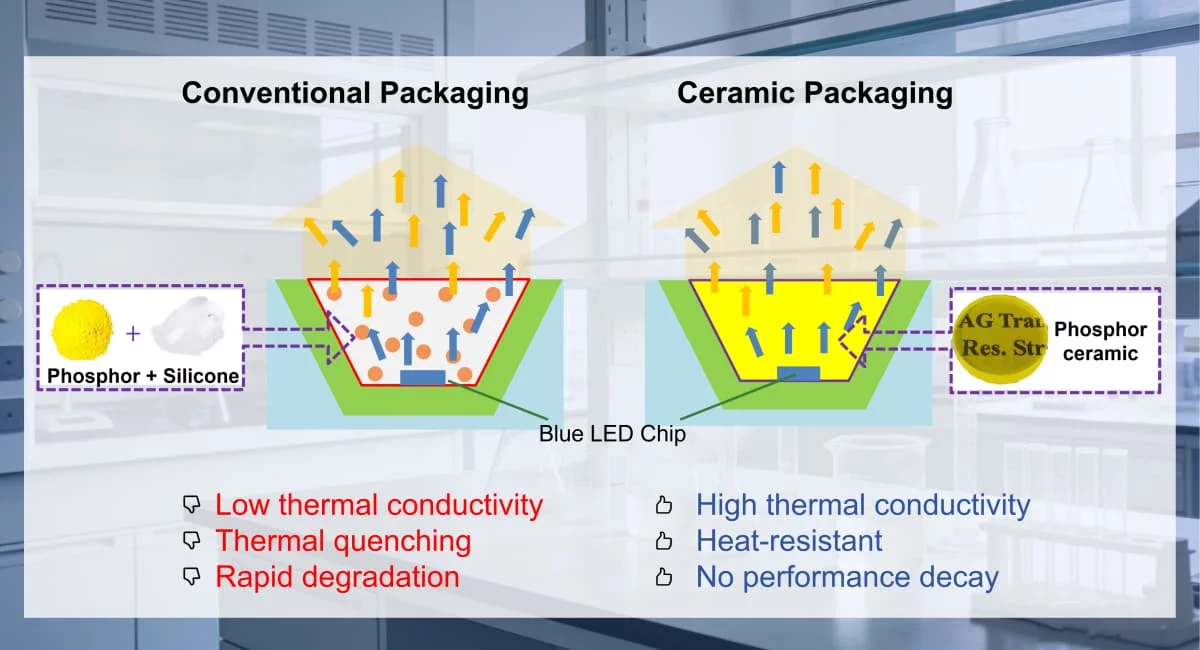
The weakest link in standard high-power LEDs is the silicone glue used to bind the phosphor. Under the intense heat of athletic field lighting, this silicone darkens (carbonizes), blocking light and altering color temperature.
Ceramiclite solves this by replacing the silicone with Fluorescent Transparent Ceramics (FTC). This is a solid, inorganic phosphor ceramic plate. It is immune to heat degradation, moisture, and chemical corrosion.
By adopting this aerospace-grade material, the lighting system achieves a level of durability and thermal stability that traditional plastic-encapsulated LEDs simply cannot match.
Common Applications & Users
High-quality athletic field lighting is not a one-size-fits-all solution. Different facilities face unique challenges, ranging from strict neighborhood light pollution laws to high-definition broadcasting requirements. Our solutions are engineered to meet the distinct needs of the following sectors:
K-12 Schools & Universities: These institutions often operate on tight public budgets. The priority here is balancing cost-efficiency with student safety and durability, ensuring the lights last for decades without burdening the maintenance staff.
Municipal Parks & Rec: Planners in urban areas are heavily focused on "Dark Sky" compliance. The goal is to illuminate the field brightly while ensuring zero light spill into adjacent residential backyards or roadways.
Professional Stadiums: For televised events, lighting must be flicker-free to support slow-motion replays. High CRI and uniformity are non-negotiable for broadcast quality.
Commercial Sports Complexes: For private academies and rental fields, the focus is ROI. With long operating hours every night, these businesses require ultra-low energy consumption to maximize profit margins.
5 Steps to Choose the Right Manufacturer
Selecting a lighting partner is a 10-year commitment. To avoid costly retrofits or compliance failures, use this checklist to vet potential suppliers.
1.Demand a Free Photometric Plan (Non-Negotiable)
Never buy fixtures based on wattage alone. A professional supplier must provide a computer-simulated photometric study (using software like AGi32) tailored to your field’s specific dimensions. This blueprint proves that the design will meet IES/EN light levels and uniformity standards before you spend a dime. If they don't offer this, walk away.
2.Scutinize the Heat Dissipation Technology
Heat is the primary cause of LED failure. In high-power applications (500W+), traditional aluminum heat sinks can become heat saturated and vulnerable to corrosion. Look for manufacturers utilizing advanced ceramic technology. Because ceramic is non-conductive and chemically stable, it handles thermal stress far better than aluminum, ensuring the light output doesn't degrade rapidly in the first few years.
3.Verify Essential Certifications
Ensure the fixtures carry the correct stamps for your region. In the USA, look for UL (safety) and DLC Premium (required to qualify for utility rebates). In Europe and Southeast Asia, CE and RoHS are mandatory. These certifications validate the safety and efficiency claims of the product.
4.Check Warranty Transparency
Read the fine print. Does the warranty cover the entire fixture, or just the LED chips? A trustworthy warranty (typically 5-10 years) should cover the driver, the housing, and the light source. Beware of warranties that exclude labor or shipping for replacement parts.
5.Ensure Control System Compatibility
Modern sports lighting should be "smart." Verify that the fixtures are compatible with standard control protocols like DALI, Zigbee, or 0-10V dimming. This allows you to integrate the lights into a centralized building management system, enabling zoning, scheduling, and instant dimming capabilities.
Frequently Asked Questions (FAQ)
Here are the most common questions facility managers ask when upgrading their athletic field lighting.
Q: How many lumens do I need for a standard football field?
A: There is no single answer—it depends entirely on your Class (level of play). For a Class III high school field requiring 30-50 foot-candles (fc), you typically need between 400,000 and 600,000 total lumens. However, placement matters more than raw power; a photometric plan is required to ensure those lumens actually reach the field evenly.
Q: How much does it cost to install athletic field lighting?
A: A complete retrofit usually falls between $40,000 and $100,000, depending on whether you are replacing just the fixtures or the poles as well. While the upfront cost is significant, switching to LED eliminates ballasts and bulb replacements, often paying for itself in maintenance and energy savings within 3-5 years.
Q: Can I retrofit existing poles with new LED fixtures?
A: Generally, yes. Modern LED fixtures are often lighter and have a smaller wind profile (EPA) than old metal halide boxes. However, you must perform a structural wind load calculation to ensure the existing poles can safely handle the new setup, especially in high-wind regions.
Q: What is the best color temperature for sports lighting?
A: The industry standard is 5000K to 5700K. This "Daylight" white color provides the best contrast for players to track high-speed balls and keeps athletes alert. It is also the preferred standard for broadcasting cameras.
Q: How do I prevent light pollution in residential areas?
A: The key is optical control. High-quality fixtures use asymmetric lenses and external shields (visors) to "cut off" the light, directing it strictly onto the field. This minimizes "sky glow" and prevents light trespass into neighboring windows, keeping your facility compliant with local Dark Sky ordinances.
Conclusion: Ready for the Switch?
Upgrading your facility is a significant investment, but the data is clear: switching to LED offers an unbeatable return on investment through energy savings and reduced maintenance. However, simply buying "bright lights" is not enough. You need a system that withstands the elements, meets IES/EN compliance standards, and utilizes advanced ceramic technology to prevent heat degradation.
Stop estimating and start planning with precision.
Don't guess your layout. Contact Ceramiclite today for a FREE Photometric Study and see exactly how much you will save on your next project.
