_thumb.jpg)
LED Tennis Court Lights: Improve Visibility and Reduce Costs
Table of Contents
Tennis Court Size and Lighting Dimensions
Why Upgrade to LED Tennis Court Lights?
Understanding Light Quality: What Matters?
How Long Do LED Tennis Court Lights Last?
LED Tennis Court Lighting Cost & ROI
Installation & Retrofit Tips for LED Lights
Introduction
For a sport as fast-paced as tennis, lighting isn't just a utility—it is a piece of equipment as vital as the racket itself. A single flicker, dark spot, or moment of glare can ruin a match point.
As the global standard shifts, LED tennis court lights have become the undisputed choice for modern facilities. But switching to LED is not just about making things brighter; it is about solving specific financial and operational problems for your facility.
Whether you manage a private academy, a public park, or a home court, the impact of an upgrade is immediate:
l For Tennis Club Owners (ROI & Prestige): Cut your electricity bills by 50-70% instantly. High-quality lighting lowers overhead while attracting new members with professional, "broadcast-quality" visibility.
l For Municipal Managers (Safety & Low Maintenance): Stop renting bucket trucks every two years. With LEDs lasting over 50,000 hours, you ensure public safety and eliminate the costly hassle of frequent replacements.
l For Avid Players (Performance): It is about the experience. Modern LEDs deliver consistent, daylight-quality light (5000K), allowing players to track ball spin instantly without being blinded by glare.
In this guide, we will walk you through everything you need to know about LED lighting for outdoor tennis courts—from critical court dimensions and cost breakdowns to selecting the right anti-glare features for your budget.
Tennis Court Size and Lighting Dimensions
Before you can select the right wattage or beam angle for your LED tennis court lights, you must define the exact area that needs illumination. A common mistake is calculating lighting only for the court lines, ignoring the critical run-back areas where players move during active play.
To ensure safety and playability, your lighting plan must cover the entire “Total Playing Area.” Here are the standard dimensions you need to know:
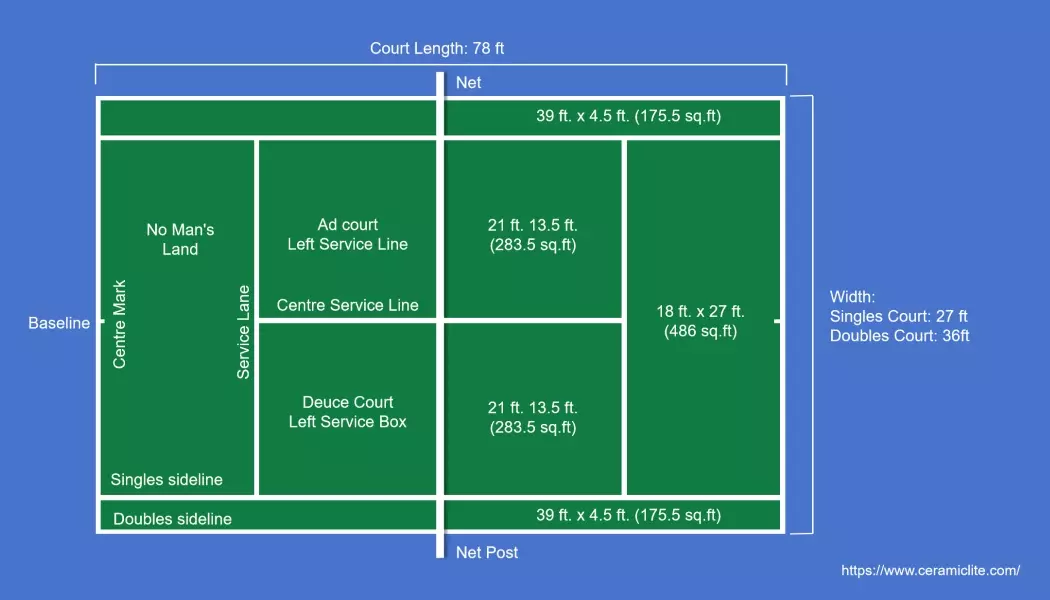
Standard Tennis Court Dimensions
l Singles Court: 78 ft long x 27 ft wide (23.77m x 8.23m)
l Doubles Court: 78 ft long x 36 ft wide (23.77m x 10.97m)
Total Lit Area (The Most Important Metric)
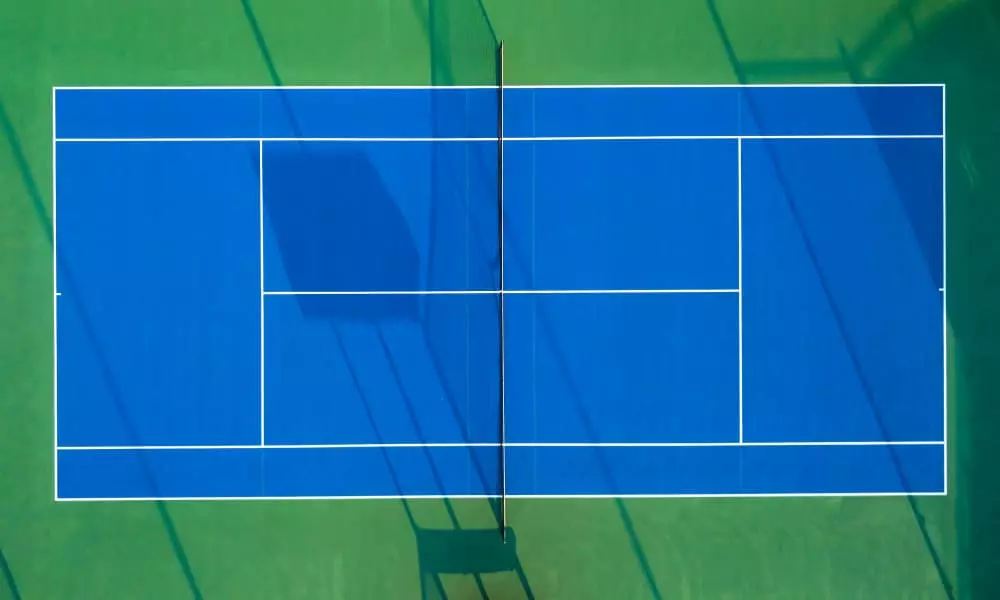
Lighting designs should not stop at the doubles alley. You must illuminate the area extending to the fence to allow players to chase down deep lobs and wide serves safely.
Standard Recreational Court (Fence-to-Fence): 120 ft x 60 ft (36.57m x 18.29m)
Pro Tip: For tournament-level facilities, the run-back area may be even larger to meet ITF (International Tennis Federation) standards. Always measure your specific fence-to-fence distance before ordering a lighting simulation.
How Pole Height Affects Your Lighting Choice?
The dimensions of your court are directly tied to the height of your light poles. The mounting height determines the number of fixtures you need and the required beam angle to achieve uniform light distribution.
Standard Residential/Club Height: 20 ft – 22 ft
Challenge: Lower poles can create more glare if not angled correctly. You may need specialized "flat" optics to push light across the court without blinding players.
Standard Competition Height: 27 ft – 33 ft (and higher)
Benefit: Higher poles generally offer better uniformity. However, they require fixtures with higher lumen output to ensure enough light reaches the ground.
Understanding these physical constraints is the first step. Once you know your coverage area (typically 7,200 sq. ft. per court) and your pole height, you can determine exactly how much power is needed to turn night into day.
Why Upgrade to LED Tennis Court Lights?
If you are still relying on traditional Metal Halide (MH) or High-Pressure Sodium (HPS) lamps, you are likely dealing with rising maintenance costs, uneven lighting, and frustrated players. Switching to LED lighting for outdoor tennis courts isn't just a modernization trend—it is a strategic financial and operational upgrade.
Here is why facility managers and homeowners are rushing to retrofit their old systems to LED:
1. Drastic Energy Savings (50–70% Reduction)
The most immediate impact of an upgrade is on your bottom line. A standard 1,000-watt Metal Halide fixture actually consumes about 1,100 watts when you account for the ballast. In contrast, a high-performance LED fixture can deliver superior brightness using only 300 to 450 watts.
This translates to an energy reduction of 50% to 70%. For a club running lights 4-5 hours a night, this difference can save thousands of dollars annually in electricity alone.
Read More: If you are debating whether the investment is worth it, read our detailed breakdown on Should I Upgrade My Tennis Court Lights to LED?
2. Instant On/Off Technology
Old-school lighting requires patience. Metal Halide lamps take 15 to 20 minutes to warm up to full brightness. If a storm passes through or a breaker trips, you are forced to wait for a "cool-down" period before you can turn them back on.
LEDs are a game-changer here. They offer instant on/off capabilities with zero warm-up time. This means you can turn the lights off between matches to save money and flip them back on the second players step onto the court.
3. Superior Visibility and Ball Tracking
Have you ever struggled to track a fast-moving ball under the dim, orange glow of old street-light style lamps? That is due to a low Color Rendering Index (CRI).
Modern LEDs offer a high CRI (>70 or >80) and a color temperature typically around 5,000K (Daylight White). This crisp, white light makes the optic yellow of the tennis ball "pop" against the blue or green court surface. This improved contrast allows players to react faster and play with greater confidence.
By choosing to retrofit to LED, you aren't just buying lights; you are buying a better game and a smaller electric bill.
Understanding Light Quality: What Matters?
When selecting tennis court LED lighting, many buyers make the mistake of looking only at the wattage. However, a 500-watt fixture from one brand might perform drastically differently than a 500-watt fixture from another. To ensure a professional playing environment, you need to look beyond the power consumption and focus on the photometric performance.
Here are the four technical metrics that define high-quality tennis court lights LED systems:
1. Brightness Levels (Lux vs. Foot-candles)
How bright should your court be? The answer depends on who is playing. The standard measurement for illuminance is Lux (or Foot-candles in the US).
l Class III (Recreational & Residential): 200–300 Lux. Sufficient for casual play, pickleball, and backyard courts.
l Class II (Club & Training): 300–500 Lux. The standard for tennis clubs, high school teams, and commercial facilities.
l Class I (National & International Competition): 500–750+ Lux. Required for televised events and professional tournaments to capture high-speed action.
2. Uniformity Ratio (The Hidden Metric)
Brightness means nothing if it is uneven. Imagine trying to hit a ball that flies from a bright patch into a shadow—your depth perception fails immediately.
Uniformity is the ratio of the minimum light level to the average light level across the court. High-quality LED systems aim for a uniformity ratio of 0.6 to 0.7 or higher. This ensures there are no "hot spots" in the center or dark zones in the corners, providing a consistent canvas for the game.
Expert Advice: Achieving the perfect uniformity requires a professional simulation. Learn more in our guide: How to Design Your Tennis Court Lighting?
3. Color Temperature (CCT)
For sports lighting, the color of the light affects player energy and visual acuity. We strongly recommend 5000K to 5700K (Cool White).
Unlike the yellowish hue of older sodium lights (3000K), cool white light mimics natural daylight. This specific spectrum is proven to increase contrast, making it easier for the human eye to separate the yellow ball from the court surface instantly.
4. Glare Control and Asymmetric Optics
Tennis is unique because players frequently look directly up into the lights during serves and overhead smashes. Standard floodlights can cause blinding glare, temporarily blinding the player.
Top-tier tennis court LED lighting utilizes Asymmetric Optics and specialized lenses. These designs direct the light beam forward and down onto the court surface with a sharp cutoff, preventing light leakage. This protects players' eyes and keeps peace with neighbors by minimizing light pollution (spill light) outside the fence.
How Long Do LED Tennis Court Lights Last?
One of the most common questions facility managers ask us is: How long do LED tennis court lights last?
The short answer is: a very long time. When you install professional-grade LED fixtures, you are looking at an operational lifespan of 50,000 to 100,000+ hours.
To put that into perspective, even if you run your court lights for 12 hours every single day—typical for a busy commercial facility—a 50,000-hour LED fixture would still last for over 11 years without needing a single replacement.
The "L70" Standard: Understanding Lifespan
Unlike traditional bulbs that "burn out" or pop suddenly, LEDs fade very slowly over time. In the lighting industry, we use the L70 rating to measure this.
An L70 rating of 50,000 hours means that after 50,000 hours of use, the light will still be emitting 70% of its original brightness. It doesn't stop working; it just gradually becomes less intense. This is a massive improvement over Metal Halide bulbs, which can lose 40-50% of their brightness within just the first two years (approx. 5,000 hours) of use.
However, at Ceramiclite, we hold our sports lighting solutions to a much higher standard - L80/L90 rating.
Our specific sports lights product lines are tested to maintain near-original brightness for decades:
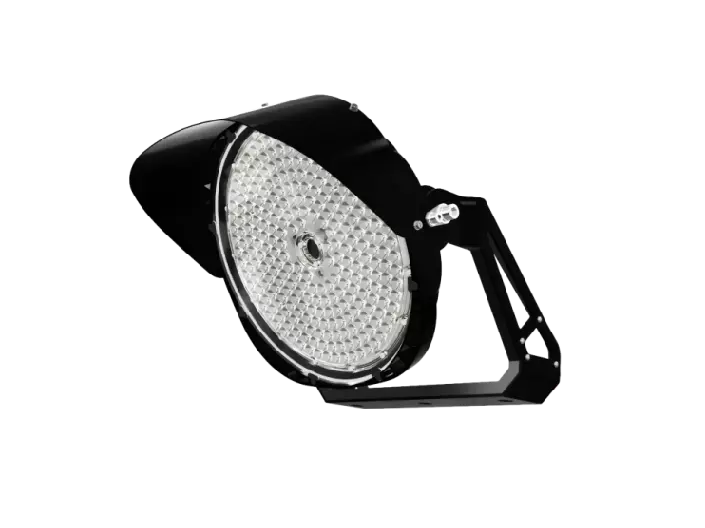
SL03 & SL04 Series: These premium fixtures feature an L90 rating at 51,000 hours (@45°C).
What this means for you: After 51,000 hours of operation in high heat, our lights retain 90% of their original brightness. While other courts are getting dim, yours will look as bright as day one.
| SL03 Series | SL04 Series |
|
|
|
|
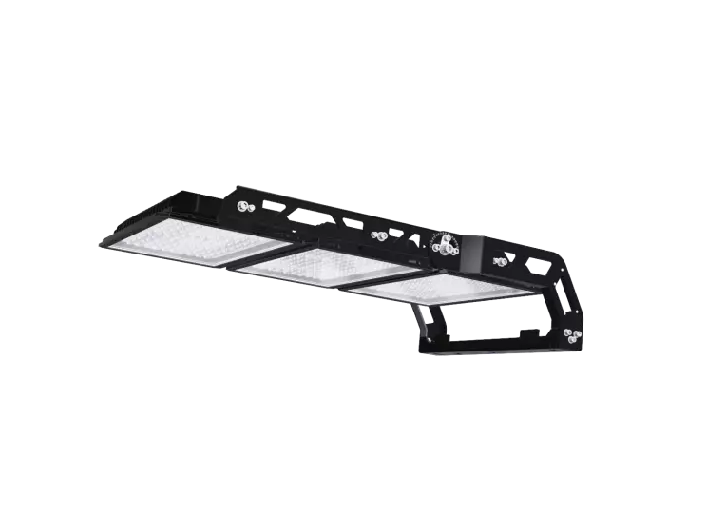


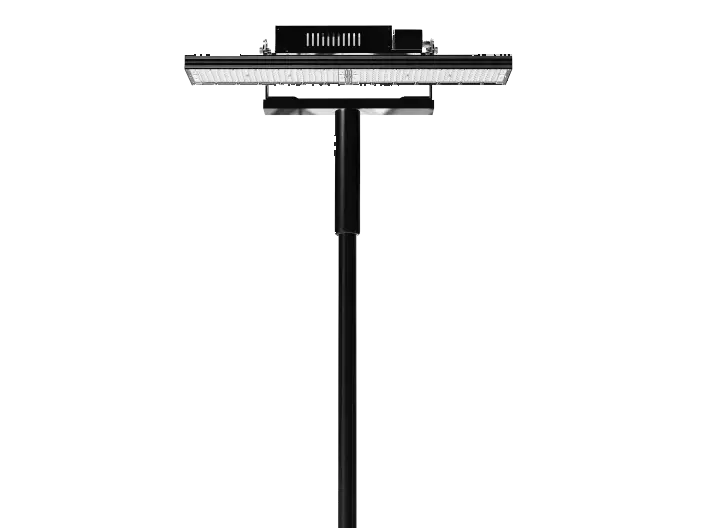
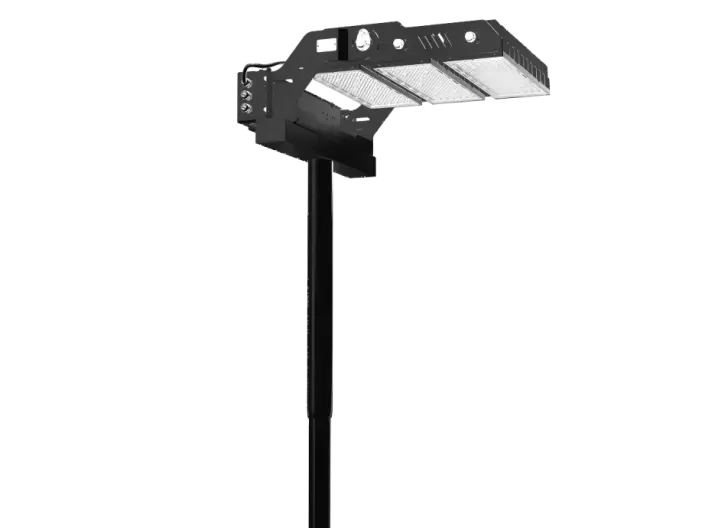
SL05 & SL06 Series: Designed for maximum longevity, these achieve an L80 rating at 102,000 hours.
| SL05 Series | SL06 Series |
 |  |
|
|
Say Goodbye to Maintenance Headaches
The true value of this longevity isn't just in the bulb itself—it's in the maintenance savings.
Replacing a tennis court light isn't as simple as changing a lightbulb in your living room. It requires renting a heavy-duty bucket truck or lift, hiring a specialized electrician, and shutting down the court for maintenance.
With LED tennis court lights, you eliminate these recurring costs. Once installed, they are virtually maintenance-free for decades, giving you peace of mind and keeping your courts open for play, not closed for repairs.
LED Tennis Court Lighting Cost & ROI
When considering an upgrade, the first question on every facility manager's mind is: How much will this cost?
It is important to be transparent: the upfront LED tennis court lighting cost is higher than buying traditional replacement bulbs. However, viewing this strictly as an expense is a mistake; it is a capital investment that pays for itself through operational savings.
Here is a breakdown of where your money goes and how fast it comes back.
Fixture Costs
The price of professional-grade LED fixtures typically ranges from $400 to $1,500 per fixture. Why is the range so wide?
l Lower End (400−600): Often generic floodlights. While cheap, they may lack specific tennis optics (causing glare) and have shorter warranties.
l Higher End (800−1,500): Professional sports lighting (like our SL Series). These include specialized asymmetric lenses to reduce light spill, high-durability drivers, and 10-year lifespans.
Note: For a standard residential court requiring 4 to 8 fixtures, the total hardware cost usually falls between $3,500 and $8,000.
Installation Costs
Labor costs vary significantly by location, but the complexity of the job is the main factor:
l Retrofit (Cheapest): If your existing poles are structurally sound, electricians can often mount new LEDs directly onto the existing cross-arms using slip fitters.
l New Install (Most Expensive): If you need to run new underground wiring or pour concrete bases for new poles, installation costs will exceed the cost of the lights themselves.
The ROI: When Do You Break Even?
The return on investment comes from two sources: Energy Savings and Maintenance Elimination.
Because LED tennis court lights cost significantly less to operate (using 50-70% less electricity), the "payback period"—the time it takes for savings to cover the initial cost—is typically 2 to 3 years.
Hypothetical Case Study:
Consider a tennis club with 12 courts (48 fixtures total) upgrading from 1,000W Metal Halide to 500W LED.
l Old Energy Cost: High consumption + frequent ballast failures.
l New Energy Cost: 50% reduction in daily usage.
Result: By eliminating the need to buy expensive Metal Halide bulbs and halving the electric bill, the club saved over $5,000 in the first year alone.
After the break-even point, those savings go straight to your bottom line, effectively turning your lighting system into a profit generator for the next decade.
Installation & Retrofit Tips for LED Lights
Whether you are building a brand new court or upgrading an existing one, the physical installation of your tennis court lights LED system requires careful planning. A successful retrofit isn't just about swapping a bulb; it is about ensuring your infrastructure can safely handle modern technology.
Here are three critical factors to check before the bucket truck arrives:
1. Weight and Wind Load (EPA)
This is the most critical safety check. Before mounting new fixtures on old poles, you must verify the "Effective Projected Area" (EPA).
The Risk: Old wooden or metal poles were designed for specific wind loads based on the original lights. If your new LED fixtures are significantly heavier or have a larger surface area than the old ones, a strong wind could topple the entire pole.
The Solution: Always check the EPA rating of the new fixture and ensure it is within the limit of your existing poles. Our SL Series is designed with a low-profile, aerodynamic housing specifically to minimize wind resistance, making them safer for retrofit projects.
2. Electrical Wiring: Bypassing the Ballast
If you are retrofitting from Metal Halide or High-Pressure Sodium, you cannot simply screw a new LED lamp into the old socket.
l Old Tech: Uses a heavy, buzzing "ballast" to regulate current.
l New Tech: LEDs use an internal "driver."
The Fix: Your electrician must bypass the old ballast and wire the new fixture directly to the line voltage (120V-277V or 480V). Failing to do this will damage the new LED driver instantly.
3. Pole Layouts: 4-Pole vs. 6-Pole Systems
The position of your poles dictates the quality of play.
l 4-Pole Layout (Corners): Common in residential courts to save money. However, this setup often creates shadows near the net and glare when players look diagonally across the court.
l 6-Pole or 8-Pole Layout (Sides): This is the professional standard. By placing lights along the sidelines rather than the corners, you achieve much better uniformity and reduce glare for the server.
Retrofit Tip: If you are stuck with a 4-pole layout, it is even more critical to choose high-end tennis court lights LED fixtures with specialized optics to push light into the center of the court without blinding the players.
Conclusion
Deciding to upgrade your facility is a big step, but the payoff is undeniable. By switching to LED tennis court lights, you are doing more than just replacing a bulb—you are transforming the entire playing experience.
From the substantial energy savings that pay for the investment in just a few years, to the maintenance-free reliability of our SL Series fixtures (rated for over 100,000 hours), the benefits are clear. You get a brighter, safer, and more professional court that keeps players happy and operating costs low.
Whether you are managing a high-traffic municipal park, a prestigious private club, or a backyard court for family matches, you deserve lighting that performs as hard as you do.
Ready to see the difference?
Lighting involves complex physics, but you don't have to figure it out alone. Achieving the perfect balance of brightness and uniformity requires a professional plan tailored to your specific pole layout.
Don't guess your lighting needs. Contact Ceramiclite today for a free lighting design simulation. Let our experts show you exactly how our LED solutions can revitalize your court—guaranteeing the perfect match, every time.