_thumb.jpg)
How to Meet Tennis Court Lighting Standards? Compliance Guide
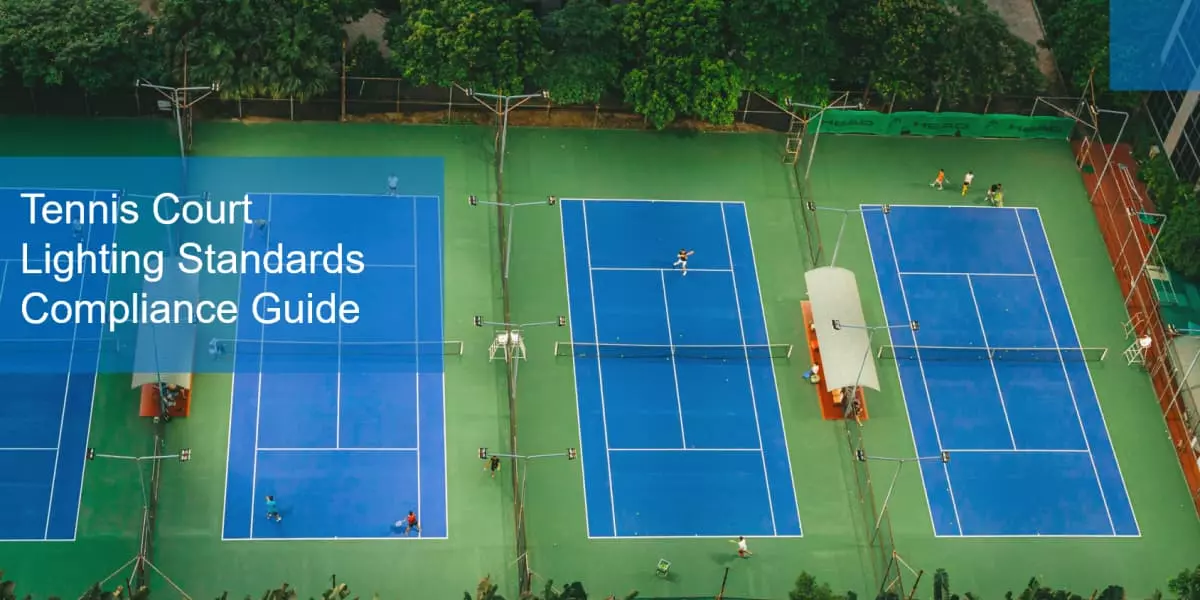
Installing the correct tennis court lighting is a technical investment in safety, performance, and facility value. It's not just about visibility; it's about meeting professional tennis court lighting standards that ensure fair play, prevent injuries, and create an optimal experience for players and spectators.
This comprehensive guide breaks down professional lighting standards for tennis court (IES, USTA, AS), explaining key metrics like lux and glare, and provides actionable steps for selecting, installing, and maintaining a compliant, high-performance LED lighting system for any court level.
Table of Contents
Why Professional Tennis Court Lighting Standards Are Non-Negotiable?
Key Lighting Metrics Explained: Understanding the Language of Light
Breakdown of Major Tennis Court Lighting Standards
How to Achieve Compliant Tennis Court Lighting?
A Practical Guide to Choosing Your Lighting
Conclusion: Light It Right for the Perfect Game
Why Professional Tennis Court Lighting Standards Are Non-Negotiable?
Choosing the right lighting goes beyond simple brightness. Professional standards, developed by organizations like the Illuminating Engineering Society (IES), provide the essential blueprint for quality and safety. Ignoring them risks creating a hazardous, unprofessional, and non-compliant facility.
Adherence to established standards for sports field lighting is mandatory for the following critical reasons:
KEY FACT: Proper lighting can reduce player injury risk by minimizing eye strain and misjudgments.
Definition: Tennis Court Lighting Standards are a set of technical guidelines and performance metrics that define the required quality, quantity, and distribution of light on a tennis court to ensure safety, fairness, and visual comfort for players and officials.
1. Safety and Injury Prevention
Poor lighting creates significant hazards on the court. The key risks include:
Tripping and Misjudgment: Deep shadows and uneven light can hide ball trajectory and court surface irregularities, leading to slips, trips, and strains.
Dangerous Glare: Unshielded or poorly aimed fixtures can cause momentary blindness, especially during a high volley or serve, increasing the risk of accident.
How Standards Help: They mandate strict limits on glare and require consistent light levels (uniformity) across the entire court, eliminating dangerous dark spots and blinding light.
2. Fairness and Game Integrity
A lighting system should never influence the outcome of a match.
The Problem: If one end of the court is significantly darker than the other, players on that side are at a disadvantage, unable to track the ball effectively.
The Solution: Lighting standards enforce strict uniformity ratios. This ensures the ball is equally visible at the baseline and the net, guaranteeing fair play for all competitors.
3. Enhanced Experience for All
Good lighting, built to standard, improves the experience for everyone involved.
For Players: Reduces eye fatigue, allowing for longer, more focused play.
For Spectators & Broadcasts: Provides the consistent, high-quality light required for comfortable viewing and professional television production, increasing your facility's appeal.
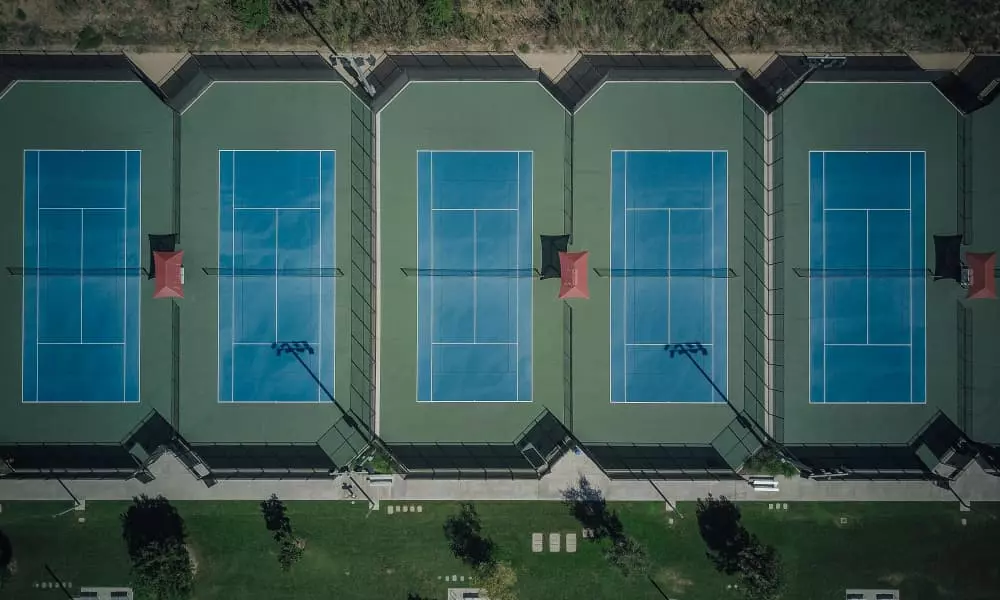
4. Regulatory and Compliance Needs
For any club or facility hosting official events, compliance is not a choice.
USTA Tournaments: Require lighting that meets specific IES benchmarks.
Local Councils: May have their own codes based on these professional standards.
Australian Facilities: Must follow the Australian standards for tennis court lighting (AS 2560.2.1).
Installing compliant lighting from the start avoids costly retrofits and ensures your facility is always ready for sanctioned play.
Key Lighting Metrics Explained: Understanding the Language of Light
To navigate tennis court lighting standards effectively, you need to speak the language. These technical metrics are not just jargon; they are the measurable parameters that define performance. Understanding them is the first step to making an informed decision.
KEY FACT: The human eye adapts to average light levels, but struggles with extreme contrasts, which is why uniformity is often more important than raw brightness.
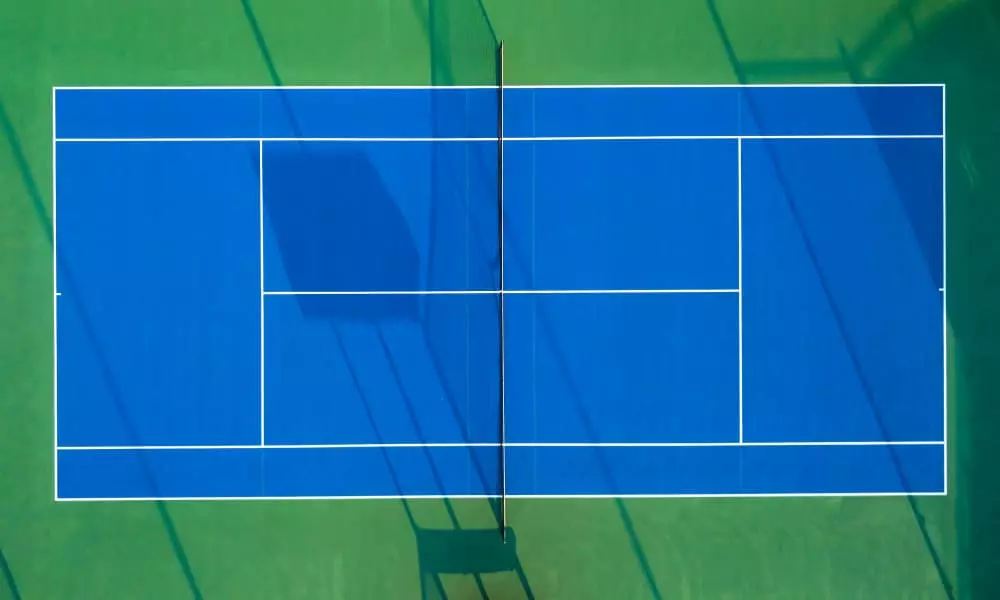
Here are the four essential metrics you need to know:
1. Horizontal Illuminance (Lux/lx)
Definition: Horizontal Illuminance measures the total amount of visible light (luminous flux) reaching a horizontal surface, such as the tennis court floor. It is measured in lux (lx).
This is the primary measure for "how bright" the court appears.
Standards specify different average lux levels for different levels of play (e.g., recreational vs. professional).
Maintenance Lux: Professional calculations use "maintenance lux," which accounts for the natural decline in light output over time due to dirt accumulation and LED aging, ensuring the system meets standards throughout its life.
2. Uniformity Ratio (Uo)
Definition: Uniformity Ratio (Uo) is the ratio of the minimum illuminance to the average illuminance across the court surface (Uo = E_min / E_avg).
A higher ratio (closer to 1.0) indicates more consistent, shadow-free lighting.
A low ratio means bright spots next to dark spots, making it difficult to track the ball.
Example: A Uo of 0.7 means the darkest point on the court is still at 70% of the average brightness, which is excellent. A Uo of 0.3 would create a patchy and problematic playing field.
3. Glare Rating (GR)
Definition: Glare Rating (GR) is a standardized metric (0-100) that quantifies the level of discomfort or disabling glare experienced by players and spectators. A lower GR value is better.
Glare is caused by overly bright, unshielded light sources in the field of view.
It reduces visibility and causes eye fatigue, directly impacting safety and performance.
GR Scale Guide:
GR < 30: Imperceptible glare (Excellent)
GR 30-35: Noticeable but acceptable (Good for sports)
GR 45-55: Unacceptable glare (Poor)
GR > 55: Unbearable glare (Hazardous)
4. Vertical Illuminance
Definition: Vertical Illuminance measures the light falling on a vertical plane, such as a player's body or the ball in flight. It is also measured in lux (lx).
This is crucial for judging the speed, spin, and trajectory of a ball in the air.
While horizontal illuminance lights the court surface, vertical illuminance lights the "action space" above it.
Modern LED systems with precise optical control are exceptionally good at providing excellent vertical illuminance without causing spill light or glare.
Breakdown of Major Tennis Court Lighting Standards
Navigating the specific requirements of professional tennis court lighting standards is crucial for compliance, safety, and performance. Different regions and governing bodies have established detailed benchmarks.
Below, we break down the key standards from North America and Australia to guide your planning and design.
IES/USTA Standards (North America & International)
The Illuminating Engineering Society (IES) standards, often referenced by the United States Tennis Association (USTA), provide the primary framework for tennis court lighting in North America and many international facilities . These recommendations help ensure optimal playing conditions across various levels of play.
Definition: IES Standards are a set of professional guidelines published by the Illuminating Engineering Society of North America that provide scientific recommendations for lighting design, including metrics for illuminance, uniformity, and glare control in sports and recreational areas .
The following table summarizes the typical lighting requirements for different levels of play according to IES/USTA principles:
Competition Level | Average Maintained Horizontal Illuminance (Footcandles/lux) | Uniformity Ratio (Uo) | Glare Rating (GR) |
Recreational / Training | 20-30 fc (200-300 lux) | 0.5 | ≤ 50 |
Club / College | 30-50 fc (300-500 lux) | 0.5 | ≤ 50 |
Professional / TV Broadcast | 50-75+ fc (500-750+ lux) | 0.7 | ≤ 50 |
Key Facts:
lMaintained Illuminance: The values listed are "maintained" levels, meaning they account for the natural decrease in light output over time due to lamp aging and dirt accumulation, ensuring the system meets requirements throughout its life .
lUniformity is Key: A higher uniformity ratio (closer to 1.0) means a more consistent light distribution with fewer shadows. Notice how the required uniformity increases for professional play to ensure fair conditions for high-speed competition and television broadcasting .
lGlare Control: A Glare Rating (GR) of 50 or less is critical for minimizing player discomfort and maintaining visual acuity, especially when tracking high-speed balls .
Australian Standards (AS 2560.2.1)
The Australian Standard AS 2560.2.1: Lighting for tennis offers a structured approach similar to the IES standards but with its own distinct classification system. It is the primary reference for court construction and lighting design in Australia and the wider Asia-Pacific region.
Definition: AS 2560.2.1 is the Australian Standard that specifies the requirements for the design, installation, and testing of tennis court lighting, using a level-based system to categorize facilities by their intended use and performance requirements.
The Australian system typically classifies courts into several levels:
AS 2560.2.1 Level | Comparable IES Level | Typical Use Case |
Level I | Recreational | Social tennis, backyard courts |
Level II | Club | Club competitions, training academies |
Level III | (Between Club & Professional) | State, regional, and high-level club competitions |
Level IV | Professional / Broadcast | National and international tournaments |
Key Facts about AS 2560.2.1:
Detailed Specifications: Each level (I through IV) has defined minimum maintained illuminance and uniformity values, with requirements becoming progressively stricter.
Emphasis on Spill Light: The standard is known for its stringent limits on obtrusive light (light spill), ensuring minimal impact on the surrounding environment.
Comparison with IES/USTA Standards:
Similar Performance Goals: Both standards share the same core objectives: providing adequate illuminance, excellent uniformity, and strict glare control for player safety and fair play.
Structural Differences: While the IES guidelines often present a range of values for broad categories, the Australian standard provides a more defined, level-based system with specific, mandatory benchmarks for each classification.
Emphasis on Spill Light: The Australian standard is known for its particularly stringent limits on obtrusive light (light spill), ensuring minimal impact on the surrounding environment and neighboring properties, which is a critical consideration in residential areas.
How to Achieve Compliant Tennis Court Lighting?
Knowing the standards is one thing; implementing them is another. Achieving full compliance requires a systematic approach that combines professional design, the right technology, and precise execution. Here is your actionable guide to turning the theoretical standards into a high-performing, compliant lighting system.
1. Start with a Professional Lighting Design Plan
Definition: A Professional Lighting Design Plan is a computer-simulated model of your court that predicts light levels, uniformity, and glare before any equipment is installed, ensuring the proposed solution meets the target standards.
KEY FACT: A professional design plan can prevent costly design errors and equipment overbuying by 20-35%, optimizing your investment from the start.
Steps in the Design Process:
ØSite Survey: A specialist collects data on your court dimensions, surrounding environment, and existing infrastructure.
ØDigital Modeling: Your court is modeled in specialized lighting design software (like Dialux or Relux).
ØSimulation & Optimization: The software simulates different fixture layouts and types, generating precise predictions for lux, Uo, and GR. The design is iteratively refined until it passes the required standards.
ØFinal Proposal: You receive a detailed report with guaranteed performance metrics, a fixture list, and a layout plan.
Skipping this step is a gamble. Always consult with a lighting expert to get a professional design plan.
2. Select the Right LED Fixtures
The right product technology is what makes compliance possible.
Optical System: Look for fixtures with asymmetric (Type III) or symmetric (Type V) distributions and precise beam control. This directs light onto the court efficiently and minimizes spill, which is the key to achieving high uniformity.
.webp "beam-angle-asymmetric-symmetric")
(Left is symmetric, right is asymmetric.)
Glare Control: Essential features include:
üDeep or honeycomb louvres
üAnti-glare filters
üMicro-prismatic lenses
These components shield the bright LED source from direct view, dramatically reducing the Glare Rating (GR).
Color Quality:
Correlated Color Temperature (CCT): 4000K-5000K is ideal. It provides a bright, neutral white light that enhances contrast without the harshness of higher temperatures.
Color Rendering Index (CRI): Choose fixtures with a CRI > 80. This ensures the true color of the ball and court is revealed, reducing eye strain.
3. Strategic Pole Placement and Mounting Height
The best fixtures will fail if installed incorrectly. The layout determines performance.
Pole Placement Guide:
Four-Corner (Tournament) Layout: The gold standard for professional courts. Poles are placed at each corner, outside the court's play area. This provides excellent vertical illuminance and superior uniformity for high-speed play and broadcast.
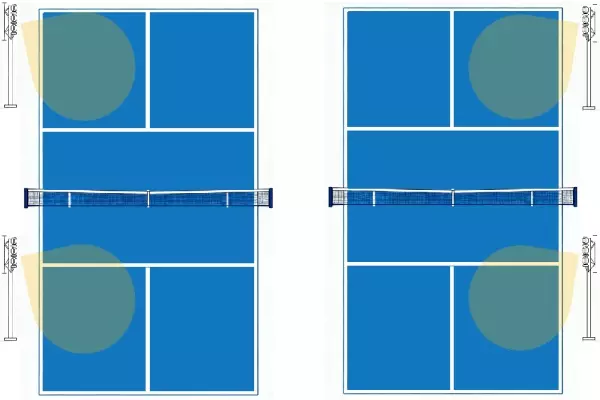
Side-Mount (Recreational) Layout: A more cost-effective solution for community clubs. Poles are placed along the two sides of the court. While easier to install, it can struggle to achieve the same level of uniformity as a four-corner system.
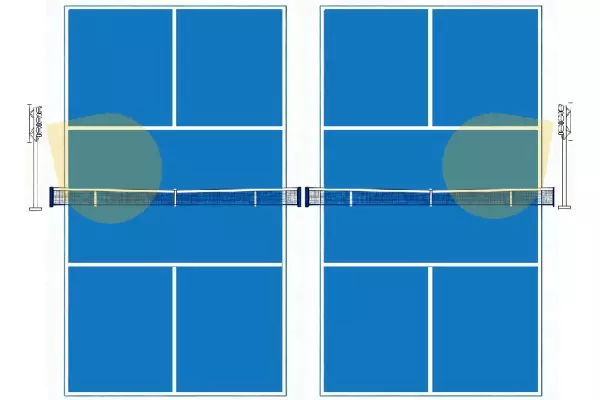
Height Principle:
To control glare and ensure wide, even light distribution, a fundamental rule is: Pole Height ≥ 50% of the Court's Width.
For a standard doubles court (~11m wide), this means a minimum pole height of 5.5 meters. In practice, heights of 8-12 meters are standard for achieving professional results.
Read more: If you are interested in lighting layout for sports field, here is a full guide about How to make perfect pickleball court lighting layout.
4. Commissioning and Maintenance
The job isn't done after installation. Verification and upkeep are what guarantee long-term compliance.
Commissioning Steps
On-Site Measurement: A certified specialist uses a calibrated lux meter to take hundreds of measurements across the court surface.
Data Analysis: The measured data is compiled and compared against the target standard (e.g., IES, AS).
Compliance Report: You receive a formal report proving your installation meets all required metrics. This is your proof of compliance.
Maintenance Plan
Initial Over-design: A professional plan will include a "maintenance factor," meaning the system is deliberately designed to be ~25% brighter at installation to compensate for future light loss.
Regular Cleaning: Wipe down lenses every 6-12 months to remove dirt and insects that block light.
Periodic Inspection: Check for any physical damage or performance degradation annually.
By following these steps, you move from hoping for compliance to guaranteeing it. The right partnership with a knowledgeable provider is essential to navigate this process successfully.
A Practical Guide to Choosing Your Lighting
You're now equipped with the knowledge of standards and implementation. This final decision-making guide will help you translate your specific needs into the perfect sports lighting solution, ensuring you invest wisely and effectively.
KEY FACT: Over-lighting a recreational court is a common and costly mistake, leading to unnecessary energy consumption, glare, and upfront cost. The goal is not maximum brightness, but optimal compliance for your use case.
Step 1: Define Your Court's Purpose
Select the description below that best matches your primary use case to identify your required performance level.
Definition: Court Classification is the process of categorizing your facility based on its primary users and activities, which directly determines the appropriate lighting standard tier.
Find Your Court's Classification
ØRecreational / Backyard
Who it's for: Homeowners, community parks, schools for casual play.
Key Standard: IES Recreational Level (200-300 lux).
Focus: Basic safety and visibility. Cost-effectiveness is a priority.
ØClub / Training Academy
Who it's for: Tennis clubs, training facilities, competitive school teams.
Key Standard: IES Club/Training Level (300-500 lux).
Focus: Excellent uniformity and glare control for serious practice and local competitions.
ØProfessional / Broadcast
Who it's for: Facilities hosting regional, national, or televised tournaments.
Key Standard: IES Professional/TV Level (500-750+ lux).
Focus: Maximum performance for player and broadcast needs, requiring a four-corner pole layout and precise engineering.
Step 2: Partner with a Lighting Expert
Once you know your category, the most critical step is choosing the right partner. A true expert provides an end-to-end service, transforming complex standards into a turnkey solution.
Steps in a Professional Partnership:
² Consultation & Needs Analysis: A specialist discusses your goals, budget, and court specifics.
² Custom Design & Quotation: You receive a professional lighting plan (as described in the previous section) with a detailed quote.
² Product Supply: You are provided with high-performance, compliant LED fixtures designed for sports lighting.
² Implementation Support: Guidance on professional installation to ensure the design is executed correctly.
² Verification & Support: Post-installation measurement to guarantee compliance and offer ongoing maintenance advice.
Partnering with a specialist like Ceramiclite ensures you navigate this process seamlessly. We provide more than just products; we deliver a guaranteed compliance solution—from initial design and premium LED fixtures to final performance validation. This integrated approach eliminates the risk and ensures your investment delivers professional results for years to come.
Ready to find your perfect lighting solution? Contact Ceramiclite for a free, no-obligation lighting design consultation tailored to your court's specific needs.

Conclusion: Light It Right for the Perfect Game
Summary: This guide has detailed the critical tennis court lighting standards from IES and other bodies, explained key metrics like lux and glare, and provided a clear, step-by-step framework for achieving a compliant, high-performance LED lighting system that ensures safety, enhances play, and delivers long-term value.
Investing in professional tennis court lighting is an investment in safety, performance, and value. As we've outlined, achieving excellence isn't about guesswork—it's about a disciplined approach that combines:
lAdherence to Proven Standards: Following IES, USTA, or AS guidelines is the blueprint for eliminating risk.
lTechnical Precision: Focusing on lux, uniformity, and glare ensures optimal playing conditions.
lExpert Implementation: From professional design to validated commissioning, each step is crucial for guaranteed, long-lasting results.
Don't compromise on the quality of your game. A properly lit court transforms the playing experience, minimizes long-term costs, and elevates your facility to a professional standard.
Ready to achieve perfect lighting that meets all standards? Let Ceramiclite handle the details—from design to compliance. Schedule your free lighting plan consultation today!